

AI Agents & Multi-Agent Systems:
The Definitive 2026 Guide
Everything practitioners, CTOs, and builders need to understand — from core architecture and the new protocol stack to real enterprise ROI, governance, and what to build first.
Description: Wide-format editorial illustration showing interconnected glowing nodes (agents) in a dark-navy environment, one central orchestrator linked to four specialist agents, each connected to tool icons (database, API, document, browser). Clean, technical, premium aesthetic. Size: 1200×630px.
AI agents are no longer a research project. As of mid-2026, 54% of enterprises have integrated them into core operations — not as assistants that answer questions, but as autonomous systems that execute multi-step workflows, take real-world actions, and deliver measurable business results. Yet 80% of organizations still lack the governance infrastructure to scale them safely. This guide cuts through both the hype and the fear to give you an honest, data-backed playbook for understanding, evaluating, and deploying AI agents in 2026.
- An AI agent is an autonomous system that perceives, reasons, acts using tools, and loops until a goal is reached — without human approval at every step.
- Multi-agent systems split complex tasks across specialized agents coordinated by an orchestrator, dramatically outperforming single-agent approaches on complex workflows.
- The MCP + A2A protocol stack (now both governed by the Linux Foundation’s AAIF) is becoming the consensus infrastructure layer for production agent systems.
- Enterprise ROI averages 171%, but only 1 in 5 organizations has the governance maturity to scale safely.
- Start small, govern first, scale only after metrics are stable — this is the pattern that works.
- What AI Agents Actually Are
- How Agents Work: The Five-Layer Architecture
- Multi-Agent Systems Explained
- MCP, A2A & ACP: The New Protocol Stack
- Six Major Frameworks Compared
- Seven Design Patterns That Actually Work
- Real Enterprise Use Cases & Verified ROI
- Risks, Governance & Safety
- How to Build Your First Agent: A Roadmap
- What Comes Next
- Frequently Asked Questions
What AI Agents Actually Are — And What They Are Not
The word “agent” gets applied to everything from a basic chatbot with memory to a sophisticated orchestration engine running hundreds of parallel sub-tasks. This ambiguity is expensive in practice — it leads teams to deploy the wrong architecture, set the wrong expectations, and measure the wrong outcomes.
Here is the operational definition that actually holds up in production:
“An AI agent is an autonomous system that perceives its environment, reasons about what action to take, executes that action using tools, observes the result, and repeats — without human approval at every step.”
Working definition consistent across Gartner, Anthropic, Google, and OpenAI technical documentation, 2025–2026
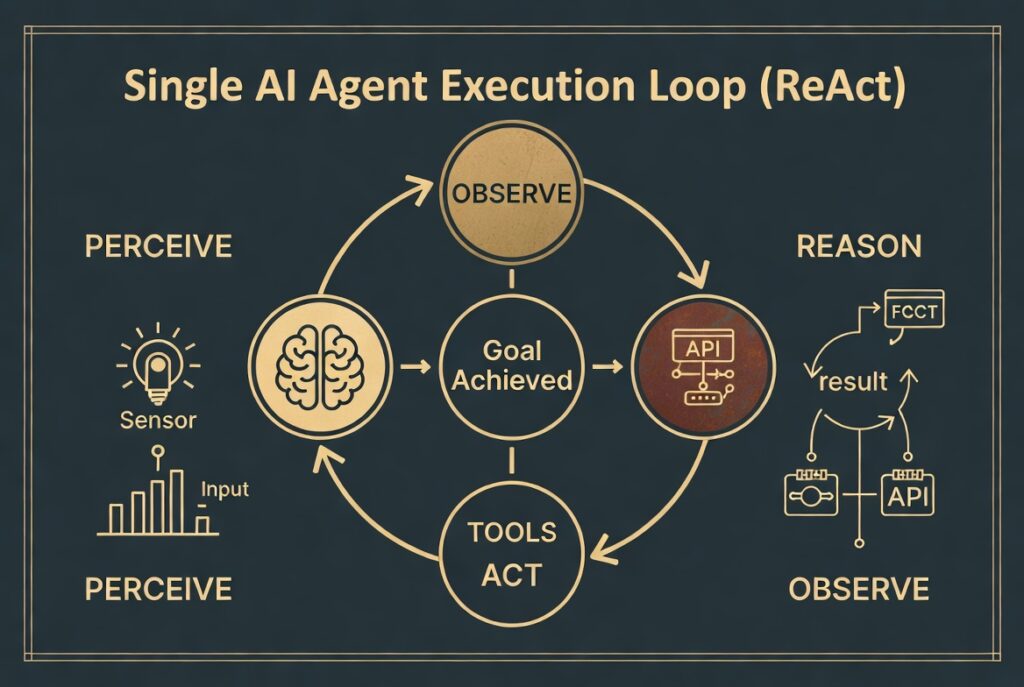
What separates an agent from a chatbot is not the underlying model — both might run on the same LLM. The difference is the loop. A chatbot responds once and waits. An agent acts, evaluates whether the action produced the intended result, adjusts its plan, and acts again. This perceive–reason–act–observe cycle — often called the ReAct loop — is the fundamental unit of agentic behavior.
Agents vs. Chatbots vs. Copilots: The Real Distinction
| System Type | Autonomy Level | Action Scope | Best For |
|---|---|---|---|
| Chatbot | None — responds, waits | Text generation only | Q&A, simple assistance |
| Copilot / Assistant | Low — suggests, human decides | Drafts, summaries, analysis | Productivity enhancement |
| Single AI Agent | Medium — acts within defined scope | Tool calls, API writes, file I/O | Repeatable, well-scoped tasks |
| Multi-Agent System | High — orchestrated autonomous execution | Cross-system, multi-step workflows | Complex enterprise processes |
The practical implication: most organizations should start with single agents on well-scoped workflows, not with multi-agent orchestration. The governance overhead of a multi-agent system requires foundational competencies most teams are still building.
Description: Four-column horizontal infographic comparing autonomy level, action scope, and ideal use case for each system type. Clean flat design in navy/rust color palette. Size: 1000×400px.
How Agents Work: The Five-Layer Architecture
Every production AI agent, regardless of which model or framework it runs on, shares the same five-layer structure. If any layer is weak, the entire system underperforms — and it is rarely obvious which layer is the bottleneck until you are debugging a production failure at 2 a.m.
Layer 1: Perception
Agents ingest inputs from their environment: natural language, structured data, images, documents, API responses, database query results. In 2026, multimodal perception is standard. Google ADK agents natively handle images, audio, and video through Gemini’s multimodal API. The key design question at this layer is: what context does the agent actually need, and how do you prevent context window bloat from degrading reasoning quality?
Layer 2: Memory
Memory is where most beginner implementations fail. A well-architected agent maintains four distinct memory types:
| Memory Type | Duration | Purpose | Implementation |
|---|---|---|---|
| In-context (working) | Current session | Active task state, tool results | LLM context window |
| Episodic | Session-persistent | Conversation history, preferences | Vector DB, conversation store |
| Semantic | Long-term | Domain knowledge, policies, facts | RAG over knowledge base |
| Procedural | Permanent | Learned strategies, workflow templates | Fine-tuned weights, prompt libraries |
Layer 3: Reasoning Engine
This is the LLM itself — the core that plans, decomposes tasks, evaluates options, and decides which tool to call next. A well-engineered prompt with a mid-tier model consistently outperforms a mediocre prompt with a frontier model. Invest in prompt engineering before investing in model upgrades.
Layer 4: Planning
Planning is the agent’s ability to break a high-level goal into concrete steps, sequence them correctly, identify dependencies, and revise the plan when intermediate results diverge from expectations. This is where the difference between a “demo-worthy” agent and a “production-reliable” agent is made or lost.
Layer 5: Action / Tool Layer
Agents take real-world action through tools: web search, code execution, database reads/writes, API calls, file system access, email, payments. Every tool call is a real-world consequence. Scope tool permissions to the absolute minimum required — this is the single most effective risk reduction measure available.
Never give agents write access to production systems unless strictly required. Always prefer read-only access. Log every tool call with agent identity, input parameters, and output. In any regulated industry context, this is a compliance requirement, not a preference.
Multi-Agent Systems: Why One Agent Is Never Enough at Scale
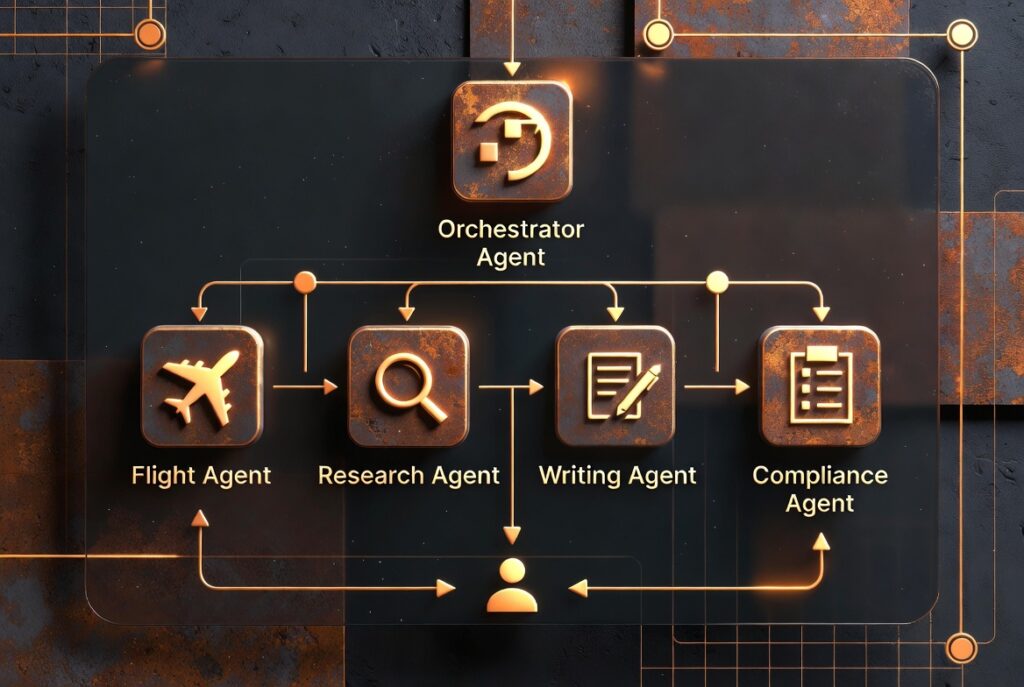
Description: Clean technical diagram — central orchestrator node in navy, four specialist agent nodes (Flight, Hotel, Writing, Compliance) in steel-blue, tool layer icons below each. Connection lines show A2A protocol labels. Dark background, technical aesthetic. 1000×500px.
Gartner recorded a 1,445% surge in multi-agent system inquiries from Q1 2024 to Q2 2025. Organizations that started with single-agent deployments hit a ceiling: tasks were too complex, too broad, or too time-sensitive for any single model to handle reliably across all cases. Multi-agent architecture is the answer to that ceiling.
The Core Insight: Specialization Beats Generalization
Multi-agent design mirrors how high-performing human teams work. No organization expects one lawyer to master M&A, IP, tax, and employment law simultaneously. Neither should your AI architecture expect one agent to be simultaneously expert at research, writing, compliance checking, and database querying.
In a well-designed system, an orchestrator agent receives the high-level goal, decomposes it into subtasks, assigns each to the most capable specialist, monitors progress, handles failures, and assembles the final result. The orchestrator itself does minimal direct execution — its value is coordination.
The Five Multi-Agent Topologies
| Topology | Description | Best For | Key Risk |
|---|---|---|---|
| Hierarchical | Orchestrator → sub-agents → leaf agents | Complex, multi-phase workflows | Orchestrator bottleneck |
| Flat / Peer-to-Peer | Agents communicate directly via A2A | Parallel independent subtasks | State drift, coordination overhead |
| Pipeline | Sequential handoffs, A outputs → B inputs | Document processing, ETL, review chains | Single point of failure |
| Market / Auction | Tasks broadcast; agents bid on fit | Dynamic load balancing | Hard to audit, emergent behavior |
| Hybrid | Orchestrator + parallel + pipeline elements | Enterprise production systems | Complexity, requires strong governance |
Honest observation: Multi-agent systems are not inherently better than single-agent. Gartner recommends using multi-agent architecture only where the task complexity genuinely justifies the operational overhead. Matching architecture to task type is the core competency that separates high performers from teams stuck in perpetual pilots.
For a deeper look at when to use single vs multi-agent architectures, see our AI architecture decision framework for enterprise teams.
MCP, A2A & ACP: The Infrastructure Layer That Changes Everything
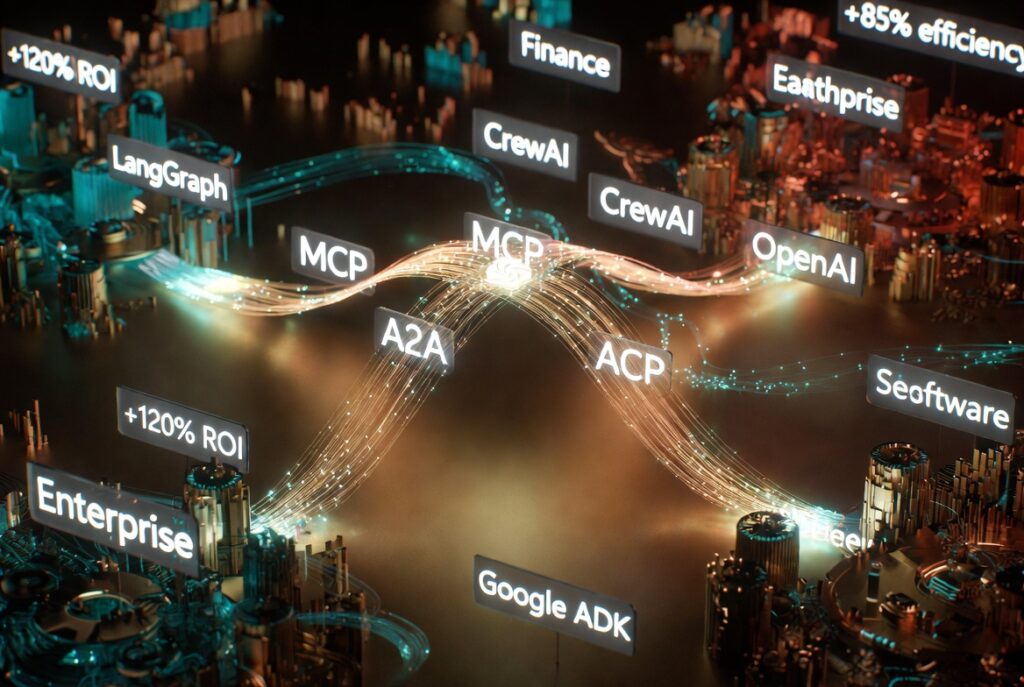
The most consequential infrastructure development in agentic AI over the past 18 months is not a new model. It is the emergence of open, standardized protocols that allow agents built by different vendors on different frameworks to communicate reliably. Without these, every multi-agent system requires custom integration — an enormous maintenance burden that blocks scale.
By early 2026, the three-layer AI protocol stack had become the consensus architecture. The governing body, the Agentic AI Foundation (AAIF) under the Linux Foundation, counts OpenAI, Anthropic, Google, Microsoft, AWS, and IBM among its co-founders, with over 146 member organizations as of Q1 2026.
Description: Three-layer horizontal stack diagram. Bottom layer: MCP (agent-to-tools, vertical). Middle layer: A2A (agent-to-agent, horizontal). Top layer: WebMCP (web access). Color-coded navy/rust/brass. Labels include governance body (AAIF/Linux Foundation). 900×400px.
Model Context Protocol (MCP) — The Vertical Layer
MCP was created by Anthropic, released open-source in late 2024, and donated to the AAIF in December 2025. It solves one specific problem: how does an AI agent connect to external tools through a single standardized interface?
Before MCP, every tool integration required custom code. With MCP, you build one MCP server per tool — and every compliant agent can use it immediately. By 2026, MCP had surpassed 97 million downloads and is natively supported by Claude, GPT-4/5, Gemini, and every major coding assistant. The November 2025 spec added OAuth 2.1 authentication, structured typed tool output, and elicitation — servers can now prompt users mid-task for additional input.
Agent-to-Agent Protocol (A2A) — The Horizontal Layer
Where MCP is vertical (agent ↔ tools), A2A is horizontal (agent ↔ agent). Released by Google Cloud in April 2025 with 50+ enterprise partners including Salesforce, Accenture, SAP, and ServiceNow, A2A reached v1.0 in early 2026 with gRPC support, signed Agent Cards, and multi-tenancy.
A2A enables agents built by completely different vendors to discover each other’s capabilities through Agent Cards — structured JSON documents published at a standard endpoint — and delegate tasks through a unified interface.
MCP answers: “My agent needs to query Salesforce.” → MCP server connects the agent to the tool.
A2A answers: “My orchestrator needs a specialist booking agent to find a flight.” → A2A handles the agent-to-agent delegation and result return.
These are complementary layers, not alternatives. Production multi-agent systems use both.
Agent Communication Protocol (ACP) — Lightweight Messaging
Developed by IBM and BeeAI, released under the Linux Foundation in 2025, and subsequently merged into AAIF governance. ACP is REST-based with multimodal message support — targeting controlled, on-premise environments where full A2A is overkill and developer familiarity with standard web APIs matters more than enterprise-grade authentication features.
| Protocol | Direction | Transport | Use Case | Status |
|---|---|---|---|---|
| MCP | Agent → Tools | JSON-RPC (stdio/HTTP) | Tool & data access | 97M+ downloads, universal |
| A2A | Agent → Agent | JSON-HTTP / gRPC | Cross-vendor delegation | v1.0, 146+ org governance |
| ACP | Agent → Agent (simple) | REST / HTTP | Local/controlled messaging | AAIF governed |
For full protocol documentation, see the Anthropic MCP documentation and the Google A2A specification.
Six Major Agent Frameworks: An Honest Comparison
Building in 2026 means choosing between at least six production-grade frameworks, each with a genuinely different philosophy on agent coordination. Choose wrong and you will rewrite your orchestration layer within six months — this is not a hypothetical, it is what happens in practice.
Description: Six-card grid infographic with each framework’s name, philosophy tag, and best-use case. Color-coded by philosophy type (graph-based, role-based, handoff, hierarchical, conversational, managed). 1000×600px.
Models workflows as directed graphs with explicit state management. Best for complex enterprise workflows where every state transition must be auditable. Steeper learning curve — worth it for production systems that cannot afford ambiguity.
Structures agents as a crew of role-playing specialists. Intuitive for teams thinking in human delegation terms. Excellent for fast prototyping. Can struggle with complex state management at enterprise scale.
Replaced the experimental Swarm framework. Core abstraction is the “handoff” — explicit control transfer between agents with full context passing. Clean, opinionated, well-documented. Best for GPT-native teams wanting production reliability out of the box.
Hierarchical agent trees with native A2A support for cross-framework interoperability. Multimodal through Gemini (text, images, audio, video). Deep Google Cloud integration. Best for multimodal pipelines and cross-vendor agent ecosystems.
Agents interact through multi-turn conversations that include code execution. Highly configurable. Strong for code generation and research workflows. Production hardening requires more effort than LangGraph or the Agents SDK.
Managed agent hosting on AWS with built-in SOC 2/HIPAA compliance, native knowledge bases, and guardrails. Less customizable than open frameworks but dramatically easier to operate in regulated industries. Best for AWS-native enterprises.
See our detailed breakdown in LangGraph vs CrewAI vs AutoGen: Which Framework to Choose in 2026.
Not Sure Which Framework Fits Your Stack?
Download our free AI Agent Framework Selection Scorecard — 12 weighted criteria that match your team size, compliance requirements, and use case complexity to the right framework in under 10 minutes.
Download Free Scorecard →Seven Design Patterns Every Agent System Must Know
Description: Seven-icon grid with each pattern name, a minimal icon, and a one-line use case. Navy/rust/cream palette. 1000×500px.
Regardless of framework, these seven patterns recur across every high-performing multi-agent system. Knowing when to apply each — and what failure mode it guards against — separates production-grade systems from perpetual proof-of-concept deployments.
1. ReAct (Reason + Act)
The foundational loop: reason about current state → select action → execute → observe result → reason again. Most frameworks implement this by default. The critical tuning parameter is how much reasoning the agent does before acting. Too little leads to premature incorrect tool calls; too much leads to overthinking loops. Calibrate through explicit step-limits in system prompts.
2. Reflection
After task completion, a critic agent (or a second prompt with a different system role) reviews output quality, accuracy, and constraint adherence before returning the result. Reflection is the highest-ROI pattern for document-heavy workflows — legal review, financial analysis, medical summaries. Cost: one extra LLM call per task. Quality gain: typically worth it.
3. Scoped Tool Use
Not a pattern in the academic sense but a security discipline that deserves pattern-level attention. Every tool an agent can access is a risk surface. Always scope permissions to the minimum required for the task. Log every tool call. Never allow agents write access to production systems without a confirmation step.
4. Planning with Replanning
High-quality agents don’t execute rigid plans. They create an initial plan, begin execution, and replan when observed results diverge from expectations. This replanning capability handles the “last 20%” of tasks — the edge cases that rigid automation always fails on.
5. Multi-Agent Collaboration
Decompose complex tasks across specialized agents, each with a narrower scope and access only to the tools it needs. The orchestrator assembles results. Hallucination rates drop because each agent reasons about a smaller, better-defined domain.
6. Sequential Workflow
For tasks where order genuinely matters, model the workflow as an explicit pipeline where each stage receives the output of the previous one. Highly auditable, easy to debug, integrates naturally with human review checkpoints between stages.
7. Human-in-the-Loop (HITL)
Define explicit escalation triggers — confidence below threshold, irreversible action, regulatory sensitivity, value above limit — that route tasks to human reviewers. HITL is not a sign of failure; it is a sign of mature agentic governance. Klarna learned this at scale: their fully automated customer service agent worked excellently on routine cases but underperformed on complex, emotionally sensitive queries. The hybrid model — agents handling volume, humans handling edge cases — outperformed both extremes.
Learn how to implement HITL correctly in our guide: Human-in-the-Loop AI: A Production Implementation Guide.
Real Enterprise Deployments: Where AI Agents Are Delivering Verified ROI
ROI reported
year one
RPA automation
Description: Horizontal bar chart showing ROI percentages by industry. Financial Services (192%), Healthcare ($3.20 per $1 invested in 14mo), Retail (supply chain savings), Software Engineering (60→90% accuracy). Navy/rust palette. 900×400px.
Financial Services
JPMorgan Chase runs over 450 active agentic AI use cases in production daily. Agents generate investment banking presentations in approximately 30 seconds — work that previously occupied junior analysts for hours. The system handles M&A memo drafting, trade settlement, and real-time fraud detection. Deutsche Bank’s DB Lumina compresses financial analyst research report creation from hours to minutes while maintaining full regulatory compliance.
Genpact’s Finance One — built on Google ADK and the A2A protocol — deploys Revenue Lens and P&L agents that allow finance users to query complex financial data through natural language, eliminating the SQL bottleneck that previously required data team involvement on every analysis request.
Customer Operations
Klarna’s AI customer service agent handled the equivalent workload of 853 employees and generated $60 million in savings by Q3 2025. The critical lesson: Klarna subsequently moved to a hybrid model — agents for high-volume routine cases, humans for complex and emotionally sensitive interactions — because full automation underperformed on edge cases. The hybrid model outperformed both pure alternatives.
Bank of America’s Erica is now used by over 90% of employees, handling code writing, client feedback capture, and internal process automation at scale — backed by $4 billion in AI and technology investment.
Supply Chain & Retail
Walmart deployed its Trend-to-Product multi-agent system — monitoring social media and search trends in real time, generating product concepts from detected signals, and feeding them directly into sourcing workflows, compressing production cycles that previously took months. A separate supply chain agent provides real-time inventory visibility across stores and fulfillment centers, autonomously rerouting inventory around weather events and logistics disruptions without manual intervention.
Healthcare
Healthcare organizations are realizing $3.20 in return for every $1 invested in AI agents within 14 months. Production workflows cover clinical note processing, prior authorization automation, claims submission, and patient intake coordination. The highest-performing healthcare deployments explicitly separate administrative workflows (agent-autonomous) from clinical decision support (agent-assisted, clinician-decides). That distinction is not optional — it is the line between a productivity tool and a liability.
Software Development
Gelato improved ticket assignment accuracy from 60% to 90% and reduced ML model deployment time from two weeks to one or two days using Gemini-based agents. Infosys equipped 100,000+ developers globally with Gemini Enterprise. Developer agents now routinely handle boilerplate generation, unit test writing, PR review, and multi-file refactoring — freeing developer attention for architectural decisions and genuine problem-solving.
Legal & Compliance
Salesforce cut $5 million in legal costs through contract review automation. Harvey uses Gemini 2.5 Pro to automate document reviews that previously consumed hundreds of hours of attorney time, reasoning over hundreds of pages to surface the key issues for legal professionals in minutes rather than days.
For a deeper breakdown by function, see our AI Agent Use Cases by Business Function: A 2026 Prioritization Guide.
Risks, Governance & Safety: What the ROI Numbers Don’t Tell You
The governance gap is real and growing. Deloitte’s 2026 report found that only 1 in 5 companies has a mature governance model for autonomous AI agents. That means 80% of organizations currently deploying agents are doing so without the infrastructure to manage them safely at scale.
The Five Risks That Actually Cause Production Failures
In a chatbot, a hallucination produces a wrong answer. In an agent, it produces a wrong action — potentially irreversible. Reflection patterns, confidence thresholds, and human escalation checkpoints are not optional features; they are the architecture that prevents a reasoning error from becoming a consequential business failure.
Malicious content embedded in documents, web pages, or emails that redirect agent behavior. This is the most underestimated security risk in production deployments. Mitigations: never use raw external content in system prompts, sanitize all external inputs, use separate parsing agents that cannot take privileged actions, monitor tool-call patterns for behavioral deviations.
The most common mistake. Agents are given broad tool access during development for convenience, and that access is never properly scoped before production deployment. Apply least-privilege as a non-negotiable principle at the architecture stage — retrofitting it is expensive and error-prone.
Organizations that launched pilots in 2025 without audit trails are now discovering the path to broader deployment requires rebuilding the permission and logging architecture they skipped. For EU deployments, the AI Act imposes specific obligations. For FCA-regulated contexts, black-box automation where auditors cannot reconstruct the decision path is not compliant. Build audit trails from day one.
Individual agent failures can propagate through interconnected systems before monitoring catches them. Circuit-breaker patterns, rate limiting on inter-agent calls, graceful degradation to human fallback, and health monitoring at every agent boundary are the engineering disciplines that prevent single-agent failures from becoming system-wide incidents.
“The technology is the easy part. The organizational change is where the real value gets created or lost.”
McKinsey Global Institute, AI Adoption in the Enterprise, 2026
See our complete framework in AI Agent Governance: A CISO’s Checklist for 2026.
Free: AI Agent Risk Assessment Template
A 24-point governance readiness checklist used by enterprise teams before scaling agent deployments — covering permissions, audit trails, HITL design, and compliance baseline.
Download Risk Template →How to Build Your First Production Agent: A 4-Phase Roadmap
Description: Horizontal timeline with four phases, each with a colored milestone marker, key activities listed below, and a time estimate. Clean, professional, consulting-style. 1000×350px.
Phase 1 — Assess (Weeks 1–2)
Identify 3–5 candidate workflows. Score each on: task volume (ROI potential), process structure (reliability), data sensitivity (governance burden), and reversibility (risk level). Start with high-volume, well-structured, low-sensitivity, reversible tasks. Classic first deployments: inquiry triage, document summarization, code review for style, invoice matching, meeting note generation.
Phase 2 — Design (Weeks 2–4)
Define agent roles and scope. Design memory architecture. Specify tool set with scoped permissions. Define human escalation triggers and escalation paths. Choose your framework. Design the audit trail before writing a line of agent code — retrofitting it is the most common and expensive mistake in production deployments.
Phase 3 — Pilot (Weeks 4–10)
Deploy on one workflow with human review of every output. Run shadow mode (agent and human process the same tasks in parallel) before removing the human from the loop. Set clear KPIs: task completion rate, accuracy, escalation rate, latency, cost per task. This phase surfaces the edge cases your design didn’t anticipate — and builds the institutional knowledge to handle them.
Phase 4 — Govern & Scale
Only scale after quality, cost, latency, and escalation metrics have been stable for at least 4 consecutive weeks. The metrics that matter: grounded accuracy rate, hallucination rate, tool-call success rate, escalation rate, cost per task, audit completeness, and business ROI. Adoption numbers tell you almost nothing about whether the system is actually working safely.
MIT Sloan’s 2026 longitudinal study found that 47% of stalled agent programs had no automated evaluation running at month 12 — and that programs without continuous eval lost 14–23 percentage points of accuracy over 18 months relative to their month-three baseline. Eval is the single highest-leverage investment in agent productivity. Vendor demos run in clean test environments. Production runs in messy ones.
For hands-on guidance, see our step-by-step tutorial: Building Your First LangGraph Agent in 2026: A Complete Walkthrough.
What Comes Next: Where the Field Is Heading Through 2028
Description: Editorial-style forward-looking timeline with four milestones (2026 H2: Agent FinOps; 2027: Vertical agents dominate; 2027–28: Agent-native apps; 2028+: Agent internet). Subtle futuristic aesthetic, dark navy background with glowing timeline nodes. 1000×450px.
Agentic AI in 2026 is an inflection point, not a destination. Here is where the evidence currently points:
- Agent FinOps matures (H2 2026): Token costs, compute, and storage across large deployments will require dedicated FinOps disciplines — cost-per-task tracking, model routing (cheaper models for simpler tasks), and agent performance benchmarking as standard infrastructure.
- Vertical agents dominate (2027): Domain-trained systems reduce error rates 20–40% vs. generic agents in regulated sectors. Healthcare, legal, financial services, and manufacturing will each have established vertical agent ecosystems with domain-specific compliance and reasoning built in.
- Agent-native enterprise apps (2027–28): Applications built from the ground up around agent orchestration — rather than bolting agents onto existing workflows — will have a measurable competitive advantage in every category where agentic capability becomes table stakes.
- The Agent Internet (2028+): As A2A and MCP reach ubiquitous adoption, a discovery and delegation layer emerges where any organization’s agents can find and work with any other organization’s agents through standardized interfaces — the business-to-business equivalent of the consumer internet.
“The agentic AI market represents a compound annual growth rate exceeding 40% — no enterprise technology sector has grown this fast since the early cloud migration wave. And unlike cloud, agentic AI affects every function simultaneously.”
Digital Applied Research, Agentic AI Statistics 2026
Stay Ahead of Agentic AI — Every Two Weeks
Our Intelligence Brief covers the research, framework updates, and enterprise case studies you need — curated for practitioners, not hype-followers. No filler, no vendor shilling.
Subscribe Free →Frequently Asked Questions About AI Agents (2026)
Description: Minimal editorial header image with “Q&A” text in large serif type, light cream background, subtle geometric line details. 900×200px.
What is an AI agent, exactly?
An AI agent is an autonomous software system that perceives its environment (via text, data, or other inputs), reasons about what action to take, executes that action using tools (APIs, databases, web search, code execution), observes the result, and repeats until a goal is achieved — without requiring human approval at every step. Unlike a chatbot that responds and waits, an agent operates in a continuous loop until the task is complete or an escalation trigger is met.
What is the difference between a single AI agent and a multi-agent system?
A single agent handles a task end-to-end using its own reasoning and tool access. A multi-agent system coordinates multiple specialized agents — an orchestrator decomposes a complex goal, assigns subtasks to specialist agents best suited for each component, monitors progress, handles failures, and assembles the final result. Multi-agent systems outperform single agents on complex, broad, or time-sensitive tasks because each specialist agent reasons about a narrower, better-defined domain, which reduces hallucination rates and improves reliability.
What is MCP and why does it matter for AI agents?
MCP (Model Context Protocol) is an open standard created by Anthropic that defines how AI agents connect to external tools, data sources, and services through a unified interface. Before MCP, every tool integration required custom code. With MCP, you build one MCP server per tool and every compliant agent can use it immediately. By 2026, MCP has surpassed 97 million downloads and is natively supported by all major AI platforms, making it the de facto standard for agent-to-tool connectivity. It is now governed by the Agentic AI Foundation (AAIF) under the Linux Foundation.
What is the A2A protocol?
A2A (Agent-to-Agent) is an open protocol released by Google Cloud in April 2025 that enables AI agents from different vendors and frameworks to discover each other’s capabilities and delegate tasks through a standardized interface. Agents publish “Agent Cards” — structured JSON documents at a standard endpoint — that describe what they can do. A2A reached v1.0 in early 2026 with gRPC support, signed Agent Cards, and multi-tenancy. It is now co-governed by the AAIF alongside MCP. MCP and A2A are complementary: MCP handles agent-to-tool connections, A2A handles agent-to-agent coordination.
Which AI agent framework should I use in 2026?
The answer depends on your specific requirements. LangGraph is best for complex workflows requiring maximum auditability and state control. CrewAI is best for rapid prototyping with role-based agent design. OpenAI Agents SDK is best for GPT-native teams wanting production reliability through explicit handoffs. Google ADK is best for multimodal pipelines and cross-vendor agent interoperability via A2A. AutoGen is best for code generation and research workflows. Amazon Bedrock Agents is best for AWS-native enterprises in regulated industries requiring SOC 2/HIPAA compliance out of the box. The wrong choice for your use case typically results in a framework rewrite within six months.
What ROI can enterprises realistically expect from AI agents?
Organizations report average ROI of 171% from agentic AI deployments, with U.S. enterprises reaching 192% — approximately 3× the ROI of traditional RPA automation. 74% of enterprises achieve ROI within the first year. Healthcare organizations see $3.20 returned per $1 invested within 14 months. However, ROI is highly uneven: the path to strong returns runs through clear strategy, governance, and workflow redesign, not just deployment. McKinsey’s high-performing organizations invest more than 20% of their digital budgets in AI and redesign workflows around it — the technology is the easy part.
What are the biggest risks of deploying AI agents?
The five most consequential risks are: (1) Hallucination in agentic loops — reasoning errors becoming consequential actions; (2) Prompt injection — malicious content in processed documents redirecting agent behavior; (3) Overprivileged agents — too-broad tool access creating outsized blast radius when errors occur; (4) Governance and compliance debt — lack of audit trails blocking scale and creating regulatory exposure; (5) Cascading failures in multi-agent networks — single-agent failures propagating through interconnected systems. The most effective mitigation strategy addresses all five through architecture, not afterthought: least-privilege permissions, reflection patterns, HITL escalation triggers, audit trails at every action step, and circuit-breaker patterns between agents.
How big is the AI agent market in 2026?
The AI agent market reached approximately $7.84 billion in 2025 and is projected to reach $52.62 billion by 2030, growing at a 46.3% CAGR. Broader projections that include the full agentic AI ecosystem estimate $199 billion by 2034 — representing a 38-fold increase from 2024 and a CAGR exceeding 40%. No enterprise technology sector has grown this fast since the early cloud migration wave. 79% of organizations have some AI agent adoption as of 2026, but only 11% run them in full production — the largest gap in enterprise technology history between stated adoption and actual production deployment.
What is Human-in-the-Loop (HITL) and when is it necessary?
Human-in-the-Loop (HITL) is a design pattern where predefined triggers route agent tasks to human reviewers before they are finalized or acted upon. Triggers typically include: agent confidence below a set threshold, actions with irreversible consequences (payments, deletions), regulatory sensitivity, or transaction value above a limit. HITL is not a sign of agent failure — it is the governance pattern that allows enterprises to deploy agents on high-stakes workflows while managing risk appropriately. Klarna’s experience shows that hybrid HITL models outperform both fully automated and fully manual approaches on complex use cases.
What industries are seeing the highest ROI from AI agents?
Industries with the highest ROI share two traits: high transaction volume and structured, repeatable workflows. Financial services leads (banking and insurance have 47% production adoption) — JPMorgan runs 450+ agentic use cases daily. Healthcare delivers $3.20 per $1 invested within 14 months through administrative automation. Technology leads in total deployments (46% of current production use). Retail and e-commerce see strong supply chain and customer service returns — Klarna’s $60M savings and Walmart’s compressed product cycles. Customer service, software development, and compliance monitoring are the three most consistently high-ROI functions across all industries.
What is prompt injection and how do you protect against it in AI agents?
Prompt injection is an attack where malicious instructions are embedded in content an agent will process — a document, web page, email, or API response — that redirect the agent’s behavior to serve the attacker’s goals instead of the intended task. This is the most underestimated security risk in production agent deployments. Effective mitigations include: never using raw external content directly in system prompts, sanitizing all external inputs before agent processing, using separate read-only parsing agents for external content that cannot trigger privileged actions, monitoring tool-call patterns for behavioral anomalies, and constraining agent permissions so even a successful injection cannot cause high-impact actions.
How is the EU AI Act affecting AI agent deployments in 2026?
The EU AI Act, which entered into force in August 2024, applies a risk-based framework to AI systems. Prohibited-practice rules became effective in early 2025. For AI agents, the most significant implications are: high-risk applications (medical, legal, financial decisions, critical infrastructure) require conformity assessments, human oversight mechanisms, transparency documentation, and audit trail generation. GDPR and DSGVO apply to data processed by agents. DORA (Digital Operational Resilience Act) imposes specific requirements for financial services agent deployments. Organizations deploying agents in EU-regulated contexts must build compliance into the architecture from the start — black-box automation where decision paths cannot be reconstructed is not compliant in any high-risk category.
What metrics should I track for AI agent deployments?
The metrics that actually predict production health — beyond vanity adoption numbers — are: grounded accuracy rate (what percentage of outputs are factually correct and on-task); hallucination rate (what percentage of outputs contain fabricated information); tool-call success rate (do tool calls complete as intended); escalation rate (what percentage of tasks trigger human review — should trend down over time as calibration improves, but never reach zero); cost per task (token + compute + storage); latency (end-to-end task completion time); audit completeness (are all actions logged with sufficient detail for compliance reconstruction); and business ROI (quantified business outcome per agent deployment). Programs without continuous evaluation accumulate “eval debt” — small accuracy losses that compound invisibly over months.
Ready to Deploy AI Agents in Your Organization?
Our team has helped enterprise teams across financial services, healthcare, and technology design, govern, and scale agentic AI systems. Book a no-pressure strategy session to talk through your specific architecture challenges.
Book a Strategy Session →Market data in this article is sourced from Gartner, McKinsey Global Institute, IDC, Forrester, BCG, Deloitte, MIT Sloan, and S&P Global Market Intelligence reports published between October 2025 and May 2026. Enterprise case study data comes from verified published company announcements, earnings calls, and Google Cloud, Anthropic, and Salesforce enterprise telemetry summaries. Where sources disagree, we report ranges rather than single-point estimates. This article was last reviewed May 12, 2026. We update quarterly or when significant new data is published. View our full editorial standards.
Continue your agentic AI journey with these in-depth resources from the Trendix Intelligence Team:
- LangGraph vs CrewAI vs OpenAI Agents SDK vs AutoGen in 2026
Deep framework comparison with decision matrix and real deployment benchmarks. - AI Agent Governance: A CISO’s 2026 Checklist
24-point risk framework, audit requirements, and compliance templates for regulated industries. - Human-in-the-Loop AI: Production Implementation Guide
When and how to design effective escalation paths that maximize both safety and ROI. - AI Agent Framework Selection Scorecard (Free Download)
12-criteria evaluator to match your team, stack, and compliance needs to the right framework. - Building Your First Production Agent with LangGraph – Step-by-Step Tutorial
Complete code walkthrough with memory, tools, persistence, and evaluation setup. - AI Agent Use Cases by Business Function: Prioritization Guide 2026
50+ ranked use cases with ROI ranges, implementation effort, and time-to-value estimates.
Pro Tip: Start with the Framework Scorecard if you’re still evaluating tools, or the Governance Checklist if you’re preparing for production.
7 Production Multi-Agent Design Patterns
MCP + A2A Protocol: The Complete Architecture Guide
AI Workflows & Automation:The Complete 2025–2026 Guide
Human-in-the-Loop AI: The Complete Production Implementation Guide
AI Agents & Multi-Agent Systems: Everything Changes This Year
AI Agent Framework Selection Scorecard
Agentic Workflows: How AI Systems Are Actually Taking Over Knowledge Work
AI Agent Use Cases by Business Function:The 2026 Prioritization Guide