

AI Engineering Guide · Updated May 2026
LangGraph vs CrewAI vs OpenAI Agents SDK vs AutoGen: The Definitive 2026 Breakdown
Architecture, production-readiness, real costs, MCP/A2A protocol support — and exactly which framework to pick for every use case.
Why the framework decision matters more than you think
Most comparisons of AI agent frameworks treat the choice like picking a UI library — swap one out for another at any time, no big deal. That framing is dangerous. A framework decision for an agentic system is closer to choosing a database engine: you’re committing to a mental model, a debugging workflow, a persistence strategy, and an observability story that will be baked into every piece of code your team writes for the next 12 to 24 months.
Get it right and you ship faster, debug more easily, and scale without rewriting core infrastructure. Get it wrong and you end up with the most common outcome teams report in 2026: starting in CrewAI for the quick prototype, then migrating to LangGraph when production requirements bite — absorbing a painful rewrite that cost weeks.
The real cost of the wrong choice
In a 2026 survey of engineering teams building production agents, the most common regret was not the framework they chose — it was choosing a framework based on the prototype they were building rather than the production system they were planning. Prototype requirements and production requirements for agents are almost entirely different.
This guide is built for people making that production decision. Not for a weekend hack. Not for a research prototype. For a system that will handle real users, real money, and real failures.
The 2026 landscape: what changed and what didn’t
The agent framework landscape moved faster in the 18 months leading up to 2026 than most observers expected. The broad strokes:
LangGraph surpassed CrewAI in GitHub stars during early 2026, driven by enterprise adoption and its graph-based architecture that maps cleanly to regulated-industry requirements: audit trails, rollback points, human-in-the-loop checkpoints. The framework reached v1.0 in late 2025, graduated to v1.1.3 by spring 2026, and is now the default runtime for all LangChain agents. Verified enterprise deployments include Klarna, Uber, LinkedIn, BlackRock, Cisco, Elastic, JPMorgan, and Replit.
CrewAI remained the fastest on-ramp for multi-agent work — you can define a working crew of specialists in under 20 lines of Python. It added an enterprise tier in March 2026 with observability, scheduling, and role-based access control. The visual editor it shipped in 2025 has become a genuine differentiator for less-technical teams.
The AutoGen / AG2 split is the most confusing development of the past year. Microsoft’s original AutoGen framework forked: the official Microsoft repository pushed a ground-up rewrite (v0.4 → v1.0 GA, event-driven, async-first), while the community that preferred the stable v0.2 API continued development under the name AG2 at ag2.ai. The two are related but are no longer the same project. For production use, the official v1.0 GA is the path Microsoft recommends; for research and experimentation, either branch works.
The OpenAI Agents SDK replaced the experimental Swarm framework in March 2025 and has matured rapidly. The April 2026 overhaul (v0.13) added an any-LLM adapter — meaning it no longer requires OpenAI models, though that remains its strongest integration path — plus native sandbox execution, first-class MCP support, and session persistence.
One meta-trend ties all of this together: convergence on common abstractions. Every framework now has some version of state persistence, tool calling, and human-in-the-loop support. The differentiation has shifted from “does it support X?” to “how mature, debuggable, and operationally sound is its support for X?”
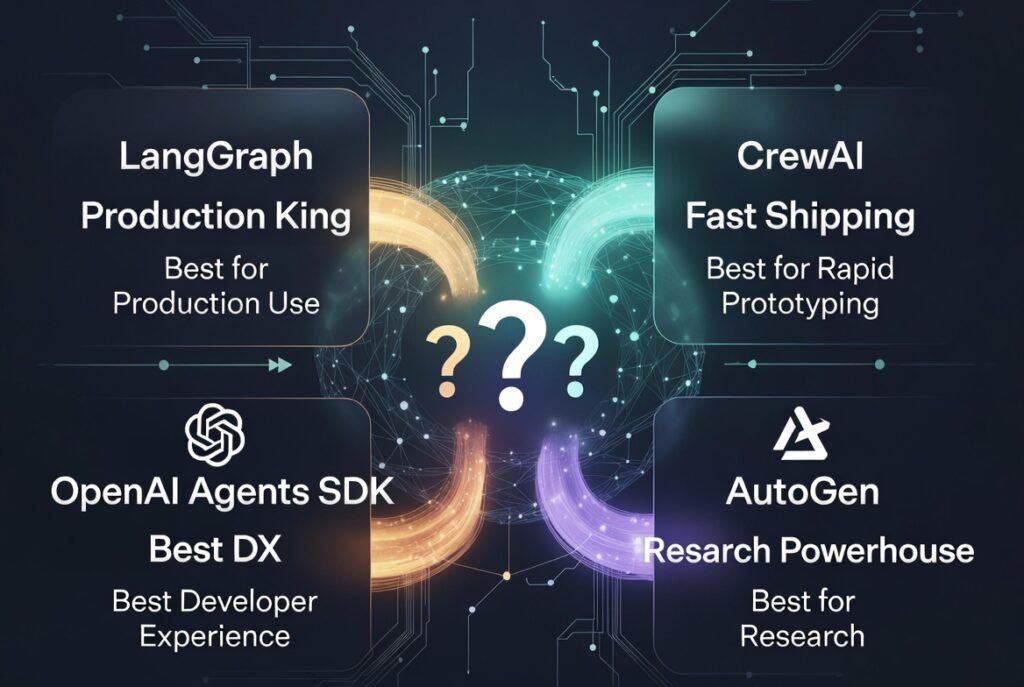
LangGraph
Best for: Production & regulated industries
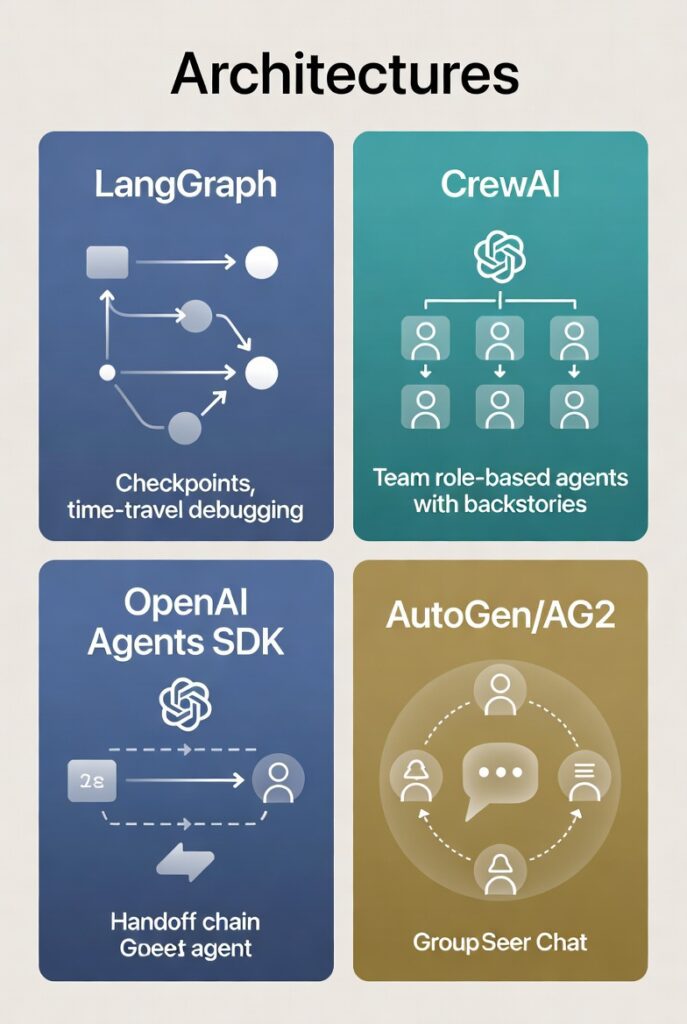
Graph-based state machine. Every step is a node; every transition is an edge you define. Time-travel debugging, checkpointing, HITL.
CrewAI
Best for: Fast multi-agent prototyping
Role-based crews where agents have personas, goals, and backstories. The lowest barrier to entry of any serious framework.
OpenAI Agents SDK
Best for: OpenAI-native workflows
Explicit agent handoffs with built-in guardrails, tracing, and tool integrations. Cleanest developer experience available.
AutoGen / AG2
Best for: Conversational research agents
Multi-agent conversations — debate, consensus, critique loops. The richest set of conversational patterns of any framework.
The production workhorse
Architecture: the graph is the point
LangGraph forces you to be explicit about your architecture. You model your agent system as a directed graph where agents, tools, and checkpoints are nodes; transitions between them are edges that can carry conditions. Each node reads from and writes to a central, serializable state object. The framework uses reducer logic to merge concurrent updates, which makes it particularly powerful when multiple agents operate in parallel.
This is not incidental complexity — it is the entire design philosophy. LangGraph does not try to abstract away your architecture decisions. It insists you make them. Teams who prefer that trade-off — more code, more control — consistently report it as a strength once they’ve debugged their first production outage in a competing framework.
What sets it apart in 2026
Time-travel debugging is the killer feature nobody talks about enough. Because every state transition is persisted and replayable, you can step backward through an agent’s execution the same way you’d rewind a video. When a long-running workflow fails on step 47, you don’t restart from zero. You resume from the last checkpoint. For regulated industries — financial services, healthcare, legal — this is not a nice-to-have. It is table stakes for audit compliance.
Human-in-the-loop support is first-class. You can insert approval gates, validation steps, or human review at any node in the graph. The agent pauses, serializes its state, and waits. Hours or days later, a human approves or modifies the state, and the workflow resumes exactly where it stopped.
LangSmith observability — LangChain’s companion platform — gives you per-token streaming visibility into what each node does, what it costs, and where it fails. In production, this is qualitatively better than what any other framework in this comparison currently offers.
# Minimal LangGraph agent — ~40 lines to a checkpointed ReAct loopfrom langgraph.graph import StateGraph, ENDfrom langgraph.checkpoint.memory import MemorySaverfrom typing import TypedDict, Annotatedimport operatorclass AgentState(TypedDict): messages: Annotated[list, operator.add]def call_model(state): # Your LLM call here — state is fully serializable return {"messages": [response]}graph = StateGraph(AgentState)graph.add_node("agent", call_model)graph.add_edge("agent", END)checkpointer = MemorySaver() # swap for PostgresSaver in productionapp = graph.compile(checkpointer=checkpointer)
Strengths
- Best-in-class observability via LangSmith
- Time-travel debugging & checkpoint replay
- First-class HITL support at any graph node
- Durable execution across failures
- Python and JavaScript support
- Largest verified enterprise deployment list
Limitations
- Steeper learning curve (graph theory concepts required)
- More boilerplate than CrewAI for simple tasks
- LangSmith observability has a paid tier for teams
- No native MCP/A2A support (community integrations exist)
- Simple ReAct agent takes ~120 lines vs. 40 in Smolagents
Bottom line
If you’re building something that needs to survive production — regulated industries, long-running workflows, multi-step approvals, audit trails — LangGraph is the safest default in 2026. The additional engineering overhead pays for itself the first time you need to replay a failed workflow instead of rebuilding it from scratch.
The fast-shipping favourite
Architecture: the team metaphor
CrewAI’s central metaphor is a crew of role-playing specialists. You define each agent with a role (e.g., “Senior Research Analyst”), a goal, a backstory that shapes its behavior, and the tools it has access to. You then assemble a crew and define the tasks they’ll collaborate on. CrewAI handles the orchestration: task delegation, sequential or parallel execution, output passing between agents.
The magic is how far that abstraction takes you with almost no code. You can stand up a functioning research-and-write pipeline — one agent searches, one synthesizes, one edits — in under 30 minutes with zero prior experience. For business teams, content operations, or any use case that maps naturally to human team structures, this is genuinely powerful.
What changed in 2026
The March 2026 Enterprise tier added the observability and scheduling capabilities that were the main reasons teams previously migrated to LangGraph. Combined with the April 2026 v1.12 release — which added agent skills, native support for OpenRouter / DeepSeek / Ollama / vLLM / Cerebras providers, Qdrant Edge memory backend, and hierarchical memory isolation — CrewAI’s gap with LangGraph on production-readiness has narrowed meaningfully, though it has not closed.
CrewAI also added A2A (Agent2Agent) protocol support, making it one of the first frameworks to ship native cross-framework agent interoperability. A CrewAI crew can now receive tasks from and hand off tasks to agents built in other frameworks through the standardized A2A interface.
# CrewAI — three agents, one crew, ~25 linesfrom crewai import Agent, Crew, Taskresearcher = Agent( role="Senior Research Analyst", goal="Find accurate, cited information on the topic", tools=[search_tool, scrape_tool])writer = Agent( role="Content Strategist", goal="Turn research into compelling narrative")crew = Crew( agents=[researcher, writer], tasks=[research_task, write_task], process="sequential")
Strengths
- Lowest learning curve of any serious framework
- Fastest prototype-to-working-agent time
- Model-agnostic (OpenAI, Anthropic, Ollama, DeepSeek, etc.)
- Visual editor for less-technical teams
- A2A protocol support (cross-framework interop)
- Growing enterprise tooling (v1.12, Enterprise tier)
Limitations
- No built-in checkpointing for long-running workflows
- Agent-to-agent communication mediated through task outputs, not direct messaging
- Coarse-grained error handling
- Debugging complex 5+ agent pipelines is painful
- Teams often migrate to LangGraph when scale bites
Bottom line
CrewAI is the right first choice when you need to validate an agent use case quickly, when the workflow maps naturally to human team structures, and when iteration speed matters more than deep orchestration control. The honest caveat: plan for the LangGraph migration before you need it, not after.
The clean room
Architecture: handoffs and guardrails
OpenAI’s Agents SDK replaced the experimental Swarm framework in March 2025. Its core abstraction is the handoff: Agent A completes its task and explicitly transfers control to Agent B, passing conversation context through the transition. Each agent is defined by instructions, a model reference, a list of tools, and a list of agents it can hand off to. The mental model is clean and predictable — no hidden orchestration, no magic routing.
The SDK was built around five core primitives: Agents, Handoffs, Guardrails, Sessions, and Tracing. The guardrail system is particularly well-designed — you can define input and output validation rules that fire automatically on every agent execution, catching off-policy behavior before it reaches your users.
The April 2026 overhaul
The v0.13 release changed the character of the SDK significantly. The any-LLM adapter means you can now route through non-OpenAI models via the Chat Completions API — though this is best understood as an escape hatch rather than a primary use case. Native MCP resource support and session persistence addressed two of the most common production complaints. The sandbox integration list expanded to include Blaxel, Cloudflare, Daytona, E2B, Modal, Runloop, and Vercel — meaning you can run code-execution agents without building your own sandboxing infrastructure.
Despite the name, the SDK now supports 100+ LLMs through the Chat Completions API. The original model-lock criticism has softened, though the best integrations and the deepest platform features — including built-in web search, file search, and computer use — still require OpenAI models.
# OpenAI Agents SDK — minimal two-agent handofffrom agents import Agent, Runner, handoffspecialist = Agent( name="Specialist", instructions="You handle the detailed analysis.", model="gpt-4.1",)triage = Agent( name="Triage", instructions="Route requests to the right specialist.", handoffs=[handoff(specialist)],)result = await Runner.run(triage, "Analyze this dataset...")
Strengths
- Cleanest, most opinionated developer experience available
- Built-in guardrails, tracing, and session management
- First-class MCP support (v0.13)
- Best sandbox integrations for code-executing agents
- Rapidly growing ecosystem and community
- Built-in tools: web search, file search, computer use
Limitations
- Deepest features still tied to OpenAI models
- No built-in long-running checkpointing
- Less mature than LangGraph for stateful production systems
- Limited control over agent-to-agent communication vs. LangGraph
- No A2A support (cross-framework interop)
Bottom line
The OpenAI Agents SDK is the right choice if you’re all-in on the OpenAI ecosystem and want the lowest friction from idea to deployed agent. The built-in tools, guardrails, and tracing save you weeks of integration work. If you need cross-LLM portability or deep stateful control, look elsewhere.
The conversational researcher
The split you need to understand before you write any code
AutoGen has a complicated 2025. Microsoft Research’s original framework — which introduced the idea of agents solving problems through multi-turn dialogue — forked into two diverging projects. The official Microsoft repository pushed a ground-up rewrite under v0.4 (now v1.0 GA), with an event-driven core, async-first execution, and pluggable orchestration strategies. The open-source community that preferred the stable, battle-tested v0.2 API continued development under the name AG2 at ag2.ai, calling itself “The Open-Source AgentOS.”
They are related but are no longer the same project. Choose deliberately before you start: ag2.ai for community-driven experimentation; the official Microsoft AutoGen v1.0 GA for projects that want alignment with the Microsoft Azure AI ecosystem.
Architecture: conversations as the orchestration primitive
AutoGen’s insight was that multi-agent collaboration could be modeled as a structured conversation rather than a predefined workflow. Agents take turns speaking, a Group Chat Manager decides who speaks next (using round-robin, random, manual, or LLM-driven selection), and the conversation history itself becomes the shared memory and coordination mechanism.
This produces genuinely emergent behavior — agents debate, critique, and refine each other’s outputs in ways that no predefined workflow would anticipate. For research tasks, code generation with review loops, and quality-iterative processes, this approach consistently outperforms more rigid orchestration models.
The honest limitation: every agent turn in a GroupChat involves a full LLM call with the accumulated conversation history. A four-agent debate with five rounds is a minimum of 20 LLM calls. This makes AutoGen expensive and slow for high-volume, real-time use cases. It excels at offline, quality-sensitive tasks where thoroughness matters more than speed or cost.
The production warning
Multiple independent engineering teams that have built with all four frameworks give the same verdict in 2026: AG2 / AutoGen is excellent for research, prototyping, and tasks where quality iteration matters. It is not where most teams should deploy customer-facing production workloads. There is no first-party observability platform, no commercial support, and the AutoGen → AG2 ecosystem split means documentation and community resources are inconsistent.
Strengths
- Most diverse set of conversational patterns (debate, consensus, critique)
- AutoGen Studio: no-code visual interface for configuring agents
- Genuinely emergent agent behavior through dialogue
- Excellent for code generation with review loops
- Completely free, no paid tiers in either fork
- AG2 Beta adds streaming and event-driven architecture
Limitations
- Expensive: 20+ LLM calls for a 4-agent 5-round debate
- No first-party observability platform (DIY logging)
- Microsoft shifted strategic focus away; AutoGen is in maintenance mode
- The Microsoft/AG2 fork fragments documentation and community resources
- Python only — no JavaScript support
- Conversational style hard to constrain in production
Side-by-side comparison
All data verified against framework documentation and production deployment reports, current as of May 2026.
| Dimension | LangGraph | CrewAI | OpenAI Agents SDK | AutoGen / AG2 |
|---|---|---|---|---|
| Orchestration model | Directed graph with conditional edges | Role-based crews with process types | Explicit handoffs between agents | Conversational GroupChat |
| State persistence | Built-in checkpointing with time travel | Task outputs passed sequentially (no checkpoint) | Session variables (ephemeral by default) | Conversation history, in-memory only |
| Production readiness | Highest — enterprise deployments at Klarna, BlackRock, JPMorgan | Medium — growing with Enterprise tier | High — built-in tracing and guardrails | Low for production — strong for research |
| Learning curve | Medium — graph concepts, state schemas | Lowest — 20 lines to working crew | Low — clean opinionated API | Medium — conversational patterns, selector logic |
| Model agnosticism | Fully model-agnostic | Fully model-agnostic (OpenAI, Anthropic, Ollama, DeepSeek, etc.) | 100+ LLMs via adapter; best features need OpenAI models | Fully model-agnostic |
| Human-in-the-loop | First-class, at any graph node | Supported but limited | Via guardrails and session management | Strong — conversation pausing supported |
| Observability | LangSmith (best-in-class) | Enterprise tier adds observability (2026) | Built-in tracing | DIY — no first-party platform |
| MCP support | Community integrations | Community integrations | First-class (v0.13) | Limited |
| A2A support | Community integrations only | Native support added 2026 | None | None |
| Streaming | Per-node token streaming | Limited | Full streaming | Limited (AG2 Beta improves this) |
| Language support | Python, JavaScript | Python | Python, JavaScript | Python only |
| Cost model | Free open-source; LangSmith has paid tiers | Free core; Enterprise tier paid | Free SDK; OpenAI API costs | Fully free, no paid tiers |
| Best single use case | Complex, stateful production workflows in regulated industries | Fast multi-agent prototypes with role-based task delegation | OpenAI-native pipelines with built-in tools (search, code, computer use) | Conversational research agents, code-gen with review loops |
MCP and A2A: the protocols that outlast your framework choice
Most framework comparisons treat MCP and A2A as feature checkboxes. In 2026, they are closer to architectural commitments that will matter long after you’ve potentially switched frameworks. Understanding them is increasingly non-optional for anyone building production agents.
Model Context Protocol (MCP)
Standardizes how AI agents connect to tools and data sources. Started as an Anthropic specification; moved to Linux Foundation stewardship in 2026 with backing from Anthropic, OpenAI, Google, Microsoft, AWS, Cloudflare, Block, and Bloomberg. If MCP matters to your architecture, the OpenAI Agents SDK currently has the strongest native support among the four frameworks here.
Agent2Agent Protocol (A2A)
Standardizes how agents from different frameworks discover and collaborate with each other. Of the four frameworks in this guide, CrewAI is the only one with native A2A support as of May 2026. LangGraph and AutoGen have community integrations for some A2A workflows. If cross-framework interoperability is central to your architecture, also evaluate dedicated interoperability-focused frameworks.
“Choosing a framework without considering MCP and A2A is like choosing a database without considering your API contract. The right decision today might become a migration headache tomorrow if the protocol landscape leaves your framework behind.”
The practical implication: if your architecture requires agents to talk to external tools through standardized interfaces (MCP) or to collaborate with agents built in other frameworks (A2A), weight those protocol capabilities heavily in your framework selection — not as a future consideration, but as a present one.
Decision framework: which one to pick
Forget the feature checklist. The framework decision comes down to four questions about your actual production context.
The migration pattern most teams follow
The most common real-world pattern in 2026 is not a single framework choice — it’s a two-phase approach. Teams start with CrewAI to validate the use case and iterate on the agent logic. Once the workflow is proven and production requirements become clear, they migrate the orchestration layer to LangGraph while reusing the agent logic, tool definitions, and LLM integrations they built in CrewAI.
This migration is less painful than starting from scratch, but it still takes weeks. The smarter approach, if you can predict that your workflow will need production-grade state management, is to start on LangGraph with the additional investment that requires, rather than building technical debt into the prototype phase.
The over-engineering trap
The single most common mistake teams make in agent development is not under-engineering — it’s over-engineering the orchestration layer before they’ve validated that the underlying model can handle the task at all. Before choosing a framework, build a single-agent proof of concept with raw API calls. Validate the LLM behavior. Then add orchestration complexity. Framework failures are often model failures in disguise.
Final verdict: 2026
LangGraph
Best for production
The safest default for complex, stateful workflows that must survive production — especially in regulated industries. Higher engineering investment, best-in-class payoff.
CrewAI
Best for shipping fast
The fastest route from concept to working multi-agent system. The 2026 Enterprise tier closes the production gap, but LangGraph’s depth remains the ceiling.
OpenAI Agents SDK
Best DX for OpenAI users
The cleanest developer experience available if you’re committed to the OpenAI ecosystem. Built-in tools, guardrails, and MCP support make it uniquely productive.
AutoGen / AG2
Best for research
Unmatched for conversational agent dynamics, iterative code generation, and research contexts. Not the right answer for customer-facing production deployments in 2026.
Further Reading & Resources
- → LangGraph Official Docs & LangSmith
- → CrewAI Enterprise + Documentation
- → OpenAI Agents SDK (v0.13)
- → AutoGen v1.0 (Microsoft) & AG2 Community
- → AI Agents & Multi-Agent Systems: The Definitive 2026 Guide (broader architecture context)
Part of the Trendix 2026 Agent Series
- ← Main Guide: AI Agents & Multi-Agent Systems 2026
- Framework Showdown: LangGraph vs CrewAI vs OpenAI Agents SDK vs AutoGen (you are here)
- 7 Production Multi-Agent Design Patterns
- MCP + A2A Protocol Deep Dive
- Agent Governance & Safety Framework
AI Agent Framework Selection Scorecard
Building Your First Production LangGraph Agent – Step-by-Step Tutorial
MCP + A2A Protocol: The Complete Architecture Guide
7 Production Multi-Agent Design Patterns
AI Agents & Multi-Agent Systems: Everything Changes This Year
Claude vs ChatGPT: Full 2026 Head-to-Head
AI Video Generators Ranked: Sora 2, Runway, Veo 3 Compared
ATLAS.ti 25 Review: Testing the AI Lab Features in Practice