

Best AI Tools for
Marketing Teams
in 2026
The market has 3,800+ AI tools now. Most are noise. This guide cuts through it — with real pricing, verified ROI data, honest trade-offs, and recommended stacks by team type. No vendor sponsorships. No hedging.
There’s an honest problem with most AI tool roundups: they’re written to rank on Google, not to help people make better decisions. The author usually hasn’t used most of the tools, the pricing is often wrong by two cycles, and the “verdict” is whatever paid the most for placement. This guide works differently. Everything below is drawn from published, citable research — McKinsey’s Global AI Survey, Gartner’s CMO Spend Survey, the Salesforce State of Marketing 2026 — and from hands-on evaluation against real marketing tasks. No tool paid to be here.
One thing worth acknowledging upfront: the landscape has changed faster in the last 18 months than in the five years before it. Chiefmartec’s Marketing Technology Landscape tracked roughly 1,200 AI marketing tools at the start of 2024. By early 2026 that number sits above 3,800. The abundance is genuinely useful in some ways and genuinely paralyzing in others.
The 2026 Landscape: What’s Actually Changed
Two years ago, “AI for marketing” meant autocomplete dressed up as a product. That category still exists, but it’s shrinking. What replaced it is more interesting and more demanding to evaluate.
The flip side matters just as much. Only 23% of marketing leaders say generative AI is clearly improving campaign performance, per Gartner. And 74% of companies still struggle to achieve and scale value from AI initiatives, per BCG. Adoption went up; accountability didn’t follow. The median mid-market marketing team spent $1,200 per month on AI tools in Q1 2025 and $3,400 per month in Q1 2026 — mostly without a coherent way to measure what that spend was producing.
“The teams getting the best results in 2026 have freed their human marketers from repetitive work to focus on creative and strategic thinking that AI still cannot do — brand positioning, customer empathy, and genuinely novel ideas.”
— Involvedigital AI Stack Guide, April 2026Three structural shifts define what matters in 2026. First, agentic workflows — 34% of enterprise marketing teams now run at least one autonomous AI agent in production, more than double the 14% reported in late 2024. Second, AI search visibility (GEO) — Gartner projects traditional search volume will decline 25% by 2026 as AI chatbots capture more of the discovery layer, which means SEO strategy now has a second axis. Third, platform consolidation — companies that consolidated around AI-capable platforms rather than accumulating point solutions reported 50–77% reductions in technology costs, per ALM Corp research.
AI video tools deliver 1.1×–1.6× ROI largely because production overhead remains high even when generation is automated. And AI-generated paid social creative underperforms because Meta, TikTok, and Google now quietly down-rank obvious AI-generated creative in their 2026 ranking updates — a pattern confirmed across multiple agency performance studies. Source: Digital Applied, April 2026.
Content & SEO Tools
Content and SEO tools represent the largest category of AI marketing adoption — and the one with the most noise-to-signal in vendor claims. In 2026, the category has split cleanly into two lanes: tools that help you write faster, and tools that ensure what you write actually ranks. The distinction matters a lot because the best tools in each lane are rarely the same product.
Jasper has survived what its main competitors haven’t: the base model commoditization wave. What it offers in 2026 that you can’t get from ChatGPT Plus is a structured institutional layer — brand voice training, content pipelines that automate the full content lifecycle from brief to publishing, and multiplayer canvas editing that actually works for teams of five or more. The recent Jasper IQ brand layer is a genuine differentiator; it ingests your brand guidelines, past content, product documentation, and customer research, then uses that context on every generation.
Its AEO/GEO rewriting features — helping your content surface in ChatGPT and Perplexity answers, not just Google — are ahead of most competitors. That said, for occasional users or bootstrapped startups, the pricing is hard to justify when the raw models are available directly.
- Brand voice training actually works at scale
- Content pipelines reduce multi-step manual work
- GEO/AEO optimization baked in
- SOC 2 — your legal team won’t panic
- Data doesn’t train third-party models
- Steep price for small teams vs. raw models
- Research depth still lags Perplexity
- Steeper learning curve than ChatGPT
Surfer SEO remains the closest thing to an industry standard for on-page content optimization. Its Content Editor provides a real-time writing workspace with a 0–100 score tracking keyword usage against top-ranking competitors. The practical advantage over alternatives is that it doesn’t just tell you to use a keyword — it tells you how many times, where, and what semantic context you’re missing.
In 2026 Surfer added an AI Tracker module that monitors your rankings and fires alerts on drops before Google Search Console catches them. The AI-generated articles on scale plans are optimization-focused but still read as AI-generated; they need human editing, which the vendor will tell you too if you ask directly. The WordPress and Google Docs integrations are genuinely smooth and reduce context-switching meaningfully.
- Real-time content scoring is genuinely useful
- Google Docs / WordPress integration
- Semantic NLP suggestions are accurate
- AI Tracker for rank-drop early warnings
- AI-generated articles need heavy editing
- Scale plan limits (20 AI articles/mo) hit fast
- Doesn’t replace Semrush/Ahrefs for research
ChatGPT & Claude — The Unsung Workhorses
No honest guide can avoid this: for most marketing tasks, the highest ROI tool on your stack is still ChatGPT (GPT-4o) or Claude — used directly, not through a wrapper. Multiple practitioners with genuine testing regimens report the combined cost of Claude Pro ($20/mo) plus ChatGPT Plus ($20/mo) as the highest-ROI line item in their marketing stack. Claude 3.5 Sonnet excels at long-form, nuanced content — research synthesis, in-depth guides, technical writing, and maintaining brand voice across large documents. GPT-4o handles structured outputs, data analysis, and iterative drafting especially well.
The honest critique of writing-wrapper tools (Jasper, Copy.ai, Writesonic) from independent practitioners in 2026 is blunt: two years ago they had a moat. Today they’re charging more than the base models they wrap. Jasper survives because it added genuine enterprise infrastructure. The others are harder to justify unless your team really can’t handle a direct API or ChatGPT interface.
Email & Marketing Automation
Email remains the highest-ROI digital marketing channel for B2C brands. AI has made the personalization gap between top-tier programs and average ones wider than ever — and the gap is visible in revenue, not just open rates.
Klaviyo is the dominant AI email platform for e-commerce, full stop. It integrates directly with Shopify, WooCommerce, Wix, and 350+ other platforms, syncing customer purchase history, browsing behavior, and product catalog data automatically. What separates it from ActiveCampaign or Mailchimp at scale isn’t just deliverability — it’s the predictive layer. Customer lifetime value forecasting surfaces your best customers, churn prediction fires win-back sequences before people leave, and send-time optimization learns each subscriber’s individual engagement patterns, not just aggregate ones.
For stores doing under $50K/month in revenue, Klaviyo’s capabilities are often more than you need. Above that threshold, the ROI case is well-documented — multiple Shopify agency reports put payback within 60 days on the paid tier.
HubSpot’s Breeze AI, launched and significantly expanded through 2025, is the most complete AI marketing platform on the market — in the sense that it’s the only one that genuinely connects CRM, content, automation, SEO, and analytics in a single interface without painful integration work. The Breeze Copilot handles conversational tasks across the entire platform, while Breeze Agents (launched Q4 2025) can execute multi-step tasks autonomously: prospecting agents, content agents, customer service agents running without human initiation on every step.
The predictive lead scoring (Professional and Enterprise tiers) works well when your CRM data is clean. The honest caveat: it doesn’t. Most marketing teams’ CRM data is a mess, and HubSpot’s AI quality is directly dependent on data quality. The pricing is significant — $800–$3,600/mo for Professional — but the alternative is paying for five separate tools and integration maintenance.
Video & Visual Creation
AI video tools saw a 340% increase in usage among marketers in 2025–2026, per Wistia’s State of Video. Sixty-eight percent of CMOs are deploying or planning to deploy AI for video generation, making it the single highest-priority AI application heading into 2026, per BCG’s survey. The practical situation is that the tools work well for internal communications, training, product explainers, and talking-head spokesperson content — and work much less well for anything that needs to feel emotionally authentic or brand-distinctive in a premium way.
HeyGen creates professional talking-head videos using AI avatars — type your script, pick from 500+ avatars, get a video with accurate lip-sync in 175+ languages. Where it pulls ahead of Synthesia is in avatar realism and flexibility. The real-time interactive avatar feature is genuinely impressive for customer service and training scenarios.
The ROI case is strongest for teams that need localized video at volume — one script, dozens of language versions without re-shooting. The real-time 4K capability is a genuine differentiator in 2026.
Visual Design: Canva Magic Studio vs. Midjourney
Canva’s Magic Studio — text-to-image, background removal, brand-kit consistency — handles the large majority of day-to-day blog headers and social graphics well enough that most teams don’t need a separate design tool. ChatGPT’s image generation (integrated into Plus) is where to go for something more custom. Midjourney v7 remains the aesthetic benchmark for the highest-quality output, but it requires a Discord workflow that most marketing teams find operationally awkward.
Analytics & Data Intelligence
One of the more revealing statistics in the 2026 data: only 19% of organizations track KPIs specific to generative AI, per McKinsey. Teams are spending and deploying but flying without visibility. This is where analytics AI tools deliver disproportionate value.
Brandwatch processes social media conversations and reviews at scale to surface audience insights, track brand sentiment, and identify emerging trends. The practical use for marketing teams is faster audience understanding and real-time brand monitoring during campaign launches. The AI layer categorizes mentions by topic, sentiment, and source, and surfaces anomalies in brand conversation automatically. Pricing: Enterprise, custom. Best suited to organizations with significant social presence and the internal capacity to act on signals.
For mid-market teams not at the scale for Brandwatch, Semrush’s integrated AI modules for topic clustering and content gap analysis deliver strong value and connect directly to existing SEO workflows. The competitive intelligence use case — monitoring rival brand positioning in social conversation — is where purpose-built tools justify their price premium over general analytics platforms.
AI Research Tools: Perplexity, NotebookLM, Elicit
This is probably the category with the fastest-moving tool quality, and it’s underappreciated in most AI marketing tool guides. The strategic question that used to take a junior marketer two days — competitive landscape research, understanding what customers are saying about a category, summarizing recent analyst reports — can now be done in two hours with the right tools.
Perplexity Pro ($20/mo) is the tool most-used by marketing practitioners for research that needs citations. Answers come with sourced references, which matters for marketing content where claims need backing. It’s backed by steady active-user growth documented by MIT Technology Review and has become the default for quick research-with-evidence tasks.
Google NotebookLM (free) has become the standard for turning company documents — product docs, customer research reports, old case studies — into queryable knowledge bases. You upload PDFs or paste text, and it surfaces answers with direct citations. For an internal marketing team that has accumulated years of research they can’t access easily, this is genuinely valuable.
Elicit is the right tool when your marketing claims need scientific citation — efficacy research, ingredient claims, health-adjacent content. It dominates in academic research retrieval and assisted summarization.
A realistic research stack in 2026 costs under $50/month: Perplexity Pro ($20) + NotebookLM (free) + one Elicit or Consensus subscription depending on the vertical. Most of the value comes from using these tools as daily habits, not from premium features. The ROI of good research habits compounds over months, not days.
Workflow Automation & AI Agents
This is arguably the most important category in 2026, and the one most underrepresented in traditional marketing tool roundups. The shift from “AI that helps me write faster” to “AI that executes multi-step workflows autonomously” is the structural change that separates high-performing marketing teams from average ones.
Gumloop is the most genuinely disruptive tool in this guide. Think of it as Zapier with an AI layer — it lets you connect any LLM model (ChatGPT, Claude, Grok) to your internal tools and workflows without writing a single line of code. The interface is notably clean and considered — meaningfully better UX than n8n — and it includes access to premium LLMs built in without needing separate API keys.
Real use cases being documented by marketing teams include: sentiment analysis on social media to aggregate product reviews automatically, competitive intelligence reports delivered on a schedule, and content pipeline automation that goes from keyword brief to first draft to Slack notification for review — all without human initiation on each step. Shopify, Instacart, and Airbnb are among the documented early enterprise users.
The broader workflow category is also seeing mature tools add agentic capabilities. Zapier Agents (launched 2025) extend Zapier from conditional automation into true agentic territory — AI workers that monitor conditions, make decisions, and act without a human trigger on each step. For teams already invested in Zapier’s 6,000+ integration ecosystem, this is meaningful evolution rather than a reason to switch.
Full Comparison: The Tools That Matter in 2026
| Tool | Category | Starting Price | Free Tier | GEO/AEO | Agents | Best For |
|---|---|---|---|---|---|---|
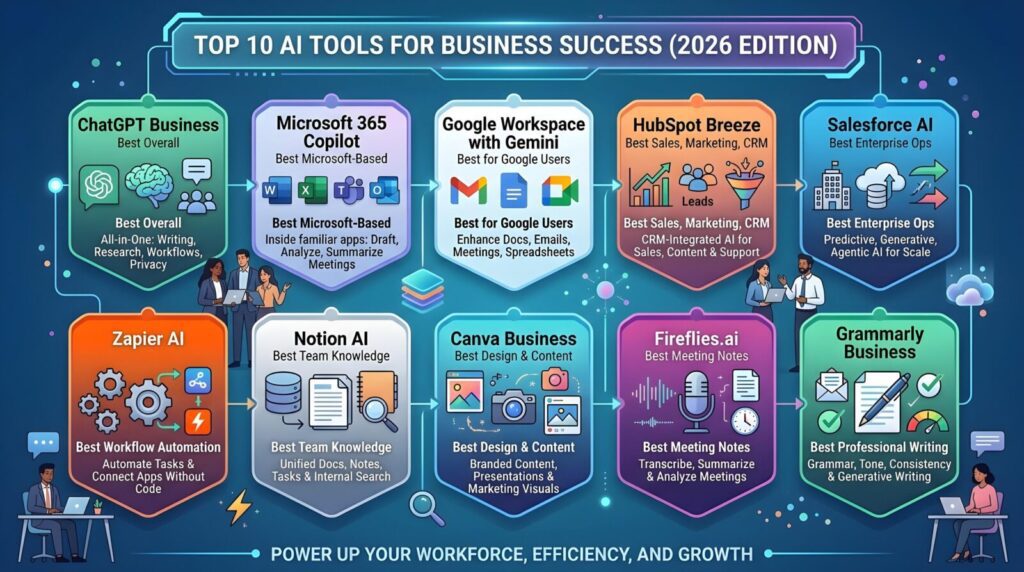
| ChatGPT (GPT-4o) | General AI | Free / $20/mo Plus | ✓ | Partial | Basic | Versatile drafting, analysis, ideation |
| Claude (Anthropic) | General AI | Free / $20/mo Pro | ✓ | Partial | Claude.ai | Long-form, nuanced content, brand voice |
| Jasper AI | Content Platform | ~$39/user/mo | 7-day trial | ✓ Native | ✓ | Brand-governed content at scale |
| Surfer SEO | SEO Optimization | $89/mo | ✗ | ✓ AI Tracker | ✗ | On-page optimization, content scoring |
| HubSpot Breeze | Full-Stack CRM+ | Free / Pro $800/mo | ✓ CRM | Basic | ✓ Breeze Agents | Teams wanting unified platform |
| Klaviyo | Email / E-com | $20/mo | ✓ (limited) | ✗ | Flows | D2C, Shopify stores, e-commerce |
| HeyGen | AI Video | $22/mo Starter | ✓ (limited) | ✗ | ✗ | Multilingual spokesperson videos |
| Gumloop | Workflow Automation | Free / Paid tiers | ✓ | ✗ | ✓ Core Feature | AI workflow automation, pipelines |
| Perplexity Pro | AI Research | $20/mo | ✓ | ✗ | ✗ | Cited research, competitive intelligence |
| Brandwatch | Social Intelligence | Enterprise custom | ✗ | ✗ | ✗ | Brand monitoring, audience intelligence |
| Canva Magic Studio | Visual Design | Free / Pro $15/mo | ✓ | ✗ | ✗ | Social graphics, presentations, brand kits |
| Semrush + AI | SEO Suite | $129/mo | ✓ Limited | Growing | ✗ | Keyword research, competitive SEO |
Recommended Stacks by Team Type
The single most common mistake marketing teams make with AI tool spending is purchasing horizontally — a little of everything — rather than vertically, going deep on the two or three use cases that actually drive revenue. The stacks below are built around that logic.
Solo Marketer / Freelancer · Budget: $40–100/mo
Small Content Team (3–8) · Budget: $500–1,200/mo
Mid-Market / Enterprise · Budget: $3,000–10,000+/mo
What Not to Buy (and Why)
Roughly $1,200–$1,800/year of most marketing teams’ AI tool spend is going to products they either don’t use or that duplicate each other. Worth naming directly:
Writing wrappers without enterprise infrastructure. Copy.ai and Writesonic built businesses on top of OpenAI’s API before the API was cheap or accessible. In 2026, access to GPT-4o and Claude is $20/month directly. Paying a wrapper $49–$149/month for the same capability with a worse interface is hard to justify unless the wrapper genuinely adds something (Jasper does; most don’t).
Paid social AI creative tools with inflated ROI claims. Multiple agency performance studies confirm that Meta, TikTok, and Google have updated their 2026 ranking systems in ways that down-rank obviously AI-generated creative. AI video tools deliver 1.1×–1.6× ROI where human-creative content typically delivers higher. This doesn’t mean stop using AI for creative — it means be realistic about the ceiling and invest in human creative direction.
Point solutions that your CRM already handles. Before adding a standalone AI analytics tool, a standalone A/B testing tool, or a standalone lead scoring tool, check what your existing CRM platform now does natively. HubSpot and Salesforce both expanded their AI capabilities significantly in 2025–2026.
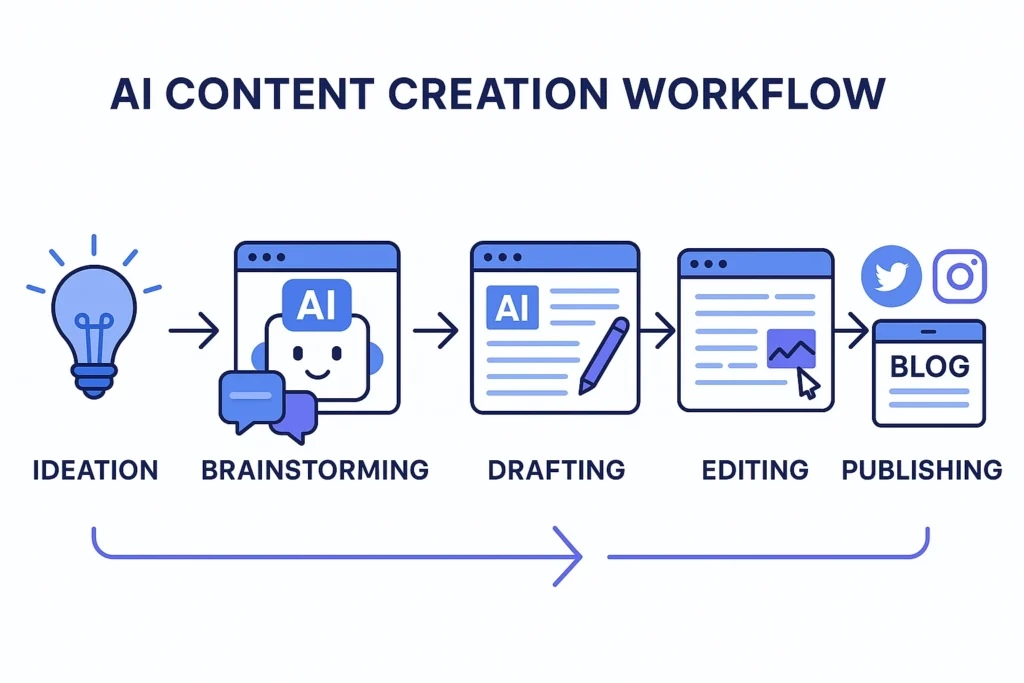
The right workflow in 2026 is AI-assisted with real human voice layered on top — not publishing unedited AI output. Google’s helpful content systems penalize sites publishing unedited AI content. The AI handles the 80% that’s mechanical; human editing handles the 20% that determines whether the content is actually useful and trusted. This is the most important publishing workflow decision you’ll make this year.
The Bottom Line
The case for AI in marketing is beyond debate at this point. McKinsey estimates generative AI can boost marketing productivity by 5–15%, with GenAI unlocking $0.8–$1.2 trillion in annual value across sales and marketing combined. AI-driven campaigns deliver 22% higher ROI, 32% more conversions, and 29% lower acquisition costs than traditional methods on average, per McKinsey and Zebracat research.
The case for buying 12–15 AI tools and hoping for the best is equally clear: it doesn’t work. BCG’s survey data shows 74% of companies still struggle to scale value from AI. The gap is between teams with coherent strategies — clear use cases, defined metrics, integrated tools — and teams with a sprawling collection of subscriptions.
“AI amplifies human capability rather than replacing human roles. The teams getting compounding value are those who’ve stopped treating AI as a department and started treating it as infrastructure.”
— Involvedigital AI Stack Guide, 2026If you take one thing from this guide: start with your biggest time sink, not the most impressive demo. For most teams, that’s content creation or workflow automation. Pick one tool in that category, master it for 90 days, measure its actual impact on a metric you care about, and only then expand. That’s a boring prescription. It’s also the one that works.
Agentic marketing workflows are the frontier. Gartner predicts 60% of brands will use agentic AI to deliver one-to-one interactions by 2028. The 34% of enterprise teams already running autonomous agents in production are building institutional knowledge about what works. If you’re not experimenting with at least one agent-mode workflow in the next six months, the gap will compound. GEO (Generative Engine Optimization) is the second axis of search strategy — tracking your brand’s presence in ChatGPT, Perplexity, and Gemini answers is now as important as tracking your Google positions. Tools like Profound and Otterly.AI are building the measurement infrastructure for this.
Primary sources referenced in this article:
Salesforce State of Marketing 2026 · HubSpot AI Trends 2026 · Gartner CMO Spend Survey · McKinsey Global AI Survey · BCG AI in Marketing Research · Chiefmartec Marketing Technology Landscape · Gartner Agentic AI Prediction 2026 · Digital Applied AI Marketing Statistics 2026
The Only Guide to AI Productivity Tools You Need in 2026
AI Tools Hub — Full Directory
Best AI Writing Tools 2026
AI for Marketers & Creators The 2026 Reality Check
The Comprehensive Ranking: Best AI Tools 2026
NVivo Alternatives: What to Switch To and When
RAG Security: Attack Surfaces in Retrieval Pipelines
AI Meeting Intelligence Tools
Freelance Pricing Strategy: How to Raise Your Rates Without Losing Clients
Best Productivity Tools in 2026: The Full Stack Guide
The AI Trends Reshaping Digital Marketing in 2026
25 AI Writing Tools That Create High-Ranking Blog Posts