


Claude vs ChatGPT:
The Full 2026 Head-to-Head
We tested both platforms hard across coding, writing, research, enterprise use, and agentic workflows. Here’s the honest verdict — benchmarks, real-world performance, pricing, and where each one genuinely falls short.
The Short Answer (If You’re in a Hurry)
Neither model wins everything. That’s the honest starting point for any serious comparison in 2026 — and if you’ve read any comparison that declares a clean winner, it’s probably selling something.
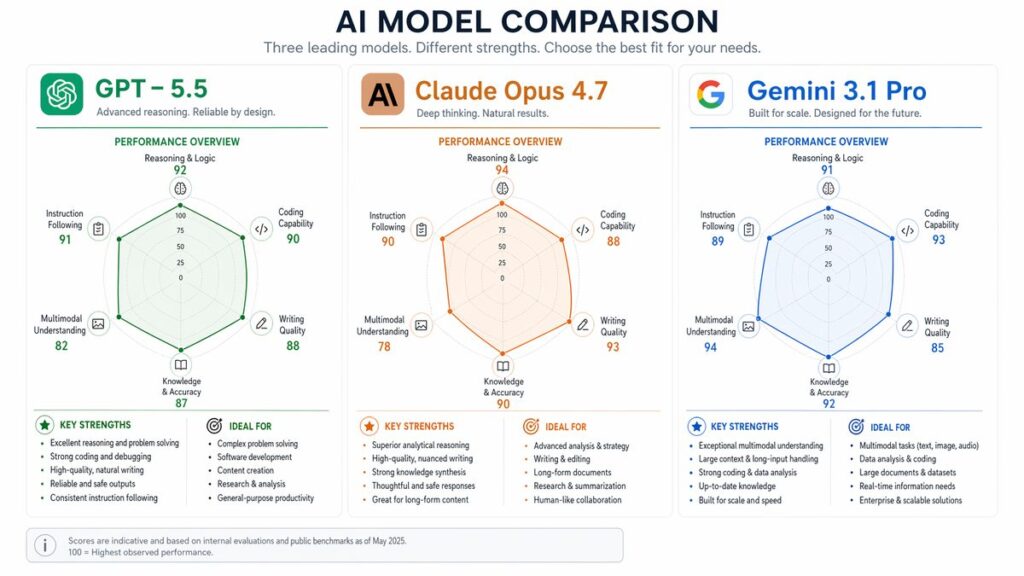
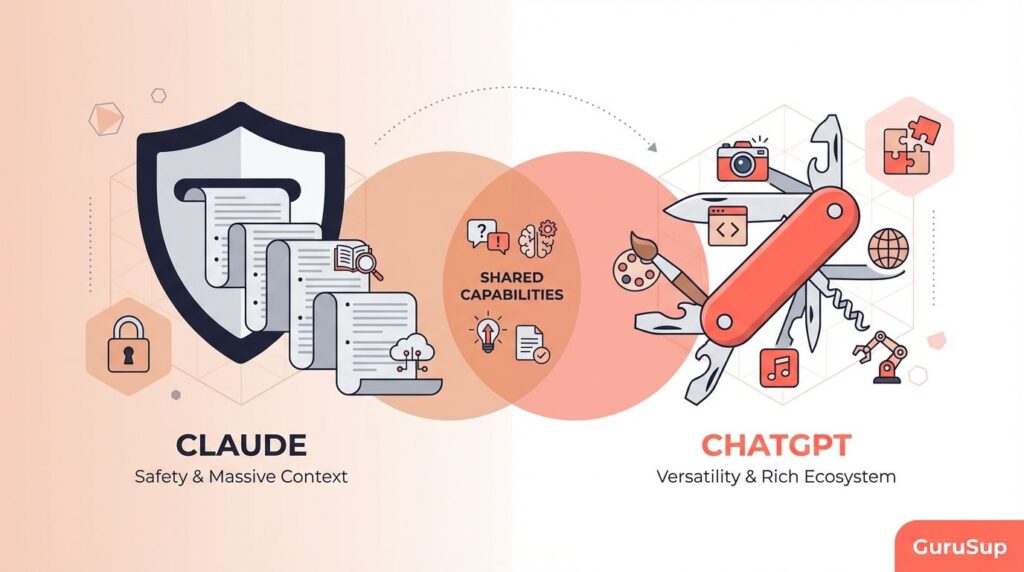
Claude Opus 4.7 is the better choice for coding, long-document analysis, professional writing, and any regulated industry where consistency and data privacy aren’t negotiable. ChatGPT with GPT-5.5 is the more versatile day-to-day tool: image generation, voice mode, web browsing, a massive ecosystem of integrations — it does more things out of the box.
Most serious practitioners we’ve spoken to use both. The $40/month combined subscription for Claude Pro and ChatGPT Plus is, frankly, the most defensible choice for anyone who uses AI professionally. But if you can only pick one, this guide tells you exactly which one to pick for your specific situation.
| Category | Claude (Opus 4.7) | ChatGPT (GPT-5.5) | Edge |
|---|---|---|---|
| Coding (SWE-bench Pro) | 64.3% | 58.6% | Claude |
| Scientific Reasoning (GPQA Diamond) | 91.3% | ~90% | Claude |
| Computer Use (OSWorld) | 78.0% | 78.7% | ChatGPT |
| Long-Context (standard) | 200K (1M on 4.7) | 128K standard | Claude |
| Image Generation | None | DALL-E + native GPT-5.5 | ChatGPT |
| Voice Mode | Limited | Advanced Voice Mode | ChatGPT |
| Coding accuracy (dev preference) | 70% dev preference | 30% | Claude |
| Professional writing quality | Cleaner, less padding | Fast, versatile | Claude |
| Ecosystem & integrations | Growing (MCP, Bedrock) | 60+ apps, GPT store, MS365 | ChatGPT |
| Data privacy (default) | No training from Pro tier | No training at Enterprise only | Claude |
| Consumer pricing | $20/month (Pro) | $20/month (Plus) | Tie |
| API input/output (per 1M) | $5 / $25 (Opus 4.7) | $5 / $30 (GPT-5.5) | Near-Tie |
The Models: What You’re Actually Comparing
A confusing part of this comparison in 2026 is that both vendors ship multiple tiers simultaneously, and the naming has gotten messy. Let me be specific about what’s actually available right now.
The Claude Family (Anthropic)
Claude Opus 4.7 (released April 16, 2026) is Anthropic’s current flagship. It introduced a 1 million token context window, high-resolution vision up to 2,576 pixels, and — notably — a built-in self-verification step that re-checks its own answers before responding. Pricing held flat at $5 per million input tokens and $25 per million output tokens. It currently leads SWE-bench Pro at 64.3% and OSWorld computer use at 78.0%.
Claude Sonnet 4.6 is the everyday workhorse: $3/$15 per million tokens, 79.6% on SWE-bench Verified, and what most Claude Pro subscribers use for the bulk of their tasks. Many developers report Sonnet handles around 90% of their daily workload without needing Opus. Claude Haiku 4.5 fills the lightweight/fast tier.
The ChatGPT Family (OpenAI)
GPT-5.5 (released April 23, 2026, internally codenamed “Spud”) is OpenAI’s response to Claude Opus 4.7, arriving exactly one week later. It’s the first fully retrained base model since GPT-4.5 and natively omnimodal — text, images, audio, and video in a unified architecture. It leads Terminal-Bench 2.0 at 82.7% and made a remarkable long-context retrieval leap on MRCR v2 at 1M tokens, going from 36.6% to 74.0%. API pricing came in at $5/$30 per million tokens — input parity with Claude Opus 4.7 but a 20% premium on output.
GPT-5.4 is still widely available at $2.50/$15 per million tokens and scores 77.2% on SWE-bench Verified. For many API use cases it remains the better value choice within the OpenAI family. GPT-5-mini at $0.25/$2.00 is the cheapest frontier-adjacent option in either ecosystem right now.
Benchmark Breakdown: The Numbers That Actually Matter
There are dozens of AI benchmarks floating around at any given moment. Most don’t matter for real-world use. Here’s a curated look at the ones that tell you something genuinely useful, with figures as of May 2026.
| Benchmark | What it tests | Claude Opus 4.7 | GPT-5.5 | Leader |
|---|---|---|---|---|
| SWE-bench Pro | Real-world software engineering (hard) | 64.3% | 58.6% | Claude |
| SWE-bench Verified | Real-world software engineering (standard) | 87.6% | n/a (GPT-5.4: 77.2%) | Claude |
| OSWorld-Verified | Computer use across real desktop apps | 78.0% | 78.7% | ChatGPT |
| Terminal-Bench 2.0 | Terminal/command-line coding agent | 69.4% | 82.7% | ChatGPT |
| GPQA Diamond | Grad-level scientific reasoning | 91.3% | ~90% | Claude |
| HLE without tools | Humanity’s Last Exam (hard reasoning) | 46.9% | 41.4% | Claude |
| MCP-Atlas tool orchestration | Multi-tool agentic coordination | 79.1% | 75.3% | Claude |
| MRCR v2 at 1M tokens | Long-context retrieval | n/a | 74.0% | ChatGPT |
| CyberGym | Cybersecurity reasoning | 73.1% | 81.8% | ChatGPT |
| BrowseComp | Web research accuracy | n/a | 90.1% | ChatGPT |
Sources: SWE-bench Leaderboard, OSWorld Benchmark, Anthropic & OpenAI official releases — all accessed May 2026. Note: GPT-5.5 API access was rolling out as of publication.
The pattern that emerges is fairly clear: Claude leads on pure software engineering tasks (SWE-bench Pro, SWE-bench Verified, MCP tool orchestration) and scientific reasoning. ChatGPT leads in terminal-based coding, computer use tasks, web research, and cybersecurity evaluation. This isn’t a one-model-dominates-all story anymore — if it ever was.
Coding & Developer Use: Claude’s Strongest Lead
This is where the comparison gets most interesting for professional developers. Claude has quietly become the infrastructure of choice for AI-assisted development in a way that raw benchmarks alone don’t capture.
Benchmark data from SWE-bench Leaderboard and Anthropic/OpenAI releases. Developer preference from independent survey data, April 2026.
Beyond benchmarks, 70% of developers now prefer Claude for coding tasks in 2026. Claude powers Cursor and Windsurf — the two most widely adopted AI coding editors among professional developers. Claude Code, Anthropic’s terminal-based agentic coding tool (included in Claude Pro at no extra cost), now handles entire projects: planning, executing multi-file changes, running tests, and committing code. Anthropic had captured 54% of the enterprise coding market as of early 2026, and Claude Code has become a multi-billion-dollar revenue line in its own right.
Where ChatGPT has a genuine coding edge is in terminal-based workflows (Terminal-Bench 2.0: 82.7% vs 69.4%) and beginner accessibility — its integrated code execution environment gives immediate feedback that helps newcomers learn faster. ChatGPT is also more forgiving with underspecified prompts, making reasonable assumptions when instructions aren’t complete.
The practical conclusion for developers: if you’re doing professional-grade software work, especially agentic coding across large codebases, Claude Code is the better tool. If you’re learning to code or need a quick, general-purpose code snippet in a broader workflow, ChatGPT remains excellent.
Case Study: Engineering Team at a Fintech Startup
A 12-person engineering team switched from GitHub Copilot to Claude Code in January 2026. They reported a reduction in code review cycles for AI-generated PRs from an average of 3.2 rounds to 1.4 rounds, attributing the improvement to Claude’s ability to handle multi-file context and maintain code style consistency across a 200,000-line codebase. The team still uses ChatGPT for documentation writing and architectural brainstorming, calling Claude “surgical” and ChatGPT “exploratory.”
Writing & Long-Form Content: Genuinely Different Styles
Both models write well. But they write differently, and the difference is real enough to matter in a professional context.
ChatGPT tends toward confident, structured prose. It produces polished first drafts quickly, handles marketing copy and email templates efficiently, and has an expressive fluency that reads naturally. Its weakness: it sometimes reaches for filler phrasing, over-structures shorter pieces, and has a slight tendency to present uncertain information with confident framing.
Claude produces writing that’s more measured and precise. It’s less likely to pad output or add unnecessary transitions, handles nuanced long-form content well, and tends to flag uncertainty rather than paper over it. Corporate communications, technical documentation, policy documents, and research write-ups consistently come out cleaner with Claude. It also supports up to 128K tokens of output in a single response — significantly more than most competitors — which matters for anyone generating long structured documents.
For creative writing — fiction, ad copy, social content, brand voice work — ChatGPT has a slight edge through expressive range and better multimodal integration (being able to generate images within the same conversation still matters for content workflows). For knowledge-work writing — reports, analysis, technical docs, long-form editorial — Claude is the better tool.
One practical note: if you’re consistently frustrated by AI writing that sounds like AI writing, Claude is noticeably more natural. Anthropic has clearly invested in this. It still happens with both, but less often with Claude.
Multimodal & Voice: ChatGPT Wins Clearly
This is the one area where the comparison isn’t close, and it’s important to be honest about it.
ChatGPT does things Claude simply cannot do. Native image generation (DALL-E and GPT-5.5’s built-in image capabilities), video generation through Sora, Advanced Voice Mode with real-time bidirectional conversation and emotional expressiveness, web browsing for live information — all of this is built into a single ChatGPT interface. Claude Opus 4.7 introduced high-resolution vision (analyzing images up to 2,576px), but it still cannot generate images at all.
If image generation, video creation, or natural voice conversation is part of your workflow, you need ChatGPT. There’s no Claude workaround for this. You’d need to bolt on separate tools — a separate image generator, a separate voice interface — and that friction is real.
For computer use, the gap has narrowed considerably. Claude Sonnet 4.6 hit 72.5% on OSWorld in early 2026 — roughly human expert baseline — representing a jump from just 28% a year earlier. Claude Opus 4.7 pushed that to 78.0%. GPT-5.5 leads at 78.7% on OSWorld-Verified, a slim margin.
Context Window & Long Documents: Claude’s Structural Advantage
Context window size has become one of the most practically significant differentiators in 2026, particularly for enterprise use cases.
The standard Claude Opus 4.7 context window is 200K tokens — it ships with this across all paid tiers. The 1M token context window, introduced with Opus 4.7, enables genuinely transformative workflows: summarizing an entire national regulatory framework, analyzing a complete codebase, processing multi-hundred-page legal documents without chunking. Claude Enterprise pushes this further, with 500K tokens available in chat and 1M in code execution environments.
ChatGPT with GPT-5.4 offers 128K tokens standard. A 1M context window exists but requires the $200/month ChatGPT Pro tier — that’s a significant cost jump. GPT-5.5’s 1M context is similarly tier-restricted. For most teams, the effective standard context comparison is 200K (Claude) versus 128K (ChatGPT).
Another practical difference: Claude supports up to 64K tokens of output per response; GPT-5.4 allows 128K output. For tasks generating very long outputs (comprehensive reports, large code files), ChatGPT’s higher output ceiling is a real advantage. Most tasks don’t hit this limit, but it’s worth knowing if your workflow does.
Pricing: Every Tier, Compared
Consumer pricing is a tie: $20/month for both Claude Pro and ChatGPT Plus. The differences emerge at the premium and API tiers.
Claude Pricing
- Free tierSonnet 4.6 (limited)
- Claude Pro$20/month
- Claude Max$100+/month
- Team (per seat)~$25–$30/user
- EnterpriseCustom (20-seat min)
- Opus 4.7 API (in/out)$5 / $25 per 1M
- Sonnet 4.6 API (in/out)$3 / $15 per 1M
- Haiku 4.5 API (in/out)Low-cost tier
ChatGPT Pricing
- Free tierGPT-5.x limited (~10 msgs/5hr)
- ChatGPT Plus$20/month
- ChatGPT Pro$200/month
- Team (per seat)~$25–$30/user
- Enterprise~$60/user (150-seat min)
- GPT-5.5 API (in/out)$5 / $30 per 1M
- GPT-5.4 API (in/out)$2.50 / $15 per 1M
- GPT-5-mini API (in/out)$0.25 / $2.00 per 1M
A few things worth highlighting. First, at the consumer tier, the $20/month price point is identical — but the value differs. Claude Pro includes Claude Code at no extra cost; ChatGPT Plus includes DALL-E image generation and web browsing. Which offers more value depends entirely on your use case.
At the API level, GPT-5.4 ($2.50/$15) remains meaningfully cheaper than Claude Opus 4.7 ($5/$25) for high-volume input-heavy workloads. At 10 million input tokens per month, that’s $25 vs $50 — the gap compounds at scale. If cost is your primary concern, GPT-5.4 or Claude Sonnet 4.6 (at $3/$15) tend to be the comparison that makes most sense, and they’re essentially at cost parity.
At the enterprise tier, ChatGPT Enterprise’s minimum of 150 seats versus Claude Enterprise’s 20 seats matters considerably for smaller companies. For mid-size teams, Claude’s lower entry threshold and custom pricing model can work in its favor.
Enterprise: Security, Privacy & Compliance
Privacy has become a primary decision factor for enterprise AI adoption, and the two platforms approach it differently enough that it genuinely changes the calculus for regulated industries.
Claude’s Default Privacy Posture
Anthropic’s default position is that Claude does not train on user conversations — and critically, this applies from the $20/month Pro tier upward, not just at enterprise pricing. Your conversations are retained briefly for safety monitoring but not fed back into model training. Constitutional AI — Anthropic’s framework for embedding safety principles at the training level rather than as post-deployment filters — gives Claude a more consistent and predictable safety profile. Independent evaluations suggest Claude is approximately 10× more resistant to jailbreaks than ChatGPT.
One trust signal that’s harder to quantify: in early 2026, when OpenAI announced a partnership with the US Department of Defense, ChatGPT uninstalls surged by 295% and 1-star reviews grew by 775%. Anthropic simultaneously made a public commitment against mass domestic surveillance and fully autonomous weaponry. For organizations in healthcare, finance, legal, and government-adjacent sectors, this positioning matters.
ChatGPT’s Enterprise Privacy
ChatGPT Enterprise is genuinely strong on privacy — no training on enterprise user data, encryption at rest and in transit, SOC 2 compliance, SAML SSO, and SCIM provisioning. The important caveat: these protections are enterprise-tier only. Free and Plus users can have their conversations used for training by default (opt-out available). If you’re a small team handling sensitive data and not on ChatGPT Enterprise, this is a meaningful concern.
Both platforms support SSO, audit logs, and admin controls at the enterprise tier. Both have achieved or are pursuing major security certifications. For most large enterprises, both are credible. For smaller teams in regulated sectors who can’t afford ChatGPT Enterprise’s 150-seat minimum, Claude’s lower-tier privacy protection is a concrete advantage.
Case Study: Financial Services Firm
A mid-size investment management firm evaluated both platforms in Q1 2026. They chose Claude for document analysis and research workflows (processing regulatory filings up to 300 pages) citing three factors: the 200K context window without enterprise-tier pricing, Claude’s default no-training policy from the Pro tier, and more predictable refusal behavior in edge-case financial scenarios. They kept ChatGPT for general employee productivity tasks and creative content. Their verdict: “Claude for anything touching client data. ChatGPT for everything else.”
Agentic AI: Where the Real Battle Is Playing Out
The most significant shift in the Claude vs ChatGPT comparison in 2026 isn’t any single benchmark — it’s the move toward agentic AI. Both platforms are increasingly less about chatting with a model and more about deploying AI that takes autonomous multi-step action. And both are getting genuinely good at it.
Claude’s agentic story centers on coding and tool orchestration. Claude Code handles complete software projects autonomously — planning architecture, editing files across a codebase, running tests, resolving errors, and committing changes. MCP (Model Context Protocol) integration expands what Claude can orchestrate. On MCP-Atlas tool orchestration, Claude leads at 79.1% vs 75.3%. It also leads OSWorld — the benchmark for AI agents operating real desktop software — at 78.0%, representing a jump from just 28% a year ago.
ChatGPT’s agentic story emphasizes browser automation and general workflow orchestration. Its virtual browser navigates websites, fills forms, clicks buttons — ideal for online tasks like research, booking, and data scraping. The GPT Store provides thousands of specialized agents built by the community. Deep Microsoft 365 integration means it can act within Word, Excel, Teams, and Outlook natively. GPT-5.5’s performance on GDPval (85% vs human workers) and BrowseComp (90.1%) reflects genuine strength in web-native agentic work.
One important note: the emergence of model routing as a production pattern tells us something real about where this is heading. Companies like Morph, which routes production API traffic to both Claude and GPT depending on the task, have found that the optimal approach isn’t choosing one model — it’s sending the right request to the right model. Expect this pattern to become standard practice in enterprise AI over the next 12 months.
Real-World Use Cases: Who Wins Each Scenario
🧑💻 Professional Developer
Working in a large codebase, managing multi-file projects, deploying agentic coding workflows.
Choose Claude🎨 Creative & Content Teams
Image generation, video, social media, brand voice work — full visual content pipeline needed.
Choose ChatGPT🔬 Researchers & Academics
Processing multiple long papers, scientific reasoning, nuanced writing, citation-heavy analysis.
Choose Claude📊 Business Analysts
Quick data visualizations, code interpreter, broader integrations — general productivity at speed.
Choose ChatGPT⚖️ Legal / Finance / Healthcare
Long documents, compliance constraints, regulated data, privacy-sensitive workflows.
Choose Claude🎙️ Voice & Conversational
Real-time voice interaction, low-latency conversation, emotional expressiveness.
Choose ChatGPT🌐 Web Research & Live Data
Current events, real-time search, fact verification from live sources.
Choose ChatGPT📝 Long-Form Writing & Reports
Technical documentation, policy documents, detailed reports, client-facing analysis.
Choose Claude🏢 Enterprise (Microsoft Stack)
Deeply embedded in Microsoft 365 — Teams, Word, Excel, Outlook already your daily reality.
Choose ChatGPT🧠 Learning to Code
Beginners who benefit from immediate code execution feedback and an exploratory interface.
Choose ChatGPT🔐 Privacy-Sensitive SMBs
Handling sensitive data without enterprise-tier pricing — need default no-training guarantees.
Choose Claude💼 Power User (Budget Allows)
Maximum capability across all categories — cost isn’t the primary constraint.
Use BothDecision Framework: Five Questions to Find Your Answer
Quick Decision Framework
Conclusion: It’s Not a Battle Anymore — It’s a Division of Labor
The framing of “Claude vs ChatGPT” implies someone has to lose. In 2026, the more accurate picture is specialization. These two platforms have diverged in meaningful ways that map onto real use cases.
Claude has become the dominant infrastructure for professional software development and knowledge-intensive enterprise work. It’s more precise, more privacy-protective by default, and better suited for the kind of deep, sustained, context-heavy tasks where accuracy is expensive to get wrong. The 54% enterprise coding market share and Claude Code’s emergence as a multi-billion-dollar product line aren’t marketing claims — they’re the market speaking clearly.
ChatGPT remains the more complete product for general use. Its multimodal ecosystem is genuinely unmatched — if you need to generate images, make videos, have a natural voice conversation, and browse the web in the same workflow, there’s no equivalent in the Claude ecosystem. Its network effects (81% of developers using it in the Stack Overflow 2025 survey versus 43% for Claude) are real and create genuine switching costs.
The honest recommendation: if you use AI seriously for professional work, use both. $40/month for Claude Pro plus ChatGPT Plus is the most defensible subscription spend in professional productivity right now. Route coding, research, and document work to Claude. Route creative, visual, voice, and general-purpose work to ChatGPT. If you must choose one: pick based on what you actually do most, not on who won which benchmark on which day.
One thing is certain — this comparison will look different again in six months. The release cadence has accelerated to the point where both Anthropic and OpenAI shipped flagship models in the same week in April 2026. Whatever competitive edge exists today won’t necessarily exist by Q4. The intelligent approach is a modular architecture — whether in your personal workflow or your company’s AI stack — that lets you route to the best model for each task as the landscape evolves.
AI Tools Hub — Full Directory
GPT-5.5, DeepSeek V4, Claude Opus 4.7: The month everything changed again
LangGraph vs CrewAI vs OpenAI Agents SDK vs AutoGen (2026): The Definitive Comparison
9 AI Tools for Qualitative Researchers: Transcription, Coding, and Analysis Strategies That Actually Work
Cursor vs Claude Code: Developer Workflow Deep Dive
Best Productivity Tools in 2026: The Full Stack Guide
How to Write a Systematic Review: PRISMA Guide for 2026
Radiology AI in Production: Distribution Shift, Bias, and Why Benchmarks Don’t Tell the Full Story