

Technology & Work Intelligence
Your Job Is Changing Because of AI — Here’s Exactly How
It’s not about replacement. It’s about restructuring — who survives, who thrives, and what most people are getting completely wrong about the transition happening right now.
Changing
TL;DR
- AI is restructuring jobs from the inside out — replacing specific tasks, not whole roles (yet).
- McKinsey data: AI use at work jumped from 30% of employees in 2023 to 76% by 2025.
- Harvard Business School research shows demand for automation-heavy roles fell 17%; demand for human-AI collaboration roles rose 22%.
- The workers most at risk aren’t the lowest-paid — they’re educated white-collar workers in repetitive knowledge roles.
- The skill gap is the real crisis: 88% of enterprises use AI, but only 1% have reached AI maturity.
- This article gives you a practical framework — not platitudes — to know where you stand and what to do.
Should You Even Worry?
This question deserves a straight answer before anything else — because most of the content out there either catastrophizes or reassures, and both are dishonest.
You need to act now if…
- Your daily work involves producing structured written outputs (reports, summaries, translations, data entry)
- You work in a role that processes predictable patterns at scale (claims, screening, routing)
- Your employer has already mentioned AI “efficiency” in the same breath as headcount
- You haven’t used an AI tool at work in the last 30 days
Your window is longer if…
- Your role involves high-stakes judgment in ambiguous situations (law, medicine, negotiation)
- You spend most of your time managing relationships, trust, or team dynamics
- Your output requires physical presence or hands-on technical skill
- You already use AI tools regularly and have adapted your workflows around them
The honest answer: almost everyone is somewhere in between. The urgency varies enormously by industry, role type, and how fast your employer is actually moving. But the direction is clear. The question isn’t if your job will change — it’s how much and how fast.
What’s Actually Happening — The Real Data
Strip away the hype and the doom, and here is what the research actually shows as of mid-2026.
Framework
The Three-Speed Reality
AI disruption is not moving at a single pace. It’s moving at three simultaneously.
Fast (Now)
Task erosion inside existing roles — your job looks the same, but 20–40% of the sub-tasks are quietly being absorbed by AI
Medium (1–3 yrs)
Role restructuring — job descriptions change, headcount stays flat but each person covers more ground with AI assistance
Slow (3–7 yrs)
Full displacement — entire role categories shrink, new categories emerge, the labour market reshapes at the macro level
Trendix has tracked AI adoption across industries, and the pattern in 2026 is consistent: most workers are living in the first speed while being warned about the third, and nobody is preparing them for the second — which is where the real disruption actually happens.
The macro numbers are worth knowing, but they shouldn’t panic you. The 2025 World Economic Forum Future of Jobs Report estimates that while 92 million jobs may be eliminated by 2030, 170 million new roles will be created, yielding a net gain of roughly 78 million positions globally. The problem isn’t the net — it’s the transition. People don’t move smoothly between eliminated and created roles. That friction is where careers break.
Meanwhile, Gallup’s 2026 survey of 23,717 U.S. employees found that workers in AI-adopting organisations are significantly more likely to report disruption than those in firms yet to adopt — 27% reporting large-scale disruption, versus 17% elsewhere. But here’s what that same Gallup data quietly reveals: the workers who use AI frequently say it improves their productivity. The problem isn’t AI. It’s uneven access to it, and uneven preparation.
The Task vs. Job Distinction That Changes Everything
The single most useful lens for thinking about your own exposure is not “will AI replace my job?” It’s “which of my tasks is AI already doing better than me, and what’s left?”
Stanford’s Dr. Erik Brynjolfsson put it plainly: a job is a bundle of different tasks. AI can help with some of them. The ones it can’t handle — administering sedation in radiology, managing a difficult client conversation, making an ethical call under time pressure — remain stubbornly human. The demand for radiologists tripled between 2016 and 2022 despite early fears that AI’s superior image recognition would eliminate them. Because image interpretation is one task. There are 26 others.
New research from Harvard Business School — published in March 2026 and spanning nearly all U.S. job vacancies from 2019 through early 2025 — found that AI is doing both displacement and enhancement simultaneously: cutting demand for automation-prone roles by 17% while increasing demand for human-AI collaboration roles by 22%. But the most striking finding wasn’t the numbers. It was the mechanism.
A financial analyst in 2026 might spend 20% of their time on tasks that consumed 80% of their time in 2023, with AI handling data processing while the analyst focuses on interpretation, client communication, and strategic recommendation. The role didn’t disappear. It got restructured from the inside. That restructuring is already happening in most knowledge-work industries — and most workers haven’t formally adapted to it.
| Task Type | AI Trajectory | Timeline | Your Move |
|---|---|---|---|
| Structured data processing | Replacing | Now | Stop doing manually; learn to audit AI output |
| First-draft written outputs | Replacing | Now | Move to editing, directing, quality-checking |
| Pattern recognition in known domains | Augmenting | Now–2 yrs | Learn to pair human judgment with AI pattern output |
| Research synthesis | Augmenting | Now–2 yrs | Develop critical evaluation; know when AI sources are wrong |
| Ambiguous judgment calls | Stable / Human | 3–7 yrs | Deliberately develop these; they’re your long-term edge |
| Relationship and trust management | Stable / Human | Long-term | Protect, signal, and leverage; AI cannot replicate this yet |
| Cross-domain creative synthesis | Stable / Human | Long-term | AI assists; original framing remains human advantage |
Who Is Actually at Risk
Here’s the counterintuitive part: the most exposed workers aren’t the lowest-paid. Research from the University of Pennsylvania and OpenAI found that educated white-collar workers earning up to $80,000 per year are among the most likely to be affected by automation — because their work is knowledge-based, structured, and reproducible in ways that physical or highly variable work is not.
Harvard Business School’s research confirms the split: after ChatGPT’s public launch in late 2022, job postings for repetitive structured-task roles fell 13%, while demand for analytical, technical, and creative roles with high augmentation potential grew 20%. The skills required for the shrinking roles are narrowing — 7% fewer skills listed in those job postings. The roles growing are gaining new requirements, particularly AI literacy and prompt engineering.
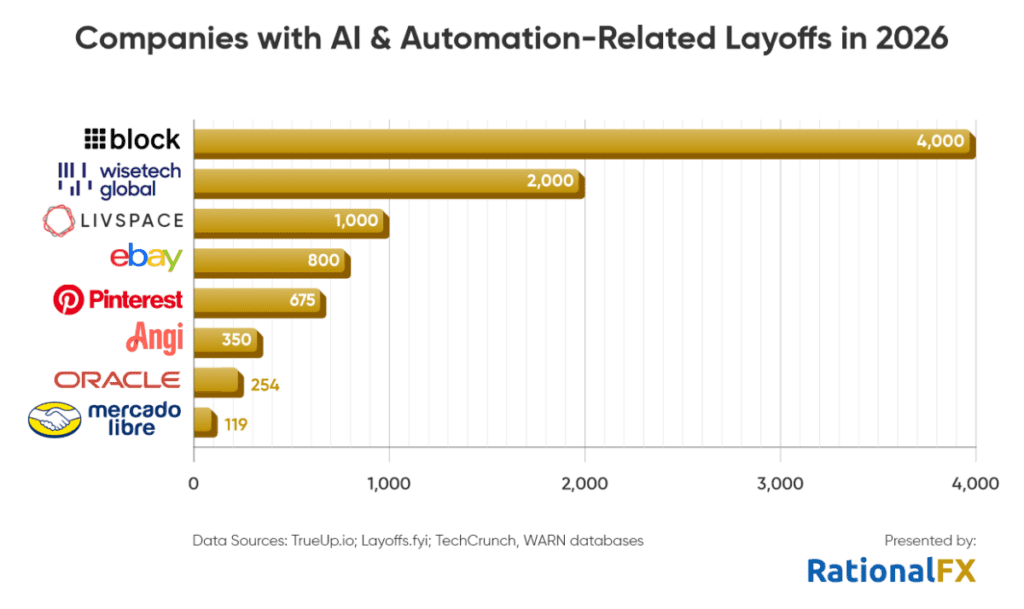
There’s also a significant sector dimension. A 2025 Epoch AI and Ipsos survey of 2,000 U.S. workers found one in five full-time employees say AI has already taken over tasks they used to perform themselves. In finance, banking, and legal services — traditionally insulated by credential barriers — the erosion is happening faster than most public commentary acknowledges. Wall Street banks have signalled expectations of around 200,000 role reductions over the next three to five years as AI takes over entry-level and back-office functions.
But the same survey found 15% of workers say AI has created new tasks they wouldn’t have taken on otherwise. The direction of your individual exposure depends heavily on whether your organisation is treating AI as a replacement tool or a capability multiplier — and that is, honestly, a management decision more than a technology one.
How AI Restructuring Actually Works in Practice
Theory is useful. Here’s what the actual workflow change looks like across three common knowledge-work roles, with the real friction points included.
The Financial Analyst
The Content Marketer
The HR Professional
The 80% Survival Stack
You don’t need to become an AI engineer. You need to build a practical set of skills that makes you significantly more valuable than a colleague who hasn’t. Research across AI-exposed roles consistently finds that workers who embed a small set of durable AI capabilities into their daily work see faster productivity growth and a salary premium — even as specific tools change around them.
This is that stack. It’s not exhaustive. It’s the 80% that matters.
The organisations that understand this are already acting on it. JPMorgan, for example, is training more than 50,000 employees on AI tools and workflows. The bet isn’t on AI replacing their workforce — it’s on the gap between their AI-proficient staff and competitors’ who haven’t invested.
Limitations and Hard Trade-offs
This article would be incomplete without naming what current AI genuinely cannot do well, and where the optimistic framing around AI-created jobs runs into serious problems.
AI adoption is not uniform. Large enterprises have AI co-pilots, governance frameworks, and dedicated teams. Small businesses in the same sector may have none. The productivity premium is accruing unevenly, which means the labour market impact will also be uneven — concentrated in specific industries and firm sizes, not spread smoothly across the workforce.
The quality paradox is real. In many workflows, organisations that deploy AI at scale without embedding quality review are producing faster, worse outputs. The short-term efficiency gain is visible; the long-term reputational and accuracy cost is not — yet. This is particularly acute in legal, medical, and financial contexts where AI errors carry real liability.
The skills gap is enormous. According to IDC, 88% of enterprises now use AI in at least one business function. Only 1% have achieved what McKinsey defines as AI maturity. This gap represents an estimated $5.5 trillion in unrealised productivity globally — not because the technology isn’t there, but because the human capability to deploy it well isn’t.
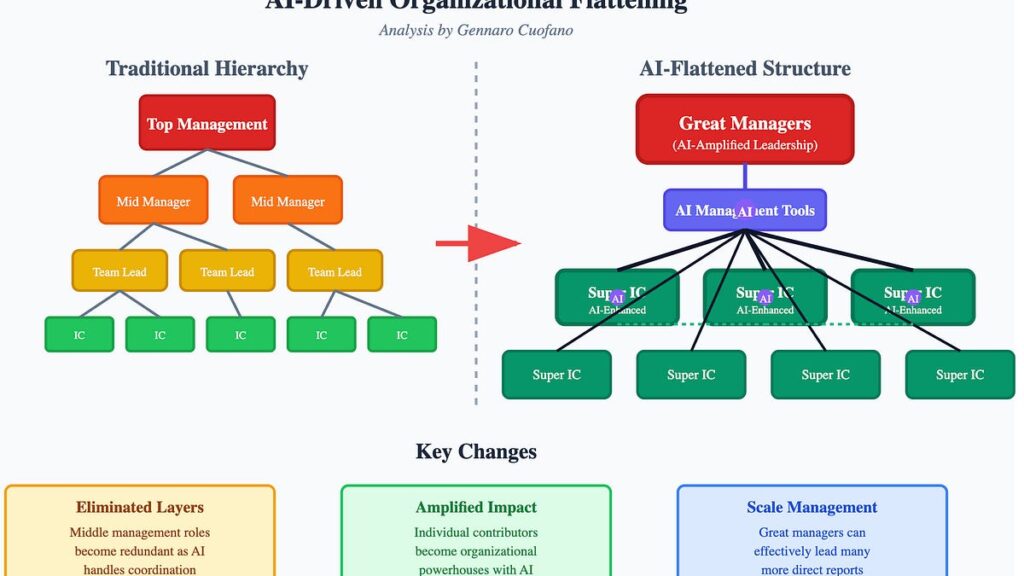
Middle management disruption has a downside nobody mentions. Removing layers of management doesn’t automatically create better organisations — it can create accountability gaps, overwhelmed senior leaders, and junior workers with no mentorship pipeline. The efficiency case is clear. The organisational health case is not.
FAQ
Will AI take my specific job?
Probably not the entire job — but it will likely take a meaningful slice of it within 24 months. The more honest question is whether the remaining tasks, after AI absorbs the routine ones, form a coherent and hireable role. In most cases they do, but the transition requires deliberate adaptation rather than waiting to see what happens.
Do I need to learn to code to stay relevant?
No. The most important AI skills for most workers are not technical — they’re about learning to direct AI effectively (context engineering), verify its output critically, and redesign workflows around it. Pure coding knowledge is valuable only for those already in technical roles. For everyone else, AI literacy and judgment are the skills that drive measurable salary differentiation in 2026.
Should I be worried about agentic AI — AI that can take actions, not just produce text?
Yes, on a 2–4 year horizon. Agentic AI systems — capable of browsing, executing tasks, making bookings, and running multi-step workflows autonomously — will extend AI’s reach into task categories currently considered safe. The workers best positioned are those who understand how to design, oversee, and audit agentic workflows. Right now, that’s a rare skill. Building it now is a genuine career advantage.
My company hasn’t deployed any AI tools yet. Does that mean I have more time?
It means you have more time before your employer acts — but not more time before the market acts. Employers who haven’t adopted AI in 2026 are increasingly at a competitive disadvantage, which typically means one of two outcomes: rapid adoption with insufficient preparation, or business pressure that leads to workforce restructuring. Neither scenario gives you more runway than you think. The time to build the skills is now, not when the tool lands on your desk.
The Uncomfortable Truth
The most honest thing to say about AI and work in 2026 is this: the net numbers look fine. More jobs created than destroyed. Productivity gains at scale. New categories of work emerging. If you zoom out far enough, the future looks manageable.
But transitions are not experienced at the macro level. They’re experienced in individual careers, in specific industries, in the six-month gap between a role disappearing and a new one existing. And the research is clear that organisations are not — on balance — investing in people’s ability to make that transition. Only 1 in 5 companies that adopt AI choose to use it to augment workers rather than reduce headcount. Nearly 40% of companies adopting AI choose automation over augmentation.
The workers who will navigate this best aren’t the ones who are most reassured by the aggregate numbers or most frightened by the worst-case projections. They’re the ones who’ve done an honest audit of which of their tasks are at risk, built the skills to work alongside AI at a high level, and positioned themselves as people who make AI more useful — not people who compete against it.
That’s not optimism. That’s the actual job market data talking.
Primary Sources
- McKinsey & Company (April 2026) — How AI is—and isn’t—changing the future of work ↗ mckinsey.com
- Harvard Business School / HBR (March 2026) — Displacement or Complementarity? The Labor Market Impact of Generative AI ↗ hbs.edu
- Gallup (April 2026) — Rising AI Adoption Spurs Workforce Changes — survey of 23,717 U.S. employees ↗ gallup.com
Secondary Sources
- World Economic Forum (2025) — Future of Jobs Report 2025 ↗ weforum.org
- BCG (April 2026) — AI Will Reshape More Jobs Than It Replaces ↗ bcg.com
- Epoch AI / Ipsos (2026) — AI Automation and Job Task Displacement ↗ futurism.com
Related on Trendix
Atomic Habits for Knowledge Workers:Small Actions, Massive Results
Micro-SaaS: Where the Growth Is and Where It Isn’t
PhD Tools That Actually Work in 2026
Personal Knowledge Management: A Complete Beginner’s Guide
Cursor vs Claude Code: 6 Months in Production — Which Is Actually Better?
Contact Us
AI Meeting Intelligence Tools