


AI Industry Applications:
The Definitive 2026 Field Guide
From $390 billion in market value to autonomous agents reshaping every vertical — here is what is actually working, where the real ROI is, and what the smartest operators are doing next.
In the twelve months to May 2026, more money poured into AI than during the entire decade between 2010 and 2020. But the gap between organizations capturing transformational value and those still running isolated pilots has never been wider. This guide cuts through the noise with verified data, named case studies, and practitioner-level guidance.
1. The 2026 AI Landscape: Scale, Investment & Adoption Reality
The headline numbers are genuinely staggering. Grand View Research placed the global AI market at $390.91 billion in 2025, expanding at a 30.6% CAGR toward a projected $3.5 trillion by 2033. The Stanford HAI AI Index 2026 confirmed that 2025 set a new record for AI investment with over $581 billion spent — more than double the $253 billion of 2024, and vastly exceeding the prior record of $360 billion set in 2021.
Critically, this is not bubble behavior. Unlike 2021, where investment was led by mergers and acquisitions, 2025’s record result was driven primarily by private investment into companies building real products. The United States alone attracted over $344 billion.
Gartner’s analysis found that AI infrastructure spending now outweighs software and services, accounting for roughly 59% of total AI expenditure. The hardware wave of 2025 is being followed by the workflow embedding wave of 2026 — the second act that actually creates durable business advantage.
Who is actually using it?
The Federal Reserve’s April 2026 monitoring report found that roughly 18% of all US businesses had adopted AI by end-2025, with over 20% planning to by mid-2026. The individual picture is even more striking: 41% of the US workforce now uses generative AI for work purposes, up 31% in twelve months.
At the enterprise level, the numbers are far higher. The Deloitte 2026 State of AI report, drawn from 3,235 senior leaders, found that worker access to AI rose 50% in 2025 and that the number of companies with 40%+ of their AI projects in production is set to double within six months.
Adoption rate by industry (AI in at least one business function)
Sources: NVIDIA State of AI 2026, Deloitte, McKinsey
“2025 was the year of heavy investment in compute, but the real breakthroughs will come in 2026 when we see a similar scale of commitment to embedding AI into real business workflows. Hardware enables, but applied intelligence transforms.”— Gartner Research Director, quoted in Vention State of AI 2026
2. Healthcare: AI That Is Saving Lives and Cutting Costs Now
Healthcare is arguably where AI’s impact is most visceral — and most validated. Menlo Ventures’ 2025 healthcare AI report identified a striking structural advantage: health systems face the highest urgency of any sector — thin margins, severe staffing ratios, and administrative burden consuming over 30 cents of every dollar spent. That creates unambiguous ROI for AI intervention.
The regulatory environment has matured in parallel. Strativera’s synthesis of 20+ peer-reviewed studies noted the FDA’s authorization of approximately 950 AI/ML-enabled medical devices as of 2024 — up from just six in 2015. The pathway is now clear, the evidence base solid.
The Five High-Impact Use Cases
Diagnostic Imaging
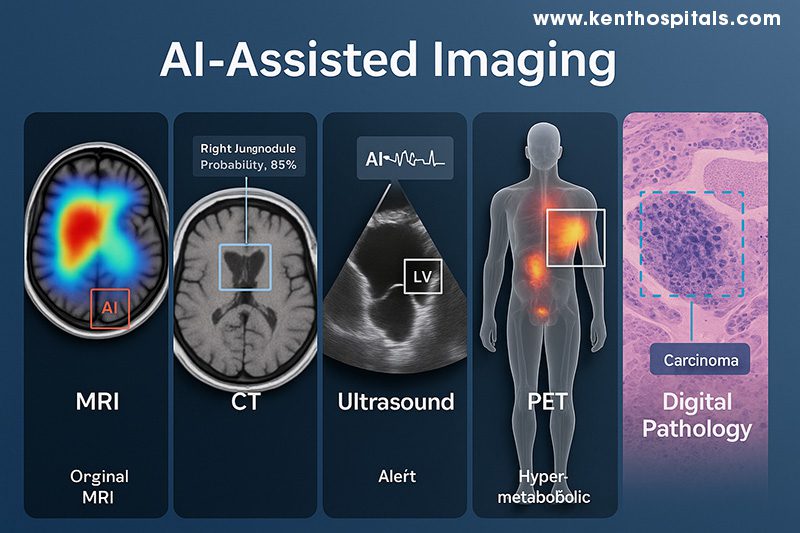
ML models analyzing X-rays, MRIs, CT scans and ultrasounds are flagging anomalies invisible to trained radiologists, with 40%+ improvements in diagnostic accuracy documented in clinical trials.
40% better accuracyDrug Discovery
AI reduces the lead-candidate discovery phase from years to months. Pharmaceutical firms apply models to regulatory tracking, clinical operations, and molecular screening simultaneously.
2–4× faster discoveryRevenue Cycle Management
46% of hospitals now deploy AI in RCM operations — automating coding, claims, prior authorizations, and appeal generation. Buying cycles have compressed from 12–18 months to under six.
30% efficiency gainsICU Patient Management
Tools like Mona by Clinomic consolidate, analyze, and visualize patient data in real time — supporting ICU nurses and physicians with prioritized alerts and predictive deterioration scoring.
Lives saved directlyPatient Engagement
AI voice interfaces for appointment scheduling, medication adherence, and discharge follow-up are reducing no-show rates and improving chronic disease management outcomes at scale.
25–40% no-show reductionAuburn Community Hospital deployed an AI-powered coding and billing system across its revenue cycle operations. The system automated clinical documentation review, flagged undercoded cases, and accelerated the billing pipeline for complex admissions.
Banner Health automated significant portions of insurance coverage discovery and appeal letter generation using generative AI. The result was a direct impact on cash flow, with denied claims overturned faster and administrative hours reallocated to patient-facing roles.
Menlo Ventures observed that healthcare AI buying cycles have compressed from 12–18 months to under six months — a signal that the technology has passed its proof-of-concept phase and is now viewed as core infrastructure, not experimentation.
3. Finance & Banking: Where the ROI Is Highest on Earth
Financial services lead every global AI adoption survey and, according to AmplifAI’s global research, deliver the highest generative AI returns of any sector: 4.2× ROI per dollar invested. The BFSI segment (Banking, Financial Services, Insurance) commands the largest AI market share at 19.6% — ahead of healthcare, manufacturing, and retail combined.
Global annual AI spending in financial services exceeded $20 billion in 2025. The breadth of application is remarkable: fraud detection at transaction speed, credit underwriting, wealth management, regulatory compliance, and customer-facing robo-advisory have all been transformed.
Applications and maturity
| Application | Maturity Level | Key Metric | Adoption Rate |
|---|---|---|---|
| Fraud Detection | Production | Millions of tx/sec analyzed | ~85% of large banks |
| Algorithmic Trading | Production | 68% of hedge funds use AI for market analysis | 68% of hedge funds |
| Robo-Advisory | Production | $1.2 trillion AUM globally | Growing rapidly |
| Credit Underwriting | Production | Decision time: hours → seconds | ~60% of major lenders |
| AML / KYC Compliance | Scaling | 90%+ cost reduction vs. manual | ~50% of tier-1 banks |
| Contract Intelligence | Scaling | Review time reduced by 80% | ~40% of investment banks |
| Predictive Churn | Early Production | 15–25% retention improvement | ~35% of retail banks |
Banking institutions leveraging AI for AML detection and contract review are reducing legal exposure while enabling proactive governance — turning compliance from a cost center into a competitive differentiator. TRooTech’s enterprise analysis identifies this as a boardroom-level priority heading into 2027.
The Middle East exception
Worth flagging: the Middle East financial sector is adopting AI agents for compliance and customer service at a pace that is outstripping many European incumbents, driven by greenfield digital banking infrastructure and regulatory sandboxes that allow faster iteration. Markets in the UAE, Saudi Arabia, and Qatar are leveraging this window aggressively.
4. Manufacturing & Industrial: The Physical AI Revolution
The Deloitte 2026 report is unequivocal: manufacturing and logistics represent the most advanced deployment of what it terms “physical AI” — robotics, autonomous vehicles, computer vision inspection systems, and digital twins. Adoption in this sector is not aspirational; it is structural.
A Vellum AI analysis of manufacturing deployments found that 61% of manufacturing executives reported decreased costs as a direct result of AI in supply chain operations — one of the highest single-metric ROI confirmations in any industry survey conducted this year.
Quality control at computer vision scale
Traditional quality control simply cannot match the throughput or detection sensitivity of AI-powered computer vision. Modern systems read thousands of items per hour and identify microscopic defects — semiconductor tolerances measured in nanometers, textile imperfections invisible to human inspectors, pharmaceutical tablet consistency deviations that conventional cameras miss entirely. The technology has crossed from premium to table-stakes.
Siemens has integrated NVIDIA AI infrastructure into its industrial tooling suite, creating a layer that applies predictive analytics, generative AI, computer vision, and agentic AI blueprints across manufacturing workflows. Clients across automotive, energy, and industrial equipment are using the platform to compress new product development timelines and identify production bottlenecks before they materialize.
Predictive maintenance: the sleeper ROI
Equipment downtime in heavy industry can cost $500,000 per hour or more. AI-driven predictive maintenance — monitoring vibration signatures, thermal profiles, fluid chemistry, and electrical draw — has moved from pilot to standard in automotive, aerospace, and energy generation. AI agents now monitor sensor data in real time, predict failures, schedule maintenance windows, and automatically update ERP and inventory systems. Unplanned downtime, historically the industry’s largest uncontrollable cost, is becoming a managed variable.
Fujitsu launched its AI-Driven Software Development Platform in February 2026, automating the complete software lifecycle — from requirements definition through integration testing. Tata Consultancy Services followed in March with its Rapid Outcome AI platform built on NVIDIA infrastructure, combining predictive analytics, generative AI, computer vision, and agentic AI across manufacturing, telecom, banking, retail, and life sciences.
5. Retail, CPG & Supply Chain: Hyper-Personalization at Scale
Retail and consumer goods occupy the second position in agentic AI adoption at 47%, according to NVIDIA’s March 2026 State of AI report. The convergence of hyper-personalization demand, supply chain complexity, and margin pressure has made AI not just attractive but existentially necessary for retailers operating at significant scale.
Where the investment is concentrated
| AI Application | Business Impact | Status |
|---|---|---|
| Demand Forecasting | Inventory reduction of 20–35%, stockout reduction of 30%+ | Mature |
| Dynamic Pricing | Revenue increase of 2–5% per category deployed | Mature |
| Recommendation Engines | 10–30% uplift in average order value | Mature |
| Supply Chain Simulation | Disruption response time reduced from days to minutes | Scaling |
| Visual Search & Discovery | Conversion rates up 15–40% vs. text search | Scaling |
| Autonomous Restocking Agents | Store-level labor cost reduction of 10–18% | Emerging |
| Returns Fraud Detection | $89B annual US returns fraud problem targeted | Emerging |
Supply chain agents: the new control tower
AI agents in supply chain management now operate with a capability set that was science fiction five years ago. They simulate disruption scenarios — port closures, supplier failures, weather events — re-route shipments, reprioritize orders, and communicate accurate ETAs to customers, all without human intervention. The 61% of manufacturing executives reporting cost decreases includes substantial contributions from this supply chain intelligence layer.
“The divide in retail isn’t between companies using AI and those that aren’t — it’s between organizations deploying in under three months and those still stuck in pilot mode. The gap in competitive advantage widens every quarter that passes.”
— AmplifAI Global Generative AI Adoption Report, 20266. Telecommunications: The Unlikely Agentic AI Leader
Telecommunications may be the most surprising finding in the NVIDIA 2026 data. The sector leads all industries in agentic AI adoption at 48% — ahead of retail, financial services, and healthcare. This counter-intuitive result reflects the sector’s structural conditions: massive real-time data volumes (network traffic, device diagnostics, customer interactions), highly commoditized core services, and intense churn pressure that demands AI-powered differentiation.
The productivity story is equally striking. NVIDIA’s telecom-specific survey found that 99% of telecom respondents said AI had improved employee productivity — with a quarter describing the improvement as major or significant. That is the highest satisfaction-with-AI-productivity rating of any sector surveyed.
Core applications driving adoption
Network optimization is the foundational use case: AI systems managing traffic load balancing, predictive maintenance of physical infrastructure, and real-time anomaly detection for security threats. Customer-facing AI includes next-generation churn prediction models, AI-powered care agents handling tier-1 support resolution without escalation, and personalized upsell recommendation engines that account for usage patterns, contract timing, and household structure simultaneously.
Perhaps most significantly, telecoms are now deploying AI for network planning itself — using digital twins of their physical infrastructure to simulate the impact of 5G and fiber rollout strategies before a single trench is dug. The capital allocation implications are substantial: a decision that previously required expensive engineering studies can now be stress-tested against hundreds of scenarios in hours.
7. Agentic AI: The Next Wave Arriving Now
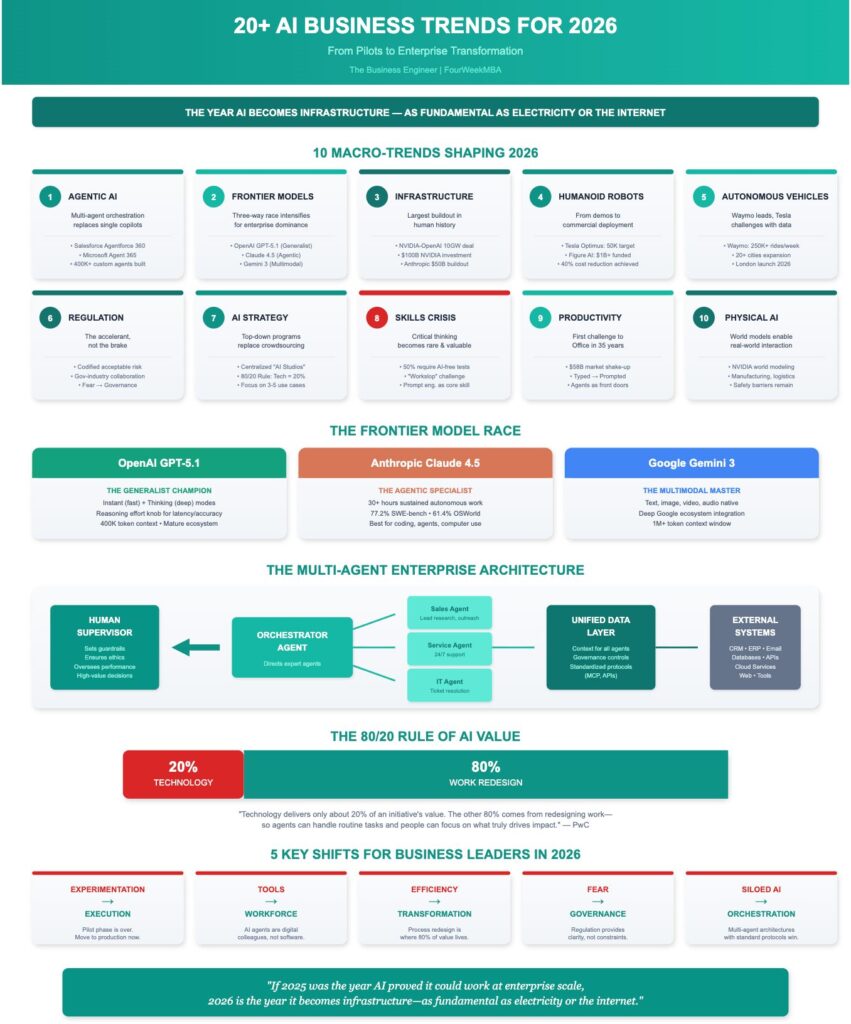
The shift from static AI tools to autonomous AI agents is the defining technology transition of 2026. Gartner predicts that enterprise applications featuring task-specific AI agents will jump from less than 5% in 2025 to 40% by end of 2026. This is not a distant projection — it is already happening across every sector covered in this guide.
Agents differ from previous AI implementations in a fundamental way: they don’t just respond to queries. They reason, plan, use tools, and execute multi-step workflows autonomously. An agent can research a prospect, draft an outreach email, schedule a follow-up, update a CRM record, and flag anomalies to a human reviewer — without being prompted for each step.
Agentic AI will resolve 80% of common customer service issues without human intervention by 2029, cutting operational costs by 30%. AI agents will intermediate more than $15 trillion in B2B spending by 2028. These numbers would have been dismissed as fantasy in 2023. In 2026, the early numbers in telco and retail already support the trajectory.
Where agents are already live in 2026
Legal Review
Agents reviewing contracts for clause anomalies, regulatory conflicts, and non-standard terms — at thousands of documents per day versus dozens per lawyer.
80% time reductionProduct Development
A major manufacturer is using AI agents to find the optimal balance between competing objectives — cost, time-to-market, material availability — in new product development.
40% cycle time reductionPublic Sector Staffing
AI agents are covering workforce shortages in government, partnering with human workers to complete key administrative processes end-to-end.
Gap coverage at scaleCode Development
Agentic coding assistants now write, test, debug, and document code — with senior developers shifting to architecture and review roles rather than implementation.
2–4× developer throughputThe most underappreciated risk of the agentic wave is not model capability — it is governance. Organizations where senior leadership actively shapes AI governance achieve significantly greater business value than those delegating governance to technical teams alone. Deloitte’s 2026 survey makes this finding unambiguous: governance is the difference between scaling successfully and stalling out at the pilot stage.
8. How to Measure AI ROI: What Actually Works
The contradiction at the heart of enterprise AI in 2026: more than 80% of organizations report no tangible effect on enterprise-level EBIT from GenAI investments, even as the aggregate ROI data is compelling. McKinsey estimates generative AI could unlock between $2.6 trillion and $4.4 trillion in annual economic value. The gap is real, and the cause is clear: companies capturing that value deploy AI across three or more business functions. Companies running isolated pilots do not.
The measurement framework that works
| Measurement Category | Primary Metrics | Measurement Horizon | Expected Range |
|---|---|---|---|
| Productivity & Efficiency | Tasks per hour, error rate, time-to-complete | 30–90 days | 15–40% improvement |
| Revenue Impact | Conversion uplift, ARPU, churn reduction | 90–180 days | 2–15% uplift |
| Cost Reduction | Labor hours displaced, error-cost reduction | 60–120 days | 10–35% reduction |
| Risk & Compliance | False positive rate, audit findings, breach cost | 90–365 days | Highly variable |
| Strategic & Innovation | New products launched, market entry speed | 12–36 months | Transformational |
🎯 Practitioner Tips: Making the ROI Case
- Start with a baseline. You cannot demonstrate AI ROI without pre-deployment measurements. Instrument the process before you touch it with AI.
- Choose process-specific metrics, not portfolio averages. “AI improved productivity by 12%” means nothing. “AI reduced invoice processing time from 8 minutes to 90 seconds for 40,000 monthly invoices” is actionable and auditable.
- Run a 60-day true pilot before scaling. The cost of a failed enterprise-wide rollout is vastly higher than the cost of a structured pilot. Define success criteria before you begin, not after.
- Account for hidden costs. Data quality remediation, change management, model monitoring, and ongoing fine-tuning are consistently underestimated and destroy ROI calculations made at procurement stage.
- Deploy across at least three functions. The data is unambiguous: companies deploying AI in one function rarely see enterprise-level impact. The economic value accrues at the intersection of multiple workflows.
- Report to the board quarterly. Deloitte found that organizations where senior leadership shapes AI governance outperform those where governance sits only with technical teams. Visibility at board level is not optional.
9. The Risks Leaders Are Getting Wrong
The Vention State of AI 2026 contains a sobering finding: in 2024 and early 2025, 32% of cybersecurity leaders reported at least one attack involving AI applications where prompts were manipulated for malicious purposes. Separately, approximately 62% of organizations have experienced deepfake attacks involving social engineering or manipulation of automated systems, including biometric verification.
The five risks most consistently underweighted
AI systems amplify the quality of their training data — including its flaws. Organizations that skip the data remediation phase before AI deployment discover the hard way that a sophisticated model applied to poor data produces confident, fast, wrong outputs. Budget for data quality as a prerequisite, not an afterthought.
Deloitte found that the AI skills gap is the number-one barrier to integration — and that organizations are addressing it primarily through education rather than role redesign. Education alone is insufficient. The companies capturing value are redesigning workflows around AI capabilities, not just training people to use new tools.
As AI systems are given agentic authority — the ability to take actions, not just generate text — the attack surface expands dramatically. Prompt injection attacks, where malicious content in the environment tricks an AI agent into taking unintended actions, are a growing threat in any deployment where agents interact with external content.
Regulation is catching up fast. Colorado’s February 2026 deadline for developers of high-risk AI products to demonstrate non-discrimination compliance is a preview of what is coming globally. Organizations that assume regulatory gaps will persist are building technical debt that will be expensive to unwind. Stanford HAI documents accelerating global regulatory activity across 40+ jurisdictions.
Remaining in pilot mode for more than six months is now a competitive liability, not a prudent strategy. The leaders are deploying in under three months. The laggards are taking significantly longer. Time in pilot mode is time during which competitors are learning, iterating, and widening their advantage. Structured speed matters.
10. The 2026 Implementation Playbook
Based on the convergent evidence across Deloitte, NVIDIA, McKinsey, Stanford HAI, and practitioner case studies, the following implementation sequence consistently separates value-capturing organizations from perpetual experimenters.
📋 Phase 1: Foundation (Weeks 1–6)
- Audit your data estate for quality, completeness, and accessibility. AI cannot compensate for data it cannot reach or trust.
- Identify two or three processes with measurable baselines, high volume, and tolerable failure cost. These are your initial use cases.
- Establish a governance structure with C-suite visibility. Define who owns AI risk, who approves deployments, and how performance is reported.
- Run a technology landscape review. The difference between building on foundation models vs. buying point solutions vs. fine-tuning proprietary models is a strategic decision with five-year implications.
🚀 Phase 2: Pilot to Production (Weeks 6–16)
- Deploy the highest-priority use case with explicit success criteria defined before launch — not after. Include a human review layer for the first 30 days.
- Measure everything against the pre-deployment baseline you established in Phase 1. Document failure modes, not just successes.
- Move to production when performance metrics exceed the baseline consistently across three weeks. Resist the temptation to extend the pilot indefinitely.
- Begin parallel development of the second use case during production rollout of the first. The learning transfers; the timeline compresses.
📈 Phase 3: Scale and Integration (Months 4–12)
- Deploy across at least three functions. This is the threshold at which enterprise-level EBIT impact becomes consistently measurable.
- Begin investigating agentic AI architectures for processes where multi-step autonomous execution would create disproportionate value.
- Build an AI literacy program — but pair it with process redesign. Education without workflow change produces educated employees doing the same old workflows slightly faster.
- Invest in model monitoring infrastructure. Models drift. Data distributions change. Without monitoring, degradation is invisible until it is expensive.
- Report quarterly to the board with function-level ROI breakdowns. This ensures organizational prioritization and budget continuity through the inevitable rough quarters.
The 34% of organizations in the Deloitte survey that are truly reimagining their businesses through AI — creating new products, reinventing core processes, rebuilding business models — share one characteristic: they stopped asking whether AI is worth it and started asking what AI makes possible that was previously impossible. That is the right question for 2026.
Newsletter
Qualitative Research Software in 2025: A Field Guide
AI ROI Is Not What You Think —Here’s What the Data Shows
No-Code Automation: Build, Connect, Scale —Without Touching a Line of Code
Agentic Workflows: How AI Systems Are Actually Taking Over Knowledge Work
Cost Analysis: The Complete 2026 Guide
AI in Healthcare: Compliance, Privacy, and the Right Model
AI Workflows & Automation:The Complete 2025–2026 Guide