

The Only Guide to AI Productivity Tools You Need in 2026
Verified ROI data from McKinsey, Gartner, and real enterprise deployments. Honest head-to-head comparisons. A clear framework for building a stack that actually works — without the hype.
Why 2026 Is Different — and Why Most Guides Get It Wrong
Every year since 2022, someone has declared this the “year of AI productivity.” But 2026 is genuinely different, and the gap between genuine adopters and laggards is now visible in balance sheets, not just benchmark decks.
The McKinsey State of AI 2025 report surveyed 1,993 companies and found that nearly 80% claim to use generative AI in at least one function — yet fewer than 6% report meaningful, enterprise-level financial returns. The gap isn’t capability. The bottleneck, as a comprehensive 2026 synthesis of 150+ data points (drawing on McKinsey, Gartner, Forrester, and vendor telemetry) made clear, is “everything between a frontier model and a measurable outcome” — evaluation infrastructure, integration depth, and governance.
“Capability is now a commodity. Eval infrastructure and integration depth are the moats.”
Digital Applied, AI Agent Productivity Statistics 2026 (citing Anthropic, Salesforce, McKinsey Q1 2026 telemetry)The tools that genuinely move the needle in 2026 are not the flashiest. They are the ones that slot cleanly into existing workflows, produce auditable outputs, and improve with use. That is the lens through which this guide evaluates everything that follows.
One more number worth anchoring on: Gartner’s 2026 enterprise forecast projects that task-specific AI agents will be embedded in 40% of enterprise applications by end of 2026 — up from less than 5% in 2025. That trajectory is not a prediction; it is already happening in the tools reviewed below.
The Six Categories of AI Productivity Tooling
AI productivity tools are not a monolith. Treating them as one is the primary reason organizations end up with bloated, overlapping stacks that cost money and deliver confusion. The six categories below map to distinct workflow problems, and the best-performing enterprises tend to have exactly one strong tool in each lane — not three mediocre ones.
Top AI Productivity Tools of 2026 — Reviewed by Category
The tools below have been evaluated against three criteria: real-world adoption at scale, verifiable productivity gains from independent research, and suitability for professional workflows beyond personal hobbyist use. Pricing reflects the most current published rates as of May 2026.
Writing & Content Tools
Meeting Intelligence Tools
Developer Productivity Tools
Automation & Workflow Tools
Research & Knowledge Tools
The Big AI Assistants: Honest Comparison Table
Most comparison guides are written by affiliates optimised for clicks, not decisions. The table below reflects independent benchmarks, real enterprise deployments, and the consistent findings from gurusup.com’s 2026 multi-model comparison and IntuitionLabs’ enterprise evaluation.
| Tool | Best For | Long-Form Writing | Coding | Real-Time Data | Ecosystem Lock-in | Free Tier | Price (Pro) |
|---|---|---|---|---|---|---|---|
| Claude Sonnet 4.6 | Writing, analysis, complex reasoning | Excellent | Excellent | Web search | Low | ✓ | $20/mo |
| ChatGPT Plus (GPT-5.4) | General productivity, custom GPTs | Excellent | Excellent | Live search | Medium | ✓ | $20/mo |
| Google Gemini Advanced | Google Workspace users | Good | Very good | Live search | High (Google) | ✓ | $19.99/mo |
| Microsoft Copilot | M365-native teams | Good | Excellent (GitHub) | Bing search | Very high (M365) | Partial | $30/user/mo |
| Perplexity Pro | Cited research, fact-checking | Good | Adequate | Best in class | Low | ✓ | $20/mo |
Sources: gurusup.com 2026 AI Comparisons, IntuitionLabs Enterprise Guide 2026, Spliiit Tool Review 2026, konabayev.com Best AI Apps 2026. Pricing verified May 2026.
The ROI & Productivity Data You Can Actually Trust
The AI productivity market is awash with vendor-generated statistics. Below is a curated set drawn only from independent research firms and multi-company surveys — each source linked directly.
Hours saved per week (knowledge workers): Multiple independent sources have converged on a strikingly consistent figure. Across McKinsey, Salesforce, Slack, and Anthropic’s own Q1 2026 telemetry, the median sits between 5.9 and 7.2 hours per knowledge worker per week. Senior practitioners and customer service reps skew toward the top of that range (10–12 hours and 8–9 hours respectively).
ROI multiplier by AI application (McKinsey Global AI Survey 2026)
Customer service and code review data from Forrester TEI studies and Anthropic enterprise telemetry, as cited in Digital Applied 2026.
Payback periods: Bain’s Agentic AI Benchmark 2026 puts the median payback at 4.1 months for customer service deployments, 6.7 months for marketing operations, and 9.3 months for engineering. Vendor-deployed agents reach positive ROI 2.4× faster than custom builds.
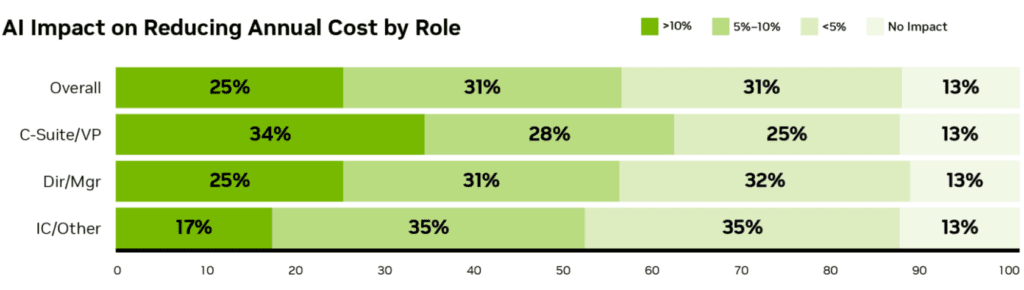
Where most organisations fail: Gartner data shows 44% of stalled AI programs cite governance rework as the primary blocker. Separately, Forrester estimates that unmeasured rework absorbs 22–38% of self-reported time savings in mature programs — meaning gross productivity numbers overstate net gains substantially. Building “edits to agent output” as a first-class telemetry event, not an afterthought, is the single biggest process change teams can make.
Real-World Case Studies: What Actually Happened
How to Build an AI Productivity Stack That Pays Back
Most teams buy tools in the wrong order and end up with overlapping subscriptions and no clear ownership. The framework below reflects what Lovable’s 2026 guide and practitioner research identify as the pattern that separates teams seeing genuine ROI from those stuck in perpetual pilots.
The 5-Step AI Stack Framework
The recommended “starter stack” for most teams
Based on independent research and real deployment data, this combination covers the core productivity needs without expensive overlap. CraftNote’s tested recommendation for most professionals aligns with this:
- Writing/Analysis Claude Pro — best prose, largest context, low ecosystem lock-in
- Meetings CraftNote — speaker memory, 100+ languages, free tier is generous
- Research Perplexity — cited sources, real-time data, defensible outputs
- Coding Cursor (frontend) + Claude Code (backend)
- Automation Zapier — largest integration library, built-in AI Copilot
Total cost for a solo professional: approximately $55–75/month. For a team of 10, expect $400–600/month all-in — a fraction of one hire and a fraction of the hours saved.
Risks, Pitfalls & Governance You Cannot Afford to Skip
Adoption without governance is how organisations end up with data leakage incidents, hallucinated outputs reaching clients, and regulatory exposure. The risks below are drawn from verified 2026 enterprise data — not hypotheticals.
10 Expert Tips for Maximum AI Productivity Impact
These are the practical interventions that separate organisations achieving genuine ROI from those stuck at 5% savings after 12 months of “exploration.” Each is grounded in the deployment patterns of high performers in McKinsey and Gartner research.
The Bottom Line for 2026
AI productivity tools have crossed from “interesting experiment” to “operational infrastructure.” The organisations capturing real value are not necessarily using the newest or most expensive tools — they are using a focused set of the right tools, with clean integration into existing workflows, clear governance, and a habit of measuring net gains rather than celebrating gross numbers.
The six-category framework, the starter stack, and the 10 tips above are enough to get most professionals and most teams to measurable ROI within 90 days. The only remaining variable is whether you start today or wait for a better moment that never quite arrives.
Bookmark this page — it is updated monthly as the market moves. And if you found a specific section useful, the related deep-dives below go substantially further on each topic.
No-Code Automation: Build, Connect, Scale —Without Touching a Line of Code
NotebookLM for Researchers: A Deep Dive Into the Most Underused AI Tool
Best AI Tools for Marketing Teams in 2026
Best Productivity Tools in 2026: The Full Stack Guide
Google Still Cares About Mobile-First Indexing — Here’s Why You Should Too
The Voice & Video AI Revolution:Everything That Matters in 2026
Second Brain Methods Compared
https://www.trendix.tech/blog/