
AI Agent Framework
AI Engineering · May 2025 · Updated Regularly
AI Agent Framework Selection Scorecard
Every framework comparison tells you what each tool does. This one tells you which to choose—with a weighted scorecard you can tune to your exact production constraints.
Why Most Framework Selections Go Wrong
Engineering teams don’t fail at AI agent projects because they chose the wrong framework. They fail because they chose a framework before they understood their constraints.
The pattern repeats constantly: a team evaluates LangChain because it has 47 million PyPI downloads, builds a prototype in a weekend, and discovers eighteen months later that the original chain abstractions don’t support the stateful, human-in-the-loop workflow they actually need in production. A rebuild follows. Timeline collapses. Budget evaporates.
The research is unambiguous. McKinsey’s State of AI 2025 found that 62% of organizations are now experimenting with AI agents, while 23% are actively scaling agentic systems in at least one business function. Yet across 2024 and 2025, 39% of AI projects continued to fall short of expectations—a rate that has barely moved despite the tooling explosion.
The conclusion is uncomfortable but clear: more framework options have not produced more successful deployments. Selection methodology has not kept pace with framework proliferation.
This guide fixes that with a concrete, weighted scorecard—one that forces you to quantify what actually matters for your project before you write a single line of framework code.
The 2025–2026 Landscape at a Glance
The AI agent framework space underwent significant consolidation in 2025. The fringe experimentation phase—dozens of hobbyist frameworks with overlapping capabilities—largely resolved into a clearer competitive structure.
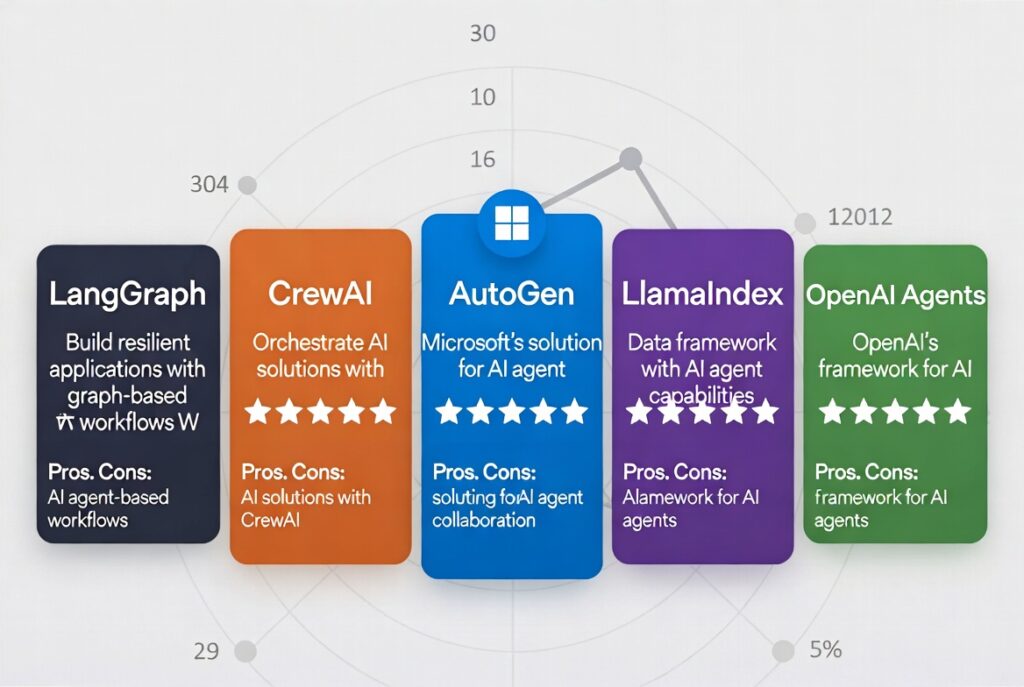
| Framework | Primary Abstraction | Best For | GitHub Stars | Production Maturity | License |
|---|---|---|---|---|---|
| LangGraph | Directed cyclic graph / state machine | Complex stateful, branching workflows | ~10K (within LangChain ~85K) | GA / v1.0 | MIT |
| CrewAI | Role-based agent crews + task assignment | Collaborative, role-oriented multi-agent | ~26K | Stable | MIT |
| Microsoft AutoGen | Conversational multi-agent orchestration | Human-in-the-loop, Azure-native workflows | ~39K | v0.4 rewrite | MIT |
| LlamaIndex | Index/retrieval-first with agent layer | RAG-heavy, data-centric applications | ~38K | Stable | MIT |
| OpenAI Agents SDK | Managed runtime with first-party tools | Fast prototyping on OpenAI stack | ~26K | Stable | MIT |
| Semantic Kernel | Plugin-based enterprise orchestration | .NET / enterprise environments | ~23K | Stable | MIT |
| MetaGPT | Software-team simulation | Automated software development workflows | ~45K | Specialized | MIT |
| Pydantic AI | Type-safe structured outputs | Strict output validation, typed workflows | ~8K | Growing | MIT |
The crowded middle is consolidating fast. By mid-2026, LangGraph and the vendor-native SDKs (OpenAI Agents, Anthropic Claude Agent SDK) are emerging as the de-facto standards for new production deployments. If you’re starting a new project today, seriously evaluate both before committing to older orchestration patterns.
What Changed in 2025
Four structural shifts reshaped the landscape this year and will continue to define selections through 2026:
- MCP (Model Context Protocol) became the context integration standard. LangChain leads on MCP maturity; other frameworks vary significantly in their native integration depth. If your agents need access to governed enterprise data, MCP readiness is now a primary selection criterion.
- AutoGen v0.4 was a near-complete rewrite. Code from v0.2 doesn’t migrate cleanly. If your team built on earlier AutoGen versions, migration effort must factor into your TCO calculation.
- The Anthropic Claude Agent SDK gained serious production traction. For teams running Claude-based agents at scale, the first-party SDK offers advantages in tool-use optimization and cost that third-party frameworks can’t replicate.
- LangGraph hit v1.0 in late 2024 and is now the default runtime for LangChain-based agents. Its graph-based state machine model—with nodes, edges, and conditional routing—is significantly more debuggable than earlier chain abstractions.
The Eight Scorecard Dimensions
Most framework comparisons evaluate the same surface metrics: GitHub stars, supported LLMs, available integrations. These are useful but insufficient. The eight dimensions below are drawn from what actually determines whether an agent project succeeds at the 12-month mark.
Interactive Selection Scorecard
Adjust the importance weights below to match your project’s actual priorities. The frameworks are scored against each dimension using curated research data; your weights determine the final ranking. This is not a marketing exercise—use it honestly.
| Rank | Framework | Weighted Score | Best Use Case | Watch Out For |
|---|
In-Depth Framework Profiles
Numbers tell part of the story. Below is the practitioner perspective that scorecard cells can’t capture—what working with each framework actually feels like at six months in production.
- Graph-based state machine makes reasoning explicit and debuggable
- Native conditional branching and cyclical flows
- LangSmith integration gives best-in-class observability
- Model-agnostic; swap providers without architecture changes
- MCP integration is the most mature of any open-source framework
- LangChain docs churn remains the #1 developer complaint
- Steeper initial learning curve than CrewAI
- Overkill for simple single-agent tool-calling tasks
- Role + goal + backstory model maps intuitively to how teams think
- Sequential and hierarchical coordination built-in
- Fastest time-to-working-demo of any multi-agent framework
- Good for marketing, research, and content workflows
- Multi-agent conversations can balloon token costs on complex tasks
- Less explicit state control than LangGraph
- Context retention limitations for complex multi-step tasks
- Native human-in-the-loop checkpoint support
- Strong Azure AI Foundry + Azure OpenAI integration
- Excellent for debate-style agent workflows
- Code execution sandbox built-in
- v0.4 broke most v0.2 codebases—significant migration cost
- Conversation overhead adds unnecessary tokens on simple tasks
- Smaller integration ecosystem than LangChain
- Best-in-class data ingestion and indexing pipeline
- Supports local model deployment for data-sensitive environments
- LlamaIndex + CrewAI integration enables sophisticated research flows
- Fine-grained control over chunking, embedding, and retrieval
- Indexing methods can incur high LLM costs at scale
- Agent capabilities are secondary to retrieval; don’t pick this as your primary agent orchestrator
- Context retention less robust than LangChain for complex scenarios
- Tightest integration with OpenAI tools (Code Interpreter, File Search)
- Simplest path to production if you’re already on the OpenAI stack
- Memory and context management handled by the platform
- Hard vendor lock-in to OpenAI models and pricing
- Limited control for teams needing custom orchestration logic
- Less community-driven extension than open frameworks
- Native C# / .NET / Java support—only enterprise-grade option for .NET shops
- Strong compliance and enterprise governance features
- Backed by Microsoft with long-term support commitments
- Smaller feature set and community than LangChain
- Less suited for pure Python teams
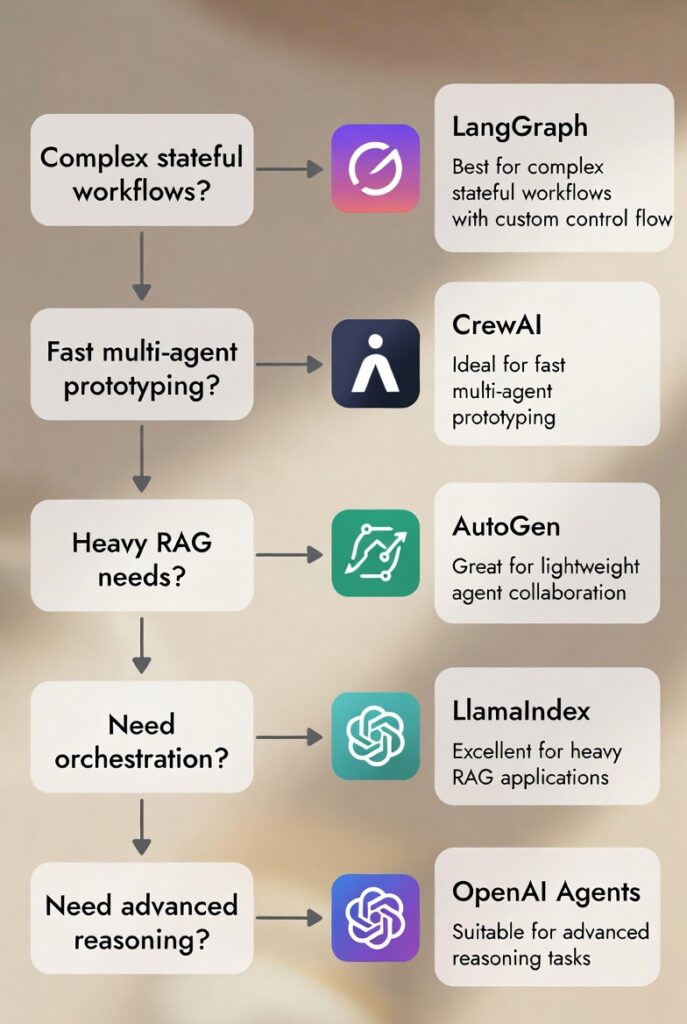
The Quick Decision Guide
Not every decision needs the full scorecard. If your situation clearly matches one of these patterns, you have your answer.
Your primary concern is…
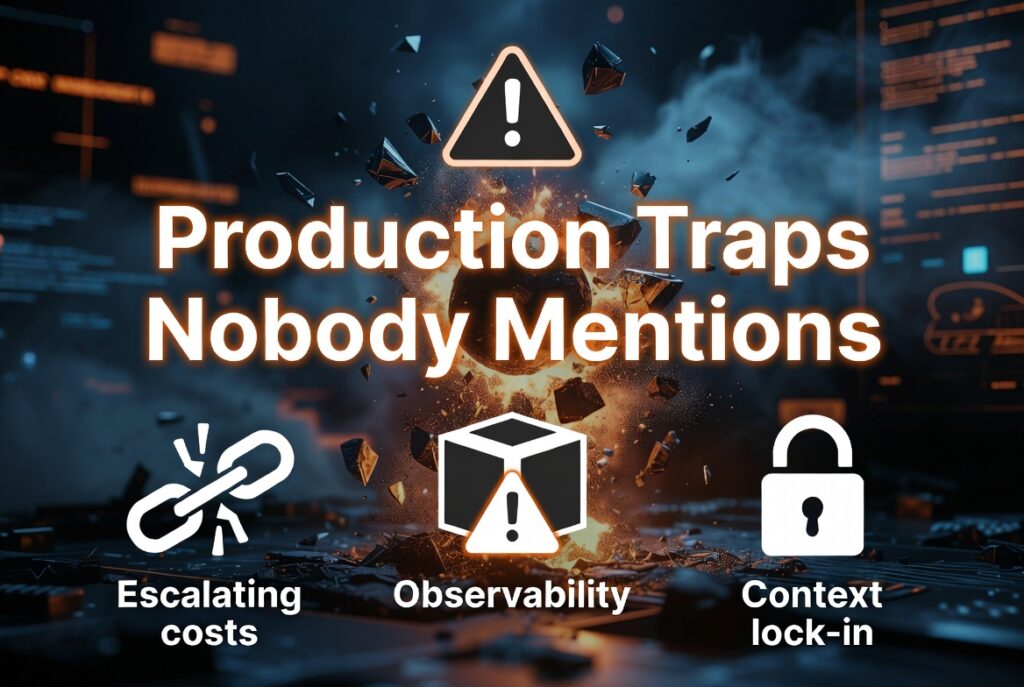
Production Traps Nobody Mentions
Framework documentation describes happy paths. Production exposes the rest. Here are the failure modes that derail agent projects after the demo succeeds.
Token Cost Explosions in Multi-Agent Conversations
AutoGen and early CrewAI configurations allow agents to exchange lengthy context-setting messages that add zero task value but consume substantial tokens. A 10-agent workflow that costs $0.40 in development can cost $40 in production under real-world load—a 100x gap. Audit your agent message patterns before any load testing, and implement explicit message compression or summarization at conversation boundaries.
Context Lock-In Is the Silent Framework Tax
This is the insight that most framework comparisons miss entirely. Enterprise teams pick a framework and embed all their business context—data definitions, governance rules, lineage—inside its native memory abstractions. When the framework changes (new version, new team, new use case), that context has to be rebuilt from scratch. The framework choice becomes a context lock-in that compounds with every new agent deployed. Architectural mitigation: treat context as a separate governed layer (via MCP or a context catalog) and keep it framework-agnostic from the start.
LangChain’s API changes frequently. Tutorials from three months ago may not work with the current version. This is the single most-cited developer frustration. Budget for framework maintenance as a recurring engineering cost, not a one-time setup activity.
The Operating Model Failure Mode
An agent implementation changes more than the codebase. Someone has to own tool permissions, escalation paths, exception queues, prompt versioning, output review, cost alerts, and post-launch evaluation. If those responsibilities are not explicitly assigned before launch, the framework becomes the easy part and the operating model becomes the failure point. This accounts for a significant portion of the 70% failure rate—not technical inadequacy, but organizational unreadiness.
Security Is Your Responsibility
No framework—not LangChain, not AutoGen, not CrewAI—provides production-grade security by default. All require custom guardrails, input validation, and enterprise hardening. Prompt injection, tool misuse, and data exfiltration through agent actions are real attack surfaces. Plan for security architecture from day one, not as a pre-launch retrofit.
The Pilot Trap
Validate framework effectiveness with real production use cases—not toy demonstrations—before committing infrastructure and development resources. A pilot that proves viability on simplified data with cooperative inputs is not a valid production test. Specifically test with adversarial inputs, edge-case tool failures, and the actual data quality (including inconsistencies) that characterizes your real environment.
The teams that succeed pair their framework selection with robust evaluation and observability from day one—before their first production deployment. Implement tracing, set cost alerts, define task success metrics, and establish automated regression checks as part of your launch criteria, not as post-launch improvements.
Bottom Line
There is no universally correct AI agent framework. That sentence is frustrating to read and important to internalize. The right framework is the one that best fits the gap between your current team capabilities and your production requirements—evaluated honestly, not aspirationally.
If you’re making this decision today, use the following as your starting point:
- Default to LangGraph if your workflow has complex branching, state requirements, or audit needs. It is the most production-proven open-source choice for 2025–2026.
- Start with CrewAI if your team is new to agents and you need to demonstrate value quickly with role-based collaboration.
- Choose AutoGen if you’re Microsoft-native and human-in-the-loop approval is a hard requirement.
- Layer LlamaIndex on top of your orchestration choice when retrieval quality over enterprise data is the primary differentiator.
- Use OpenAI Agents SDK only if you’ve consciously decided to optimize for speed over flexibility and are genuinely comfortable with vendor lock-in.
Run the interactive scorecard above with your actual team constraints, set the weights honestly, and let the output challenge your assumptions. The 30% of AI projects that succeed have one thing in common: they chose a framework they could actually operate in production, not the one with the best GitHub metrics.
Then pilot with real data, instrument from day one, and revisit the scorecard after three months of production data. The framework you choose today should earn its place every quarter.
- LangGraph Official Documentation — State machines, graph architecture, production deployment
- CrewAI Documentation — Crew composition, role design, task orchestration
- Microsoft AutoGen — v0.4 architecture, human-in-the-loop, Azure integration
- LlamaIndex Documentation — RAG pipelines, indexing strategies, enterprise data integration
- OpenAI Agents SDK Documentation — Managed runtime, built-in tools, deployment
- Microsoft Semantic Kernel — .NET integration, enterprise plugin architecture
- Agent Governance Scorecard — Equilateral AI — 6-dimension governance framework for enterprise deployments
- McKinsey State of AI 2025 — Enterprise adoption benchmarks and failure rate data
Continue Your AI Agent Journey
-
LangGraph vs CrewAI vs OpenAI Agents SDK vs AutoGen (2026): The Definitive Comparison
Deep dive with benchmarks and production case studies. -
AI Agents & Multi-Agent Systems: The Definitive 2026 Guide
Architecture patterns, real-world deployments, and future roadmap.
0 responses to “AI Agent Framework Selection Scorecard”