
AI Image Generators Ranked


AI Image Generators Ranked:
Midjourney to Ideogram
Seven major platforms. Real benchmark data. Honest weaknesses. No tool wins every category — and this guide will tell you exactly which one wins yours.
In This Guide
- The State of AI Image Generation in 2026
- How We Ranked Them (Methodology)
- Quick Verdict: Who Wins What
- 1. Midjourney v7 — The Aesthetic King
- 2. FLUX 2 Pro — The Photorealism Machine
- 3. GPT Image 2 — The Precision Tool
- 4. Ideogram 3.0 — The Typography Specialist
- 5. Adobe Firefly Image 3 — The Commercial-Safe Choice
- 6. Stable Diffusion 3.5 — The Open-Source Champion
- 7. Google Imagen 4 — The Dark Horse
- Full Comparison Table
- Decision Guide: Which Tool Is Yours?
- The Copyright Reality No One Wants to Talk About
- Prompt Engineering Still Matters More Than the Model
- Final Verdict
The State of AI Image Generation in 2026
Two years ago, you could pick an AI image generator pretty casually. Midjourney for art, DALL-E if you needed it to actually follow instructions — done. The rest were either technically behind or operationally awkward enough to ignore.
That era is genuinely over. In 2026, there are at least seven production-grade platforms, each doing something specific better than the others. The question is no longer “which AI image generator is best?” It’s “best for what, specifically?”
The market has fractured along use-case lines. Photorealism has its own frontier model. Text rendering in images has a specialist that crushes the competition. Commercial licensing safety has a clear winner. Artistic quality remains a separate category entirely. And open-source workflows have matured to the point where technically-capable teams are building entirely custom pipelines.
Curious Refuge’s comprehensive 29-scenario testing gave Midjourney a score of 8.62/10 for cinematic and painterly quality — the highest of any model tested. But that same test showed Ideogram 3.0 with text rendering accuracy near 90–95%, compared to Midjourney’s roughly 30% on short phrases. Those two numbers alone illustrate how wrong it is to crown any single winner.
The LM Arena leaderboard (as of Q1 2026) puts GPT Image 1.5 at an ELO of 1,264 and FLUX 2 Pro v1.1 at 1,265 — essentially a statistical tie at the top for general-purpose quality. Google’s Gemini 3 Pro Image sits at 1,252. These scores reflect broad prompt diversity, not specialization, which is why context still trumps composite rankings.
One practical reality worth noting upfront: Midjourney removed its free trial in early 2026, with all access now behind a $10/month minimum. That’s a meaningful shift for people who want to experiment before committing. Several alternatives still offer generous free tiers — Ideogram gives 10 slow credits per week, and Imagen 4 is accessible free through Google’s AI Studio.
How We Ranked Them
This ranking draws on multiple independent sources rather than a single internal test. The criteria are weighted to reflect how professional creators and teams actually use these tools:
- Output quality (artistic and photorealistic) — 30%
- Prompt adherence (does it do what you asked?) — 20%
- Text-in-image accuracy — 15%
- Pricing & value — 15%
- API / workflow integration — 10%
- Commercial licensing clarity — 10%
Benchmark sources referenced throughout: LM Arena ELO leaderboard, Curious Refuge 29-scenario testing, LaoZhang API pricing analysis (Feb 2026), and hands-on testing documented by AVB’s benchmark battery.
One honest disclosure: this is a rapidly moving space. FLUX 2 Pro received a speed doubling update on March 3, 2026. GPT Image 2 launched April 21, 2026. Some details here will age faster than any publication would like.
Quick Verdict: Who Wins What
1. Midjourney v7
Score / 10
Midjourney v7 launched in alpha on April 3, 2025 — what CEO David Holz called “a totally different architecture,” not an incremental update. The most immediately useful addition is Draft Mode, which renders at ten times the speed of standard mode at half the GPU cost, and switches the interface to a conversational layout where you can say “make it nighttime” or “swap the cat for an owl.” That iteration loop is genuinely faster for early-stage concepting.
For pure visual quality, nothing else in 2026 touches it consistently. Curious Refuge’s 29-scenario benchmark scored it 8.62/10 overall, praising the “cinematic” and “painterly” default rendering. Skin textures, lighting fall-off, atmospheric depth — these details have a composure that makes other models’ output look like they’re trying. Midjourney also solved the long-running “hands problem” — anatomically correct hands are now the norm, not the exception.
But there are real limitations, and they’re worth being honest about. Text rendering is weak — roughly 30% accuracy on short phrases, which means any image requiring legible words is the wrong job for Midjourney. There’s no official API, which rules it out for developers building production workflows. And the ongoing copyright lawsuits from Disney, NBCUniversal, DreamWorks, and Warner Bros. (filed in 2025, unresolved as of April 2026) introduce genuine commercial risk for large-scale professional use.
The Niji 7 model (anime-focused, released January 2026) and the v8 Alpha (March 2026, adding 2K native resolution and 5x faster generation) show the pace of development remains high. Midjourney isn’t resting on its artistic reputation.
- Unmatched cinematic and painterly image quality
- Draft Mode for rapid 10x-speed ideation
- –cref and –sref for character/style consistency
- Massive community ecosystem and prompt library
- Unlimited Relax-mode generations on $30 Standard plan
- ~30% text-in-image accuracy — essentially unreliable
- No official public API
- Active copyright lawsuits from major studios
- No free trial as of early 2026
- Less literal prompt adherence than GPT Image or FLUX
2. FLUX 2 Pro (Black Forest Labs)
Score / 10
FLUX 2 Pro from Black Forest Labs is the model that makes professional photographers nervous, and that’s not an exaggeration. Built on a 32-billion-parameter Rectified Flow Transformer architecture, it generates photorealistic output up to 4 megapixels — sharp enough for large-format print — with sub-10-second generation times via API. The March 3, 2026 speed update doubled generation speed with no reported quality loss.
On the LM Arena leaderboard, FLUX 2 Pro v1.1 registers an ELO of 1,265 — essentially tied with GPT Image 1.5 at the top of the general-purpose rankings. In specialized photorealism testing, it consistently leads. Skin texture, lighting physics, fabric folds, material rendering — all of these behave like real photographs rather than generated images.
The Kontext Engine allows natural language image editing: describe the change you want, and the model applies it to an existing image while preserving the surrounding composition. Its multi-reference system lets you upload up to 10 source images for composite work. These are production features that matter on real projects.
Where FLUX 2 falls short is artistic flexibility. Its training skews heavily toward photographic realism, which means “watercolor illustration” or “impressionist painting” prompts produce competent but unremarkable results compared to Midjourney. It’s not a tool for creative exploration — it’s a tool for precise commercial execution. FLUX.1 Schnell (the lightweight open-weight variant) is also one of the few models fully trained on licensed data, giving it cleaner commercial credentials than the Pro variant.
- Best-in-class photorealism for commercial photography
- Full API access via Replicate, fal.ai, and BFL’s own API
- 4MP resolution output, print-ready
- Kontext Engine for natural-language image editing
- ELO 1,265 on LM Arena — top-tier general quality
- Less artistic/stylistic range than Midjourney
- Per-megapixel API billing can get expensive at scale
- No negative prompts in the architecture
- Requires API setup — no beginner-friendly consumer UI
LM Arena ELO Snapshot — Q1 2026
Sources: LM Arena Leaderboard · AVB Benchmark Battery · Anthemcreation independent testing
3. GPT Image 2 (OpenAI)
Score / 10
GPT Image 2 (API name: gpt-image-2) launched April 21, 2026, introducing something genuinely new: a native reasoning loop that plans image layout mathematically before pixel generation begins. The result is measurably better handling of complex spatial instructions — “red ball on top of blue box, with green background, left side of frame” — compared to any diffusion model that jumps straight to generation.
Text accuracy is approximately 95% across Latin script, and the AVB benchmark documented it outperforming Midjourney v8.1 on typography while trailing Nano Banana Pro on photorealism specifically. On dense in-image text — infographics, UI mockups, posters with multiple text elements — it’s the most reliable option currently available.
The ChatGPT integration makes it the most accessible model for non-technical users. You describe what you want conversationally, refine it in plain English, and iterate without needing to learn prompt syntax. GPT-4o previously replaced DALL-E 3 as OpenAI’s flagship; GPT Image 2 has continued that evolution with the reasoning layer.
The tradeoff is aesthetic ceiling. Results trend toward clean, competent, and accurate — which is exactly what many commercial workflows need — but they rarely achieve Midjourney’s compositional drama or FLUX 2’s photographic depth. One practical note: Thinking Mode can take up to two minutes per generation, which matters for time-sensitive workflows. Disabling it for the Instant mode restores normal speed.
- ~95% text rendering accuracy across scripts
- Best-in-class prompt adherence for complex multi-element scenes
- Native reasoning loop for spatial layout planning
- Conversational refinement via ChatGPT integration
- Clean REST API with clear billing
- Thinking Mode can add up to 2 minutes latency
- Less distinctive visual style than Midjourney or FLUX
- Rate limits tighter for new API accounts
- API cost ($0.006–$0.211/image by quality tier) can scale up
4. Ideogram 3.0
Score / 10
Ideogram was built by four former Google Brain researchers — Mohammad Norouzi, William Chan, Chitwan Saharia, and Jonathan Ho — specifically to solve the text-in-image problem. Version 3.0, released March 26, 2025, delivered on the founding premise: approximately 90–95% text rendering accuracy, compared to roughly 30% for Midjourney and comparable tools.
That gap is the entire story for a significant category of professional work. If you’ve ever tried generating a poster, logo, or marketing banner with Midjourney and ended up with garbled, unreadable text — you know what Ideogram fixes. A “Coffee Bar” logo actually says “Coffee Bar.” A Black Friday sale poster with pricing actually shows readable pricing.
Version 3.0 also introduced Style References: upload up to three images to guide the aesthetic of a generation. Describing visual style in words is notoriously unreliable; showing the model is a genuine quality-of-life improvement. The advanced color palette system lets designers specify exact brand colors, extracting palettes from reference images for consistency across assets.
The photorealism in v3.0 has improved substantially over v2.0 — faces, lighting, and textures are markedly better — though it still trails FLUX 2 on raw photographic output. As a specialist platform, Ideogram works best when text or typography is a core design requirement, not as a general-purpose replacement for Midjourney or FLUX.
In ELO testing, Ideogram V3 remains the artistic typography leader for t-shirts, neon signs, and embossed lettering, per the AVB benchmark battery. Google’s Nano Banana 2 is the first serious challenger in this specific area, but Ideogram still leads as of May 2026.
- 90–95% text rendering accuracy — best-in-class
- Style Reference feature (up to 3 reference images)
- Exact color palette control for brand consistency
- Strong prompt adherence on design-heavy prompts
- Free tier (10 slow credits/week)
- Not a general-purpose Midjourney replacement
- Photorealism still trails FLUX 2 and GPT Image 2
- Free tier is limited (10 generations/week)
- Newer challenger (Nano Banana 2) closing the text gap
A marketing director testing Ideogram for a client’s Black Friday campaign needed posters with pricing, promotional copy, and branded color schemes. Ideogram 3.0 nailed readable text on the second generation attempt, with the Magic Prompt feature producing cohesive design layouts. The same prompts in Midjourney required 15+ iterations and still produced partially garbled text. For signage and promotional material, the gap is genuinely large.
5. Adobe Firefly Image 3
Score / 10
Adobe Firefly’s strategic story in 2026 is less about raw image quality and more about ecosystem position. It’s trained exclusively on Adobe Stock licensed imagery, openly licensed content, and public domain material. That’s not a footnote — it’s the reason enterprise legal teams approve Firefly assets without friction while sometimes rejecting Midjourney output outright. Adobe backs this with IP indemnification for enterprise customers.
The Generative Fill inside Photoshop remains one of the best AI-assisted editing features available — select an area, type what you want, and the blend is seamless in a way that standalone generators can’t match. The same applies to Generative Expand (extending canvas boundaries) and text-to-vector inside Illustrator.
Adobe’s December 2025 strategic pivot changed the platform’s nature substantially. Firefly is now an aggregator: through one subscription, users access Runway Gen-4.5 for video, Black Forest Labs FLUX.2 for photorealism, Google Nano Banana Pro for editing, ElevenLabs for audio, and Topaz Astra for 4K video upscaling. That partner model approach is unique in the market and gives Firefly a durable competitive position regardless of which individual model wins the quality race in any given month.
What Firefly doesn’t do well: standalone artistic generation. Its default outputs tend toward clean, stock-photo aesthetics — useful for commercial production, but without the compositional ambition of Midjourney’s best work. Text rendering in Firefly’s native model is still unreliable; the FLUX.2 integration inside Firefly is the better option for text-heavy designs. For Creative Cloud subscribers, however, Firefly costs essentially nothing additional — its value is already bundled into subscriptions most design professionals hold.
- Fully licensed training data — clear commercial IP provenance
- Adobe IP indemnification for enterprise customers
- Deep Photoshop/Illustrator/Premiere Pro integration
- Partner model access: Runway, FLUX.2, Nano Banana Pro, ElevenLabs
- Zero marginal cost for existing Creative Cloud subscribers
- Standalone artistic quality trails Midjourney noticeably
- Native text rendering still unreliable (use FLUX.2 integration)
- Credit system for advanced features can get complicated
- Less useful without existing Adobe ecosystem
6. Stable Diffusion 3.5
Score / 10
Stable Diffusion 3.5 is not a product — it’s a platform. The base model (available in three sizes, released late 2024) is the foundation for an ecosystem of hundreds of community fine-tunes, LoRAs, and specialized models for anime, architectural visualization, character consistency, product photography, and more. If you need a style that doesn’t exist elsewhere, or a workflow that can’t be built on closed APIs, SD 3.5 is your starting point.
The raw quality gap between SD 3.5 and frontier closed-source models (FLUX 2, Midjourney v7, GPT Image 2) is real and visible in direct comparisons. But that framing misses what SD 3.5 actually is: not a competitor to those models on quality alone, but a platform for teams with technical resources to build things those models can’t do. ControlNet (for enforcing poses or edge detection), custom LoRA training on proprietary datasets, and integration into automated enterprise pipelines — none of this is possible on closed platforms.
Minimum hardware requirement for local operation: NVIDIA GPU with at least 8–12GB VRAM (RTX 3060 minimum), 16GB RAM, and 50–100GB storage. For teams without that infrastructure, cloud-based access via platforms like Replicate or Automatic1111 is available. Expect a meaningful setup investment either way — this is not a tool for people who want results in 90 seconds.
- Completely free — no subscription, no per-image cost when local
- Unlimited generation volume at marginal electricity cost
- ControlNet, LoRA, inpainting, outpainting, img2img
- Fine-tune on proprietary datasets for brand-specific styles
- No content moderation restrictions
- Requires technical setup — not beginner-friendly
- Base model quality trails FLUX 2 and Midjourney v7
- Significant hardware requirement for local operation
- Quality varies widely by chosen model and settings
7. Google Imagen 4
Score / 10
Google’s Imagen 4 is the model that appears least in casual AI discussions and perhaps deserves more. On the LM Arena leaderboard, Gemini 3 Pro Image (which uses Imagen 4 Ultra) sits at ELO 1,252 — meaningfully close to the FLUX 2 / GPT Image 1.5 tie at the top. Its image editing and transformation capabilities are particularly strong: morphing two images together, changing perspectives, and object-level modifications work with a precision that’s ahead of most alternatives.
The API pricing is the most competitive among premium models. Imagen 4 Fast costs $0.02 per image — half the price of GPT Image 1.5 Standard at $0.04 and well below FLUX 2 Pro at $0.055. For high-volume workflows where quality is important but budget is constrained, Imagen 4 Fast via Google Cloud Vertex AI is the clearest value option in the market.
Nano Banana 2 (released early March 2026) is Google’s most recent challenger specifically for text rendering, drawing on Gemini’s knowledge base and real-time web search to generate research-informed visuals. For users inside the Google ecosystem — Google Workspace, Vertex AI pipelines, Gemini integrations — this combination is compelling. Outside that ecosystem, the consumer access story is less straightforward than competitors with cleaner consumer UIs.
- Best price/quality ratio at the API level ($0.02–$0.06/image)
- Strong image editing, perspective changes, morphing
- Nano Banana 2: real-time search-informed generation
- Free access via Google AI Studio for evaluation
- ELO 1,252 — legitimately competitive quality
- Best value when inside Google ecosystem
- Consumer UI less polished than Midjourney or Ideogram
- Artistic quality trails Midjourney for stylized work
- Less community knowledge base than competitors
Full Comparison Table
| Model | Artistic Quality | Photorealism | Text Rendering | API Access | Commercial Safety | Starting Price | Free Tier |
|---|---|---|---|---|---|---|---|
| Midjourney v7 | ★★★★★ | ★★★★☆ | ★☆☆☆☆ | None | Contested | $10/mo | No |
| FLUX 2 Pro | ★★★☆☆ | ★★★★★ | ★★★☆☆ | Full API | Partial (Schnell only) | $0.055/img | Limited |
| GPT Image 2 | ★★★☆☆ | ★★★☆☆ | ★★★★★ | Full API | Unclear | $20/mo or API | ChatGPT free tier |
| Ideogram 3.0 | ★★★☆☆ | ★★★☆☆ | ★★★★★ | Available | Unclear | $7/mo | 10/week |
| Adobe Firefly | ★★★☆☆ | ★★★☆☆ | ★★☆☆☆ | Limited | Fully licensed | $9.99/mo | 25 credits/mo |
| Stable Diffusion 3.5 | ★★★☆☆ | ★★★☆☆ | ★★☆☆☆ | Self-hosted | Open-weight | Free (hardware) | Fully free |
| Google Imagen 4 | ★★★☆☆ | ★★★★☆ | ★★★★☆ | Full API | Licensed | $0.02/img | AI Studio |
Data as of May 2026. Sources: LM Arena, official pricing pages, and independent testing cited throughout this article.
Decision Guide: Which Tool Is Actually Yours?
The comparison table above is useful for scanning. This section is for deciding. The right tool is almost never “the best one overall” — it’s the one that handles your actual use case without forcing workarounds.
Match Your Use Case to the Right Model
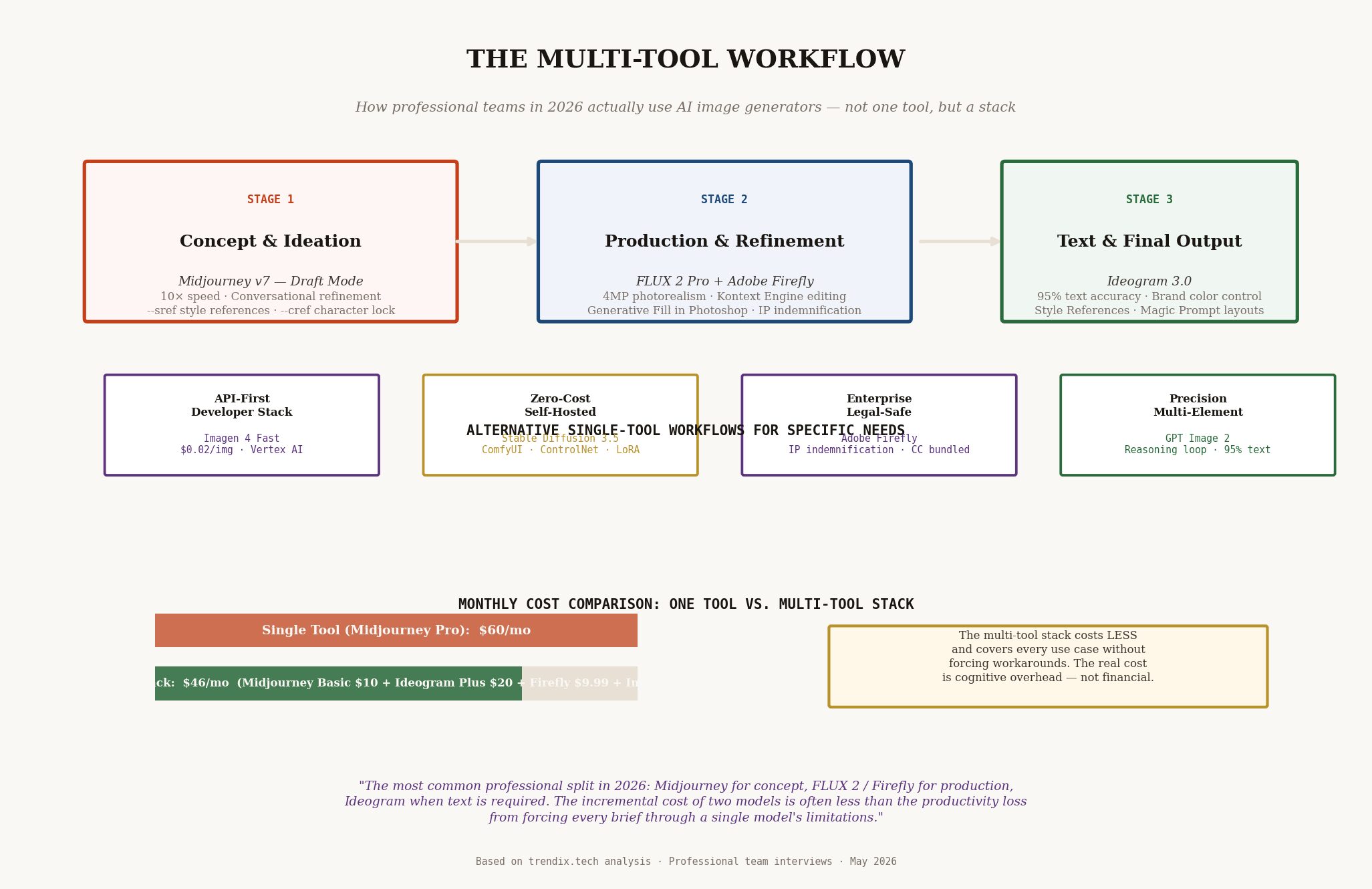
A significant number of professional teams in 2026 run two or three models in rotation rather than committing to one. The most common professional split: Midjourney for concept and ideation, Firefly or FLUX 2 for production-ready commercial output, and Ideogram when any design requires text. The incremental cost of running two models is often less than the productivity loss from forcing every brief through a single model’s limitations.
The Copyright Reality No One Wants to Talk About
This is the section most AI image generator reviews skip or soften. It shouldn’t be.
Midjourney, FLUX 2, GPT Image 2, and Stable Diffusion were all trained on images scraped from the internet, almost certainly including copyrighted works. This isn’t a hypothetical legal concern anymore — Disney, NBCUniversal, DreamWorks, and Warner Bros. filed major IP infringement lawsuits against Midjourney in 2025, and those cases remain unresolved as of April 2026. Internal communications surfaced during discovery raised additional complications for Midjourney’s fair-use defense.
For individual creators doing personal work, this risk may be acceptable. For an agency producing assets that appear in major advertising campaigns, product packaging, or published media, the risk calculus is different. One enterprise team’s experience (documented by We and the Color) was explicit: Midjourney-generated assets were rejected during legal review on a real client project, while Firefly output passed without friction.
Adobe Firefly is currently the only major platform with fully documented content provenance and IP indemnification. Its training data — Adobe Stock licensed imagery, openly licensed content, public domain material — can be traced and defended. FLUX.1 Schnell (the open-weight lightweight variant) is also trained on licensed data. Google Imagen 4’s training data is licensed through Google’s content agreements.
One fair counterpoint: millions of creators generate commercial content with Midjourney daily without legal incidents. The legal risk is real but not universal. What’s changed is that enterprise risk tolerance has tightened as the lawsuits have progressed and as IP teams at major companies have developed formal AI asset review policies.
Prompt Engineering Still Matters More Than the Model
This is the part of any AI image generator comparison that tends to get dismissed, but it’s the part that most affects actual output quality for most users. A mediocre prompt in Midjourney produces mediocre results. The same mediocre prompt in GPT Image 2 produces mediocre results. The tool matters less than you think at the level of most failures.
What separates a useful prompt from a weak one, specifically:
- Specify the subject clearly and early — models weight the beginning of prompts more heavily
- Name the lighting — “golden hour backlight” or “soft studio fill” is more reliable than “good lighting”
- Specify camera language when you want photorealism — “shot on 85mm, f/1.8, shallow depth of field” changes FLUX 2’s output meaningfully
- Include negative constraints — in models that accept them, “no text, no watermarks, no artifacts” is often as important as positive descriptions
- Use style references (Midjourney –sref, Ideogram Style References) — showing the model is more reliable than describing in words for complex aesthetics
The two resources with the best return on time invested: Midjourney’s community showcase (for learning what excellent prompts produce), and Ideogram’s public gallery (for learning prompt structures that generate consistent design results).
Before committing to any subscription, run the same five prompts across three platforms. Make them representative of your actual work: one simple subject, one complex scene with multiple elements, one requiring text if relevant, one requiring a specific photographic style. This 15-minute test is more informative than any comparison article — including this one.
Final Verdict
The honest summary: there is no universal winner in 2026, and any ranking that crowns one is either lazy or trying to sell you something. The market has genuinely fractured into specialists.
If someone is forcing you to pick just one — most people aren’t, and maybe they shouldn’t be — the choice depends on one question: what does your actual work require most?
For pure creative quality and artistic output: Midjourney v7, with the understanding that text in images is unreliable and the copyright situation warrants legal awareness. For commercial photorealism at API scale: FLUX 2 Pro. For marketing and branded content requiring readable text: Ideogram 3.0. For enterprise teams with legal review: Adobe Firefly, where the IP indemnification is a real differentiator. For technical teams building custom workflows: Stable Diffusion 3.5. For the best per-image API value: Imagen 4 Fast at $0.02.
One thing that won’t change regardless of which model you pick: this landscape will look substantially different in twelve months. FLUX has doubled generation speed in one update. GPT Image 2 introduced a reasoning loop that didn’t exist three months ago. Google is closing the text rendering gap that Ideogram built its reputation on. The velocity of improvement here remains high enough that any fixed ranking is inherently provisional.
What’s not provisional: understanding your own use case well enough to match it to the right tool. That knowledge compounds even as the tools themselves change.
0 responses to “AI Image Generators Ranked: Midjourney to Ideogram”