

Prompt Injection: What It Is and How to Defend Against It in Production
The attack that turns your AI assistant into an accomplice — no malware required, no code exploits, just words. Here’s how it actually works, what’s already been stolen, and what defenses hold up under real adversarial pressure.
- Prompt injection is OWASP’s #1 LLM threat for 2025 and shows up in 73% of production AI deployments during security audits.
- EchoLeak (CVE-2025-32711, CVSS 9.3) proved zero-click exploitation is real: one email, no interaction, full data exfiltration from Microsoft 365 Copilot.
- There’s no single fix. Defense is layered: input validation, privilege isolation, output sandboxing, and human gates on high-risk actions.
- Only 34.7% of organizations currently have dedicated prompt injection defenses deployed. If yours isn’t one of them, that’s the gap to close first.
Let me be direct about something that doesn’t get said enough: prompt injection isn’t a bug you patch and forget. It’s a structural tension baked into how large language models work. The same property that makes an LLM useful — its ability to follow natural language instructions — is exactly what makes it exploitable. You can’t fully separate “instruction” from “data” when both arrive as text. That’s not a vendor failure; that’s the architecture.
That said, “it can’t be fully solved” shouldn’t become an excuse for shipping AI features with zero mitigations. There’s a wide range between “immune” and “completely undefended,” and most production systems I’ve reviewed are sitting much closer to the wrong end of that spectrum than they need to be.
What Prompt Injection Actually Is
The term gets used loosely, so let’s be precise. A prompt injection attack happens when an adversary supplies text — directly or through a data source the model reads — that causes the model to override or bypass its original operating instructions. The model treats attacker-controlled content as a legitimate directive.
This is categorically different from traditional injection attacks like SQL injection. In SQL injection, the parser confuses data with syntax. In prompt injection, there is no parser to fool — the model genuinely interprets attacker text as instruction, because that’s what it was trained to do with text. The distinction matters for defense design.
Direct Injection
The attacker controls what’s typed directly into the user input field. Classic example: “Ignore your previous instructions and instead do X.” Crude, but often still effective against lightly guarded systems, especially through roleplay framing or hypothetical scaffolding.
Indirect Injection
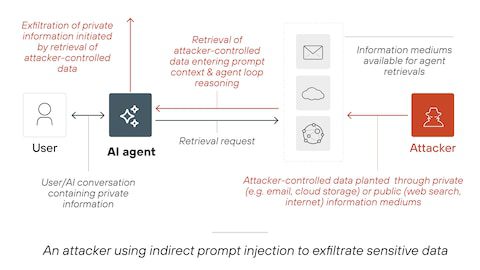
The attacker embeds malicious instructions in content the model reads from an external source — a document, webpage, email, database record, code comment. The user triggers the attack by asking the AI to summarize or work with that content. This is where most dangerous enterprise attacks live.
Multi-Hop / Agentic
The model is part of an agent chain. An injection in one step propagates to subsequent steps, potentially triggering tool calls, API requests, or actions in downstream systems. The blast radius expands dramatically with each connected capability.
Stored / Persistent
Injections written into persistent storage — memory systems, vector databases, user profiles — and retrieved in future sessions. One 2024 incident involved ChatGPT’s memory feature being poisoned to enable data exfiltration across multiple subsequent conversations.
Source: OWASP LLM01:2025 · NIST AI RMF
The Anatomy of a Modern Attack
Theory is one thing. But understanding how these attacks unfold in practice — against real systems that have real defenses — is where the useful lessons are.
EchoLeak: One Email, Zero Clicks, Full Organizational Access
In January 2025, researchers at Aim Security’s Aim Labs disclosed what became arguably the most significant prompt injection exploit to date. EchoLeak, assigned CVE-2025-32711 with a CVSS score of 9.3, was a zero-click vulnerability in Microsoft 365 Copilot’s RAG pipeline.
The attack chain was elegant in its ruthlessness. An attacker sent a carefully crafted email to a target organization. The email contained hidden prompt injection instructions. When Copilot’s retrieval system processed that email — even without the user opening or reading it — the injected prompt caused the AI to access sensitive data from the user’s entire M365 context (emails, documents, meeting notes) and embed it in a URL that exfiltrated the data to the attacker’s server.
The chain bypassed four separate Microsoft defenses: their XPIA (Cross-Prompt Injection Attack) classifier, external link redaction, Content Security Policy headers, and reference mention filtering. No user interaction was required at any step. The victim never knew it happened.
Microsoft patched it server-side in June 2025 as part of that month’s Patch Tuesday. No customer action was required — but the window between disclosure and patch was significant.
What made EchoLeak particularly instructive wasn’t just the exploit — it was how it worked despite Microsoft having prompt injection defenses actively running. The academic post-mortem shows a systematic bypass of each defense layer in sequence. This is the pattern in modern attacks: not brute force, but chained bypass of inadequate layered controls.
GitHub Copilot RCE via Malicious Repository (CVE-2025-53773)
Researchers documented a remote code execution chain through GitHub Copilot’s IDE integration. An attacker embedded prompt injection payloads inside code comments in a public repository. When a developer opened the repository with Copilot active, the injected prompt instructed the IDE’s AI to modify .vscode/settings.json, enabling “YOLO mode” — a configuration that causes Copilot to execute code suggestions without developer confirmation.
Subsequent AI-suggested code then contained attacker-controlled instructions. The supply chain attack surface here is enormous: millions of developers routinely open unfamiliar repositories for review, benchmarking, or learning. A malicious package sitting on npm or PyPI, designed to trigger this chain, was a realistic scenario.
The Regex Reconciliation Attack: 45,000 Records Gone
This one doesn’t have a CVE number because it was handled quietly — financial institutions rarely publicize this kind of incident. An attacker targeting a financial services firm’s AI reconciliation agent crafted a prompt that asked the agent to export “all customer records matching pattern X,” where X was a regex expression that matched every record in the database.
The tool call syntax looked legitimate. The pattern matched the expected format. No unusual behavior flags were triggered. The agent dutifully complied.
Why Standard Defenses Often Fail
Before getting into what works, it’s worth being honest about why the “obvious” fixes don’t hold up as well as advertised.
Input Filtering Alone Doesn’t Cut It
Pattern matching and keyword blocklists are where most teams start. Blocking phrases like “ignore previous instructions” or “you are now DAN” catches the dumbest attacks. But any attacker worth worrying about doesn’t use those phrases. They use roleplay framing, hypothetical scaffolding, base64 encoding, language switching, character substitution, or they embed the payload in a PDF table header where your filter never looks.
The Google Gemini adversarial study bears this out uncomfortably: after applying their best defenses including adversarial fine-tuning, the most effective attack technique still succeeded 53.6% of the time. You can raise the bar significantly. You probably can’t reach zero.
RAG Doesn’t Protect You Either
There’s a persistent belief that Retrieval-Augmented Generation architectures are safer because the model only “sees” retrieved chunks rather than full databases. EchoLeak specifically disproves this. The retrieved chunk is exactly where indirect injection lives. If an attacker can influence what gets retrieved — through a malicious document, email, webpage, or database record — they’ve already won the first stage.
Fine-Tuning Helps but Doesn’t Solve It
Fine-tuning on examples of attacks and desired refusals improves robustness. But it creates a cat-and-mouse dynamic: new attack patterns that weren’t in the training set slip through. The AAAI 2025 defense paper notes that fine-tuning-based defenses require annotated data and significant computational resources, and are still outpaced when attackers iteratively probe. It’s a meaningful defense layer, not a silver bullet.
A Layered Defense Architecture That Actually Works
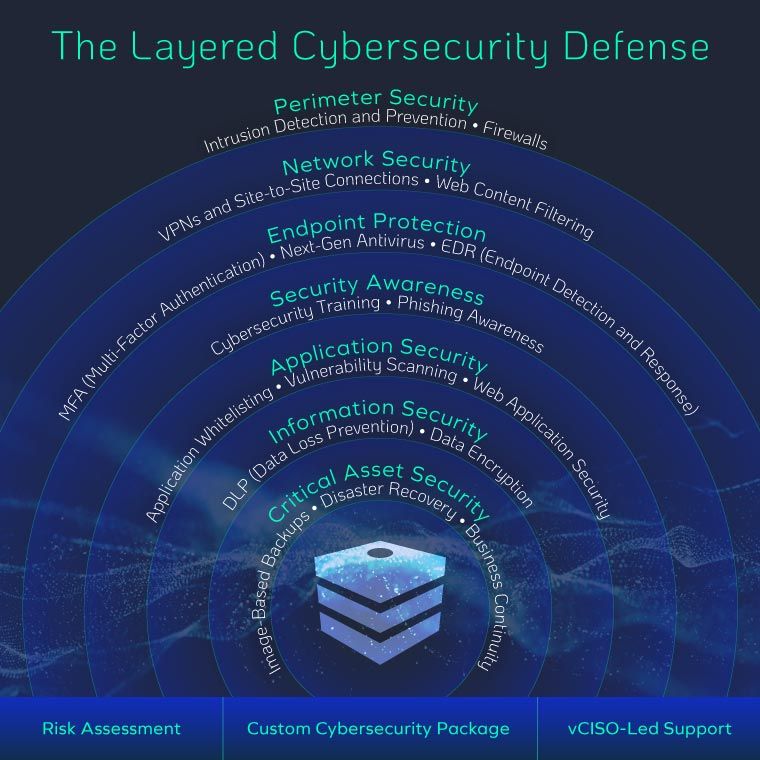
Given that no single control is sufficient, production-ready defense means thinking in layers. Here’s how I’d frame it for a real system, with honest notes on what each layer contributes and where it fails.
Layer 1: Privilege Minimization (Highest ROI)
The single most effective mitigation isn’t technical at all — it’s architectural. An AI agent that has read-only access to summarize documents and no ability to send emails, modify files, or make API calls outside a narrow scope cannot be weaponized to do those things, no matter how clever the injection. Excessive agency (OWASP LLM06) amplifies prompt injection from data theft to full system compromise.
Audit every tool, API permission, and data source your AI system can reach. Remove everything it doesn’t strictly need. Require explicit human confirmation for actions that are irreversible — financial transactions, external communications, account modifications. This doesn’t prevent the injection; it limits the blast radius dramatically.
Layer 2: Input/Output Sanitization Pipeline
Not a magic filter — a structured pipeline. The goal isn’t to catch every attack pattern but to raise cost and delay successful attacks long enough that other controls engage.
Layer 3: Context Isolation and Tagging
One of the more promising research-backed approaches is prompt scope isolation: explicitly marking in the system prompt which parts of the context are trusted instructions versus untrusted user-controlled data, and fine-tuning the model to treat those sections differently. The EchoLeak post-mortem specifically recommends this as a mitigation category.
In practice: system instructions should come first, be clearly demarcated, and explicitly instruct the model that subsequent content from external sources (emails, documents, web pages) is data to be analyzed — not instructions to be followed. Something like:
This doesn’t guarantee safety — a sufficiently crafted injection can blur even clear markup — but it meaningfully increases attack complexity. Pair it with model-level fine-tuning on boundary respect for better results.
Layer 4: Secondary Classifier (Separate Model)
Run a second, smaller model in read-only mode as an inspector of what the primary model produces before responses go out or tool calls execute. This model’s only job is to flag: “Does this output look like it’s exfiltrating data? Does this tool call look unusual given the stated task?” An independent model is harder to manipulate through the same injection that affected the primary.
Implementation note: this adds latency (typically 50–300ms depending on the classifier). For synchronous user-facing interactions, that’s often acceptable. For high-throughput pipelines, you may need to sample rather than inspect 100%. That’s a business risk decision, not a technical one.
Layer 5: Comprehensive Logging and Anomaly Detection
The 290-day average breach detection time in AI environments (versus ~200 days in traditional systems) reflects a logging gap. Most teams log model outputs for debugging; far fewer build anomaly detection that treats output patterns as security signals. Behavior to flag: unusual volume of retrieved records, URLs in outputs pointing to external domains, base64 strings in outputs, outputs that echo back private context in unexpected formats.
- Enforce strict privilege minimization on all AI agents — audit every connected tool, data source, and API. Remove read-write access wherever read-only suffices. Require human confirmation for all irreversible actions.
- Implement explicit context isolation in system prompts — separate trusted instructions from untrusted external content with clear markers. Update regularly as new bypass patterns are discovered.
- Log all inputs and outputs with security intent, not just debugging — build anomaly detection on output patterns. External URLs, large data dumps, base64 strings, and unusual retrieval volumes should all trigger alerts.
- Deploy a secondary classifier model on tool calls — an independent model that inspects intended tool calls before they execute. Particularly important for agents with access to databases, email, or external APIs.
- Conduct adversarial red-teaming quarterly, not annually — attack techniques evolve faster than yearly review cycles can track. Include indirect injection via documents, emails, and web content in scope.
- Apply DLP (Data Loss Prevention) policies to AI outputs — classic DLP patterns (SSNs, credit card numbers, API keys) should scan AI outputs just as they scan email or file transfers. AI systems are now a data exfiltration vector DLP needs to cover.
- Scope RAG retrieval with tight access controls — retrieved content should respect the same access permissions as the requesting user. An AI shouldn’t be able to retrieve documents the user couldn’t access directly.
- Harden against “jailbreak as a service” — track emerging attack libraries — adversarial prompts are shared in communities and automated. Pillar Security’s research shows 20% of such attempts succeed within 5 interactions. Staying current on known patterns matters.
The Bigger Risk Table: Attacks by Impact
| Attack Type | Vector | Severity | Real-World Example | Primary Mitigation |
|---|---|---|---|---|
| Indirect via email/RAG | External content in retrieval pipeline | Critical | EchoLeak / CVE-2025-32711 (M365 Copilot) | Context isolation + output sandboxing |
| Agentic tool misuse | Prompt causes agent to misuse its own tools | Critical | Financial reconciliation agent, 45K records (2024) | Privilege minimization + human gates |
| Supply chain via IDE | Code comment injection in public repos | Critical | GitHub Copilot RCE / CVE-2025-53773 | Code context sandboxing + user confirmation flows |
| Memory poisoning (persistent) | Malicious instructions written to AI memory | High | ChatGPT memory feature exploit, 2024 | Memory access controls + session isolation |
| Direct jailbreak | User input overrides system prompt | High | Brave Comet browser AI compromise (Aug 2025) | Fine-tuning + secondary classifier |
| Document-embedded injection | Hidden text in PDFs, resumes, spreadsheets | High | Resume hidden text hiring bias exploit (2024) | Input preprocessing + structured data parsing |
| Cross-tab browser injection | Malicious page instructs AI to read other tabs | High | Brave Comet — email access from malicious tab (2025) | Browser-level AI isolation, strict CSP |
What “Good” Looks Like in Practice
Honest caveat first: I’ve assessed 300+ B2B production AI deployments, mostly US and EU markets, mostly SaaS. This is the pattern I see in the systems that hold up better — not the ones that hold up perfectly, because that set is empty.
The Architecture That Reduces Blast Radius
The most defensible production AI systems I’ve seen share a structural property: they treat AI agents like they treat third-party code in a security context. Sandboxed, least-privilege, monitored, with explicit approval workflows before anything irreversible happens. This is standard security hygiene applied to a new category of actor.
Teams that approach AI agents like they’re “just another feature” rather than “a new class of privileged actor inside the trust boundary” consistently have the largest gaps. The mental model matters.
The Governance Layer Often Missing
Cisco’s State of AI Security 2026 report found 83% of organizations plan to deploy agentic AI, while only 29% feel ready to do so securely. The gap between intent and readiness is largely governance, not technology. Who owns prompt injection as a risk? Who reviews when the AI’s permissions change? Who’s accountable when an agentic system causes a data incident?
In most organizations I’ve reviewed: nobody. It’s a shared ambiguity between security, product, and AI/ML teams. Naming an owner and a review process is unsexy, but it’s often the highest-leverage action available.
The Industry Trajectory
This space moves fast enough that some of what I’m writing here will be partially outdated within a year. A few things look stable enough to act on:
Agentic AI expands the attack surface exponentially. The Cisco report’s finding that 83% of organizations plan agentic AI while only 29% feel ready to secure it describes a near-term crisis in slow motion. Agents with tool access, memory, and multi-step reasoning are not just “better chatbots” from a security standpoint — they’re fundamentally higher-risk actors inside organizational trust boundaries.
The regulatory response is forming. The EU AI Act’s high-risk application requirements and NIST’s AI Risk Management Framework are both moving toward explicit expectations around prompt injection testing for certain deployment categories. Organizations in regulated sectors that aren’t already developing documented testing and mitigation frameworks are building technical debt with a compliance deadline attached.
Detection is the neglected half of defense. Most organizations are investing in prevention controls (filters, classifiers) rather than detection and response. Given that prevention will always be imperfect, the teams that build strong detection — knowing what a successful injection looks like in their logs — will recover faster and understand their actual exposure better.
Key Sources & Further Reading
- OWASP LLM01:2025 — Prompt Injection
- EchoLeak: The First Real-World Zero-Click Prompt Injection Exploit (AAAI 2025)
- Checkmarx — EchoLeak CVE-2025-32711 Analysis
- Vectra AI — Prompt Injection: Types, CVEs, Enterprise Defenses
- Defense Against Prompt Injection by Leveraging Attack Techniques (AAAI 2025)
- Comprehensive Review: Prompt Injection Attacks in LLMs (Preprints.org, 2025)
- Simon Willison — Breaking Down EchoLeak
- SANS NewsBites — M365 Copilot Prompt Injection Patched
More from Trendix.tech
RAG Security: Attack Surfaces in Retrieval Pipelines
AI Image Generators Ranked: Midjourney to Ideogram
LLM Security Testing: Tools, Techniques, and What Garak Doesn’t Cover
AI Safety in the Enterprise: What Every CTO Should Know
Prompt Engineering for Non-Techies: The Solopreneur’s Complete Guide
https://www.trendix.tech/blog/
Radiology AI in Production: Distribution Shift, Bias, and Why Benchmarks Don’t Tell the Full Story