



AI Agents & Multi-Agent Systems: Everything Changes This Year
From experimental pilots to the backbone of enterprise operations — a data-driven, protocol-level guide to the agentic AI stack reshaping how business actually gets done in 2026.
Something shifted in the final weeks of 2025 that most commentary missed. The conversation about AI agents stopped being about whether autonomous AI could work and started being about how to govern, scale, and connect systems that are already in production. By May 2026, 78% of enterprise AI teams report at least one agent in production, according to Digital Applied’s comprehensive MCP Adoption Survey — a number that was in the single digits just eighteen months ago.
This guide is written for the people who have to make actual decisions: CTOs choosing protocols, architects designing orchestration layers, product leaders defining governance programs before the EU AI Act’s August deadline, and technical founders trying to understand which of the dozens of agentic frameworks will still matter in 2027. It is not written to impress you with the word “agentic.” It is written to give you the clearest map possible of where things actually stand.
The organizations that will thrive are those that recognize agentic AI isn’t about smarter automation. It’s about new architectures, new standards, new economics, and new organizational capabilities.
MachineLearningMastery.com — 7 Agentic AI Trends to Watch in 2026
What Actually Changed in 2025–2026
The standard narrative — “AI agents are here” — obscures the specific and consequential things that actually happened to make agentic AI viable at scale. Three shifts matter above all others.
Infrastructure beat frameworks
For most of 2024, the main question in agentic AI was which framework to use: LangChain, AutoGen, CrewAI, or a dozen others. That question is now secondary. The genuinely new development of 2025–2026 is infrastructure-level coordination primitives — protocols that work across frameworks and vendors, rather than inside a single ecosystem.
The Model Context Protocol (MCP) and the Agent-to-Agent (A2A) protocol joined the Linux Foundation’s Agentic AI Foundation (AAIF) in December 2025, with founding co-signatories including OpenAI, Anthropic, Google, Microsoft, AWS, and Block. This was not a marketing announcement — it was the moment these protocols gained the vendor-neutral governance structure that enterprise procurement and legal teams require before standardizing on anything.
The token economics became undeniable
Internal analysis from multiple AI providers confirmed a cost reality that architects have been running into quietly: agents use approximately 4× more tokens than single-turn chat interactions, and multi-agent systems use roughly 15× more tokens than chat. This changes the build calculus considerably. Systems that looked cheap in prototype become expensive in production — which is exactly why KVCOMM (NeurIPS 2025) and Phase-Scheduled Multi-Agent Systems (PSMAS, February 2026) have attracted so much engineering attention. KVCOMM demonstrates over 70% KV-cache reuse with a reported 7.8× speedup in five-agent settings; PSMAS reports a 34.8% token reduction by treating agent activation as continuous control over shared attention.
Pilot purgatory became a diagnosed condition
PwC research shows 79% of organizations now use AI agents to some degree, but the gap between “using to some degree” and “production at scale” is wide. The diagnosis is consistent across sources: agents fail not because the models are weak, but because the integration layer — context fragmentation, governance delays, brittle tool connections — was never designed for autonomous systems. MCP exists precisely to close this gap.
Agent Architecture: What You’re Actually Building
Before choosing a framework or a protocol, it helps to be precise about what an AI agent actually is — because the definition has become muddier as the hype cycle inflated.
An AI agent is an autonomous system that perceives its environment, reasons about a goal, plans a sequence of actions, executes those actions using tools (APIs, code execution, file systems, search), observes the results, and adapts until the task is complete — without requiring human approval at every step. The critical qualifier is the loop: a one-shot LLM call is not an agent. An agent runs until it finishes or until a human-in-the-loop checkpoint interrupts it.
The five core components
Every agent, regardless of framework, rests on the same five pillars. Understanding these makes framework selection rational rather than tribal.
When to go multi-agent
The research in 2026 pushes a clear conclusion: start with one agent and MCP tools; add A2A only when you have genuine reasons for agent autonomy and specialization. Multi-agent systems are harder to debug, more expensive to run, and slower to respond to individual requests. They justify their complexity when tasks genuinely benefit from parallelism, specialization, or adversarial checking — but not before.
Tran & Kiela (arXiv 2604.02460, April 2026, Stanford / Contextual AI) tested Qwen3, DeepSeek-R1-Distill, and Gemini 2.5 and found that under a fixed reasoning-token budget and with perfect context utilization, single-agent systems often match multi-agent ones — the performance gain from multi-agent coordination comes at a cost that needs explicit justification.
The Protocol Stack: MCP, A2A, and Beyond
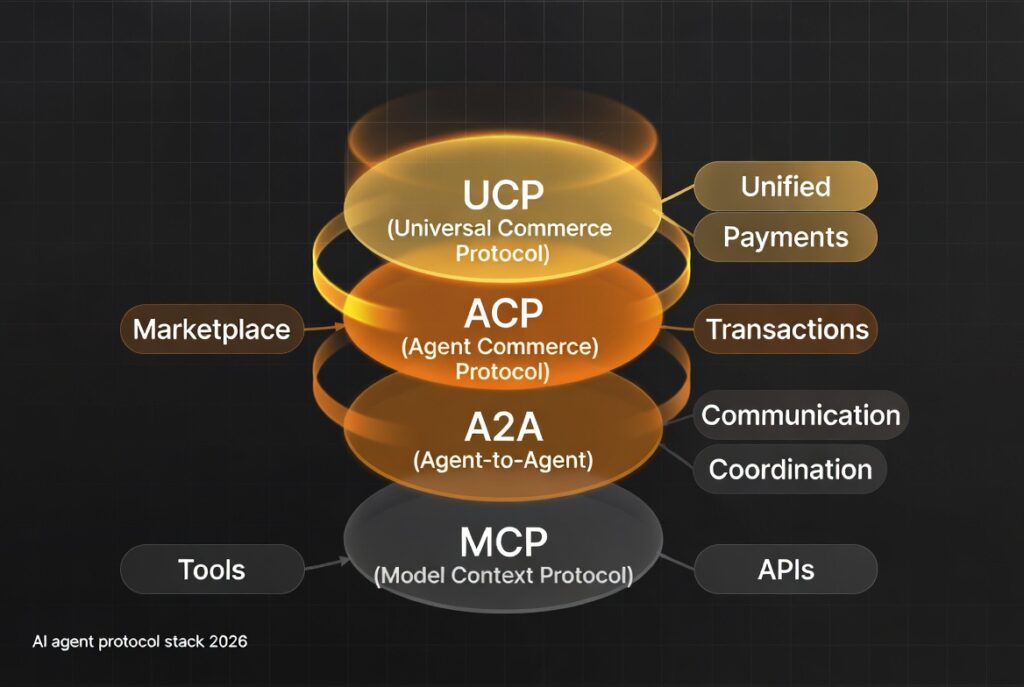
The AI agent protocol landscape has moved from fragmented chaos to a recognizable stack in roughly 14 months. By Q1 2026, four protocols have meaningful industry adoption, and the roles of each have clarified enough to drive real architectural decisions.
MCP gives your agent hands. A2A lets agents talk to each other. These are not competing protocols — they are consecutive layers in the same stack. ACP and UCP handle the commerce and transaction layer above both.
MCP adoption in numbers
The scale of MCP adoption in early 2026 is striking. 67% of CTOs surveyed named MCP their default agent-integration standard for the next 12 months. The public MCP server registry expanded from 1,200 servers in Q1 2025 to over 9,400 by April 2026 — a 7.8× year-on-year increase — with month-over-month growth still tracking at +18% through Q1 2026. Every major AI development environment now ships MCP support: Claude, ChatGPT, Gemini API, Vertex AI Agent Builder, Cursor, Windsurf, JetBrains AI Assistant, and the Vercel AI SDK.
Competing protocols — A2A, ACP, and UCP — trail in enterprise adoption (23%, 8%, and 4% respectively by one measure) but serve distinct architectural roles that MCP explicitly does not address. The practical rule for 2026: use MCP for tool access, layer A2A when you have three or more interoperating agents, and add ACP/UCP only when agents are transacting commercially.
The Framework Landscape: Five Worth Understanding
Six or seven frameworks were in serious contention a year ago. The 2026 picture is sharper: each major framework has found a distinct niche, and the churn has slowed as teams discover that switching orchestration layers mid-project is extremely painful. Here are the five that have earned their positions in production environments.
| Framework | Architecture Philosophy | Best For | Status 2026 |
|---|---|---|---|
| LangGraph | Directed cyclic graphs; stateful, multi-actor | Complex stateful workflows needing fine-grained control over branching and long-running processes | Production Standard |
| Microsoft Agent Framework 1.0 | Supervisor-as-tool; nested handoff history opt-in | Enterprise Microsoft stack; complex org-wide multi-agent coordination | AutoGen Successor |
| CrewAI | Role-based team automation; crew + task + process | Startups and SMBs; business workflow automation with defined agent roles | SMB Favourite |
| OpenAgents / OpenAI Agents SDK | Nested handoffs; tool-first; MCP-native | Financial and web task execution; teams already on OpenAI stack | Maturing |
| MetaGPT | Software company simulation; role-play agents | Software development automation; automated engineering workflows | Specialist |
A notable trend: peer GroupChat architectures are declining across the board. AutoGen merged into Microsoft Agent Framework 1.0 and peer GroupChat is no longer its flagship pattern. LangChain now recommends supervisor-as-tool over the supervisor library. The direction across all five major vendors points toward hierarchical, role-scoped orchestration over peer-to-peer agent teams. April 2026’s research from Anthropic and the three-agent harness patterns for full-stack development reinforce this: subagents with clear role scope outperform peer teams in both cost and reliability.
Real Enterprise ROI: Verified Case Studies
The most important thing to know about agentic AI ROI in 2026 is that the data is now real — not projected. Companies that deployed agents report measurable outcomes on specific line items. The numbers below come from named organizations with cited metrics, not vendor projections.
Organizations report an average ROI of 171% from agentic AI deployments, with U.S. enterprises averaging 192% — exceeding traditional automation ROI by 3×. 74% of executives achieved ROI within the first year of deployment.
AI Monk — Agentic AI Enterprise Case Studies 2025–2026The pattern across all these deployments is consistent: the highest ROI comes not from agents replacing headcount, but from agents eliminating the administrative overhead that prevents skilled people from doing skilled work. Clinicians freed from documentation. Analysts freed from data assembly. Engineers freed from dependency management. This nuance is important for internal business cases — measure agent value in new capability unlocked, not FTE reduction.
Design Patterns That Actually Work in 2026
Seven design patterns form the architectural vocabulary for agent development in 2026. The two most debated — and most frequently misapplied — are ReAct and Multi-Agent Collaboration, so they deserve the most attention here.
ReAct (Reason + Act)
The foundational loop: reason about the current state, take an action, observe the result, reason again. ReAct is the basis of almost every production agent. Its failure mode is getting stuck in loops when tools return ambiguous results — which is why error-handling and exit conditions matter more than most tutorials suggest.
Reflection
The agent reviews its own output before committing. Effective for long-form generation, code, and plans where a second pass catches errors that the first reasoning step misses. Doubles token usage — apply selectively to high-stakes steps.
Tool Use
The agent calls external APIs, runs code, searches the web, or reads files. MCP has standardized tool definition and security controls here. The key architectural decision is read vs. write permissions: agents with write access require more stringent audit logging and human-in-the-loop gates.
Planning
The agent decomposes a goal into subtasks, assigns priorities, and sequences execution. Hierarchical planning (goals → subgoals → actions) outperforms flat task lists for complex multi-step work. April 2026 research from Anthropic and three-agent harnesses for full-stack development confirmed that role-scoped subagents with explicit task boundaries outperform general-purpose peer teams.
Multi-Agent Collaboration
Specialized agents (a researcher, a writer, a reviewer) work on subtasks and pass results. Effective when tasks are genuinely parallel and specialization adds quality. Expensive. The supervisor-as-tool pattern — where one orchestrator agent delegates to specialists via MCP tool calls rather than peer-to-peer messaging — has become the recommended pattern across LangChain, OpenAI Agents SDK, and Microsoft Agent Framework 1.0 in 2026.
Sequential Workflows
A deterministic pipeline where each agent processes the output of the previous one. Simple, debuggable, and often the right answer when the workflow is well-understood. Use this before reaching for the complexity of a full orchestration graph.
Human-in-the-Loop
Checkpoints where the agent surfaces its plan or result for human review before proceeding. Non-negotiable in regulated industries (finance, healthcare, HR) and mandatory for EU AI Act high-risk system compliance. The pattern is not a weakness — it is the mechanism that makes autonomous systems trustworthy in production.
Governance and the EU AI Act: The August 2026 Deadline
If one topic has moved fastest from background concern to urgent operational requirement in the first half of 2026, it is governance. Two forces are responsible: the EU AI Act’s August 2026 enforcement deadline for high-risk AI systems, and the recognition — hard-won in production — that ungoverned agents create liabilities that compound faster than their ROI.
August 2, 2026: EU AI Act high-risk system requirements become enforceable. Obligations apply to all operators of high-risk AI systems placed on the market or in service before this date. The Act’s extra-territorial reach mirrors GDPR — any organization, regardless of location, must comply if its AI systems are used within the EU or produce outputs affecting EU residents.
Penalties for non-compliance are substantial. According to the Act, failures of governance in high-risk areas — including systems that process personally identifiable information or conduct financial operations — carry penalties that may extend to criminal liability in certain jurisdictions.
The EU AI Act risk classification that matters for agents
The Act uses risk-based logic: the higher the potential harm, the more stringent the compliance obligations. For AI agents, the high-risk classification applies to systems that determine credit scores, screen employment applicants, handle regulatory reporting, make decisions in healthcare settings, or make autonomous infrastructure choices. If your agent does any of these things, the August deadline applies directly to it.
The governance requirements that are technically hard
Beyond the legal checkboxes, governance of multi-agent systems raises specific technical challenges that the Act implicitly requires you to solve. Multi-agent process logs are particularly complex: failures can occur within chains of agents, and the log must reconstruct which agent made which decision at which point — with the actual data it saw. Security policies must be tested during development in any system intending to use multiple agents.
The practical test: can every aspect of your agent system be identified, constrained by policy, audited, interrupted, and explained? If the answer is unclear, governance is not yet in place.
- Agent identity established — every agent has a defined identity and documented capability scope
- Comprehensive logs — every action, tool call, and decision recorded with context
- Policy checks enforced at the action layer, not just the prompt layer
- Human oversight checkpoints defined and documented for high-risk decisions
- Rapid revocation capability — agents can be paused or reverted without data loss
- Vendor documentation obtained — third-party AI components have accessible technical documentation
- Evidence package prepared for regulators — structured, not assembled after the fact
The Five Architecture Decisions That Define 2026 Projects
If you are starting or scaling an agentic AI project in 2026, five decisions will determine most of your outcomes. Get these right and the framework choice becomes secondary.
Decision 1: Single-agent or multi-agent?
Default to a single agent with rich MCP tooling. The evidence from April 2026 research (Tran & Kiela, Stanford) is clear: under a fixed token budget, a well-designed single agent frequently matches multi-agent performance. Add agents when you have parallelism that genuinely accelerates delivery, or when adversarial checking (one agent reviews another’s output) meaningfully improves quality. Not before.
Decision 2: Self-hosted MCP or hosted remote MCP?
Plan for hosted remote MCP unless you have specific regulatory reasons to self-host. Authentication, scaling, and cold-start latency are significantly easier delegated. The 4.3× time-to-integrate advantage that MCP provides over per-vendor function calling disappears if you spend that time maintaining your own MCP infrastructure.
Decision 3: Synchronous or asynchronous agent execution?
Most agent workflows run synchronously in prototypes and need asynchronous execution in production. Long-running agents (research tasks, complex code generation, multi-step document processing) block resources and create poor UX if synchronous. Design for async from the start and surface intermediate results progressively — it changes the UX from “waiting for an answer” to “watching work happen.”
Decision 4: Which memory architecture?
Short-term memory (conversation context) is handled by the LLM. Long-term memory — the agent’s ability to recall information across sessions — requires deliberate design. In 2026, the dominant approaches are RAG (retrieval-augmented generation) for factual memory and structured state stores for process state. Conflating these is a common architecture mistake that creates agents that seem to remember things but actually hallucinate recalled details.
Decision 5: Where do humans stay in the loop?
Define your human-in-the-loop gates before you build, not after. The EU AI Act requires documented oversight for high-risk systems. Beyond compliance, the practical evidence from failed agentic deployments is consistent: agents without defined escalation paths and checkpoint logic eventually take actions that no one authorized and no one can explain. The answer is not to make agents less autonomous — it is to define precisely which decisions require human confirmation.
Market Outlook: Where the Agentic Economy Lands
The numbers around agentic AI market size are large and fast-moving enough that specific figures become outdated quickly. What is more useful is the structural direction.
The structural shift worth internalizing: in 2026, the leading organizations are not measuring agent ROI in headcount reduction — they are measuring it in new revenue models, new capability, and competitive positioning that did not exist before agents. Dynamic pricing that responds to real-time market signals. Personalized financial advice at the scale of mass-market banking. Drug discovery workflows where scientists never touch administrative processes. These are not efficiency gains. They are entirely new categories of value that agents make economically viable.
By 2027, the open question is not whether MCP becomes the standard (it has, for the agent-to-tool layer) but how quickly the agent-to-agent coordination layer above it consolidates — whether around A2A, something newer, or a combination. Organizations building now should design for protocol agility: wrap your agent coordination layer in an abstraction that can be swapped as standards evolve.
What to Do Now: A Practical 90-Day Roadmap
The gap between understanding agentic AI and deploying it productively is implementation discipline. Here is what the organizations achieving the strongest results in 2026 did in their first 90 days.
Days 1–30: Assess and target
Audit every workflow in your organization that involves a human handling information, making a routine decision, or coordinating between systems. Score each by two criteria: transaction volume (high volume = more agent leverage) and decision structure (more structured = faster agent deployment). The highest-scoring workflows are your starting candidates. Do not try to automate judgment-intensive, low-volume decisions first — you will spend months and prove nothing.
Days 31–60: Prove one thing completely
Deploy one agent, in one workflow, with full observability, human-in-the-loop checkpoints, and a clear success metric. Not five agents. Not a platform. One agent. Prove the integration, the governance model, and the token economics before adding complexity. Most agentic AI failures happen because teams skip this step and build the platform before they understand the problem.
Days 61–90: Standardize and scale
Once the first agent is in production with a verified success metric, document what you learned about MCP server architecture, logging requirements, and human oversight integration. This documentation becomes your agentic AI playbook. The second and third agents should be faster and cheaper to deploy than the first — if they are not, you built a custom solution instead of a reusable pattern.
If you operate in or serve EU residents, you need a parallel track running from Day 1: AI system inventory, high-risk classification, and documentation of human oversight mechanisms. The August 2026 deadline is not abstract. Work with legal and compliance teams on the conformity assessment process before, not after, your first agent goes into production in a regulated workflow.
The Bottom Line: What 2026 Actually Means
The most honest summary of where AI agents and multi-agent systems stand in May 2026 is this: the infrastructure question is largely settled, the governance question is urgent, and the strategic question is only beginning.
MCP has won the agent-to-tool layer. A2A is the emerging standard for agent-to-agent coordination. The Linux Foundation’s AAIF gives both the vendor-neutral governance that enterprise procurement requires. The frameworks — LangGraph, Microsoft Agent Framework, CrewAI — have found their niches and stabilized. The ROI data is real and large.
What remains contested is everything else: which agent architectures will compound in value as they accumulate operational memory, which industries will see the deepest disruption, and whether the agentic commerce layer (ACP, UCP) will create the distributed economic infrastructure that some researchers believe is possible — a world where AI agents negotiate, transact, and deliver outcomes on behalf of humans at a scale that changes the structure of markets, not just the efficiency of processes.
The organizations that will look back on 2026 as a turning point are not the ones that moved fastest. They are the ones that built correctly — with protocol-native architectures, real governance programs, and the discipline to prove one thing completely before scaling to many. That combination is harder than deploying quickly, and it is the only one that compounds.
Continue reading on Trendix
Key sources & further reading
- FlowHunt — Multi-Agent AI Systems in 2026: What the Research Actually Says
- MachineLearningMastery — 7 Agentic AI Trends to Watch in 2026
- Digital Applied — MCP Adoption Statistics 2026
- Digital Applied — AI Agent Protocol Ecosystem Map 2026: MCP, A2A, ACP, UCP
- DEV Community — MCP vs A2A: Complete Guide to AI Agent Protocols in 2026
- AI Monk — 12 Agentic AI Examples with Measurable Enterprise ROI
- Covasant — EU AI Act Compliance for Autonomous AI Agents in 2026
- AI News — Agentic AI’s Governance Challenges Under the EU AI Act
- FifthRow — AI Agent Orchestration Goes Enterprise: The April 2026 Playbook
- OneReach.ai — Agentic AI Stats 2026: Adoption Rates, ROI & Market Trends
MCP + A2A Protocol: The Complete Architecture Guide
7 Production Multi-Agent Design Patterns
AI Workflows & Automation:The Complete 2025–2026 Guide
AI Agents & Multi-Agent Systems: The Definitive 2026 Guide
LangGraph vs CrewAI vs OpenAI Agents SDK vs AutoGen (2026): The Definitive Comparison
AI Agent Framework Selection Scorecard
NotebookLM for Researchers: A Deep Dive Into the Most Underused AI Tool
Agentic Workflows: How AI Systems Are Actually Taking Over Knowledge Work
Human-in-the-Loop AI: The Complete Production Implementation Guide
AI ROI Is Not What You Think —Here’s What the Data Shows