

Trendix.tech · June 2026 · Solo Business Intelligence
The AI Sales Assistant
Everyone’s Building Wrong
You bought the tool. You set up the sequences. Three weeks later, your inbox is clean and your pipeline is exactly where it was. Here’s the structural mistake most solopreneurs make — and it’s not the tool they chose.
An AI sales assistant is often defined as software that automates outreach, qualifies leads, and schedules meetings. That’s the vendor definition. The operational definition — the one that matters when you’re the only person in the company — is different: it’s any system that converts your time into closed revenue without requiring your continuous presence.
Those two definitions produce completely different tool choices. Most solopreneurs optimize for the first one and wonder why the second never happens.
You Don’t Have an Outreach Problem. You Have a Trust Sequencing Problem.
The default solopreneur AI sales stack in mid-2026 looks like this: an outreach automation tool (Apollo, Instantly, or Lemlist), a CRM with AI scoring (HubSpot or Pipedrive), and maybe a meeting scheduler with AI follow-up (Calendly or Cal.com). That’s a fine team setup. For a solo operator, it’s three systems that each require ongoing maintenance and produce outputs no one has time to evaluate.
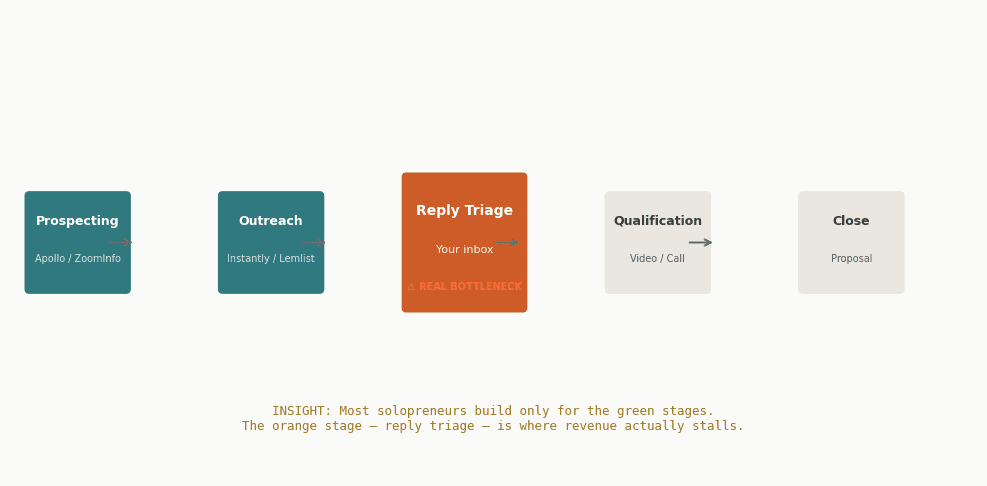
Here’s what actually happens when you run AI outreach as a solopreneur: the replies come in and then sit in your inbox while you’re doing client work. The AI did its job. You didn’t do yours, because yours can’t be automated. The bottleneck was never the outreach — it was your capacity to respond, qualify, and convert in real time. Automating outreach just makes the bottleneck more visible.
The Instantly 2026 Cold Email Benchmark puts average AI-assisted reply rates at 3.43%, with top-quartile campaigns hitting 5.5%. At those numbers, if you send 500 emails a week — which is a reasonable ceiling before domain reputation degrades — you’re getting roughly 17 replies. That’s 17 humans who need a response from another human, within about 4 hours, or the thread goes cold. Build your stack for those 17 conversations, not for the 500 sends.
The Seven Categories of AI Sales Tools — and Which Three Actually Matter for Solo Operators
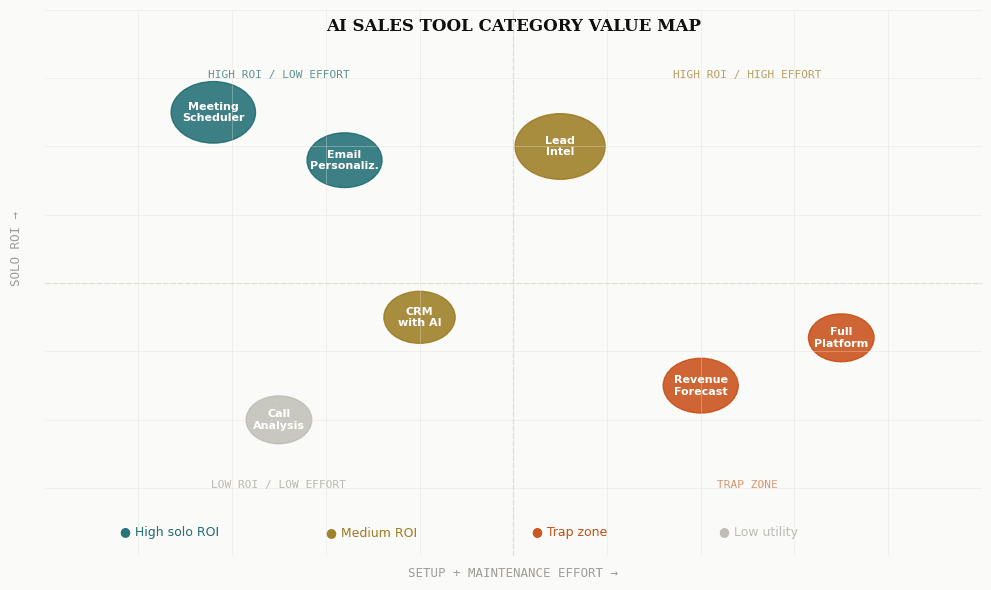
Vendors categorize AI sales tools by feature set. That’s useful for procurement teams at mid-market companies. For a solopreneur, a more useful taxonomy is: does this tool generate revenue when I’m not looking at it, or does it generate work that requires me?
Revenue forecasting tools are a particular trap. They’re genuinely excellent for a team of six with a $2M pipeline. For a solopreneur with four active prospects and $80K in potential deals, you don’t need an AI to tell you which deal is at risk — you know, because you’re in every conversation. The cognitive overhead of configuring a forecasting model exceeds the value it returns. I stopped recommending Clari to solo operators after watching three different consultants spend their first month configuring dashboards they never looked at again.
1. Meeting scheduling with async follow-up AI — Fathom (free tier) for call notes and auto-follow-up. The ROI shows up on day one.
2. Email personalization at scale — Not bulk blasting. Personalizing 30–50 targeted emails with AI-assisted research per contact. Apollo’s AI sequences do this well when you cap volume hard.
3. Personality intelligence for outreach — Crystal reads DISC profiles from LinkedIn and tells you how a prospect prefers to receive information. Worth $49/month if you’re closing B2B deals above $3,000.
The Stack That Fits One Person Without Breaking Them
Most solopreneur AI sales stacks are assembled piecemeal — one tool for this, another for that, a Zapier bridge between them that breaks every six weeks. The result is a system that requires more maintenance than a junior SDR would. The architecture question is less “which tool” and more “what can I actually commit to operating.”
A useful constraint: never maintain more than five active tools in your sales stack. Five is already pushing it. Each tool has a failure mode, an update cycle, and a mental model you have to hold. At seven tools, you spend more time on tool upkeep than on selling.
The Deliverability Trap That Kills AI Outreach in Month Two
Nobody in the AI sales tool marketing material tells you this clearly: domain reputation is a finite resource, and AI outreach burns it faster than manual outreach does.
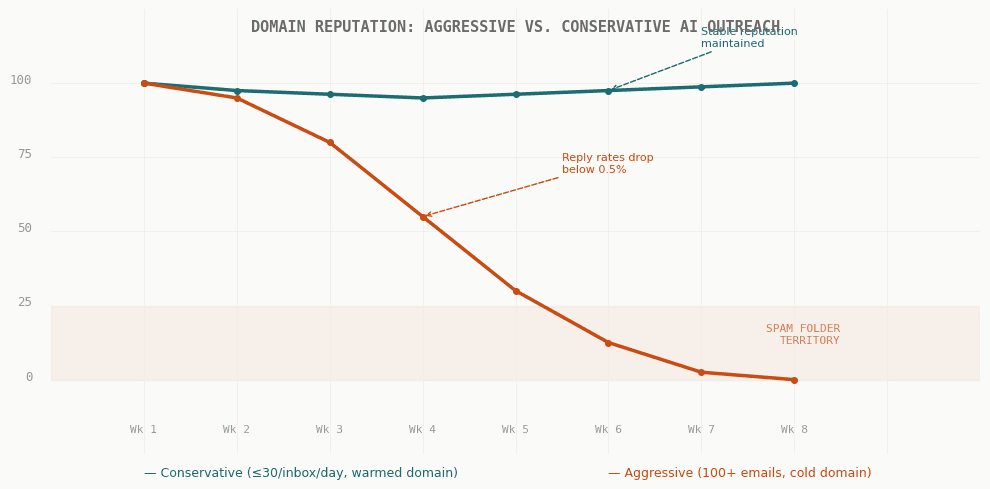
When you connect an outreach tool to your primary business domain and push volume — even carefully — you’re spending reputation you’ve built over years. The ISP behavior detection that Gmail and Microsoft 365 use doesn’t care that the emails were AI-personalized. It cares about volume, send patterns, and engagement rates. Once a domain starts flagging, recovery takes six to twelve weeks of near-zero sending. I’ve watched solo operators burn their primary domain in under forty days by being too aggressive with a tool they were genuinely excited about.
“The 30-email-per-inbox-per-day cap applies equally to both AI agents and human SDRs — because the limit is set by ISP behavior detection, not by human capacity.”
Instantly.ai — Cold Email Benchmark Report, 2026The practical implication: run your AI outreach from a secondary domain (yourbrand-hq.com, or a subdomain variant), warm it for four weeks before sending anything, keep daily volume at or below 30 per inbox, and use your primary domain only for replies and relationship maintenance. This is friction. It costs time to set up. But the alternative is losing the reputation you’ve earned, and rebuilding it while also trying to close deals is genuinely unpleasant.
Apollo’s verified contact database has grown to over 224 million records as of mid-2026, which sounds impressive until you realize that database freshness — not size — is what determines whether your outreach lands. A contact who changed jobs six months ago is a dead send that still counts against your bounce rate. Verify independently with a service like NeverBounce before any bulk send. Budget $15–40 per 10,000 contacts for this. It’s not optional.
The Honest Tool Comparison Nobody Publishes
Every tool comparison you’ll find is written by someone with an affiliate relationship or a sponsored post deal. I don’t have either here. What follows is based on what solopreneurs actually report after three months of use — not what works in a demo.
| Tool | Best for solo operators when… | Honest limitation | Price (2026) | Verdict |
|---|---|---|---|---|
| Apollo.io | You need contact data + sequencing in one place. Good free tier gets you started. | Data quality drops outside North America/UK. Sequences need manual curation or they read as robotic. | Free → $59/mo | Start here |
| Fathom | You’re doing discovery calls and spending 20+ min writing follow-up emails afterward. | Free tier is Zoom-only. Non-obvious how to share summaries in a branded way without upgrading. | Free / $32/mo | Default pick |
| Crystal | You sell high-ticket B2B ($3K+) and do 5–15 personalized outreaches per week. | Below 20 outreaches/week, overkill. The DISC analysis is probabilistic, not precise — treat it as one signal, not gospel. | $49/mo | High-ticket only |
| HubSpot Free CRM | You want deal tracking without a monthly bill and are comfortable with basic pipeline views. | AI features are paywalled. Free CRM is genuinely useful; upgrading to Sales Hub ($90/mo) rarely makes sense solo. | Free / $90/mo | Use the free tier |
| Instantly.ai | You’re running cold outreach campaigns at volume and need domain warmup built in. | Requires a separate sending domain. Setup takes a week properly. Not a “turn it on” tool. | $37–$97/mo | Setup overhead |
| Gong | You’re managing a team of 3+ and want coaching data from call recordings. | Custom pricing typically starts around $1,200/year per seat. For a solopreneur, call-recording AI from Fathom covers 90% of the need for free. | Custom (~$100+/mo/seat) | Not for solo use |
| Salesforce Einstein | You’re already deeply inside the Salesforce ecosystem. | If you’re not already paying for Salesforce, adding it for AI features as a solopreneur is expensive complexity. HubSpot achieves 80% of the result at 20% of the cost. | $75–$150+/mo | Ecosystem lock-in risk |
| Pipedrive + AI | You prefer a pipeline-first CRM over a marketing-first one (HubSpot’s layout). | AI features are still maturing versus HubSpot. Solid for pure pipeline management, weaker on outreach automation. | $14–$49/mo | Good alternative |
The Number the Market Reports Don’t Show You
The AI sales assistant software market is projected to reach $26 billion by 2035, growing at 23.7% annually. Every vendor cites this number. None of them tell you what it means for a solopreneur.
It means the tools are getting cheaper and more capable every six months. It means whatever pricing you see today is likely to drop. It also means the competitive floor for outreach quality is rising continuously — the personalization that impressed prospects in 2024 now reads as template. Crystal-matched DISC messaging that converted at 8% in 2023 converts at 5.5% now, because buyers have received enough AI-personalized outreach to recognize the pattern.
“AI doesn’t remove the need for trust in sales. It accelerates the path to it by handling the busywork — so you can focus on the conversations where trust is actually built.”
Raj Patel, Chief Product Officer, CloseBot AIThat observation points to something the tool vendors are structurally unable to tell you: the competitive advantage from AI outreach is shrinking faster than adoption is growing. By the time a tactic is in a “Best AI Sales Tools for 2026” listicle, every serious solopreneur in your niche already uses it. The window between “this works surprisingly well” and “everyone does this now and it’s saturated” collapsed from about eighteen months to about six between 2023 and 2026.
What this means practically: build the AI stack for efficiency, not differentiation. Use it to free up time for the activities that actually can’t be commoditized — the thinking, the positioning, the specific thing you know about your niche that no model can reproduce at scale. See how Trendix covers the fast-moving AI tool landscape for signals on when to adopt versus when to wait out the hype cycle.
The Friction Nobody Talks About: Buyers Know Now
Here’s the thing I keep watching play out and don’t see written honestly anywhere: B2B buyers in 2026 have developed remarkably accurate pattern recognition for AI-generated outreach. Not because they’re suspicious — because they’ve been on the receiving end of enough of it. The “Hi [First Name], I noticed you recently [vague company event] and thought [generic bridge to pitch]” structure has a detectable texture now, regardless of how many personalization tokens you inject.
This isn’t an argument against using AI outreach. It’s an argument for using it differently than the default playbook suggests. The solopreneurs getting response rates above 5% in 2026 share a specific pattern: they use AI to handle the research and the first draft, then they rewrite the opening two sentences themselves, using something they actually noticed about the prospect that an AI wouldn’t have surfaced — a specific podcast they appeared on, a comment they left on a LinkedIn post six months ago, a product decision that a competitor announced that would directly affect them.
Salesforce’s SMB AI Trends report from 2025 found that solopreneurs automating outreach saw a 41% increase in deal velocity and a 22% higher close rate. Those numbers are real. They’re also averages that include a wide range of implementation quality. The bottom quartile of implementations probably dragged those averages down significantly — and anecdotally, those are the implementations that went fully automated without human review. The Trendix.tech intelligence briefings on AI adoption cover this pattern in more detail across sectors.
What’s Actually Changing in the Next 18 Months
The current generation of AI sales tools is, broadly, about automation with oversight. You set up the sequences, review the outputs, and intervene when things go wrong. The generation emerging now — tools like Artisan’s Ava, Unify’s intent-based agents, and 11x’s Alice — operates more autonomously. They don’t just draft and queue; they monitor buying signals, reprioritize targets in real time, and adapt messaging cadence based on engagement patterns without being told to.
For enterprise teams, this is a genuine capability leap. For solopreneurs, I’d be more cautious. The risk with autonomous sales agents is proportional to the size of your addressable market. A company with 50,000 potential accounts can afford to let an agent make a few hundred decisions that turn out to be wrong. A solopreneur with 200 realistic prospects cannot — one bad agent decision can burn a relationship you spent eighteen months building. Autonomous AI sales agents are better suited to solopreneurs once you have a product that benefits from high-volume, low-stakes initial outreach to a large pool.
The intent-detection angle is genuinely useful now, though. Unify and similar tools monitor buying signals — prospect companies visiting competitor pricing pages, job postings that signal a product need, funding announcements that create buying windows — and surface them in real time. For a solopreneur who can move fast on a warm signal, this is more valuable than any outreach automation. It converts market intelligence into timing advantage, which is something a solo operator can actually capitalize on in ways a large team with approval processes cannot.
Before You Buy Anything: The One Question Worth Answering
Most solopreneurs buy AI sales tools to solve a lead generation problem. After three months of use, they discover the actual problem was a conversion problem, or a follow-up consistency problem, or a positioning problem that no amount of outreach volume was going to solve.
The question worth sitting with before adding any tool to your stack: if I got 30 qualified replies tomorrow, what would actually happen? Do I have a clear, documented response that moves prospects to the next stage? Do I have a qualification process that takes less than 20 minutes per conversation? Do I have an offer that closes without a lengthy back-and-forth proposal process?
If the answer to any of those is “not really,” then the AI outreach tool is going to expose that gap loudly and expensively. Fix the conversion system first. Even a minimal version — a clear positioning statement, a single qualifying question, a proposal template that doesn’t require two days of work — transforms what AI outreach can accomplish.
1. Document your offer and what qualifies a prospect — before any tool
2. Add meeting AI (Fathom) — recover time from calls immediately
3. Add inbox intelligence (alfred_) — triage, draft, and flag
4. Add targeted prospecting (Apollo free tier) — carefully, with hard volume limits
5. Add personality layer (Crystal) — only if deal size justifies it
At each stage, ask: does adding this tool create work, or remove it?
The real reason most solopreneurs don’t act on what I’ve described here isn’t skepticism about the tools. The tools work. The barrier is that designing a sales system before you start buying tools feels like delay — like you’re not doing the thing when you’re actually doing the more important thing.
Everything above will need to be revisited in roughly twelve months. The agentic tools are improving at a rate that will make some of these recommendations obsolete. The conversion advantage from AI personalization is narrowing. The deliverability rules are tightening. What won’t change: the solopreneurs with the clearest offer and the most disciplined follow-up will keep outperforming the ones with the most sophisticated stack.
Only you know which of those you actually are right now.
Sources: Precedence Research AI Sales Software Market Report 2026 · Instantly.ai Cold Email Benchmark Report 2026 · Bain & Company Sales Productivity Research 2025 · Salesforce SMB AI Trends 2025 · EntrepreneurLoop Solopreneur Data 2026 · QuickBooks Solopreneur Study 2025
Published: June 15, 2026 · Author: Trendix.tech Editorial · No sponsored content