

Zettelkasten vs. PARA:
Which System Actually Works?
Two of the most influential personal knowledge management methods, put through a proper stress test — not a surface-level summary, but a real reckoning with what each system delivers, where it breaks down, and who should actually use it.
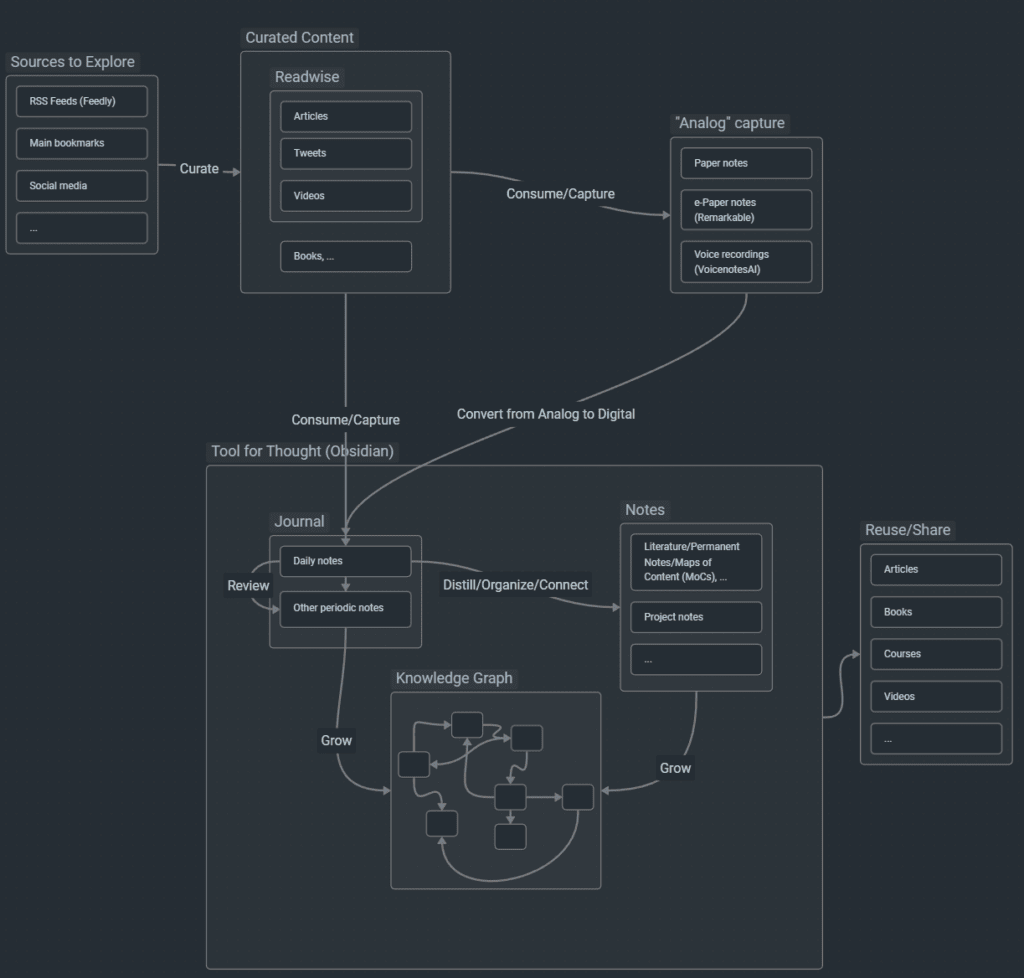
The productivity internet has turned Zettelkasten and PARA into something close to religious camps. Obsidian devotees swear by atomic notes and bidirectional links. Tiago Forte’s students swear by their four tidy folders. But when you strip away the community enthusiasm, the YouTube tutorials, and the Reddit threads — which one genuinely helps people think and work better?
Where These Systems Actually Came From
It matters, more than people realize, that Zettelkasten was not invented as a productivity hack. Niklas Luhmann — the German social scientist who built the most famous version of the system — was trying to solve a specific intellectual problem: how do you build a body of knowledge that keeps generating new ideas over decades, without the whole thing collapsing into a filing cabinet of useless clippings?
Luhmann’s slip-box, which he maintained from the 1950s until his death in 1998, ended up containing over 90,000 index cards. From that foundation he produced, depending on how you count, somewhere between 50 and 70 books and more than 400 scholarly articles — a body of work that rivals entire research departments. He described the Zettelkasten not as a filing system but as a “communication partner” — something that could surprise him with unexpected connections he hadn’t consciously made.
PARA has a different origin story — and understanding that changes how you evaluate it. Tiago Forte didn’t invent PARA in a library. He built it while dealing with a chronic illness, trying to manage the overwhelming information load of modern office work at a San Francisco consulting firm. The system emerged from a practical need: how do you find what you need, when you need it, without spending half your day looking?
That difference in origin is not a knock against either system. It’s the most clarifying thing you can know about them. Luhmann was solving for thinking. Forte was solving for retrieving. Both problems are real. They’re just not the same problem.
How Each System Actually Works
Zettelkasten: The Slip-Box Method
The mechanics of Zettelkasten, at their core, are simple — though properly implementing them is harder than it looks. Every note is:
- Atomic — one idea per note, fully expressed in your own words. Not a quote, not a highlight. Your understanding.
- Uniquely identified — traditionally with a timestamp or alphanumeric ID (Luhmann used a branching numbering system; most digital users today use timestamps like 202405141420).
- Linked — to other notes where a genuine connection exists. Not tags. Not categories. Specific links with a brief explanation of why the connection matters.
- Written as if for a reader — because future-you won’t remember the context, and that constraint forces real understanding.
The result, over time, is a network — not a hierarchy. There’s no master folder structure. Notes cluster around themes organically, and unexpected paths emerge that you never planned. Sönke Ahrens, whose 2017 book How to Take Smart Notes popularized Zettelkasten for the English-speaking world, calls this “bottom-up” organization: structure emerges from the notes themselves rather than being imposed on them from above.
Critically, Luhmann didn’t use his Zettelkasten to store information. He used it to think. Writing an atomic note meant he had to genuinely understand an idea well enough to express it without looking at the source. That cognitive work — often called “elaborative encoding” in memory research — is where the actual learning happens.
PARA: Projects, Areas, Resources, Archives
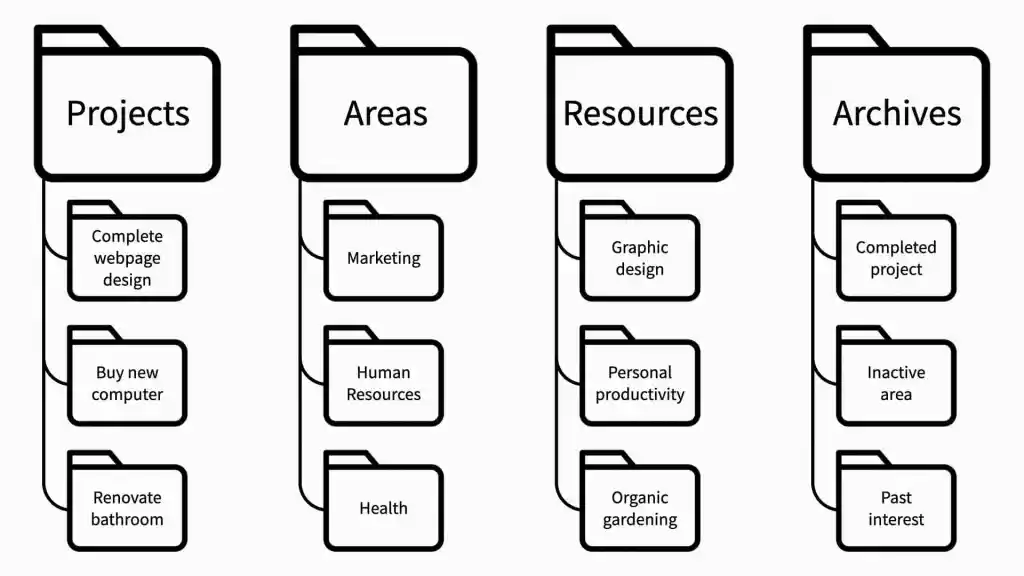
PARA is a folder-based organizational system for all your digital information — not just notes. The four buckets are:
- Projects — work with a defined outcome and deadline that you’re actively pursuing right now.
- Areas — ongoing responsibilities with no finish line (health, finances, team management, etc.).
- Resources — reference material you might want someday, organized by topic rather than by action.
- Archives — everything inactive. Completed projects, abandoned ideas, reference material you no longer need.
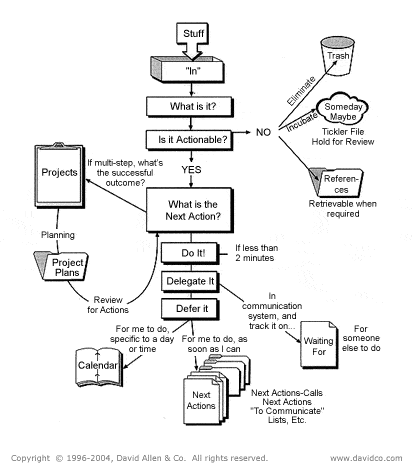
The organizing principle is actionability — not subject, not chronology, not type of content. A note about nutrition goes in Projects if you’re actively working on a diet plan, in Areas if you manage your health as an ongoing responsibility, in Resources if it’s reference material you might use someday.
That means things move around, which bothers some people. But Forte’s point is that “where should I file this?” is the wrong question. The right question is “when will I use this?” That reframe is actually fairly radical once you internalize it.
Head-to-Head: The Real Differences
| Dimension | Zettelkasten | PARA |
|---|---|---|
| Primary goal | Generate insight & original thought | Find what you need, when you need it |
| Organization logic | Emergent, via links — bottom-up | Hierarchical folders — top-down |
| What it organizes | Notes only (ideas) | All digital information (files, docs, emails, notes) |
| Note length | Short, atomic — one idea fully expressed | No constraint — whatever belongs in the folder |
| Learning curve | Steep — easy to do badly for months | Gentle — intuitive from day one |
| Maintenance overhead | High — every note needs writing, linking, revisiting | Low — move items between folders as priorities shift |
| Best tool fit | Obsidian, Logseq, Roam Research | Notion, Evernote, Dropbox, any folder system |
| Collaboration | Poor — highly personal, non-transferable | Good — structure maps cleanly to team workflows |
| AI compatibility (2025–26) | Excellent — graph structures enhance LLM retrieval | Good — but flat retrieval vs. linked context |
| Scales with volume? | Yes — links improve with more notes | Moderate — Archive can become a graveyard |
| Output type it supports | Long-form writing, research, creative work | Project delivery, task execution, information retrieval |
| Risk of failure | Over-complexity, “collector fallacy,” never writing | Notes in Resources never accessed; shallow capture |
Scoring Each System Across Key Dimensions
Real-World Use Cases: Who Thrives, Who Struggles
The Academic Researcher
A doctoral student in philosophy builds a Zettelkasten in Obsidian over four years. By the time she’s writing her dissertation, she has roughly 3,000 linked notes. She discovers that three separate threads in her research — on language, agency, and ethics — connect through a common premise she never consciously identified. The connection surfaces only because Obsidian’s graph view revealed unexpected clusters. She attributes two of her dissertation’s original arguments to that discovery. For this user, Zettelkasten is genuinely irreplaceable. PARA would have filed those threads in three separate resource folders with no bridge between them.
The Marketing Director
A marketing director managing five simultaneous campaigns, a brand refresh, and a quarterly report has no time to write atomic notes about every idea she encounters. She implements PARA across Notion in a weekend. Projects folder holds active campaigns. Areas covers brand standards, team management, budget tracking. Resources holds competitor research, creative inspiration, brand voice guides. Archives captures finished campaign files. Six months later, she can locate any asset in under 30 seconds. Before PARA, that was closer to 10 minutes. For her, Zettelkasten would be a disaster — she doesn’t need to synthesize ideas, she needs to execute and retrieve.
The Writer / Content Creator
A journalist who covers technology builds a hybrid: PARA for active commissions (Projects), general beats (Areas), and press releases (Archives), while maintaining a small Zettelkasten within the Resources folder for ideas that might compound into longer essays. She writes about 800 notes per year and links roughly 30% of them. The Zettelkasten portion surfaces essay angles she wouldn’t have found otherwise. The PARA shell keeps her deadline-driven work organized. Neither system alone would have covered both needs.
The Knowledge Worker Who Tried Zettelkasten and Quit
A product manager read How to Take Smart Notes, spent three weeks setting up an elaborate Obsidian vault, wrote 200 notes — and then stopped. Looking back, he identifies two problems. First, the “atomic note” requirement felt artificial given that his work involves decisions, not ideas: most of what he captured didn’t want to link to anything else. Second, he was capturing rather than thinking: converting articles into notes without genuinely engaging with them. The Zettelkasten wasn’t failing him — he was using it wrong. But PARA was a better fit for his role from the start.
The Pitfalls Nobody Talks About Enough
Both systems share a meta-failure that rarely gets discussed: maintenance collapse. Most people set up either system enthusiastically, use it intensively for two to four months, then slowly stop processing new inputs because the upkeep cost exceeds the perceived benefit. The notes pile up unprocessed. The system becomes a source of anxiety rather than clarity. This isn’t a flaw in the systems — it’s a flaw in how people implement them without realistic expectations about the daily discipline required.
Luhmann never worked on a topic he didn’t feel like working on. He took the lack of motivation as natural feedback and instead of forcing himself to work on a topic, he would look for a more interesting idea in his slip box.
— Sönke Ahrens, How to Take Smart Notes (2017)
This observation from Ahrens points to something genuinely underrated about Zettelkasten: it’s self-regulating. You can’t fake engagement with it the way you can with a folder system. If you’re not genuinely interested, you won’t write the notes — and the system signals that clearly. PARA doesn’t have this self-correcting mechanism. You can have a beautifully organized PARA vault full of content you’ve never actually processed.
The Case for a Hybrid (and When It’s Just Procrastination)
The most common recommendation you’ll find online is “use both” — PARA for organization, Zettelkasten for deep thinking. In principle, this makes sense. In practice, most people who try it end up implementing one half-heartedly.
The hybrid works best when the roles are genuinely distinct. Using PARA as the outer shell — structuring active projects, ongoing responsibilities, and archived work — while maintaining a Zettelkasten specifically within the Resources quadrant for ideas you want to compound over time, gives you both systems’ core benefits without either one undermining the other.
What doesn’t work is trying to maintain a full Zettelkasten and a full PARA system simultaneously as two parallel note systems. The cognitive overhead of deciding “does this go in my Zettelkasten or my PARA Resources?” quickly becomes paralyzing. The people who make the hybrid work have clear rules about what belongs where — and they mostly write those rules down.
Inner structure (Zettelkasten): Atomic notes within the Resources folder in Obsidian, linked to each other but also referenced from PARA project notes when relevant.
Bridge: When a Zettelkasten note becomes directly relevant to an active Project, link to it from the project note — but don’t move it. The ZK note stays in the network; the project note gains a pointer.
AI and the Future of Both Systems (2025–2026)
The rise of AI assistants changes the calculus for both systems in interesting ways — and not uniformly in one direction.
For Zettelkasten, the graph structure of linked atomic notes turns out to be excellent fodder for AI retrieval. Emergent tools like MCP servers for Obsidian vaults (several of which appeared on GitHub in late 2025) allow large language models to traverse your note graph contextually — not just searching for keywords, but following link chains to surface relevant context. A Zettelkasten, properly maintained, becomes a high-quality knowledge graph that an AI can reason over. The atomic, in-your-own-words nature of the notes also helps: LLMs are better at working with processed, synthesized ideas than with raw highlights and excerpts.
For PARA, AI brings efficient retrieval — the system’s core strength — to its logical conclusion. AI-powered search in tools like Notion AI or similar integrations largely solves PARA’s one genuine weakness: that knowing which folder something is in requires remembering your own organizational logic. If an AI can find anything in your PARA vault regardless of where you put it, the strict four-folder taxonomy becomes less critical.
The honest assessment: AI makes PARA less necessary as a strict discipline, while it makes a well-maintained Zettelkasten more valuable. The rich connection structure that was always Zettelkasten’s theoretical strength becomes practically exploitable as AI tools improve.
The Verdict: Which One Should You Actually Use?
Choose Zettelkasten if you…
- Write long-form content, research papers, or books
- Work in academic, philosophical, or creative domains
- Are willing to invest 20–30 minutes per day writing and linking notes
- Value original insight over operational efficiency
- Work primarily alone, not in team workflows
- Are playing a long game — the system compounds over years, not weeks
- Find genuine pleasure in connecting ideas
Choose PARA if you…
- Manage multiple simultaneous projects with deadlines
- Work in a professional or organizational setting
- Need to retrieve specific information quickly and reliably
- Collaborate with teams and share knowledge assets
- Want a system that works across every digital tool you use
- Have moderate discipline — PARA forgives inconsistency better
- Are solving an organization problem, not a thinking problem
Further Reading & Sources
The claims and frameworks in this article draw on the following primary sources and verified research:
- Ahrens, S. (2022). How to Take Smart Notes (2nd ed.). Sönke Ahrens.
- Forte, T. (2022). Building a Second Brain. Atria Books. PARA overview ↗
- Luhmann, N. (1981). “Kommunikation mit Zettelkästen” [Communicating with Slip Boxes]. In: Öffentliche Meinung und sozialer Wandel. English introduction ↗
- Schmidt, J. (2016). “Niklas Luhmann’s Card Index.” In: Forgetting Machines. Brill.
- Chiang, E. (2025). “Niklas Luhmann’s Original Zettelkasten.” ernestchiang.com ↗
- Dubois, S. (2025). “Personal Knowledge Management at Scale: 8,000 Notes and 64,000 Links.” dsebastien.net ↗
- Bielefeld University Zettelkasten Archive. Full digital archive of Luhmann’s 90,000 cards. niklas-luhmann-archiv.de ↗
* Luhmann’s publication count varies by source (50–70 books) depending on whether co-authored works, edited volumes, and essay collections are included. The figure of 50+ books used in this article reflects the most conservative scholarly count (zettelkasten.de). The 400+ articles figure is from the same source. His complete bibliography has been partially digitized by Bielefeld University.
* The 25,000+ PARA students figure is sourced from buildingasecondbrain.com as of April 2026. The “6,000 live cohort students” figure is from the same source.
More on Trendix.tech
Related articles · productivity · knowledge management · tools
Personal AI Agents: Your Digital Self, Finally Unleashed
Productivity Systems: What Actually Works
How to Set Up a Zettelkasten in Obsidian
Building Your Second Brain: A Practical PARA Setup
Terms & Conditions
Atomic Habits for Knowledge Workers:Small Actions, Massive Results