

Qualitative Research Methods:
A Practical Guide for Modern Studies
A field-tested breakdown of every major qualitative method — from grounded theory to digital ethnography — with honest appraisals of AI-assisted analysis tools, real-world case studies, and what the latest methodological scholarship actually says about rigor.
TL;DR — What You Need to Know in 2 Minutes
- The core problem: Most introductions to qualitative research are either too abstract to be useful or so simplified that they produce methodologically indefensible studies. This guide sits squarely in the middle — practical, current, and honest.
- Five main traditions: Thematic analysis, grounded theory, phenomenology, ethnography, and case study research each answer different questions and demand different postures from the researcher. Mixing them without understanding those demands produces weak work.
- AI tools are real but limited: NVivo’s AI Assistant and ATLAS.ti’s GPT-powered coding accelerate early-stage work, but they cannot replace the interpretive judgment that makes qualitative research worth doing. Use them for efficiency, not for insight.
- Trustworthiness is non-negotiable: Lincoln and Guba’s credibility/transferability/dependability/confirmability framework remains the gold standard. Triangulation and reflexive journaling aren’t optional extras — they’re the difference between publishable and unpublishable work.
- Sample sizes are contextual: The “12–15 interviews” rule-of-thumb is misleading. Saturation depends on method, population heterogeneity, and research question. Grounded theory may require 30+; IPA may be rich with 6.
- Honest warning: Qualitative research done poorly is far worse than not doing it. Poorly executed thematic analysis generating vague, unsupported “themes” pollutes the literature. This guide shows you where the traps are.
- Next steps: Identify your research question, then select the method — not the other way around. Read Sections 4–6 if you’re already deep in fieldwork; read Sections 1–3 if you’re designing a study from scratch.
Table of Contents
- What Is Qualitative Research — and What It Isn’t
- Epistemological Foundations: Paradigms Matter More Than You Think
- The Five Core Traditions: A Comparative Overview
- Data Collection: Interviews, Focus Groups, and Observation
- Analysis in Practice: From Raw Data to Findings
- AI-Assisted QDA: Honest Assessment of Modern Tools
- Rigor, Trustworthiness, and Quality Criteria
- Mixed Methods: When and How to Integrate
- Real-World Case Studies
- The Most Common Mistakes — and How to Avoid Them
- FAQ: 13 Questions Real Researchers Ask
- Final Thoughts
1. What Is Qualitative Research — and What It Isn’t
Qualitative research is the systematic inquiry into meaning, experience, and social phenomena through non-numerical data — language, gesture, image, artifact, and context. That definition is accurate but insufficient. What makes qualitative research distinctive isn’t just the absence of numbers; it’s a fundamentally different orientation toward knowledge.
Where quantitative research asks “how many?” and “how much?”, qualitative research asks “how?” and “why?” and “what does this mean to the people living it?” The goal isn’t to measure a variable but to understand a phenomenon from the inside out. This is not a soft alternative to quantitative research — it’s a different tool for different questions. Using it as a fallback when you don’t have enough data for statistics is a methodological error.
Lim’s 2025 overview in Qualitative Market Research frames it well: qualitative work is inherently connected to real-world issues, seeking to explore phenomena within their natural settings rather than abstracting them into controlled conditions. The value lies in what he calls “rich, contextualized insights” — exactly the kind of understanding that survives contact with the complexity of actual human lives.
What Qualitative Research Is Well-Suited For
Qualitative methods are the right choice when you need to: understand how people make sense of an experience that hasn’t been well-theorized; generate hypotheses rather than test them; explore a phenomenon in a new population or context; or understand the mechanisms behind a quantitative finding. They’re less suitable when you need prevalence estimates, causal inference under experimental control, or findings that need to be precisely reproduced at scale.
2. Epistemological Foundations: Paradigms Matter More Than You Think
One of the most reliable markers of underdeveloped qualitative work is a mismatch between the researcher’s unstated epistemological assumptions and the method they claim to be using. You can’t coherently do a post-positivist phenomenology. You can’t do a constructivist grounded theory and then treat your theory as an objective discovery. Getting the paradigm right before choosing a method isn’t philosophical navel-gazing — it determines how you collect data, how you analyze it, and how you defend your interpretations.
| Paradigm | Ontology | Epistemology | Methods Most Compatible | Typical Output |
|---|---|---|---|---|
| Positivism / Post-positivism | Single, objective reality | Observer separate from observed | Structured interviews, content analysis, quantitative-adjacent QDA | Generalizable patterns |
| Interpretivism / Constructivism | Multiple, socially constructed realities | Knowledge co-constructed by researcher and participant | Grounded theory (Charmaz), ethnography, phenomenology, narrative | Rich interpretation, thick description |
| Critical Theory | Reality shaped by power and history | Value-laden inquiry; research as emancipation | Participatory action research, critical ethnography, discourse analysis | Social critique, transformative action |
| Pragmatism | Practical consequences define truth | Method determined by research question | Mixed methods, case study, applied research | Workable solutions |
Table 1: Core research paradigms and their methodological implications. Adapted from Creswell & Poth (2018).
Most qualitative researchers working today operate somewhere in the interpretivist-constructivist space, but the critical and pragmatist traditions are growing — particularly in applied, health, and education research. Knowing where you stand lets you make defensible choices and write a coherent methodology chapter.
3. The Five Core Traditions: A Comparative Overview
Below is an honest characterization of each tradition — including where researchers typically go wrong and when you should consider something else entirely.
Thematic Analysis
The most widely used qualitative method — and the most frequently misused. Flexible, systematic, and applicable across paradigms when done properly (Braun & Clarke’s reflexive TA). Often treated as a default when researchers don’t know what else to do.
Grounded Theory
Designed to generate theory from data through constant comparison and theoretical sampling. Three main variants: Glaserian, Straussian, and Charmaz’s constructivist GT. Each has genuinely different philosophical commitments — you can’t just pick the name.
Phenomenology
The study of lived experience — what it is actually like, from the inside, to undergo a particular phenomenon. IPA (Interpretative Phenomenological Analysis) and Descriptive Phenomenology (Giorgi) have distinct procedures. Requires small, purposive samples.
Ethnography
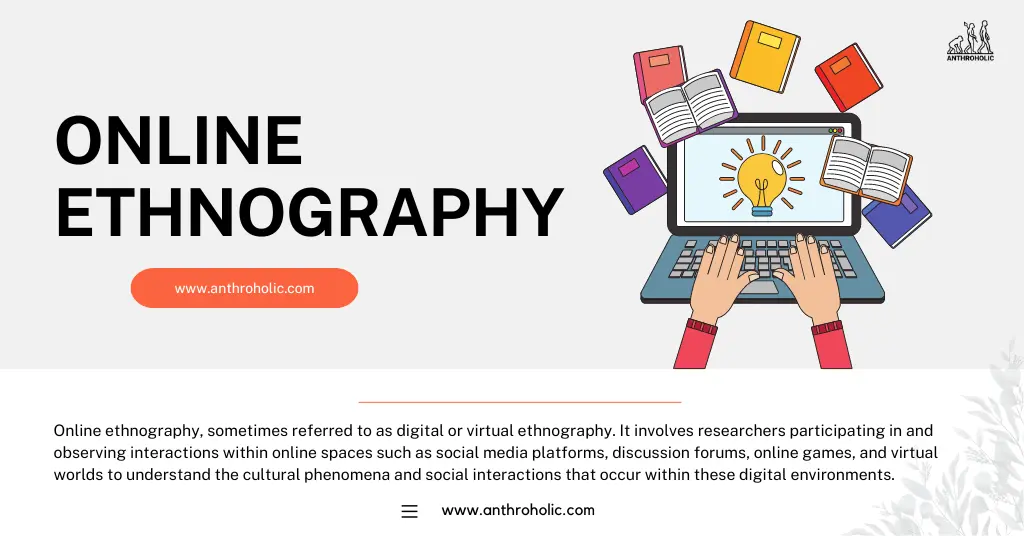
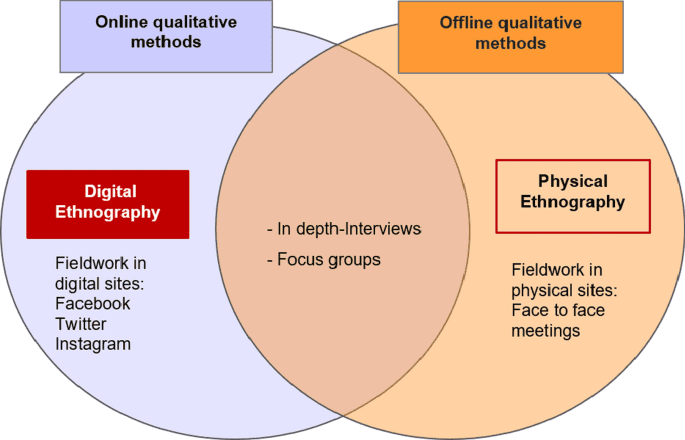
Prolonged engagement in a social setting — observation, participation, informal conversation, artifact collection. Digital ethnography (netnography) has expanded the field into online communities. Requires careful management of researcher role and ethics.
Case Study
In-depth investigation of one or a small number of bounded instances — organizations, programs, events, decisions. Yin’s framework distinguishes exploratory, descriptive, and explanatory case studies. Particularly useful in policy, education, and organizational research.
3.1 Thematic Analysis
Braun and Clarke’s reflexive thematic analysis (rTA) has become the dominant version of the method, and for good reason. Their 2006 paper in Qualitative Research in Psychology — now among the most cited papers in social science — describes a six-phase process: familiarization, generating initial codes, searching for themes, reviewing themes, defining and naming themes, and producing the report. Their more recent work (2019–2022) has heavily criticized the “coding reliability” approach to TA, arguing it fundamentally misunderstands what the method is for.
The most important distinction in current TA practice is between inductive and deductive approaches. Inductive TA lets themes emerge from the data; deductive TA applies a pre-existing framework. Neither is inherently superior, but using inductive language to describe a deductive process — which happens constantly in published research — is methodologically dishonest.
3.2 Grounded Theory
Glaser and Strauss introduced GT in 1967 to give sociologists an explicit methodology for building theory from field data — a response to the theory-data gap that plagued mid-20th century sociology. The method has since fractured into at least three distinct camps, and the choice between them is not trivial.
Glaserian GT insists on theoretical sensitivity and minimal prior literature engagement to let theory “emerge.” Straussian GT (Strauss & Corbin) employs a more structured coding procedure including open, axial, and selective coding. Charmaz’s constructivist GT explicitly acknowledges that categories are constructed by the researcher-participant interaction, not discovered. Pratt’s 2025 Annual Review paper traces how GT has evolved in organizational research and notes a persistent pattern of researchers claiming GT while using only selective coding procedures stripped of theoretical sampling — which produces thematic analysis with GT labels, not actual grounded theory.
The key procedural commitments that actually define GT: concurrent data collection and analysis, constant comparative method, theoretical sampling (sampling to develop emerging theory, not for representativeness), and stopping at theoretical saturation.
3.3 Phenomenology
Husserl’s original project — suspending natural attitude to examine pure experience — was never meant to be a social science method. It was Heidegger, Merleau-Ponty, and van Manen who translated phenomenological philosophy into a framework that could actually generate knowledge about human experience in context. In practice, most qualitative phenomenological research falls into two camps:
Interpretative Phenomenological Analysis (IPA), developed by Jonathan Smith in the 1990s, focuses on how individuals make sense of their personal and social world. It’s idiographic — starting with individual cases before moving to patterns across cases. Typical sample sizes are 4–8 participants, analyzed in extraordinary depth. IPA papers are often better characterized by what they don’t do: they don’t aim for saturation in the GT sense, they don’t generalize to populations, and they don’t code mechanically.
Descriptive Phenomenology (Giorgi’s method) is more structured — using bracketing, meaning units, and essential structure descriptions — and aims to identify the invariant structure of an experience across participants. It has stricter procedural requirements and is more common in health-related research.
3.4 Ethnography and Digital Ethnography
Traditional ethnography — months or years embedded in a community, producing dense fieldnotes and eventually a written account of cultural practices — has been transformed by digital environments. Netnography (Kozinets, 1998–2020) applies ethnographic principles to online communities: data is often already “written,” participation is mediated, and ethical questions around informed consent are genuinely complex.
The most significant methodological debates in contemporary ethnography concern researcher positionality. The ideal of the neutral, invisible observer was always a fiction; contemporary ethnography is more honest about this. Reflexive accounts of how the researcher’s presence shaped the field are now standard in quality ethnographic work. This isn’t a weakness — it’s an epistemological resource.
3.5 Case Study Research
Yin’s framework, now in its sixth edition, remains the standard reference for case study methodology, but Stake’s more interpretivist approach and Eisenhardt’s theory-building approach represent genuinely different commitments. The central methodological question — “what is the case a case of?” — should be answered before data collection begins, not retrospectively to fit whatever you found.
Case studies are at their strongest when: the boundary of the case is clear, multiple data sources (documents, interviews, observations, archives) can be triangulated, rival explanations have been seriously considered, and the analytical generalization (to theory, not to populations) is explicit. Without those, you have a narrative account, not a rigorous case study.
Methods Comparison Matrix
| Method | Best Research Question Type | Typical Sample | Time Required | Rigor Complexity | AI-Tool Fit |
|---|---|---|---|---|---|
| Thematic Analysis | Patterns across a dataset; exploratory | 15–40 interviews | 3–6 months | Medium | High |
| Grounded Theory | Theory generation from experience | 20–50+ interviews | 12–24 months | Very High | Medium |
| IPA Phenomenology | Lived experience; meaning-making | 4–10 individuals | 4–9 months | High | Low |
| Ethnography | Cultural practices; social processes | 1 community/setting | 6–36 months | Very High | Low |
| Case Study | Contextual “how” and “why” questions | 1–5 cases | 6–18 months | High | Medium |
| Narrative Research | Identity, life history, storied experience | 3–15 participants | 6–12 months | High | Low |
Table 2: Comparative overview of major qualitative traditions. “AI-Tool Fit” refers to how much AI-assisted coding can accelerate analysis without distorting the method’s epistemological commitments. Time estimates assume an experienced researcher working part-time.
4. Data Collection: Interviews, Focus Groups, and Observation
Semi-Structured Interviews
The most common qualitative data collection method. “Semi-structured” means having an interview guide — a list of topic areas and potential questions — while remaining genuinely open to following the participant’s lead. The interview guide is a scaffold, not a script.
The most common failure mode in interview research is question design. Leading questions, binary questions, and multi-part questions all generate poor-quality data. The best qualitative interview questions are open, singular, and curious: “Tell me about a time when…” or “What was it like to…” are more productive than “Did you feel that…?” or “Would you say that X was important?”
Develop the interview guide iteratively
Write 8–12 core questions, then pilot with 2–3 participants who are similar to but not part of your study sample. Revise based on where conversations stalled or went in unexpectedly productive directions.
Attend to the relational dimension
Interview quality is inseparable from rapport. Budget the first 10–15 minutes for genuine informal conversation. Participants share more substantively when they trust the researcher is actually interested, not just collecting data points.
Transcribe verbatim, with notation
AI transcription tools (Otter.ai, Whisper-based tools) have improved dramatically but still miss hesitations, overlapping speech, and emotional tone. Always review the transcript against the recording. In IPA and discourse analysis, those pauses matter.
Memo immediately after each interview
Write 1–2 pages of analytical notes within 24 hours of each interview: what surprised you, what resonated with emerging themes, what new questions this raises. These memos are data — they make your analytical process transparent and auditable.
Focus Groups
Focus groups are not group interviews. The data they generate is fundamentally different — it’s produced by interaction between participants, not individual reflection. Their strength is surfacing social norms, shared meanings, and points of consensus and disagreement within a group. They’re often more appropriate than interviews when you want to understand how people discuss a topic in social context rather than their individual private views.
The evidence on optimal focus group size is surprisingly consistent: 6–8 participants is the practical optimum. Fewer than 5 risks too little interaction diversity; more than 10 leads to dominant-voice dynamics where shy participants don’t contribute meaningfully. Online focus groups (Zoom-based) reduce practical barriers and some evidence suggests they can improve participation equality, but they sacrifice the nonverbal richness of in-person groups.
Observation and Field Notes
Observation exists on a continuum from complete observer (watching without participation) to complete participant (fully embedded, no explicit researcher role). Choosing the right position depends on research question, access, and ethical constraints. Most ethnographic work involves some degree of participant observation, but the researcher-as-participant role must be explicitly managed and reflected upon.
Field notes should be written as close to events as possible — ideally same day. The standard distinction between descriptive notes (what happened, as concretely as possible) and analytic notes (your interpretations, questions, emerging ideas) should be maintained, usually through separate documents or clearly marked sections. Mixing the two in a single undifferentiated stream makes it nearly impossible to trace the line between observation and interpretation later.
5. Analysis in Practice: From Raw Data to Findings
Analysis is where qualitative research either delivers or falls apart. The most common failure is treating analysis as a single stage rather than an ongoing process woven through the entire study. In methods like GT, you’re analyzing while you’re still collecting data. Even in more bounded approaches like TA, your analytic sensibility should be active from the first transcript.
Coding: What It Actually Means
Coding is the process of labeling data segments with short phrases that capture their analytic significance. This is not the same as categorizing or summarizing. A code like “feeling judged by the healthcare system” is analytical; a code like “participant talks about hospital visit” is just indexing.
Charmaz distinguishes between initial coding (open, provisional, gerund-based — “experiencing doubt,” “managing competing demands”), focused coding (using the most significant initial codes to sort large amounts of data), and theoretical coding (integrating categories into a coherent theoretical model). Each stage is progressively more interpretive and less data-driven. Using only initial codes and calling the result a grounded theory is a methodological shortcut that undermines the entire enterprise.
Moving From Codes to Themes
The threshold question — “when is a code a theme?” — has no universal answer, but some useful heuristics: a theme should account for a meaningful proportion of the data; it should be internally coherent; it should be distinct from other themes; and it should connect to your research question. Theme proliferation (ending up with 18 themes in a 15-interview study) almost always signals insufficient analysis — you’ve stopped at codes and labelled them themes.
| Coding Approach | Method Context | Process | Output | Common Errors |
|---|---|---|---|---|
| Line-by-line coding | GT (Charmaz, Strauss) | Each line or utterance receives a code | Dense, granular code list | Excessive codes, loss of context |
| In vivo coding | GT, Narrative | Participant’s own words become codes | Conceptually grounded vocabulary | Over-reliance; misses latent meaning |
| Structural coding | TA (deductive) | Pre-existing framework applied | Framework-aligned categories | Forcing data into poor-fit categories |
| Process coding | Action research, GT | Gerund-based; captures action/change | Dynamic, processual codes | Difficulty reaching abstraction |
| Meaning unit analysis | Giorgi’s phenomenology | Identify natural meaning transitions | Transformed meaning units | Mechanical application without bracketing |
Table 3: Coding approaches across qualitative traditions, with common errors.
6. AI-Assisted QDA: Honest Assessment of Modern Tools
The AI-in-qualitative-research landscape has changed substantially in 2024–2026, and most write-ups are either breathlessly enthusiastic or needlessly dismissive. Here’s a more calibrated picture.
AI tools can dramatically accelerate the preparatory and organizational phases of qualitative analysis. They cannot — yet — replace the interpretive judgment that constitutes the core of the work.
— Adapted from Skimle QDA Analysis Guide, 2026The Current Tool Landscape
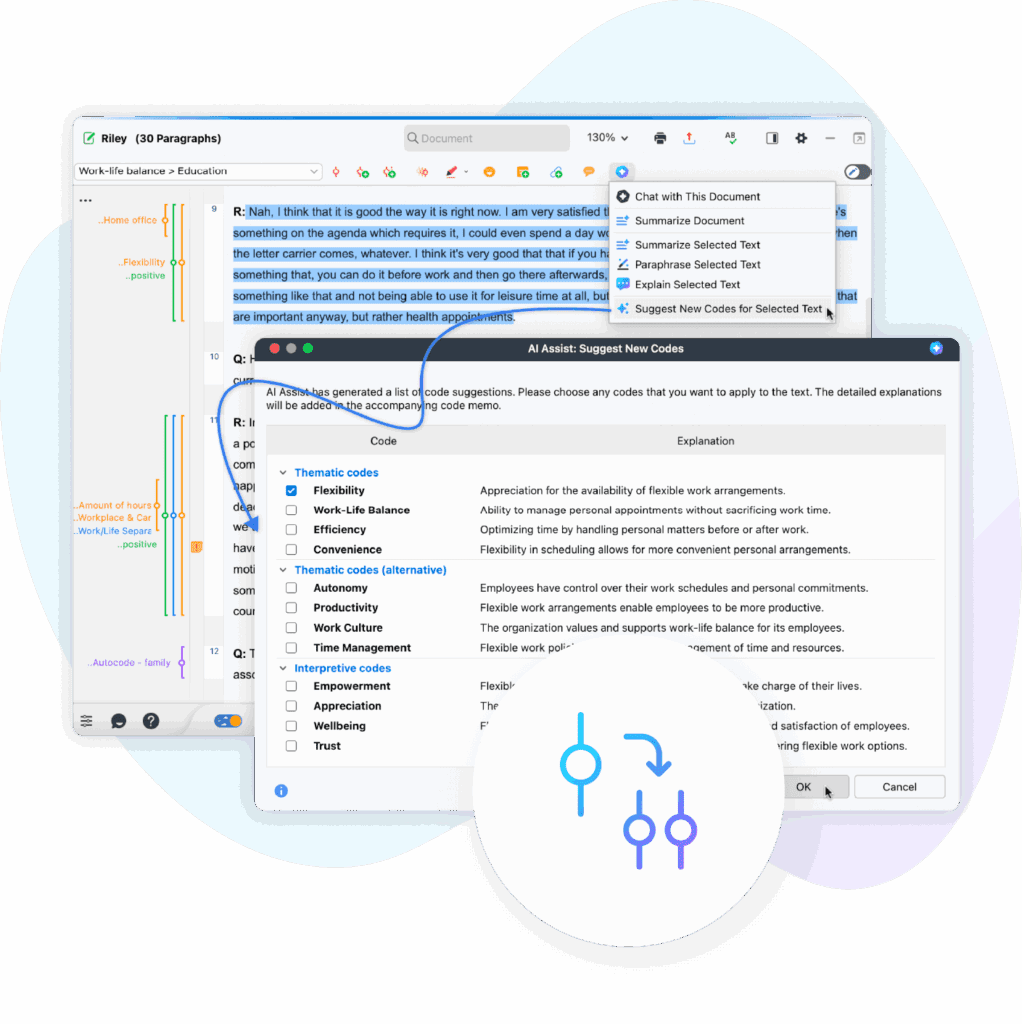
NVivo (Lumivero) has integrated an AI Assistant that can summarize transcripts, suggest topic clusters, and propose preliminary codes. According to Lumivero’s 2025 documentation, the assistant “helps researchers save time and focus more on interpretation, while still allowing full control over the final analysis.” That’s an honest framing. The assistant is a first-pass tool, not an analyst.
ATLAS.ti has gone further with GPT-powered support for coding, category development, and visualization. Their network views and co-occurrence tables remain some of the best in the field for making complex coding schemes visible. The 2026 version emphasizes AI-driven efficiency while maintaining researcher control — which is the right balance to aim for.
MAXQDA sits between NVivo and ATLAS.ti in terms of interface complexity and is particularly strong for mixed methods integration, with excellent visualization tools for presenting relationships between quantitative and qualitative findings.
Newer entrants worth knowing about: Dovetail (excellent for UX research, AI transcription, product management integrations), Dedoose (cloud-based, good for distributed teams, affordable), and Skimle (AI-native tool specifically built for academic transparency, maintaining traceability from finding to source quote).
| Tool | Best For | AI Features | Learning Curve | Price Range | Rigour Support |
|---|---|---|---|---|---|
| NVivo | Academic, complex mixed methods | AI coding, transcript summary | High | ~$900–1200/yr (academic) | Very High |
| ATLAS.ti | Academic, team collaboration, visualization | GPT-powered coding, web platform | Medium-High | ~$400–900/yr | Very High |
| MAXQDA | Mixed methods, visual analysis | AI coding, concept maps | Medium | ~$400–700/yr | High |
| Dovetail | UX research, product teams | AI transcription, tags, highlights | Low | $29–$99/user/mo | Medium |
| Dedoose | Distributed academic teams, budget-conscious | Basic AI assist, intercoder tracking | Low-Medium | $14.95/mo per user | Medium-High |
| Skimle | Academic, AI-native, full traceability | Full AI-driven thematic analysis | Low | Emerging (2025–) | High |
Table 4: QDA Software comparison, 2025–2026. Prices are approximate and change frequently — verify current pricing directly. Sources: Thematic.com, Skimle, vendor sites.
7. Rigor, Trustworthiness, and Quality Criteria
Lincoln and Guba’s 1985 framework for trustworthiness in qualitative research remains the most widely cited alternative to positivist validity/reliability criteria. Their four criteria — credibility, transferability, dependability, and confirmability — map onto internal validity, external validity, reliability, and objectivity respectively, while acknowledging that qualitative research operates under different assumptions.
| Criterion | Parallel Quantitative Concept | Key Strategies | What It Actually Requires |
|---|---|---|---|
| Credibility | Internal validity | Prolonged engagement, triangulation, member checking, peer debriefing | Enough time in the field; cross-checking with participants that your interpretation resonates |
| Transferability | External validity / generalizability | Thick description; purposive sampling rationale | Rich enough description that readers can judge applicability to their context |
| Dependability | Reliability | Audit trail; process documentation | A transparent, documented decision trail that someone else could examine and follow |
| Confirmability | Objectivity | Reflexive journaling; audit trail; triangulation | Demonstrating that findings are grounded in data, not researcher projection |
Table 5: Lincoln and Guba’s trustworthiness criteria with practical implementation strategies.
On Member Checking
Member checking — returning interpretations to participants for feedback — is frequently cited as a key credibility strategy, but it’s also frequently misunderstood. Participants confirming that your themes “feel right” to them is valuable. Participants disagreeing with your interpretations is even more valuable — it prompts deeper analysis. The goal isn’t consensus; it’s deepening understanding. And participants confirming findings doesn’t automatically validate them: their self-report of their experience isn’t the same as the accuracy of your interpretation of that experience.
Sample Size and Saturation
The question of how many participants is “enough” is among the most contested in qualitative methodology. Ahmed’s 2025 SSRN paper on saturation provides one of the more systematic reviews. Key findings: there is no universal threshold; saturation is method-specific and phenomenon-specific; and the commonly cited “12–15 interviews” figure applies only under specific conditions (homogeneous sample, narrow research question, experienced researcher).
More useful heuristics by method:
| Method | Typical Range | Saturation Concept Used | Notes |
|---|---|---|---|
| Grounded Theory | 20–50+ | Theoretical saturation | Stop when new data no longer generates new theoretical insights |
| IPA Phenomenology | 4–10 | Richness, not saturation | Depth over breadth; 6 is often cited as adequate |
| Descriptive Phenomenology | 8–15 | Structural saturation | Stop when essential structure is stable across new cases |
| Reflexive Thematic Analysis | 15–40 | Data saturation (contested) | Braun & Clarke argue saturation is not applicable to rTA |
| Ethnography | N/A (time-based) | Thick description achieved | 6–18+ months in field; depth of understanding, not participant count |
Table 6: Sample size guidance by method. These are informed starting points, not rules. Sources include Ahmed (2025, SSRN), Creswell & Poth (2018).
8. Mixed Methods: When and How to Integrate
Mixed methods research — combining qualitative and quantitative approaches within a single study — is now mainstream, particularly in health services research, education, and organizational studies. But “mixed methods” is frequently invoked as a hedge rather than a design decision. Adding a few open-ended survey questions to a quantitative study does not constitute a mixed methods design.
Creswell and Plano Clark’s typology distinguishes three core designs: explanatory sequential (quantitative first, then qualitative to explain), exploratory sequential (qualitative first, then quantitative to test/measure), and convergent parallel (both simultaneously, integrated at interpretation). Each serves a different purpose and has different analytic requirements.
A December 2025 industry report from Tremendous notes a clear convergence trend: “quantitative and qualitative research projects are converging as technology evolves,” with AI tools making it easier to handle large qualitative datasets at near-quantitative scale. This is real and accelerating, but it also creates new risks — treating qualitatively generated categories as if they have the precision of measured variables is an epistemological error that no amount of tool sophistication can fix.
9. Real-World Case Studies
Healthcare Transition Experience: An IPA Study
A research team at a UK university used IPA to explore the lived experience of young adults (18–25) moving from pediatric to adult mental health services. The transition is notoriously difficult — continuity of care breaks down, therapeutic relationships are severed, administrative complexity multiplies — but the mechanism through which it was experienced as harmful hadn’t been systematically examined from the patient’s perspective.
Methodological decisions worth noting:
- The team conducted a deliberate, documented bracketing exercise before data collection — interviewer kept a reflexive journal tracking assumptions about the transition being inherently problematic
- Each interview transcript was analyzed idiographically before cross-case analysis began — IPA’s core procedure, but commonly skipped in published work
- Member checking sessions were scheduled 6 weeks post-interview; two participants fundamentally reframed their initial accounts, leading to revision of a central theme
Startup Culture Formation: A Grounded Theory Study
A business school researcher used Charmaz’s constructivist GT to build a theory of how organizational culture forms in early-stage startups — not what culture they end up with, but the process by which initial micro-decisions solidify into patterns that become self-reinforcing.
The theoretical sampling process is worth describing concretely. Initial interviews with two founders at seed-stage companies generated codes around “narrative performance” — founders telling stories about the company that simultaneously described and prescribed cultural norms. The researcher then deliberately sampled toward variation: solo founders vs. co-founders; founder-led vs. professionally-managed teams; technical vs. commercial founding backgrounds. Each variation refined, challenged, or extended the emerging theory.
- ATLAS.ti was used for data management and initial coding; theoretical memo-writing was done in a separate document system to maintain narrative coherence
- The researcher kept a detailed audit trail documenting every theoretical sampling decision and the reasoning behind it
- Theoretical saturation was reached at 31 interviews — but the researcher notes that saturation was reached for the core category at around interview 22; the final 9 tested the theory’s boundaries and exceptions
Digital Ethnography of a Climate Activism Online Community
The study examined how climate activists construct and maintain collective identity online — specifically, how disagreements about tactics (direct action vs. policy advocacy vs. individual lifestyle change) are managed within the community without fracturing it.
The ethical complexity deserves attention. Public posts are technically accessible but the researcher adopted an active consent protocol for any direct quotes from named users. Anonymous data was treated as public; named or identifiable users were contacted for consent before interview. This is more rigorous than most digital ethnography but remains a contested area — community norms around research engagement vary significantly across platforms.
10. The Most Common Mistakes — and How to Avoid Them
| # | Mistake | Why It Happens | How to Avoid It | Severity |
|---|---|---|---|---|
| 1 | Method-question mismatch | Method chosen before question is fully formed | Write out the exact research question; then ask “which method’s analytic output actually answers this?” | Critical |
| 2 | Paradigm inconsistency | Copying boilerplate methodology language from another study | Write one paragraph describing your ontological and epistemological assumptions explicitly; check consistency with method claims | Critical |
| 3 | Descriptive themes | Conflating topics with themes; stopping analysis too early | For each theme, ask: “what interpretive claim am I making?” If the answer is just “this topic appeared,” it’s not a theme yet | High |
| 4 | Undisclosed researcher positionality | Discomfort with acknowledging subjectivity; lack of reflexivity training | Write a positionality statement for every study; include it in publications | High |
| 5 | Convenience sampling justified as purposive | Sampling from available networks and adding post-hoc rationale | Define sampling criteria before recruitment; document participant-criterion matching | Medium-High |
| 6 | Premature GT closure | Stopping at focused codes without pursuing theoretical development | Explicitly track the move from focused codes → categories → core category → theory in your memos | High (if claiming GT) |
| 7 | AI tool over-reliance | Time pressure; trust in algorithmic output | Treat AI-suggested codes as hypotheses to be interrogated, not findings to be accepted | Medium-High |
| 8 | Saturation claimed prematurely | Financial or time constraints; desire to stop data collection | Continue collecting until new data genuinely adds nothing new — and document specifically why you stopped when you did | Medium |
Table 7: The most consequential errors in qualitative research, with severity ratings and mitigation strategies.
11. FAQ: 13 Questions Real Researchers Ask
Is qualitative research less rigorous than quantitative?
No — it’s differently rigorous. Qualitative research has its own quality criteria (trustworthiness, reflexivity, transferability) that are as demanding as statistical power and measurement validity, just designed for different epistemological assumptions. Poorly executed qualitative work is no more forgivable than underpowered quantitative work. The perception of lower rigor usually reflects unfamiliarity with qualitative standards, not an inherent limitation of the approach.
How many participants do I need for a qualitative study?
It depends entirely on method and research question. IPA: 4–10. Reflexive TA: 15–40. Grounded theory: 20–50+. Ethnography: time-based, not count-based. The question isn’t “how many?” but “have I reached the depth/saturation appropriate for this method?” See Table 6 for method-specific guidance. The widespread “12–15 interviews” heuristic applies to a narrow set of conditions and is frequently misapplied.
Can I use AI tools for qualitative analysis in academic research?
Yes, with important caveats. AI-assisted tools like NVivo’s AI Assistant or ATLAS.ti’s GPT-powered coding are acceptable for efficiency in early-stage coding and organization. What they cannot do is replace interpretive judgment, ensure methodological coherence with your chosen tradition, or provide the transparent audit trail required for academic accountability. Generic LLMs (ChatGPT, etc.) should not be used as standalone analysis tools in published research — they lack traceability. Disclose any AI tool use in your methodology section.
What’s the difference between thematic analysis and content analysis?
Content analysis counts and categorizes manifest content — what is explicitly present in the data. It can be quantitative (word frequencies) or qualitative (categories of meaning). Thematic analysis, particularly Braun and Clarke’s reflexive TA, is interpretive: it seeks latent patterns that go beyond what’s explicitly stated. Content analysis answers “what is present and how often?” TA answers “what does this mean?” They’re complementary but distinct in their analytic claims.
What’s the difference between Glaserian and Charmaz grounded theory?
Glaser insists on theoretical sensitivity and minimal prior literature to let theory “emerge” from data; he views categories as discovered. Charmaz explicitly acknowledges that categories are constructed through the researcher-participant interaction — categories don’t exist independent of the analytical act. This isn’t just philosophical: it affects how you write your methodology, how you handle pre-existing conceptual frameworks, and how you defend your theoretical claims.
Is member checking always necessary?
No, but it’s one of the most valuable credibility strategies when it’s genuinely implemented — meaning you share interpretations, not just summaries, and you engage seriously with disagreement. Some research contexts make it impractical (historical oral history, participants who have since become unavailable) or inappropriate (research involving sensitive topics where re-contact could cause harm). When you omit it, explain why and describe alternative credibility strategies.
How do I write a reflexivity statement?
A reflexivity statement describes your position relative to the research: relevant personal experiences, professional background, assumptions, values, and relationships to the study community. It then explains how you managed these influences — through bracketing, reflexive journaling, peer debriefing, or other strategies. It shouldn’t be a confessional catalog of every bias you possess; it should be a focused account of how your positionality shaped the study and what you did about it.
What is theoretical sampling, and why does it matter for grounded theory?
Theoretical sampling means making participant selection decisions based on your emerging theory, not predetermined criteria. After early interviews generate initial categories, you deliberately seek cases that will develop, test, or challenge those categories. This is fundamentally different from purposive sampling, which is defined before data collection. Without genuine theoretical sampling, you cannot claim to have followed grounded theory methodology, regardless of what coding procedures you used.
What’s the best software for qualitative research beginners?
Dedoose or ATLAS.ti Web for most beginners — both have gentler learning curves than NVivo. Dovetail if the context is UX research. For small, budget-constrained projects, even well-organized Excel or Word documents with consistent formatting can substitute for formal QDA software; the tool matters less than the analytical discipline. MAXQDA is worth learning if you anticipate mixed methods work.
How do I handle contradictory data — participants who say opposite things?
Contradictions are data, not problems. In interpretive work, they often signal the most analytically interesting territory — competing narratives, context-dependence, social desirability effects, or genuine within-population variation. Negative case analysis (deliberately seeking and examining cases that contradict your emerging interpretation) is a core rigor strategy in GT and TA. Don’t average away contradiction; analyze it.
Can qualitative findings be generalized?
Not to populations, in the statistical sense. But qualitative findings can be analytically generalized — to theory, to other cases that share relevant characteristics, or to practical principles. Lincoln and Guba’s concept of transferability is the right frame: the researcher provides sufficiently thick description that readers can judge whether findings apply to their context. Claiming quantitative-style generalizability from a 12-person qualitative study is an error; claiming no generalizability whatsoever is equally misleading.
How long does a typical qualitative study take?
More than most people plan for. A well-executed reflexive TA study with 20 interviews, from ethics approval to submitted manuscript, rarely takes less than 9–12 months for an experienced researcher. Grounded theory typically runs 18–30 months. Ethnography can extend to years. The timeline compression that comes from using AI tools for transcription and preliminary coding saves weeks, not months — the interpretive work takes the time it takes.
What are the ethical requirements specific to qualitative research?
Qualitative research has distinct ethical demands beyond standard research ethics: the relational nature of in-depth interviews means participants often disclose more than they anticipated; maintaining confidentiality in small communities is harder when rich, identifying detail is central to thick description; the iterative nature of study design can mean consent needs to be ongoing rather than one-time. Particular care is required in research with vulnerable populations, online communities where consent norms are ambiguous, and sensitive topic research where disclosure could cause harm.
12. Final Thoughts
Qualitative research, at its best, does something no other method can: it gets inside the experience of being human in a particular situation, at a particular time, in a particular social context — and it makes that interior comprehensible to people who weren’t there. That’s not a soft skill. It requires methodological discipline, theoretical sophistication, and a genuine commitment to the people whose experiences you’re seeking to understand.
The current moment in qualitative methodology is genuinely interesting. AI tools are making the mechanical phases of analysis faster and cheaper. Digital trace data is making certain kinds of ethnographic access possible that weren’t previously. The global proliferation of qualitative research — documented in Pratt’s 2025 Annual Review — is expanding the field in productive ways. And the honest reckoning with researcher positionality, reflexivity, and the politics of representation that has characterized the last two decades is making the best qualitative work more credible, not less.
The risks are also real. The ease of claiming qualitative rigor without demonstrating it. The allure of AI-generated code suggestions that look rigorous but bypass interpretive judgment. The compression of “qualitative study” into a few online surveys with open-ended questions. These tendencies exist, and they produce work that wastes resources, misleads practice, and corrodes trust in the field.
The path through is exactly what it’s always been: know your method well enough to use it honestly, stay genuinely curious about your participants, document everything, and hold your interpretations accountable to the data. The tools change. The discipline doesn’t.
Author: Trendix Research Editorial | Peer review: Internal editorial review
Sources: All primary sources linked in-text. Full reference list available on request.
Changelog: v1.0 — initial publication; v1.1 — added AI tools comparison table; v1.2 — expanded sample size section and case studies
More From Trendix Research
- Trendix.tech — Research & Trends Hub
- Quantitative Research Methods: A Practical Guide
- Mixed Methods Research Design: Strategies and Examples
- Research Ethics in 2026: Key Principles and Emerging Issues
- NVivo vs ATLAS.ti vs MAXQDA: Full 2026 Comparison
- How to Write a Research Methodology Chapter
- Grounded Theory in Practice: Step-by-Step Guide
- Survey Design Best Practices for Researchers
- Phenomenology vs Ethnography: Choosing the Right Method
- AI in Academic Research: Tools, Risks, and Ethics
- How to Analyze Interview Data: A Practical Workflow
- Research Trends 2026: What’s Shaping Modern Studies
Cost Analysis: The Complete 2026 Guide
Research Design Fundamentals: A Practical Framework
ATLAS.ti 25 Review: Testing the AI Lab Features in Practice
NVivo Alternatives: What to Switch To and When
Qualitative Research Software in 2025: A Field Guide
Second Brain Methods Compared
How to Write a Systematic Review: PRISMA Guide for 2026
AI Research Paper Writing: Complete Guide From Outline to Submission