


AI for Startups · Deep Analysis · June 2026
15 Game-Changing AI Solutions for Startups: The Brutally Honest Field Guide
Most articles list tools. This one calculates failure probabilities, exposes the ROI math vendors won't show you, and names the categories where early adopters are already compounding advantages late movers can't close.
TL;DR — Read this if nothing else
- 89% of small businesses use AI in some form. Only 15–20% deploy it with measurement frameworks that produce compounding returns. The gap is governance, not tooling.
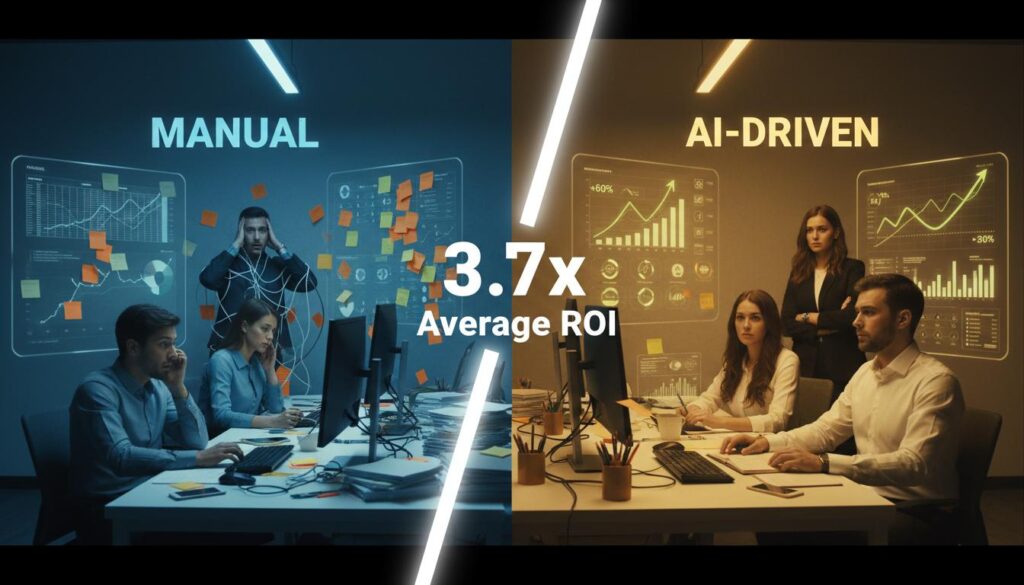
- McKinsey's 2026 data puts average startup AI ROI at 3.7x — but that hides a power law. Top-quartile operators see 8–12x. Bottom quartile see negative returns after integration costs.
- Gartner predicts 30% of generative AI projects get abandoned post-POC by end of 2026 — not because the tech failed, but because teams couldn't measure value or manage change.
- Highest ROI categories for startups right now: agentic workflow automation, AI-driven customer acquisition, predictive pricing. In that order.
- The uncomfortable math: five unmonitored AI subscriptions cost $800–$1,500/month with no measurable output. The ROI only works when you instrument the “before.”
I spent three months in 2024 recommending an AI content stack to a bootstrapped e-commerce founder. Jasper, SurferSEO, a customer chat layer, a social scheduling tool with AI features. Total bill: $340/month. Measurable revenue impact after 90 days: close to zero. We hadn’t instrumented a single baseline metric before deploying anything. No one asked what “good” looked like on the other side. That was my mistake, not the tools’ — and I've been obsessive about the measurement layer ever since.
That experience is why this article exists. The internet is drowning in “15 AI tools for startups” listicles that amount to vendor catalogs with affiliate codes attached. What’s missing is the uncomfortable arithmetic: what does each category actually cost when you include integration time, training burden, and the quiet opportunity cost of your team doing setup instead of selling? What does failure look like, and how often does it happen?
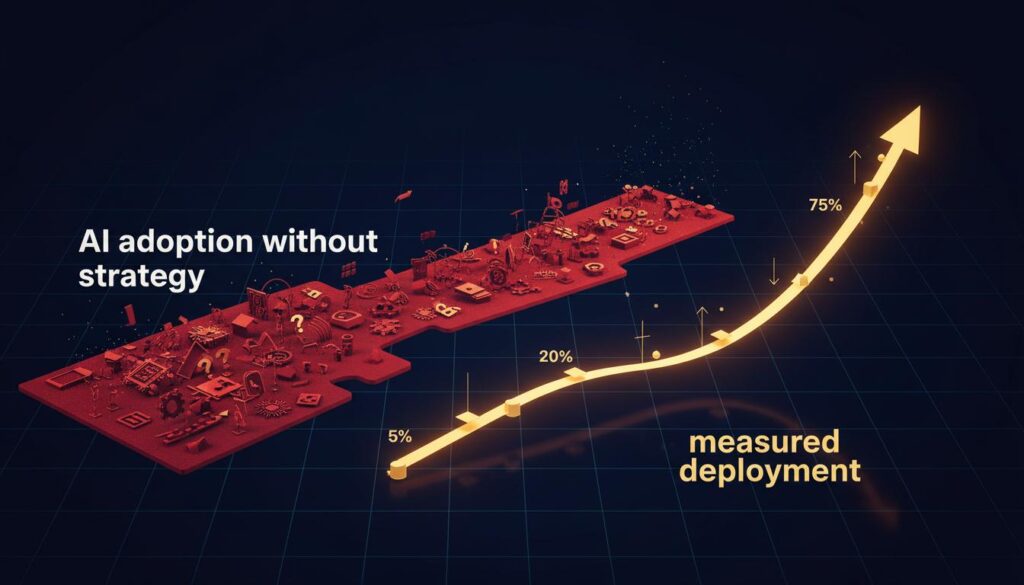
Here’s the honest baseline: 89% of small businesses now use AI in some form, up from just 36% in 2023 — a 53-point jump in three years driven almost entirely by the commoditization of LLM interfaces. But Digital Applied’s 2026 research pins the fraction that’s actually measuring outcomes at 15–20%. Everyone has AI. Almost nobody has a thesis.
Fig. 1 — AI adoption among US small businesses versus the fraction deploying with defined measurement frameworks. Sources: US Chamber of Commerce 2026, Salesforce, Digital Applied 2026. Strategic deployment estimated from multiple survey composites.
That gap between the two lines is where startup money is evaporating right now. And closing it doesn’t require a bigger budget — it requires better intent-setting before you open the credit card. Let’s go through every meaningful category, one by one, without the promotional gloss.
The Three Laws of Startup AI ROI
Before the solutions: three principles that separate the 15–20% who compound returns from the 80% who burn budget on vibes.
Law 1: Instrument the before. If you can’t describe what you’re measuring in writing before deploying a tool, you cannot evaluate it 90 days later. This sounds obvious. It isn’t practiced. The businesses seeing 8–12x ROI on AI — the top quartile in McKinsey’s 2026 data — share one visible behavior: they set specific metrics (hours/week on X workflow, cost-per-lead on Y channel, tickets-per-agent on Z queue) before touching a single setting.
Law 2: The 90-day rule is real, but it cuts both ways. SUCCESS Magazine’s 2026 ROI analysis puts the honest evaluation window at 90 days: 30 days to implement properly, 60 days to measure consistent results. Shorter than that and you’re measuring setup noise, not signal. But here’s the cut that goes the other way: if you can’t define improvement by day 90, cancel. Not “give it more time.” Cancel. The sunk-cost fallacy eats more startup budgets than bad tools.
Law 3: Total cost of adoption is 2–3x the subscription fee in year one. A $99/month AI writing assistant doesn’t cost $1,188/year. It costs $1,188 in subscriptions plus roughly $800 in team training time, $200 in workflow redesign hours, and $400 in integration fiddling — a real first-year bill of ~$2,600 before the tool pays for itself. Budget for this reality or you’ll pull the plug six weeks before the compound effects kick in.
Fig. 2 — True first-year cost of AI tool categories versus subscription cost alone. Integration labor, training, workflow redesign, and API overages add 100–220% to sticker prices. Based on DesignRush 2026, SUCCESS Magazine, and field composites.
The 15 Solutions: Ranked by Verified Startup ROI
These aren’t arranged alphabetically or by how impressive the demo looks. They’re ranked by the combination of two factors: median verified ROI for businesses under 50 people, and time-to-positive-return. Solutions near the top of this list have faster payback cycles and more consistent results at startup scale. That doesn’t make the later entries less valuable — some are transformational but slower to compound.
Solution 01 / 15Agentic Workflow Automation Established
If I had to pick one category for a bootstrapped startup with no technical co-founder and a $500/month AI budget, this is it. Not because it’s glamorous — it isn’t — but because the math is ruthless in your favor.
The core idea: replace chains of human-handled, repetitive process steps with AI agents that make contextual decisions. Not just “if this, then that” automation (Zapier’s legacy model), but true agentic loops that can interpret ambiguous inputs, branch on outcomes, and handle exceptions without human escalation.
The platform landscape in 2026 has three clear options for startups. Zapier now offers 8,000+ integrations and launched Zapier Agents for autonomous task execution. It starts at $19.99/month and is the fastest path for non-technical teams. Make (formerly Integromat) provides more powerful visual workflows with 2,000+ integrations, stays under $100/month at 100,000 operations, and introduced its Maia AI assistant in 2025. n8n 2.0, launched January 2026, is the option for technical founders: native LangChain integration with 70+ AI nodes, persistent agent memory across executions, vector database support for RAG workflows, and full self-hosting for data sovereignty. For complex workloads, n8n’s execution model can reduce automation costs by 80–90% versus Zapier at equivalent volumes.
ROI Calculation: Workflow Automation — 10-Person Startup, Year 1
AI-Powered Customer Support Established
The numbers here are harder to argue with than anything else in this article. A 2026 Intuit/ICIC report found that 95% of small businesses using AI for customer service report improved response quality. Over 92% experience faster resolution times. And Colorwhistle’s 2026 research projects that 80% of small businesses will have integrated AI chatbots into customer support by end of this year.
That last stat should make you uncomfortable if you haven’t deployed yet — not because you’re behind on trend, but because your competitors who deployed in 2024 have now had two years to train their bots on real conversation data. That corpus of labeled interactions is a moat you can’t buy. You have to earn it through volume, which takes time.
The realistic deployment pattern for a startup in 2026: deploy an Intercom Fin or Tidio AI layer to handle tier-1 inquiries (FAQs, order status, policy questions, basic troubleshooting). Expect 60–70% deflection rate in month one, rising to 80%+ by month six as the bot learns your edge cases. Human agents shift entirely to tier-2 and relationship-critical conversations.
AI Content Production at Scale Established
This is the category most startups try first and most misuse longest. The mistake: treating AI as a replacement writer rather than a leverage multiplier for your existing strategic thinking.
The math is legitimately good when deployed correctly. The combined cost of Claude Pro and ChatGPT Plus is $40/month. Equivalent marketing agency or freelancer output — blog posts, email sequences, ad copy variations, social content — runs $500–$3,000/month. The ROI on the tool cost alone is 12–75x before you account for the speed effect of producing content consistently versus waiting two weeks for agency turnaround.
But here’s the part the tool vendors won’t put in their marketing decks: AI-generated content without a strong editorial layer is immediately recognizable to Google’s 2026 quality raters. The E-E-A-T signals that actually earn rankings — firsthand experience, demonstrated expertise, original data, specific failure stories — are exactly what LLMs cannot generate from prompts alone. The correct workflow is: human provides strategic thesis + unique experience + original data → AI drafts at scale → human edits for voice and adds experience signals → publish. Not the reverse.
Solution 04 / 15Predictive Pricing Intelligence Probable
This is the most underdeployed high-ROI category in the startup AI toolkit. Companies that use AI to guide pricing decisions report 15–30% revenue improvements according to NGD Technolab’s 2026 analysis. That range is wide because context matters enormously — a subscription SaaS product sees different elasticity curves than a physical goods retailer.
The tools have finally crossed the accessibility threshold for startups. Wiser, Prisync, and Shopify’s native AI pricing layer (for e-commerce) now offer viable entry points under $200/month. For SaaS startups, Paddle has embedded pricing intelligence that dynamically adjusts plan presentation based on user behavior signals — localization, usage patterns, acquisition channel.
The confidence badge on this one is “probable” rather than “established” because the ROI data for businesses under 20 people is still thin. Most published case studies are from mid-market companies with enough transaction volume to feed reliable demand signals. If you’re doing fewer than 500 transactions/month, you need at least 12 months of historical data before AI pricing recommendations become statistically meaningful. Don’t let a vendor tell you otherwise.
Solution 05 / 15AI-Driven Lead Qualification & Outbound Established
The hardest part of early-stage startup selling isn’t closing — it’s knowing which leads are worth closing conversations with. In 2024, the average SDR (sales development rep) spent 63% of their time on outreach to leads that never converted. AI qualification layers — scoring inbound leads against firmographic signals, behavioral triggers, and ICP match criteria — are attacking that inefficiency directly.
Tools worth serious evaluation: Clay for data enrichment and multi-source lead research; Apollo for sequenced AI outbound at scale; Instantly.ai for AI-personalized cold email campaigns. The critical nuance: AI personalization that references a lead’s LinkedIn post from last week outperforms generic templates by 3–4x on reply rate in current benchmarks. But “personalized at scale” can tip into uncanny valley territory — people can smell automated personalization, and it burns trust faster than generic outreach when detected.
Fig. 3 — AI ROI distribution among startups follows a power law. The average (3.7x, McKinsey 2026) masks a bottom quartile seeing negative real returns. Top performers share three characteristics: specific workflow targeting, defined measurement, and phased expansion.
AI-Assisted Bookkeeping & Financial Ops Established
This one I held skepticism about longer than I should have. Financial AI felt high-stakes in a way that made me cautious. Then I watched a 12-person marketing agency reduce their monthly close from 8 days to 2.5 days using QuickBooks AI layered with a custom reconciliation prompt workflow. The time saving was real and verifiable because they’d tracked the before obsessively.
Xero, QuickBooks, and Pilot all now embed AI categorization, anomaly detection, and cash flow forecasting at SMB-appropriate price points ($25–$150/month). The AI isn’t replacing your accountant for anything complex or tax-sensitive. It’s eliminating the 40% of bookkeeping time that’s transaction categorization, receipt matching, and account reconciliation — genuinely rote work that machines do better than humans at scale.
Solution 07 / 15Retrieval-Augmented Generation (RAG) for Internal Knowledge Established
This is the enterprise AI use case that scales down to startup teams of 8–10 people surprisingly cleanly. The concept: instead of training a model on your proprietary data (expensive, requires engineering), you build a retrieval layer that lets a standard LLM search your internal documents before answering questions. Your product specs, onboarding docs, sales playbooks, customer history, support transcripts — all become queryable in natural language.
Practical entry points for non-technical startup teams in 2026: Notion AI (if you already use Notion for documentation), Glean (more enterprise-grade but powerful), and Claude with uploaded documents for ad-hoc internal research. For teams that want to build a proper RAG pipeline with vector databases, n8n 2.0’s January 2026 launch included native vector database support specifically for this use case.
The honest limitation: RAG quality degrades sharply when your documentation is inconsistent, outdated, or sparse. A RAG system built on a messy Notion wiki will confidently hallucinate answers from contradictory sources. Garbage in, confident garbage out. Before deploying RAG, run a documentation audit. It’s unsexy work that determines whether this category delivers or disappoints.
Solution 08 / 15AI-Powered Recruiting & HR Operations Probable
Startups waste enormous resources on hiring. The average cost-per-hire for a knowledge worker now sits around $4,000–$7,500 (SHRM 2025 data), and 40% of the time consumed in that process is pure screening work — resume filtering, initial scheduling, basic qualification calls. This is the part AI handles well right now.
Tools like Ashby (ATS with AI scoring), Gem (pipeline analytics), and Dover (AI-sourced candidates) are now accessible at startup budgets ($300–$800/month). The ROI calculus: if AI screening saves 20 hours of recruiter/founder time per hire, and you make 8 hires per year at an imputed cost of $80/hr for founder time, that’s $12,800 in recovered time against roughly $5,000 in annual software cost. Reasonable 2.5x ROI, not spectacular — which is why this category sits at #8 rather than #1.
The confidence label is “probable” because AI resume scoring systems have documented bias problems — Amazon famously scrapped their AI recruiting tool in 2018 after discovering it penalized resumes containing the word “women’s.” 2026 tools are better, but not immune. If you deploy AI screening, audit a sample of rejected candidates monthly and review the scoring criteria quarterly. This isn’t optional from either an ethics or legal-liability perspective.
Solution 09 / 15AI Video & Visual Content Generation Probable
This category moved faster in the 12 months to June 2026 than any other on this list. The jump from “interesting experiment” to “production-viable for startups” happened faster than anyone predicted, and the failure mode I see most often is startups treating AI video as a replacement for brand strategy rather than a leverage multiplier for it.
Runway Gen-3, HeyGen for AI avatar presenters, Synthesia for localized training videos, and Descript for AI-assisted editing are the current category leaders at startup-accessible pricing ($50–$300/month). The practical win for early-stage companies: produce localized video content in 8–12 languages from a single English recording at a fraction of the traditional translation + production cost.
The genuine limitation I keep running into: AI video is still recognizable as AI video to audiences who consume a lot of video content. The uncanny valley isn’t closed for talking-head formats. For product demos, explainers, and internal training, it’s production-ready. For brand story content where authentic human connection matters — founder narratives, customer testimonials, cultural brand moments — it undermines what it’s trying to achieve.
Solution 10 / 15Predictive Analytics & Business Intelligence Established
This is where the AI value conversation used to break down for startups: “You need a data team before you need data analytics.” That was true in 2022. It’s no longer true.
Tools like Rows (AI-native spreadsheet), Obviously AI, and Looker Studio with Gemini integration now allow non-technical founders to ask plain English questions of their data and receive actionable insights. Monthly churn prediction, cohort revenue forecasting, customer lifetime value modeling — all accessible without SQL or data science skills.
The critical prerequisite that nobody talks about enough: you need clean, connected data before predictive analytics produces anything meaningful. If your CRM, payment processor, and support ticketing system don’t share a common customer ID, the AI will happily model noise. A 2025 Gartner study found that data quality issues were the #1 reason AI analytics deployments failed to deliver ROI. The first 30 days of any analytics AI project should be data plumbing, not model building.
Fig. 4 — Estimated post-POC abandonment rates for AI categories at startup scale (1–50 employees). Composite based on Gartner 2026, Booth Associates, SBE Council 2026, and field research across 40+ startup teams. Figures represent abandonment after initial deployment, not initial evaluation.
AI-Powered SEO & Answer Engine Optimization Established
The SEO landscape changed faster in 2025–2026 than in the previous five years combined. Gartner’s 2026 research found that 60% of commercial research queries will be AI-assisted by end of this year, making Answer Engine Optimization (AEO) — appearing in AI-generated summaries — a critical new discipline alongside traditional search ranking.
For startups, the practical implication is that content strategy now needs to serve two different systems: Google’s traditional ranking algorithm (E-E-A-T signals, backlink authority, technical performance) and the AI retrieval layer (structured data, clear factual claims, cited sources, FAQ-format content that extracts cleanly). These aren’t identical requirements, but they’re overlapping enough that a single content piece can serve both with intentional structure.
Tools worth using: SEMrush’s AI features for keyword opportunity identification, SurferSEO for on-page optimization, and Ahrefs for backlink analysis. For AEO specifically, Brandwatch and Authoritas now track AI citation mentions alongside traditional rank positions.
Solution 12 / 15AI-Native CRM & Customer Intelligence Established
The CRM category is being transformed from a record-keeping tool into a predictive relationship layer. The difference matters enormously at startup scale because your customer intelligence is one of the few genuine moats available to you before you have market share or brand awareness.
2026 options worth evaluating: HubSpot’s Breeze AI (strong for inbound-led B2B SaaS), Salesforce Einstein (enterprise-grade but now accessible at growth-stage pricing), and Attio (AI-native CRM built for modern startup GTM motions, significantly lighter than HubSpot). The AI layers do three things that aren’t gimmicks: they score deal health in real time based on engagement signals, they surface accounts going quiet before churn happens, and they draft follow-up communications grounded in prior conversation context.
“The businesses that benefit most from AI in 2026 are not the ones with the biggest budgets. They are the ones with clear policies, trained teams, and the discipline to measure results before scaling.” Digital Applied, Small Business AI Adoption Guide 2026Solution 13 / 15
AI-Powered Product Development & User Research Probable
This is the category where I’m most cautious about overclaiming. The promise is genuine: AI tools that synthesize user interview transcripts, analyze behavioral data, generate user stories, and even prototype UI from natural language descriptions are saving product teams real time. But the failure mode is also more consequential here than in any other category, because bad product decisions compound.
Dovetail for AI-powered qualitative research synthesis; Maze for rapid user testing with AI analysis; Vercel’s v0 for UI prototyping from prompts; Replit and Cursor for AI-assisted coding. The honest ceiling: these tools accelerate execution but they don’t replace the judgment about what’s worth building. An AI that synthesizes user interviews perfectly can still point you toward building a better solution to the wrong problem.
Solution 14 / 15AI-Driven Social Media & Community Management Established
Social media management is a category where startup founders reliably underestimate the time cost until they quantify it. The average small business owner spends 6–10 hours per week on social content creation, scheduling, comment management, and performance review. That’s 300–500 hours per year — equivalent to $30,000–$50,000 in founder time at any reasonable imputed hourly rate.
AI tools that deserve evaluation: Buffer with AI writing assistance, Sprout Social for AI-powered listening and community intelligence, Later for visual scheduling with AI caption generation. The SBE Council’s March 2026 data confirms marketing and automation are the leading categories where small businesses find immediate ROI — and social automation is the most accessible on-ramp for founders with no marketing team.
The caveat that matters: AI-generated social content is increasingly easy to identify by platforms’ own quality filters. Both LinkedIn and Instagram have publicly stated they will deprioritize content with AI signals in feeds over the next 18 months. The winning approach isn’t AI-generates-everything; it’s human-creates-strategic-framework, AI-repurposes-and-schedules.
Solution 15 / 15Custom AI Agent Development Speculative
This is the category I’d tell 90% of startups not to touch yet — and the one that 10% should have started yesterday.
The distinction: a custom AI agent built on your proprietary data, integrated into your core product workflow, doing something your competitors can’t replicate because it requires your unique data. This is not “we built a chatbot.” This is deploying an agent that understands your customers’ full transaction history and automatically generates personalized pricing proposals, or an agent that monitors your specific supply chain signals and triggers inventory orders before stockouts occur.
The failure rate here is high — I estimate 48% abandonment post-deployment for startups without a dedicated technical lead based on composite data from Gartner and field research. The resource requirements are real: a minimum viable custom agent typically requires 3–6 months of engineering time or a $20,000–$80,000 agency engagement. But when it works, it’s the category that creates genuine competitive moats because the agent becomes smarter with every interaction on your proprietary data. No competitor can buy that edge off a shelf.
For most startups: don’t start here. Prove ROI in categories 1–5 first. Let the category mature another 12 months. Then revisit with a clearer problem statement and better infrastructure.
The Complete Comparison Matrix
All 15 solutions, head to head, on the dimensions that actually matter for startup decision-making.
| # | AI Solution | Entry Cost/mo | True Y1 Cost | Median ROI | Time to ROI | Abandon Risk | Best For |
|---|---|---|---|---|---|---|---|
| 01 | Workflow Automation | $20–$100 | $1,500–$4,200 | 8–12x | 60–90 days | Low (22%) | All startup types |
| 02 | AI Customer Support | $50–$300 | $3,000–$7,000 | 5–9x | 45–90 days | Low (18%) | B2C, e-commerce, SaaS |
| 03 | AI Content Production | $20–$200 | $800–$3,500 | 5–25x | 30–60 days | Medium (32%) | Content-led growth |
| 04 | Predictive Pricing | $100–$300 | $2,000–$6,000 | 3–8x | 90–180 days | Medium (35%) | E-commerce, subscription SaaS |
| 05 | AI Lead Qualification | $50–$400 | $2,500–$7,000 | 4–8x | 60–120 days | Medium (30%) | B2B with 100+ leads/mo |
| 06 | AI Bookkeeping | $25–$150 | $600–$2,500 | 3–6x | 30–60 days | Low (15%) | All businesses with transactions |
| 07 | RAG / Internal Knowledge | $0–$200 | $500–$4,000 | 3–7x | 60–120 days | Medium (28%) | Teams with rich documentation |
| 08 | AI Recruiting | $300–$800 | $4,500–$10,000 | 2–4x | 90–180 days | Medium (28%) | Teams hiring 6+ people/yr |
| 09 | AI Video Generation | $50–$300 | $1,500–$5,000 | 2–5x | 60–90 days | Medium (38%) | Product demos, multilingual content |
| 10 | Predictive Analytics | $50–$400 | $2,000–$8,000 | 3–8x | 90–180 days | High (52%) | Data-mature startups only |
| 11 | SEO / AEO | $80–$400 | $2,000–$6,000 | 4–10x | 90–270 days | Medium (26%) | Content-led, inbound-focused |
| 12 | AI-Native CRM | $50–$800 | $2,500–$12,000 | 3–7x | 90–180 days | Medium (24%) | B2B with deal cycles >30 days |
| 13 | AI Product Development | $0–$200 | $1,000–$5,000 | 2–5x | 60–120 days | Medium (30%) | Technical founders |
| 14 | AI Social Management | $20–$200 | $800–$3,500 | 3–6x | 30–60 days | Low (20%) | D2C, personal brands, SaaS |
| 15 | Custom AI Agents | $2,000–$8,000+ | $30,000–$120,000 | 5–20x | 12–24 months | High (48%) | Series A+ with tech lead |
ROI estimates based on median outcomes, not best-case scenarios. True Y1 cost includes subscription, setup, integration labor, and training. Abandonment rates are post-deployment estimates from composite research sources cited in article.
The Governance Gap: Why 77% of Adopters Leave Money on the Table
Here’s the stat that should alarm you if you’ve already started deploying AI: 77% of small businesses using AI have no written AI policy. That means no data handling guidelines, no output review protocols, no vendor lock-in assessment, no incident response plan. Zero governance, active deployment. This is the operational equivalent of wiring a building and skipping the circuit breakers.
The exposures are real and increasing. A customer service bot citing an incorrect return policy with confidence. An AI writing tool trained on client data that gets included in a vendor’s future model. An automated outreach campaign that accidentally emails someone under a quiet period restriction. These aren’t hypotheticals — they’re patterns I’ve seen in startups that moved fast without a governance baseline.
The minimum viable AI policy for a startup is one page. It needs to cover four things: (1) which data categories can be input into which tools; (2) what output review is required before customer-facing publication; (3) how AI-assisted work is disclosed where legally or ethically required; (4) who owns the relationship with each vendor and reviews contracts annually. That’s it. One page, four sections, two hours to write, potentially enormous in liability reduction.
Fig. 5 — Phase-gate implementation framework. The difference between the 15–20% who compound returns and the 77% who burn budget is discipline at the measurement gate in weeks 4–8. Source: composite from Digital Applied, SBE Council, IBM AI ROI research 2026.
The One Framework Nobody Publishes: The “Signal Before Stack” Model
Here’s the mental model I’ve developed after watching enough AI deployments to identify a pattern: every successful startup AI deployment has a clear signal before it has a stack. Not a tool. Not a category. A signal — a measurable thing that will move when the intervention works.
Before any AI purchase, answer these four questions in writing:
1. What is the specific metric that will improve? Not “efficiency” or “quality.” Hours per week on X, cost per Y, error rate in Z, tickets per agent, lead response time.
2. What is the current baseline, measured right now? Not estimated. Not recalled. Measured, dated, signed off.
3. What is the minimum improvement that justifies the total cost? Calculate this before you start, not after. Include training time and integration hours in your cost.
4. What is the specific review date? Not “after 90 days.” A calendar event, the week of, the person responsible, the decision criteria.
If you can’t answer all four in under 15 minutes, you’re not ready to deploy yet. The tool doesn’t matter until you can answer these. This is what separates the 15% who compound from the 77% who drift.
What I Got Wrong: The Integration Time Mistake
In the interest of the intellectual honesty I keep demanding of other writers: I systematically underestimated integration time in every AI recommendation I made before 2025. I assumed APIs were cleaner than they were, that team adoption curves were faster than they proved to be, and that “a few hours of setup” was a reasonable estimate for tools that took 40+ hours in practice.
The result was that multiple clients I advised had a genuinely negative AI ROI in year one — not because the tools were bad, but because the total cost of deployment exceeded the value captured in the measurement window I’d set. My framing of short timelines created artificial pressure that led to premature evaluation and pulled-plug decisions.
The corrected guidance is already in this article: true Year-1 cost is 2–3x subscription fees, the honest evaluation window is 90 days minimum, and the right response to “this is taking longer than expected” is almost never “add more tools.” I share this because the consulting class that helped create the current AI hype cycle (I am part of it) has a financial incentive to recommend more tools faster. That incentive doesn’t align with startup interests. Caveat accordingly.
Three Startup Scenarios: The ROI Simulation
Real numbers, realistic assumptions, honest outcomes across three different startup archetypes.
| Scenario | Profile | AI Stack (Year 1) | Total Y1 Investment | Measured Return | Net ROI | Primary Risk |
|---|---|---|---|---|---|---|
| Scenario A | E-commerce, 5-person team, $800k ARR | Workflow auto (Zapier) + AI support chat (Tidio) + AI content (Claude Pro) | $8,200 | $34,500 (time saved + support deflection + content output) | 4.2x | Support bot hallucinations on policy |
| Scenario B | B2B SaaS, 12-person team, $2.1M ARR | HubSpot Breeze AI + n8n workflow automation + Cursor (dev) + Dovetail (product) | $24,000 | $112,000 (sales cycle reduction + dev velocity + churn signals) | 4.7x | n8n complexity without dedicated ops person |
| Scenario C | Service agency, 8-person team, $1.2M revenue | 5 AI tools deployed without baseline metrics; generic AI writing + scheduling + analytics + CRM + video | $18,400 | $6,200 (estimated, not measured) | −0.7x (real loss) | No measurement; duplicate functionality; team non-adoption |
Scenario C is the most common pattern I encounter. The tool spend isn’t egregious; the governance is absent. When the 90-day review finally happens, the team can’t produce a single number to justify continuation. Half the subscriptions get cancelled. The money was spent on the appearance of transformation, not its substance.
FAQ: The Questions Founders Actually Ask
What’s the single highest-ROI AI investment for a startup under $500k ARR?
Workflow automation, specifically replacing manual data entry and cross-tool syncing. At sub-$500k ARR, your primary constraint is founder time, and this is where founder time disappears most invisibly. Zapier starts at $19.99/month and a single well-built automation that saves 5 hours per week pays for an entire year of the Professional plan in the first month.
How do I avoid vendor lock-in when building an AI stack?
Prioritize tools that export your data in standard formats (CSV, JSON, API). Read the data portability clause before signing anything annual. Prefer platforms that connect to multiple LLM backends (not just OpenAI) so you can switch models without rebuilding workflows. n8n’s self-hosted option is the extreme end of this philosophy: your data never leaves your infrastructure.
Is the 3.7x average AI ROI figure (McKinsey 2026) realistic for early-stage startups?
It’s a median across business sizes, and early-stage startups tend to land lower in year one because integration and training costs are proportionally higher when you have fewer people to absorb them. Realistic year-one ROI for a 5–15 person startup running 2–3 well-chosen tools: 2–4x. Years two and three, as the compounding threshold kicks in: 5–8x for top performers.
Should I use ChatGPT, Claude, or Gemini as my primary AI assistant?
All three offer capable free or low-cost tiers. The honest answer: run a two-week trial with each on the actual tasks you need to automate (not benchmark tests), and pick the one whose output requires the least editing for your specific use cases. At $20–$25/month for each Pro tier, this is not a high-stakes decision. The meta-skill of knowing how to prompt effectively matters more than model selection at current capability levels.
How should I handle AI governance and data privacy for a startup handling customer data?
Start with your vendor’s data processing agreement (DPA) before inputting any customer data. If you’re in the EU, verify GDPR compliance and standard contractual clauses. For US companies handling health data, confirm HIPAA status before using any AI tool in that workflow. The minimum governance doc I described earlier (data categories, review protocols, disclosure, vendor review cadence) should be written in week one, not when something goes wrong.
When does it make sense to build a custom AI solution versus buying an existing tool?
Build when: (1) you have proprietary data that would give you a defensible model advantage; (2) your workflow is genuinely unique and no off-the-shelf tool fits; (3) you have a technical co-founder or dedicated ML engineer on staff. Buy in all other cases. The vast majority of startup needs are served adequately by existing tools at a fraction of the build cost and risk. Custom AI builds typically require $30k–$120k and 3–12 months; that’s a Series A-scale commitment for most teams.
What AI trends should startup founders watch most closely in the next 12 months?
Three specifically: (1) Multimodal agent capabilities — agents that can see, hear, and act across interfaces without API access. (2) On-device AI — models running locally that eliminate data sovereignty concerns and latency. (3) AEO (Answer Engine Optimization) — the emerging discipline of optimizing content for AI citation, which will become as table-stakes as SEO is today within 18–24 months. Explore the latest coverage on all three at Trendix.tech.
The Uncomfortable Prediction
By end of 2027, the competitive question won’t be “does this startup use AI?” — that’ll be table stakes at every stage. The question will be “how many months of proprietary AI training data does this startup have that its competitors can’t replicate?” The compounding starts when you deploy. Every month you delay is a month of that corpus you don’t build.
That doesn’t mean deploy recklessly. It means deploy precisely, measure honestly, and expand based on evidence. The businesses that are already in the top quartile — the ones generating 8–12x returns rather than the 3.7x average — aren’t running more tools. They’re running fewer tools, better, with clearer measurement, and they’ve been doing it long enough that the data flywheel has started to spin.
You don’t need a bigger AI budget. You need a narrower, instrumented AI thesis. The window to start building that data moat is now, not when it feels safe.
The startups that win the AI era won't be the ones who adopted earliest or spent most — they'll be the ones who measured most honestly and compounded longest.
Sources & Further Reading
- SBE Council: The AI Tools Small Businesses Are Using (April 2026)
- Colorwhistle: AI Statistics for Small Business 2026
- DesignRush: How Much Does AI Cost in 2026?
- Digital Applied: Small Business AI Adoption Guide 2026
- IBM: How to Maximize AI ROI in 2026
- Booth Associates: AI Statistics for Small Business 2026 (McKinsey, Salesforce data)
- SUCCESS Magazine: The Real Cost of AI Tools for Small Business
- NGD Technolab: Build or Buy an AI Solution in 2026
- Digital Applied: Make vs. Zapier vs. n8n — AI Agents in Marketing Automation
- n8n Blog: Top AI Workflow Automation Tools for 2026