

AI for Small Business:
The Complete Honest Guide
Beyond the hype, past the fear — what’s actually working, what it costs, what it risks, and how to build an AI stack that earns its keep. Based on the latest data from the SBA, Salesforce, QuickBooks, JP Morgan Chase, and the Federal Reserve.
The Reality Check First
There’s a particular kind of exhaustion that comes from reading too many articles about AI for small business. They tend to fall into two camps: breathless enthusiasm that makes you feel like you’re missing out on a revolution, or doom-and-gloom warnings that robots are coming for every job you’ve ever known. Neither is especially useful if you’re running a twelve-person landscaping company or a thirty-seat restaurant trying to figure out whether a $25-a-month chatbot is actually worth it.
So let’s start with something unusually honest: AI is neither magic nor a threat for most small businesses right now. It’s a set of software tools — some genuinely impressive, some overhyped to the point of embarrassment — that can save you real time on specific tasks if you choose carefully and implement deliberately. That’s it. That’s the whole story.
The businesses getting real value from AI in 2026 aren’t doing anything exotic. They’re using AI-assisted customer chat to stop losing leads at 11pm. They’re using writing tools to get email campaigns out faster. They’re letting AI sort their QuickBooks categories instead of doing it manually on Sunday afternoons. The gap between a small business that’s benefiting from AI and one that isn’t usually comes down to one thing: specificity. The specific problem, the specific tool, the specific workflow.
Where Adoption Actually Stands in 2026
The adoption numbers you’ll see thrown around vary wildly depending on who’s asking and what they’re counting. That’s worth understanding, not ignoring. When the US Census Bureau’s Business Trends and Outlook Survey uses strict production-use definitions, about 18% of US firms were using AI at the end of 2025. The US Chamber of Commerce, using a broader definition that includes experimentation, puts the number at 58% for 2025. QuickBooks, drawing on data from 34,000 business owners and 5.3 million actual QuickBooks businesses, finds 68% regular AI use in 2026.
None of these numbers is wrong — they’re measuring different things. But together they tell a coherent story: AI adoption among small businesses has accelerated dramatically and is now mainstream in any meaningful sense of that word. The Federal Reserve’s analysis is particularly interesting: firms founded in 2025 reached a 10% AI adoption rate within just six months of opening, compared to over six years for firms started in 2019. This is a genuinely significant shift in how new businesses are set up from day one.
The gap between large and small businesses in AI adoption shrank from 1.8x to 1.2x between 2024 and 2025, according to the SBA Office of Advocacy. Small businesses are catching up faster than at any point in this technology’s history — and newer small firms are starting with AI baked in from day one.
One data point that doesn’t get enough attention: by 2025, the ratio of consistent AI users to sporadic AI users among small businesses reached 1.8, up from about 1.2 during the initial ChatGPT-launch frenzy in 2022-2023. That recovery suggests that after an initial wave of “let me try this thing,” small businesses are settling into regular, operational use rather than occasional experimentation. The tools are becoming part of the daily workflow, not just something you play with on a slow Thursday.
| Source | Reported Adoption Rate | Methodology | Date |
|---|---|---|---|
| US Census BTOS | ~18% (production use) | Strict: AI in producing goods/services | End 2025 |
| US Chamber of Commerce | 58% | Broad: includes generative AI tools | 2025 |
| QuickBooks / Intuit | 68% (regular use) | 34,000 SMB survey + 5.3M business data | 2026 |
| SBE Council | 82% have invested in AI tools | Employer firms only | March 2026 |
| OnDeck / Ocrolus | 58% use AI; 89% report positive impact | 651 SMBs with working capital loans | March 2026 |
| Reimagine Main Street (PayPal) | 76% using or actively exploring AI | Broad: includes exploration phase | 2025 |
What’s Actually Working — The Use Cases That Matter
Marketing consistently comes out on top. Not by a little — by a lot. The SBE Council’s 2026 Small Business Tech Use Survey lists marketing as the #1 AI use case for small businesses, with content creation and campaign support delivering immediate, measurable ROI in time savings and customer reach. And it makes sense. A small business owner who used to spend four hours writing a monthly email newsletter can now spend forty-five minutes, with AI handling the first draft and the owner doing what only they can do — applying judgment, brand voice, and local knowledge.
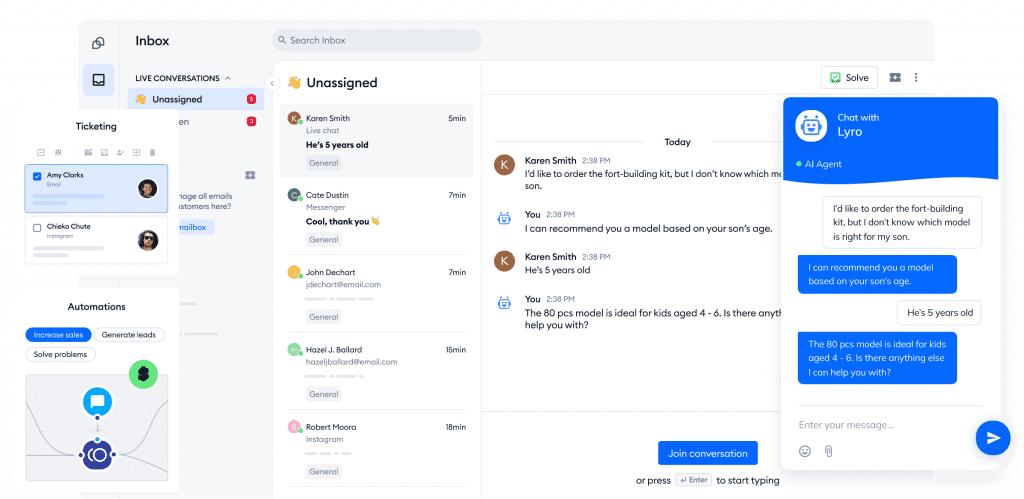
The second category that’s genuinely delivering is customer engagement. Chatbots and AI-powered customer service tools are doing something that matters enormously for small businesses: they’re handling inquiries when the owner is asleep. You’ve probably seen the statistic that 74% of consumers now expect 24/7 service availability (Zendesk, 2026). That expectation was always there — people just didn’t say it out loud. An AI customer service tool at $29-$40 per month that captures leads and answers basic questions at 2am is doing something genuinely valuable, not just sounding impressive in a marketing deck.
Content & Marketing
Email campaigns, social posts, product descriptions, ad copy. AI reduces time-to-publish dramatically while maintaining quality — especially useful when there’s no marketing team to speak of.
Customer Support & Chat
AI chatbots convert at 10-15% vs. 2% for contact forms (Oscar Chat, 2026). After-hours lead capture alone justifies the cost for most service businesses.
Workflow Automation
Tools like Make and Zapier with AI components handle the repetitive connective tissue: sending follow-up emails, updating CRM records, booking confirmations. Hours saved every week.
Financial Management
AI-enhanced QuickBooks and similar tools automatically categorize expenses, flag anomalies, and predict cash flow — tasks that used to require an accountant or a painful Sunday night.
Dynamic Pricing
An emerging frontier: 65% of small businesses are using or planning to implement AI pricing tools (SBE Council 2026). Restaurants, hotels, and service firms are seeing margin improvements.
Visual Content
Canva’s AI and similar tools make professional-looking graphics achievable without a designer on payroll. Brand consistency gets easier; one-off social assets become fast.
The third use case worth calling out separately is administrative automation — the category the SBE Council calls “one of the fastest-growing uses of AI.” This is AI handling scheduling, transcribing meetings (Fathom, Fireflies, Otter.ai), summarizing documents, and routing inquiries. It’s unglamorous work, but saving a team of five people two hours a week each is ten hours of capacity recovered — that’s real money, and it compounds.
What’s notably not delivering consistent value yet for most small businesses: anything involving complex internal data analysis that requires clean, structured historical data (which most small businesses don’t have), sophisticated AI hiring tools (usually overkill and occasionally legally risky), and elaborate AI-generated video for marketing unless you’re in a vertical where that format actually converts.
The 2026 Small Business AI Stack (With Real Pricing)
The average small business is now running a median of five AI tools according to the SBE Council — and the best-performing businesses aren’t running the most tools, they’re running the best-integrated ones. Salesforce’s 2025 SMB research found that businesses running three to five well-integrated tools reported twice the productivity gains of those running ten or more fragmented apps. So the goal isn’t a comprehensive AI ecosystem — it’s a focused, integrated stack where each tool connects to something else you already use.
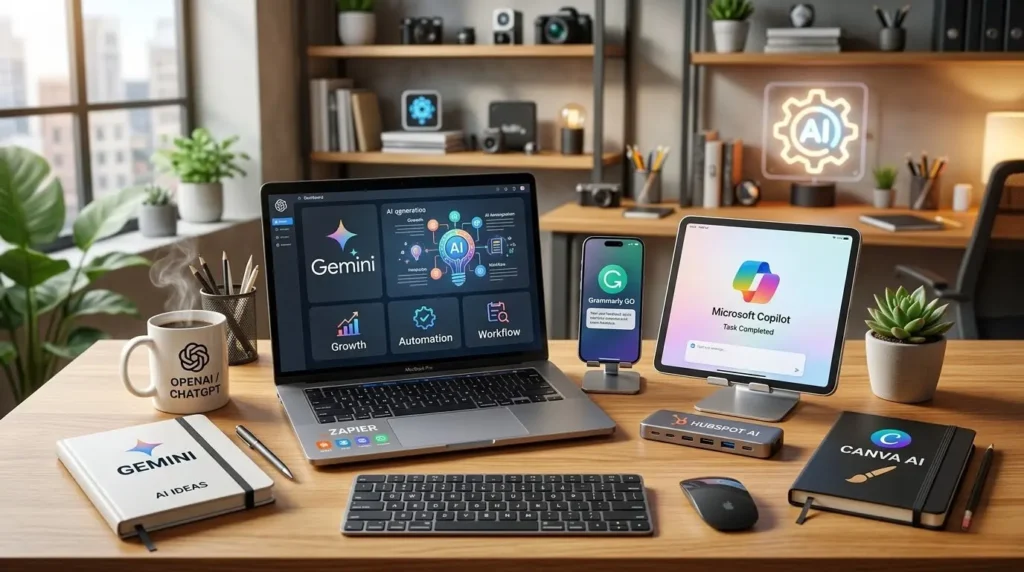
Here’s what a sensible 2026 stack looks like for a typical small business, with honest assessments of each layer:
What it actually does
Drafts emails, summarizes documents, answers complex business questions, writes first-cut marketing copy, creates business plans and SOPs. The flexible Swiss Army knife of the AI stack.
Honest assessment
ChatGPT dominates market share. Claude is worth considering for legal, finance, and research-heavy work — its longer context window and document handling are genuinely better. Start with one; don’t pay for both unless there’s a clear reason.
What it actually does
Connects your other tools so they talk to each other. New form submission automatically creates a CRM contact, sends a welcome email, and books a calendar slot — without anyone touching it.
Honest assessment
Make is more powerful and cheaper than Zapier at comparable automation volume; Zapier has a gentler learning curve. Either is fine. This layer often delivers the fastest, clearest ROI of anything in the stack.
What it actually does
AI chatbot on your website that answers questions, qualifies leads, books appointments, and handles basic support — 24 hours a day, without payroll.
Honest assessment
Oscar Chat is the best value at ~$40/month for all-in-one (chatbot + live chat + popups). Tidio is solid for e-commerce. Intercom Fin is excellent but enterprise-priced. For most small businesses, the mid-tier options are entirely sufficient.
What it actually does
Joins Zoom/Teams/Meet calls automatically, transcribes everything, generates a clean summary with action items, and syncs to your CRM or Slack. You stop taking notes during calls.
Honest assessment
Fathom’s free tier is genuinely excellent — unusual in AI tools. Start there. Fireflies is marginally better for searchable archives across a large call history. Both outperform Otter.ai for meeting-specific use.
What it actually does
Auto-categorizes transactions, flags unusual spending, predicts cash flow, automates invoice matching. The AI in modern accounting tools has improved enough to eliminate most manual bookkeeping for simple business structures.
Honest assessment
If you’re already using QuickBooks, the AI features are mostly included — make sure you’re using them. The ROI on financial AI is high partly because the alternative (manual categorization, missed invoice errors) has a real, measurable cost.
Small businesses spent an average of $2,340 on AI subscriptions in 2025, and roughly 31% of those tools went unused within 90 days (Gartner, July 2025). The full stack above runs $65–$300 per month — far less than the industry average spend. Start narrow, prove the ROI, then add. The problem is rarely not having enough AI tools; it’s paying for tools the team hasn’t actually adopted.
Real ROI Numbers — What Small Businesses Are Actually Seeing
ROI from AI tools isn’t just about cost savings, though that’s real too. It shows up in recovered time, captured revenue that would otherwise be lost, and a measurable improvement in the speed and quality of work. The numbers from credible sources are encouraging — with some important caveats.
| AI Use Case | Reported Impact | Source | Reliability |
|---|---|---|---|
| AI chatbots vs. contact forms | 10-15% conversion vs. 2% for forms | Oscar Chat, 2026 | Vendor data |
| Marketing team time savings | 12-18 hours/week | Builts AI, 2026 | Vendor data |
| SMBs with AI reporting revenue boost | 91% say AI boosts revenue | Salesforce SMB Research, 2025 | Large-sample survey |
| Microsoft 365 Copilot ROI | 132–353% ROI over 3 years; 20% operating cost reduction | Microsoft / AI Tool Discovery, 2026 | Third-party verified |
| SMBs with AI: 40% productivity gains | 40% reported improvement | Multiple sources (AI Tool Discovery, 2026) | Self-reported |
| Payback period | 7–11 months for initial AI investment | Multiple surveys, 2026 | Aggregated |
| Cost reduction (conservative) | 54% of firms using AI report minimum 1% cost reduction | Survey via CloudEagle, 2026 | Self-reported |
A note on reading these numbers honestly: most AI ROI data comes from vendor surveys or self-reported business owner assessments, both of which have obvious biases. Businesses that adopted AI successfully are more likely to respond to surveys about AI. The Microsoft Copilot ROI figure is the strongest here because it comes from an independent analysis using real financial data — and even so, the range is enormous (132% to 353%), meaning your results will depend heavily on your specific use case, team size, and how well implementation goes.
The most useful framework for thinking about ROI at the small business level is simple: if a tool saves one hour per week and costs $20 per month, it pays for itself at $5/hour of your time. Most business owners and employees are worth significantly more than that to their companies. Under those conditions, a lot of tools clear the bar — the question is just whether they’re actually being used.
Case Studies — Small Businesses Getting Real Results
HVAC Company Stops Losing After-Hours Leads
A 14-person HVAC company in the US Southeast was losing an estimated 30-40% of their weekend and evening inquiries because no one was available to respond within the first hour — the window where conversion rates are highest. They implemented an AI chatbot (Tidio at $50/month) trained on their service area, pricing brackets, and FAQ. The bot qualifies leads, books diagnostic appointments, and captures contact information for anything it can’t handle.
Eight weeks after launch: after-hours inquiry capture rate went from near zero to 78%. Booked appointments from the chatbot alone were covering the monthly tool cost within the first week of each month. Owner’s note: “I was skeptical because I thought customers would hate talking to a bot. Turns out they just hate waiting. If the bot answers in five seconds at midnight, they’re fine with it.”
Boutique Clothing Brand Rebuilds Email Marketing Without a Team
A solo-founded fashion e-commerce brand with about $800K in annual revenue was sending one email newsletter per month because it was taking two full days to write, design, and schedule. The owner implemented ChatGPT Plus for copy, Canva AI for imagery and layout, and Mailchimp’s built-in AI for send-time optimization. Total additional cost: $35/month beyond tools already in use.
Within three months, email frequency went from monthly to twice-weekly. Revenue from email as a channel increased by 34%. Time per campaign dropped from 16 hours to about 90 minutes. The owner kept the editorial voice by using AI for structure and drafts, then spending 20 minutes adding personal touches and story — which she says has actually made the emails more genuine, not less, because she’s not exhausted when writing them.
Small Accounting Firm Automates Client Onboarding and Document Review
A five-person accounting firm spent roughly 40% of senior staff time on client onboarding: collecting documents, answering the same intake questions, and preparing initial review summaries. They implemented a combination of Fathom for discovery calls, Claude Pro for document summarization and initial review notes, and Make for automated document request workflows.
Result: onboarding time for a new client dropped from 8+ hours of staff time to about 2.5 hours. The firm was able to take on four additional clients per quarter without hiring. Cost of the AI tools: approximately $60/month total. Annual revenue added: approximately $48,000. They’ve since started using AI for audit preparation and are exploring dynamic pricing for different client tiers.
The Risks You Actually Need to Worry About
Most articles about AI for small business either ignore the risks entirely or catastrophize them. The reality is more nuanced: there are real risks, some of them genuinely serious, but most of them are manageable with reasonable precautions. The ones that matter most for small businesses aren’t existential — they’re operational and legal.
Data Privacy & Shadow AI
Sensitive data makes up 34.8% of employee ChatGPT inputs (2025 research) — a dramatic increase from 11% in 2023. Employees aren’t being malicious; they’re being efficient. But business data, client information, and financials in consumer-grade AI accounts create real exposure. IBM found 20% of organizations suffered a breach last year related to shadow AI usage. Establish clear policies about what data can and cannot go into which tools.
Over-Reliance on AI Outputs
AI-generated content, analysis, and advice can be wrong in very confident-sounding ways. Small business owners who’ve used AI to draft legal clauses, financial projections, or compliance documents without professional review have encountered expensive surprises. AI is a first-draft tool, not a final authority. Budget for human review of anything with significant legal or financial consequences.
Skills Gap & Adoption Failure
43% of business leaders cite lack of AI expertise as their biggest barrier (Hostinger survey, 2026). And 31% of AI tools go unused within 90 days (Gartner, 2025). A tool nobody uses doesn’t just fail to deliver ROI — it costs money and erodes confidence in AI generally. Prioritize adoption and training over tool acquisition.
Regulatory Compliance
The EU AI Act is now in effect, with prohibited practices including real-time biometric surveillance and certain social scoring applications. Colorado enacted consumer AI regulations effective February 2026 requiring disclosure of high-risk AI applications. If you use AI in customer-facing decisions, check your local requirements. The rules are evolving fast enough that what was acceptable last year may not be this year.
Vendor Lock-In
Building critical workflows around a single AI vendor creates dependency risk if that vendor raises prices, changes terms, or shuts down a product. Maintain human-readable documentation of your processes. Don’t build workflows that only work if one specific AI tool is available.
Brand Voice Dilution
AI-generated content that isn’t carefully edited tends toward a certain blandness. Customer communications that sound generic — or obviously AI-written — erode the trust that small businesses often depend on more than large ones. Use AI for structure and speed; invest human time in voice, specificity, and authenticity.
Use consumer AI tools (free ChatGPT, personal Claude accounts) only for tasks involving publicly available or entirely internal/non-sensitive information. For anything involving client data, financial records, employee information, or proprietary business processes, use either enterprise-grade tools with appropriate data agreements, or keep the AI working with anonymized/generalized information. This one rule eliminates most of the meaningful privacy exposure.
How to Start — and Not Make the Common Mistakes
The single most common mistake is trying to “implement AI” as a general project. That’s not a plan — it’s an aspiration that leads to buying several subscriptions, confusing your team, and abandoning the effort after three months having seen minimal results and spent meaningful money. The businesses that extract real value from AI do something much simpler: they identify one painful, repetitive problem and solve it with one tool.
-
Start with the pain, not the tool
Write down the five most repetitive, time-consuming tasks in your business that don’t require your unique judgment. Not “improve customer service” — that’s too vague. “Answer the same 12 FAQ questions via email 40 times a week.” That’s a problem with a tractable AI solution.
-
Choose one tool, implement it properly
Pick the tool that best addresses your #1 pain point. Spend two weeks actually setting it up, integrating it with your existing tools, and training your team on it. Don’t add a second tool until the first one is genuinely part of your workflow.
-
Set measurable baselines before you start
If you can’t answer “how long does this task take now?” and “what does it cost now?” before you implement an AI tool, you won’t be able to prove the ROI afterward. Write down the current numbers. Time per email campaign, cost of responding to after-hours leads, hours per week on manual categorization. Then measure again after 30 days.
-
Establish your data policy on day one
Before your team starts using any AI tools, decide and document: what data can go into which tools, who approves new AI tool purchases, and what outputs require human review. This takes 30 minutes and prevents most of the serious risks. Post it somewhere visible.
-
Expand only once the first tool is earning its cost
If tool #1 is saving time or generating measurable revenue, add tool #2. If it’s not, fix the implementation or change the tool before adding more. The “AI stack” should grow in proportion to demonstrated value, not in proportion to your enthusiasm for the technology.
What’s Coming — The Next 12-18 Months for Small Business AI
A few trends are worth tracking, even if you’re not ready to act on them yet.
Agentic AI — tools that can carry out multi-step tasks autonomously, not just respond to a single prompt — is moving from research labs into commercial products. In practical terms for small businesses, this means software that can research a potential client, draft an outreach email, schedule a follow-up, and update your CRM with the outcome, all triggered by a single instruction. The early versions of these tools exist now; the reliable, small-business-accessible versions are probably 12-18 months away for most use cases.
AI in every SaaS tool you already use is already happening and will accelerate. Your accounting software, CRM, email platform, and scheduling tool all have AI features being added continuously. The best AI adoption strategy for most small businesses in the near term might simply be turning on and actually using the AI features in tools you’re already paying for — that’s free productivity waiting on the table.
AI pricing and forecasting is the emerging frontier that’s generating the most excitement among small businesses that have moved past the marketing-and-automation basics. The SBE Council found 65% of small businesses are either using or planning to implement AI pricing tools. For businesses in competitive markets — hospitality, food service, professional services — dynamic pricing guided by AI could become a meaningful competitive differentiator within two years.
Regulation will tighten, slowly but genuinely. The EU AI Act, Colorado’s February 2026 rules, and proposed federal frameworks in the US are the beginning of an era where AI-using businesses face compliance requirements the way they currently face data privacy requirements. Businesses that start developing good AI governance practices now — data policies, usage documentation, output review processes — will have less catching up to do than those who don’t.
By the end of 2026, 80% of small businesses plan to integrate AI chatbots into their customer support strategies (ColorWhistle, 2026). If you operate in a competitive market, this means that within 18 months, not having at least basic AI-assisted customer engagement is likely to feel like not having a website felt in 2010. You don’t have to be an early adopter — but you probably don’t want to be among the last.
The Honest Verdict
AI isn’t going to save your business if the fundamentals aren’t there. It won’t create demand where there isn’t any, fix a broken customer experience at its root, or replace the judgment and relationships that make a small business worth choosing over a competitor. It can’t do those things, and the vendors selling it know that too, even if their marketing materials don’t always say so.
What it genuinely can do — for the right tasks, with the right tools, implemented with reasonable care — is meaningful. It can give a five-person team the operational capacity of a ten-person team. It can ensure you never miss a lead because you were asleep or with another customer. It can remove the mundane friction from marketing, scheduling, and communication so that the people in your business spend more time on things that actually matter. At $100-$300 per month for a functional AI stack, that’s a calculation that usually works out.
The data backs this up more clearly now than it ever has. Eighty-nine percent of small businesses using AI report a positive impact. Ninety-three percent plan to keep investing. The adoption gap between large and small businesses is narrowing faster than anyone predicted three years ago. These aren’t the numbers of a technology that’s failing to deliver — they’re the numbers of one that’s settling into real operational use after an initial period of experimentation.
The one thing I’d push back on in almost all the optimistic coverage: implementation difficulty is consistently underestimated. Not because the tools are complicated — most are genuinely accessible now — but because changing how people work is always harder than it looks in a demo. Give your team time, be specific about what you’re trying to solve, and measure honestly. The AI part, these days, is usually the easy bit.
Start with one specific problem. Use one tool to solve it. Measure the result against a clear baseline. If it works, expand. If it doesn’t, diagnose and fix before adding more. That’s the entire AI strategy most small businesses need in 2026 — the rest is noise.
| Source | Publication | Link |
|---|---|---|
| Federal Reserve — Monitoring AI Adoption in the US Economy | April 2026 | federalreserve.gov |
| JP Morgan Chase Institute — Understanding AI Use by Small Businesses | April 2026 | jpmorganchase.com |
| SBE Council — The AI Tools Small Businesses Are Using | April 2026 | sbecouncil.org |
| QuickBooks / Intuit — 2026 AI Impact Report | May 2026 | quickbooks.intuit.com |
| OnDeck — 93% of Small Businesses Expect Growth in 2026 | April 2026 | prnewswire.com |
| ColorWhistle — AI Statistics for Small Business (2026) | January 2026 | colorwhistle.com |
| Salesforce — Best AI Tools for Small Business 2026 | March 2026 | salesforce.com |
AI Customer Service Tools Ranked: Chatbots, Live Chat & Hybrid Solutions
GPT-5.5 Just Dropped. DeepSeek Answered in 24 Hours. And Your AI Stack Is Already Wrong.
Small Business Marketing Automation Is Broken — Here’s What Works
AI for Solopreneurs: The Definitive Playbook
Notion for Solopreneurs: Build Your Entire Business OS
Logseq vs Obsidian in 2026: An Honest Breakdown