



LLM Pricing Guide:
Every Major Model Compared
Token costs, hidden multipliers, prompt caching math, and a routing playbook for the production teams who actually pay these bills. Numbers verified May 2026 from official API documentation.
There’s a pattern every developer stumbles into. You estimate your monthly AI spend during prototyping, watch it come in at $80, think “manageable,” ship, and then see a $4,200 invoice three weeks later. The token pricing page looked simple. What went wrong?
Usually several things at once. The context window was fuller than expected. Output tokens — which cost three to five times more per token than input on every major platform — ballooned. Reasoning models generated thousands of internal “thinking” tokens that billed as output. And nobody remembered to turn on prompt caching.
This guide tries to give you the complete picture. Not just headline rates, but the multipliers, batch discounts, caching math, and routing decisions that determine what you actually pay. We cover OpenAI, Anthropic, Google, DeepSeek, Mistral, and xAI’s Grok — every model family worth knowing about as of May 2026.
Contents
- 01 —How LLM Pricing Actually Works
- 02 —The Price Collapse: 2022–2026
- 03 —Anthropic Claude (4.x Family)
- 04 —OpenAI GPT-5.x / GPT-4.1
- 05 —Google Gemini 2.5 / 3.x
- 06 —DeepSeek V3 & R1
- 07 —Mistral, Grok, Llama
- 08 —The Master Comparison Table
- 09 —Cost Optimization Strategies
- 10 —Model Routing Playbook
- 11 —Real-World Cost Scenarios
- 12 —FAQ
Token-Based Billing: The Mechanics
Every major LLM API bills by the token, not by the request. A token is roughly 0.75 words in English — so “1 million tokens” is about 750,000 words, or roughly six standard novels. That sounds enormous, but in practice a single well-structured RAG pipeline with a 4,000-token system prompt, five retrieved chunks, and a 500-token user query can consume 8,000+ input tokens before the model writes a single word.
The billing split matters enormously: input tokens and output tokens are priced separately, and output is almost always more expensive. The ratio varies by provider, but typically runs 3:1 to 5:1 output vs. input. That asymmetry is there for a real reason — generating tokens (autoregressive decoding) is computationally more intensive than processing the prompt (parallel encoding).
The Key Pricing Variables
| Variable | What It Means | Typical Impact |
|---|---|---|
| Input price | Cost per 1M tokens you send | The visible headline rate |
| Output price | Cost per 1M tokens the model generates | Usually 3–5x the input rate |
| Prompt caching | Repeated content billed at ~10% of input price | Can cut costs 60–90% on agent workloads |
| Batch API | Async processing within 24 hours | 50% discount across all major providers |
| Reasoning tokens | Internal “thinking” billed as output | Can 3–5x visible output costs |
| Context window size | How much text fits in one request | Larger windows don’t cost more per token — but you’ll use more tokens |
| Long-context tiers | Some models charge more above 200K tokens | Gemini Pro surcharges above 200K |
| Regional routing | Data residency options add ~10% premium | Relevant for GDPR compliance |
The Price Collapse: 2022 to 2026
GPT-4 launched in early 2023 at $30 per million input tokens. Two years later, GPT-4-equivalent capability was available for around $2.50. By mid-2026, models matching GPT-4’s 2023 benchmark scores run for under $0.50 per million tokens on several platforms. Epoch AI’s analysis documents this trend in detail, finding that the price to achieve GPT-4’s performance on PhD-level science questions (GPQA Diamond) fell by roughly 40× per year between early 2023 and early 2025.
The acceleration is real but uneven. Standard text generation models fell faster than reasoning models. And at the absolute frontier — Claude Opus 4.7, GPT-5.5 Pro — pricing has actually been relatively stable over the past 18 months even as capability improved, because demand is high and the compute is genuinely expensive.
The forces driving these declines are well-understood: hardware improvements (H100s, next-gen Trainium, TPU v6), competition from DeepSeek’s open-weight models, and Mixture-of-Experts architectures that activate only a fraction of parameters per token. Introl’s infrastructure analysis documents GPT-4 equivalent performance dropping from $20/M tokens in late 2022 to roughly $0.40/M by end of 2025 — a 50× reduction in under three years.
This is Jevons’ paradox in action. Cheaper tokens lead to more ambitious architectures, longer contexts, more agent steps, and more reasoning — all of which consume tokens at rates that outpace the price drop. The engineers who benefit most from cheap tokens are also the ones most likely to build systems that need a lot of them.
Claude: The 4.x Family
Anthropic’s current lineup — Opus 4.7, Sonnet 4.6, and Haiku 4.5 — is structured around three clearly distinct tiers. The price points have been surprisingly stable since the 4.5 generation launched in late 2025. Anthropic hasn’t raised prices on a new model release in over a year, which is unusual in this market.
| Model | Input ($/1M) | Output ($/1M) | Batch Input | Batch Output | Context | Best For |
|---|---|---|---|---|---|---|
| Claude Opus 4.7 Latest | $5.00 | $25.00 | $2.50 | $12.50 | 1M tokens | Autonomous coding agents, complex reasoning |
| Claude Opus 4.6 | $5.00 | $25.00 | $2.50 | $12.50 | 1M tokens | Production Opus workloads (known tokenizer) |
| Claude Sonnet 4.6 Recommended | $3.00 | $15.00 | $1.50 | $7.50 | 1M tokens | Most production use cases, coding, RAG |
| Claude Haiku 4.5 | $1.00 | $5.00 | $0.50 | $2.50 | 200K tokens | Classification, routing, extraction at volume |
| Opus Fast Mode (4.6) | $30.00 | $150.00 | N/A | N/A | 1M tokens | Latency-critical Opus workloads (beta) |
| Prompt Cache Write | 1.25× input | — | One-time write cost per cache-eligible block | |||
| Prompt Cache Read | 0.1× input | — | Up to 90% savings on repeated context | |||
The Sonnet 4.6 vs. Opus 4.7 Decision
On SWE-bench Verified — the most widely cited benchmark for real-world coding tasks — the gap between Opus 4.6 and Sonnet 4.6 is just 1.2 percentage points: 80.8% vs. 79.6%. That’s a surprisingly small quality delta for a 40% price premium. For most production coding pipelines, Sonnet 4.6 is the right default unless you specifically need Opus-level autonomous agent capability or computer-use tasks.
Haiku 4.5 at 73.3% SWE-bench is within 7.5 points of Opus — while costing one-fifth as much per output token. For classification, moderation, extraction, and any task where you can tolerate an accuracy trade-off, Haiku has an overwhelming cost argument.
Prompt Caching: Anthropic’s Most Powerful Cost Feature
Cache reads on Anthropic cost just 10% of the standard input price. If your application reuses a large system prompt, a document corpus, or tool definitions across many requests, caching can cut your input costs by 90% on those tokens. The math compounds aggressively. A content moderation pipeline pushing one million posts per day through Haiku 4.5, with a 2,000-token shared system prompt, saves roughly $1,800/day from caching that prompt alone — before any other optimizations.
OpenAI: GPT-5.x, GPT-4.1, and the O-Series
OpenAI’s model lineup is now the broadest of any provider, which makes it genuinely confusing. There are four distinct families — GPT-5.x, GPT-4.1, GPT-4o, and the o-series reasoning models — each with their own pricing logic and use-case fit. The ranges are extreme: GPT-4.1 Nano at $0.10/M input vs. GPT-5.5 Pro at $30.00/M input, a 300× spread within a single provider’s catalog.
| Model | Input ($/1M) | Output ($/1M) | Context | Notes |
|---|---|---|---|---|
| GPT-5.5 Flagship | $5.00 | $30.00 | 1.05M tokens | Cached input $0.50/M (90% off) |
| GPT-5.5 Pro | $30.00 | $180.00 | 1.05M tokens | Highest-stakes reasoning; rarely needed |
| GPT-5.4 Popular | $2.50 | $15.00 | 128K tokens | Current mainstream production choice |
| GPT-5.4 mini | $0.75 | $3.00 | 128K tokens | Strong price/quality ratio |
| GPT-4.1 | $2.00 | $8.00 | 1M tokens | Best value for long-document workloads |
| GPT-4.1 mini | $0.40 | $1.60 | 1M tokens | 1M context at budget price |
| GPT-4.1 Nano Cheapest | $0.10 | $0.40 | 1M tokens | Cheapest model in OpenAI’s entire lineup |
| GPT-4o | $2.50 | $10.00 | 128K tokens | Legacy; strong multimodal; still widely used |
| GPT-4o mini | $0.15 | $0.60 | 128K tokens | Legacy budget flagship; still competitive |
| o3 (reasoning) | $2.00 | $8.00 | 200K tokens | Hidden thinking tokens add real cost |
| o4-mini (reasoning) | $1.10 | $4.40 | 200K tokens | Most cost-effective OpenAI reasoning model |
The GPT-4.1 Family: The Underrated Value Play
GPT-4.1 at $2.00/$8.00 with a 1M token context window is one of the more interesting pricing positions in the current market. For long-document processing — legal contract analysis, codebase reviews, lengthy RAG contexts — it’s cheaper than GPT-5.4 despite the lower per-token rate on short prompts, because you can batch more into a single request. GPT-4.1 mini at $0.40/$1.60 extends that advantage further down the cost curve.
Google Gemini: The Context Window Kings
Google’s Gemini family has become genuinely competitive in a way that wasn’t obvious 18 months ago. The free tier is the most generous in the industry, and the Gemini 2.5 Pro’s pricing — especially with prompt caching — is hard to beat for long-context work. The tiered pricing structure (below vs. above 200K tokens) is worth understanding before you build anything with long documents.
| Model | Input ≤200K ($/1M) | Input >200K ($/1M) | Output ≤200K | Output >200K | Context |
|---|---|---|---|---|---|
| Gemini 2.5 Pro Current | $1.25 | $2.50 | $10.00 | $15.00 | 1M+ tokens |
| Gemini 2.5 Flash Value | $0.30 | $0.30 | $2.50 | $2.50 | 1M tokens |
| Gemini 2.5 Flash-Lite | $0.10 | $0.10 | $0.40 | $0.40 | 1M tokens |
| Gemini 2.0 Flash | $0.10 | $0.10 | $0.40 | $0.40 | 1M tokens |
| Gemini 3.1 Pro Preview | $2.00 | $2.00 | $12.00 | $12.00 | 1M tokens |
Gemini 2.5 Flash at $0.30/$2.50 is a remarkable data point. It supports a 1M token context window, handles multimodal input, and benchmarks competitively with models costing three to four times as much. For many mid-complexity use cases — document Q&A, structured extraction, summarization — it’s the most defensible budget choice from a major provider.
The Long-Context Calculation for Gemini Pro
Gemini 2.5 Pro’s tiered pricing deserves a specific example. If you’re processing a 500,000-token document (about 375,000 words), the first 200,000 tokens cost $1.25/M and the remaining 300,000 cost $2.50/M. Total input cost: $0.25 + $0.75 = $1.00. Output at $15/M for the same tier. For very long-context work, the math is reasonable, but plan carefully — the jump from $10/M to $15/M output above 200K is significant if your responses are long.
DeepSeek: The Pricing Disruptor
DeepSeek’s January 2025 release reshaped the conversation around LLM economics. V3 at $0.14/$0.28 per million tokens — later refined to V3.2 — offered performance comparable to the frontier Western models at a fraction of the cost. The reaction from established providers was swift: a wave of price cuts across the industry in early 2025 can be traced directly to DeepSeek’s market entry.
| Model | Input ($/1M) | Output ($/1M) | Cached Input | Notes |
|---|---|---|---|---|
| DeepSeek V3.2 / V4 Flash | $0.14 | $0.28 | $0.0028 | Cache-miss pricing; extraordinary cache discount |
| DeepSeek R1 (reasoning) | $0.55 | $2.19 | Varies | Competitive reasoning model; 95% cheaper than o1 |
The cache pricing is worth dwelling on. DeepSeek charges $0.0028 per million cached input tokens — that’s 0.28 cents, or roughly two percent of what GPT-4.1 charges for the same tokens. For agent workflows with large, repeated system contexts, DeepSeek’s effective cost approaches zero on the input side.
What DeepSeek Doesn’t Tell You
The raw price is extraordinary, but several practical factors complicate the picture for production Western deployments. Data residency is primarily in China, which creates compliance concerns for healthcare, finance, and any business handling European user data under GDPR. Latency can be higher than US-hosted alternatives. And reliability SLAs are less mature than what you get from OpenAI or Anthropic. For non-sensitive, internal, or batch workloads? DeepSeek is hard to beat. For customer-facing production at enterprise scale with data residency requirements? Factor in the tradeoffs carefully.
Mistral, Grok, and Llama
The Complete Comparison: Every Major Model
| Model | Provider | Input $/1M | Output $/1M | Context | Batch? | Caching? | Tier |
|---|---|---|---|---|---|---|---|
| GPT-5.5 Pro | OpenAI | $30.00 | $180.00 | 1.05M | Yes | Yes (90%) | Ultra-premium |
| GPT-5.5 | OpenAI | $5.00 | $30.00 | 1.05M | Yes | Yes (90%) | Flagship |
| Claude Opus 4.7 | Anthropic | $5.00 | $25.00 | 1M | Yes | Yes (90%) | Flagship |
| Claude Opus 4.6 | Anthropic | $5.00 | $25.00 | 1M | Yes | Yes (90%) | Flagship |
| Gemini 3.1 Pro Preview | $2.00 | $12.00 | 1M | Yes | Yes | Flagship | |
| GPT-5.4 | OpenAI | $2.50 | $15.00 | 128K | Yes | Yes (90%) | Mid-premium |
| Claude Sonnet 4.6 | Anthropic | $3.00 | $15.00 | 1M | Yes | Yes (90%) | Mid-premium |
| GPT-4.1 | OpenAI | $2.00 | $8.00 | 1M | Yes | Yes (75%) | Mid-tier |
| Gemini 2.5 Pro | $1.25 | $10.00 | 1M+ | Yes | Yes | Mid-tier | |
| Grok 3 | xAI | $3.00 | $15.00 | 131K | No | Partial | Mid-tier |
| o3 (reasoning) | OpenAI | $2.00 | $8.00 | 200K | Yes | Yes (50%) | Reasoning |
| o4-mini (reasoning) | OpenAI | $1.10 | $4.40 | 200K | Yes | Yes (50%) | Reasoning (budget) |
| GPT-5.4 mini | OpenAI | $0.75 | $3.00 | 128K | Yes | Yes (90%) | Budget mid |
| GPT-4.1 mini | OpenAI | $0.40 | $1.60 | 1M | Yes | Yes (75%) | Budget mid |
| Claude Haiku 4.5 | Anthropic | $1.00 | $5.00 | 200K | Yes | Yes (90%) | Budget |
| Gemini 2.5 Flash | $0.30 | $2.50 | 1M | Yes | Yes | Budget | |
| Grok 3 Mini | xAI | $0.30 | $0.50 | 131K | No | No | Budget |
| DeepSeek R1 | DeepSeek | $0.55 | $2.19 | 128K | No | Yes | Budget reasoning |
| Mistral Small 3.1 | Mistral | $0.10 | $0.30 | 128K | Yes | Limited | Ultra-budget (EU) |
| DeepSeek V3.2 / V4 Flash | DeepSeek | $0.14 | $0.28 | 128K | No | Yes ($0.0028/M) | Ultra-budget |
| GPT-4.1 Nano | OpenAI | $0.10 | $0.40 | 1M | Yes | Yes (75%) | Ultra-budget |
| Gemini 2.5 Flash-Lite | $0.10 | $0.40 | 1M | Yes | Yes | Ultra-budget | |
| GPT-4o mini | OpenAI | $0.15 | $0.60 | 128K | Yes | Yes (50%) | Budget legacy |
| Llama 4 Maverick | Meta (hosted) | $0.10–0.27 | $0.60–0.85 | 1M | Host-dependent | Host-dependent | Open-weight |
Cost Optimization Strategies That Actually Move the Needle
Most cost optimization guides list ten things and nothing specific. Let’s be direct: three levers account for most of the savings available to a typical production team.
1. Model Selection (Biggest Impact)
The choice of model is the single largest cost lever. Switching from GPT-5.4 ($2.50/$15) to GPT-4.1 Nano ($0.10/$0.40) for classification queries can reduce costs by over 90%. The catch, of course, is that you can’t use Nano for everything — you need to know which tasks actually require frontier capability and which are genuinely routine.
A useful heuristic: run a sample of 500 real queries through both your current model and a cheaper one. If accuracy on the cheaper model is within 3-5 percentage points and errors are recoverable, it’s probably worth the switch. If errors are consequential and non-recoverable (medical decisions, financial transactions, legal documents), stay with the higher-capability model regardless of cost.
2. Prompt Caching (High Impact, Often Overlooked)
Without caching (Claude Haiku 4.5):
Input: (2000 + 200) × 1M = 2.2B tokens × $1.00/1M = $2,200/day
With prompt caching on the 2000-token system prompt:
Cache reads (2000 × 1M): 2B tokens × $0.10/1M = $200/day
Fresh input (200 × 1M): 0.2B tokens × $1.00/1M = $200/day
Total: $400/day — an 82% reduction
3. Batch API (High Impact for Non-Realtime Workloads)
Both OpenAI and Anthropic offer 50% discounts for batch processing — requests submitted asynchronously with up to 24-hour completion time. For analytics, nightly data processing, bulk classification, content generation pipelines that don’t need immediate responses, or any task running outside of a live user session, the batch API should be the default. There’s no meaningful downside other than latency, and half-price is half-price.
Additional Levers Worth Considering
- Use RAG with precise retrieval (2 chunks, not 10)
- Strip HTML/formatting before sending
- Truncate conversation history aggressively
- Move from full documents to relevant excerpts
- Ask for structured JSON output vs. verbose prose
- Specify output length limits explicitly
- For summarization, request bullet points
- Constrain response format in system prompt
- Cascade: cheap model first, upgrade on failure
- Pre-filter with keyword/regex before API call
- Cache deterministic responses (same query = same answer)
- Split tasks: classify with Nano, generate with Sonnet
- Track per-request token counts in production
- Set per-endpoint spending alerts
- Monitor cache hit rates — a warm cache is valuable
- Watch for prompt bloat over time
The Model Routing Playbook
The most sophisticated production AI teams don’t use a single model — they route queries to different models based on complexity and cost tolerance. This isn’t complicated to implement, and the savings are real.
A Practical Routing Framework
| Task Type | Recommended Model | Approx. Cost Tier | Why |
|---|---|---|---|
| Binary classification, routing, tagging | GPT-4.1 Nano / Gemini Flash-Lite / Haiku 4.5 | $0.10–$1.00/M | Simple tasks; accuracy drop is negligible |
| Standard chat, Q&A, summarization | GPT-5.4 mini / Gemini 2.5 Flash / Claude Sonnet 4.6 | $0.30–$3.00/M | Good capability-to-cost; handles most user queries |
| Long-document processing (>100K tokens) | GPT-4.1 / Gemini 2.5 Pro / Claude Sonnet 4.6 | $1.25–$3.00/M | 1M context + acceptable pricing |
| Complex coding, multi-step agents | Claude Opus 4.7 / GPT-5.5 / Claude Sonnet 4.6 | $3.00–$5.00/M | Quality differential matters; errors are expensive |
| Multi-step reasoning (math, science, logic) | o3 / o4-mini / Claude with extended thinking | $2.00–$8.00/M (+ hidden) | Reasoning models genuinely outperform on these tasks |
| Bulk batch processing (non-realtime) | Any model + Batch API | 50% of standard | Flat 50% discount; no downside except latency |
| GDPR-sensitive EU workloads | Mistral Small 3.1 / Mistral Large 3 | $0.10–$0.60/M | EU-hosted infrastructure; GDPR compliance |
| Internal tools, no data residency concerns | DeepSeek V3.2 / V4 Flash | $0.14/$0.28/M | Best raw economics available; China-hosted |
Real-World Cost Scenarios
Abstract pricing comparisons have limits. Here are four concrete scenarios, built from common production architectures, with actual numbers.
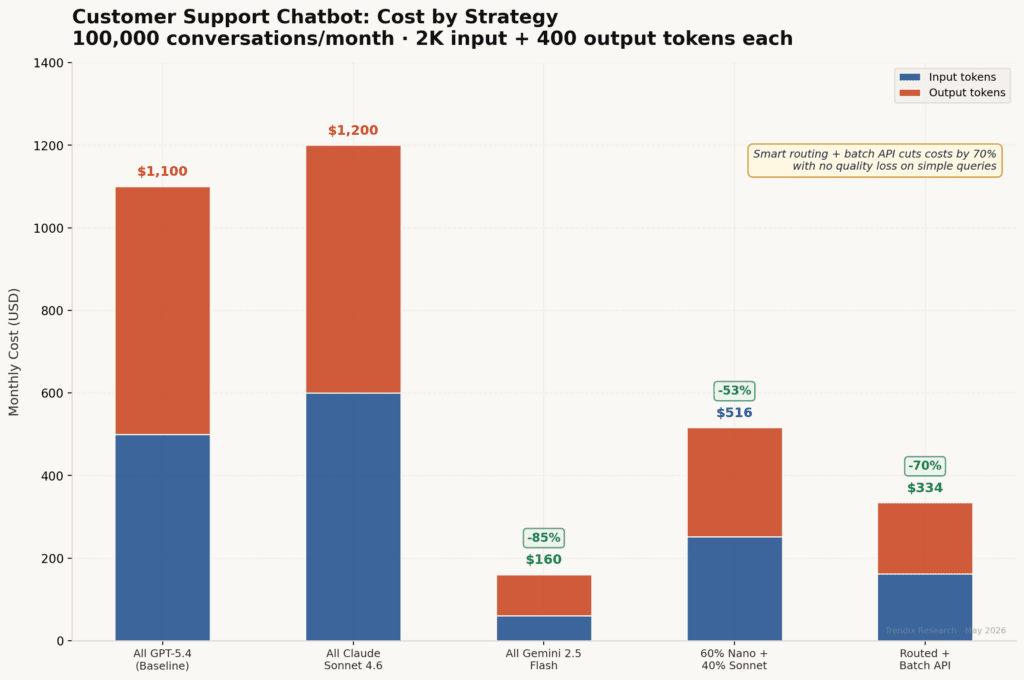
Assumptions: Average 2,000 input tokens (history + context + query) and 400 output tokens per conversation. Using a tiered approach: 60% routed to GPT-4.1 Nano, 40% to Claude Sonnet 4.6 for complex queries.
| Configuration | Monthly Input Cost | Monthly Output Cost | Total/Month |
|---|---|---|---|
| All GPT-5.4 | $500 | $600 | $1,100 |
| All Claude Sonnet 4.6 | $600 | $600 | $1,200 |
| All Gemini 2.5 Flash | $60 | $100 | $160 |
| 60% Nano + 40% Sonnet 4.6 (routed) | $252 | $264 | $516 |
| Routed + Batch API (non-realtime portion) | $162 | $172 | $334 |
Each record: 200 input tokens, 50 output tokens. Structured extraction from unstructured text. No realtime requirement — batch processing is viable.
| Model | Input Cost ($/night) | Output Cost ($/night) | Total/night | Annual |
|---|---|---|---|---|
| GPT-5.4 (standard) | $500 | $750 | $1,250 | $456,250 |
| Claude Haiku 4.5 (standard) | $200 | $250 | $450 | $164,250 |
| Claude Haiku 4.5 (batch) | $100 | $125 | $225 | $82,125 |
| Gemini 2.5 Flash (standard) | $60 | $125 | $185 | $67,525 |
| GPT-4.1 Nano (batch) | $10 | $10 | $20 | $7,300 |
If GPT-4.1 Nano accuracy is acceptable for your extraction task, the annual savings vs. GPT-5.4 are over $448,000. The model evaluation cost (a few hundred dollars and a weekend) pays for itself in hours.
Each developer averages 20 coding sessions/day. Each session: 50,000 input tokens, 15,000 output tokens. Caching applies (40,000 tokens cached per session — reused codebase context).
| Model | Daily Cost (no caching) | Daily Cost (with caching) | Monthly (with caching) |
|---|---|---|---|
| Claude Opus 4.6 | $625 | $228 | $6,840 |
| Claude Opus 4.7 (+35% tokenizer) | $844 | $308 | $9,240 |
| Claude Sonnet 4.6 | $375 | $140 | $4,200 |
| GPT-5.5 | $800 | $290 | $8,700 |
Caching alone saves 60%+ on agentic coding workloads with large shared codebases. The Sonnet vs. Opus choice here is a $2,640/month decision — teams should run quality benchmarks on their specific codebase before defaulting to Opus.
Frequently Asked Questions
What’s the cheapest capable model available right now?
For pure token price, GPT-4.1 Nano and Gemini 2.5 Flash-Lite both hit $0.10/M input and $0.40/M output. DeepSeek V3.2 at $0.14/$0.28 is slightly more expensive but stronger on reasoning tasks. For production-quality generation with no data residency concerns, Gemini 2.5 Flash at $0.30/$2.50 offers the best balance of capability and cost at the budget tier.
Should I use Claude Opus 4.7 or 4.6?
For most workloads, 4.6. Opus 4.7 uses a new tokenizer that can generate up to 35% more tokens for the same input text — same sticker price, higher effective cost. If your prompts are short and unstructured (mainly code, prose), the tokenizer difference is smaller. If they’re data-heavy (JSON, structured output, tabular data), test before migrating. The quality uplift is real, but it’s concentrated in autonomous coding agents and computer-use scenarios. For general reasoning and analysis, the improvement over 4.6 is modest.
Is DeepSeek worth using in production?
For internal tooling, analytics pipelines, and non-sensitive workloads: genuinely hard to beat on economics. For anything touching user data subject to GDPR, healthcare records, financial data with specific residency requirements, or classified/sensitive information: the compliance picture is complicated, and most enterprise legal teams will push back. Evaluate your specific constraints before deploying.
How much does context window size affect cost?
Larger context windows don’t directly cost more per token — you pay the same rate regardless of context size. The problem is that larger windows encourage you to put more in them. A 1M token context window is only useful if you actually fill it, and filling it means spending on every token you send. RAG with a 200K window and precise retrieval is almost always cheaper than naive full-document loading with a 1M window.
What’s the real cost of reasoning models like o3?
Higher than the rate card suggests, for complex queries. The listed $2.00/$8.00 per million tokens for o3 doesn’t account for internal reasoning tokens that are billed as output but invisible in the response. On complex multi-step problems, visible output tokens may be 20–30% of total output consumption. For simple queries, the overhead is low. Monitor your actual token counts, not just visible output, if you’re using reasoning models at scale.
What are subscription plans and how do they differ from API pricing?
Subscription plans (Claude Pro at $20/month, ChatGPT Plus at $20/month, etc.) give individual users access to the consumer interfaces with usage limits. They don’t cover API access. The API is metered separately by token. Enterprise and team plans (Claude Team, ChatGPT Enterprise, Google Workspace AI) are per-seat, not per-token, and bundle product features with usage quotas. They’re structured differently and generally priced for business procurement rather than developer billing.
Sources & References
- Anthropic. Claude API Pricing Documentation. platform.claude.com/docs/en/about-claude/pricing — accessed May 15, 2026
- OpenAI. API Pricing. openai.com/api/pricing — accessed May 15, 2026
- Google. Gemini API Pricing. ai.google.dev/pricing — accessed May 15, 2026
- DeepSeek. API Pricing. deepseek.ai/pricing — accessed May 15, 2026
- Epoch AI. “LLM inference prices have fallen rapidly but unequally across tasks.” Ben Cottier et al., March 2025.
- Introl. “Inference Unit Economics: The True Cost Per Million Tokens.” December 2025.
- Finout. “Claude Opus 4.7 Pricing: The Real Cost Story.” May 2026.
- Tech-Insider. “Claude Opus 4.6 vs Sonnet 4.6 vs Haiku 4.5 — 2026 Benchmarks.” May 2026.
- CloudZero. “LLM API Pricing Comparison in 2026.” May 2026.
- AI Pricing Guru. “OpenAI API Pricing 2026.” Synced May 14, 2026.
- IntuitionLabs. “LLM API Pricing Comparison 2025.” October 2025.
- ArXiv. “The Price of Progress: Algorithmic Efficiency and the Falling Cost of AI Inference.” NeurIPS 2025 Workshop, November 2025.
Deep-dive guides on AI, infrastructure, and emerging technology
AI Agent Use Cases by Business Function:The 2026 Prioritization Guide
Building Your First Production LangGraph Agent – Step-by-Step Tutorial
Best AI Writing Tools 2026
AI Comparisons & Benchmarks: What the Numbers Actually Mean
Notion + AI: From Smart Notes to Autonomous Agents
Cost Analysis: The Complete 2026 Guide
Enterprise LLM Procurement: What the Contracts Actually Say
Claude vs ChatGPT: Full 2026 Head-to-Head
AI Video Generators Ranked: Sora 2, Runway, Veo 3 Compared
RAG Security: Attack Surfaces in Retrieval Pipelines
LLM Security Testing: Tools, Techniques, and What Garak Doesn’t Cover
AI Transcription Software Compared: Accuracy, Privacy, Price (2026)
Perplexity Comet & the AI Personal Computer: Everything Explained