
AI Agent Use Cases by Business Function

AI Agent Use Cases
by Business Function:
The 2026 Prioritization Guide
Not every business function benefits equally from AI agents — and deploying in the wrong order costs money, momentum, and trust. This guide maps every major function, ranks them by ROI speed and implementation difficulty, and gives you the exact prioritization framework used by organizations already seeing measurable returns in 2026.
AI agents in production
AI agents by end 2026
ROI within year one
software revenue by 2035
AI agents market
Every enterprise technology wave has its version of the same mistake: buying the tool before knowing where to put it. AI agents are no different. The organizations that are winning right now — the ones where agentic AI has moved from pilot to production and is generating real P&L impact — share one defining habit: they chose where to start before they chose what to build.
This is not a philosophical guide. It is a prioritization framework grounded in the latest data from Gartner, Google Cloud, McKinsey, PwC, and deployment evidence from hundreds of enterprise implementations in 2025 and early 2026. You will leave knowing which business functions to deploy AI agents in first, in what sequence, and why — with the metrics to back every recommendation.
Gartner forecasts that 40% of enterprise applications will include task-specific AI agents by the end of 2026, up from less than 5% at the start of 2025.[1] C-suite leaders have three to six months to set their agentic AI strategy before being outpaced by competitors already in production. The window for orderly, strategic deployment is closing.
What Makes an AI Agent Use Case “Ready”
Before ranking functions, you need a consistent scoring rubric. Four dimensions determine whether an AI agent use case is worth prioritizing: the speed at which you will see ROI, the complexity of integration, the volume and quality of underlying data, and the regulatory and reputational risk of errors.
The organizations consistently extracting value apply what PwC calls the 80/20 rule in reverse: technology accounts for only 20% of an initiative’s value. The remaining 80% comes from redesigning the work itself so agents can own the routine and humans can focus on judgment.[2]
With that model in mind, here is how every major business function scores — and what the deployment evidence actually says about each.
Tier 1: Deploy First — High ROI, Fast Feedback Loops
These three functions consistently produce measurable returns within 90 days of production deployment. They share two traits: the underlying tasks are high in volume and low in ambiguity, and the data pipelines feeding the agents are already mature inside most enterprises.
Customer Service & Support
Why it leads every deployment ranking
Customer service is the single most-deployed AI agent use case globally in 2026 — and for good reason. The workflow structure is ideal: high transaction volume, documented resolution paths, and a clear success metric in customer satisfaction score (CSAT). Agents here operate in a closed loop where every interaction generates labeled training data for the next generation of the model.
The results are no longer projections. ServiceNow’s integration of AI agents produced a 52% reduction in time to handle complex customer service cases.[3] Google Cloud reports that some organizations are achieving 120 seconds saved per contact and generating $2 million in additional revenue from better routing and information management.[4] Gartner projects that conversational AI will save $80 billion in labor costs in call centers by 2026 alone.[5]
The strategic priority within customer service should follow this sequence: first, autonomous resolution of Tier-1 tickets (password resets, order status, return initiation); second, intelligent escalation routing with full context handoff to human agents; third, proactive outreach triggered by behavioral signals before customers even contact support.
Home Depot’s Magic Apron — a suite of generative AI tools — gives store associates instant access to product knowledge and guidance on home improvement projects. It combines company data with AI to improve employee productivity and customer service on the sales floor, demonstrating that agentic support works just as well internally as it does facing customers.[1]
Sales & Revenue Operations
The function with the clearest ROI signal
Sales is where AI agents generate measurable revenue lift — not just cost reduction. Companies adopting agentic AI in sales report an average revenue increase of 6% to 10%, with McKinsey data showing a 10% to 20% boost in sales ROI.[6] Marketing-to-sales pipeline functions are seeing businesses cut marketing operations costs by up to 37% while achieving 3–15% revenue uplift.[7]
Modern AI sales agents operate as learning agents — systems that continuously analyze customer data, past interactions, and deal outcomes to qualify leads, book meetings, and follow up automatically. Unlike static automation, these agents improve over time and coordinate actions across CRMs, email platforms, and calendars. Automated SDRs research leads, personalize outreach, and boost meeting conversions at four times the speed of manual efforts.[8]
The highest-impact sequence inside sales: lead qualification and scoring first (the task with the clearest decision logic), then automated outreach personalization, then pipeline forecasting, then deal risk scoring.
- Tier-1 ticket auto-resolution
- Intelligent escalation routing
- Proactive retention outreach
- 24/7 omnichannel coverage
- Lead qualification & scoring
- Personalized outreach at scale
- Pipeline forecasting
- Deal risk & churn signals
- Alert triage & threat investigation
- Vulnerability discovery
- Incident response automation
- IT service desk automation
- Code generation & review
- Automated testing & QA
- Documentation generation
- Refactoring & modernization
IT Operations & Cybersecurity
The function where agents handle what humans cannot scale
Security operations present the clearest case for agentic AI in the entire enterprise. Alert volume has outgrown human capacity — period. An AI agent can triage, investigate, correlate, and respond across a full alert-to-resolution lifecycle in minutes rather than hours.
According to Google Cloud’s 2025 ROI of AI study, 46% of organizations with production-ready AI agents are using them for security operations and cybersecurity — the highest single use-case concentration in the entire dataset.[9] Google Cloud also reports that AI agents in security operations are delivering a 70% reduction in breach risk and 50% faster mean time to respond to threats.[4]
The progression here mirrors a security maturity model: start with automated alert triage at the top of the SOC funnel, then move to autonomous threat investigation, then to containment and remediation. Human analysts then shift their focus to threat hunting, agent supervision, and long-term architecture — the work that actually requires human judgment at scale.
Tier 2: Second Wave — High Value, Moderate Complexity
Tier 2 functions deliver significant, measurable ROI — but they require either longer data preparation, more complex workflow redesign, or more careful governance before full deployment. These are not lower-priority by importance; they are lower-priority by readiness. The enterprises that fail here typically try to deploy Tier 2 before their Tier 1 infrastructure is stable.
Finance & Accounting
Where precision governs the pace of deployment
Finance functions are among the highest-value targets for agentic AI — and among the most consequential if agents make errors. This is why enterprises with the most successful finance agent deployments approach them with a phased model: start with the most rule-bound, data-rich, and auditable processes first.
Deloitte’s Zora AI platform targets a 25% reduction in finance team costs and a 40% increase in productivity.[10] PwC explicitly names finance as one of the “especially ripe” areas for agentic AI, alongside IT, HR, and internal audit.[2] Cross-study data shows cost savings of 26–31% reported across finance and accounting functions at scale.[11]
The deployment sequence that works: accounts payable and receivable automation first (highest volume, most structured), then financial close acceleration, then regulatory reporting and compliance monitoring, then real-time cash flow forecasting. Fraud detection can begin in parallel with the first phase if the data infrastructure exists.
EY has deployed 150 AI tax agents to assist in compliance and data review processes. This is not a chatbot deployment — these are agents embedded in the tax function workflow, handling the high-volume, structured-data tasks that previously required armies of junior associates during reporting season.[10]
Human Resources & People Operations
Faster hiring, better retention — but the data foundation matters
HR was an early adopter of AI-powered tools — chatbots for policy questions, screening tools for resumes — but agentic AI represents a fundamentally different capability. Instead of answering individual queries, agents now orchestrate the full employee lifecycle: from candidate sourcing to onboarding sequencing to ongoing sentiment monitoring that flags retention risks before they become attrition.
47% of HR teams are currently prioritizing AI agents for recruiting, and 65% report major onboarding gains.[12] Companies using AI in HR functions report a 65% gain in efficiency, especially in onboarding and hiring.[5] Vellum’s deployment data shows a 75% reduction in hiring time when full AI agent orchestration is applied across the recruiting pipeline.[13]
The key complexity in HR agent deployment is data sensitivity. Employee data requires rigorous governance, bias monitoring in automated screening, and clear human-in-the-loop points at offer and termination decisions. The enterprises that deploy HR agents successfully build the governance model before the agent — not after.
- AP/AR automation
- Financial close acceleration
- Fraud detection agents
- Real-time compliance monitoring
- Resume screening & matching
- Onboarding orchestration
- Employee sentiment monitoring
- Policy Q&A and benefits support
- Content creation & repurposing
- Campaign optimization
- Audience segmentation
- SEO & performance analysis
- Contract review & analysis
- Regulatory change monitoring
- E-discovery classification
- Knowledge base maintenance
Marketing Operations
The function with the fastest content-speed payoff
Marketing was among the first functions to adopt generative AI for content creation — but agentic marketing goes much further. Agents now run full content operations: researching, drafting, testing variants, analyzing performance, and feeding insights back into the next campaign without a human initiating each cycle.
The data here is striking. 51% of marketers use AI tools to optimize content, including email campaigns and SEO.[14] Human-AI collaborative marketing teams demonstrated 60% greater productivity than human-only teams, spending 23% more time on creative content and 60% less on editing while maintaining equivalent output quality.[14] Businesses using AI in marketing operations report up to 37% cost savings and 3–15% revenue uplift.
The highest-priority marketing agent deployments in 2026: SEO content agents that research, draft, and optimize without per-piece human initiation; campaign performance agents that detect underperforming ads and automatically test alternatives; and audience segmentation agents that continuously update personas from real behavioral data rather than static quarterly analysis.
Legal & Compliance
240 hours per legal professional — that is the documented savings
Legal teams are experiencing one of the most significant productivity unlocks of any business function. Vellum’s deployment data shows that legal teams using AI agents save an average of 240 hours per legal professional per year by automating document review, legal research, and contract analysis.[13]
The deployment pattern is critical here: start with contract review and analysis (the most structured, highest-volume legal task in most enterprises), then regulatory monitoring, then e-discovery, and finally litigation support and knowledge base management. The legal function has the highest error-cost of any Tier 2 function — which means governance infrastructure must precede deployment, not follow it.
Tier 3: Foundation First — High Potential, Complex Prerequisites
Tier 3 functions are not lower in strategic importance — several are among the highest-value areas in the entire enterprise. They appear in Tier 3 because they require specific prerequisites: clean, integrated data pipelines; mature process documentation; cross-system API connectivity; and, frequently, regulatory clarity that is still developing in 2026.
Supply Chain & Operations
Walmart’s agentic supply chain provides the clearest enterprise case study. The company has unified its supply chain with AI agents that provide real-time inventory visibility across stores, fulfillment centers, and logistics facilities, automatically detecting demand surges, adjusting replenishment schedules, and rerouting inventory around weather or logistics disruptions — all without manual intervention.[15] Amazon’s AI engine drives 35% of its online sales, with agents managing inventory, optimizing shelf space, and automating order picking.[16]
For most enterprises, supply chain AI agents require 12–18 months of data consolidation work before deployment can begin. The prerequisite is a unified data layer across supply chain, logistics, and point-of-sale systems. Companies that skip this step consistently produce agents that make locally optimal but globally suboptimal decisions.
Product Development & R&D
Product development agents — systems that track social trends, generate product concepts, and feed them into prototyping — represent one of the highest-upside use cases in the entire enterprise. Walmart’s Trend-to-Product system is a multi-agent AI engine that tracks social media and search trends, generates product concepts, and feeds them directly into sourcing, dramatically shortening traditional production timelines.[15]
This is genuinely frontier territory in 2026. The agents that work in R&D today are still predominantly research assistants and literature synthesis tools, not autonomous product designers. Organizations should build this capability deliberately — starting with agents that surface market signal and competitive intelligence, then moving to concept generation, and only then to autonomous prototype initiation.
One of the most exciting capabilities of AI agents is their potential to work together. Instead of single, monolithic entities, agentic architecture will consist of teams of specialized agents designed to work on specific tasks while also collaborating and sharing data.— Bernard Marr, AI Strategist & Author, 2026
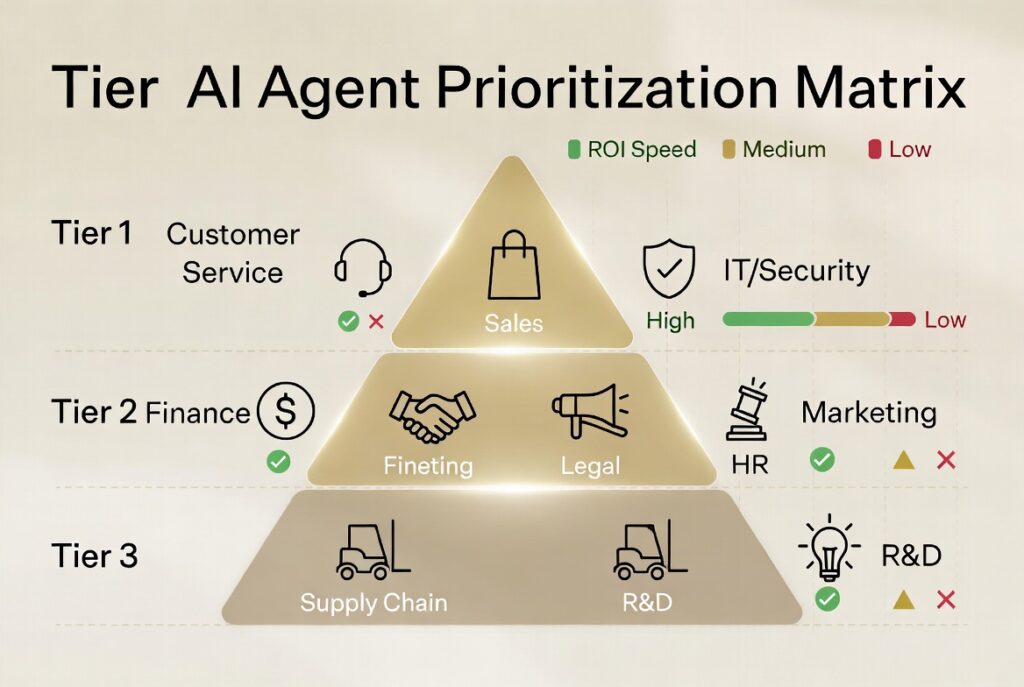
The Full Prioritization Matrix
The table below consolidates every major business function into a single decision framework. Use this to build your deployment roadmap, sequence investment conversations with finance, and set realistic timelines with implementation teams.
| Business Function | Tier | ROI Timeline | Key Agents | Top Prerequisite |
|---|---|---|---|---|
| Customer Service | 1 — Now | 4–12 weeks | Resolution, routing, retention | Ticket taxonomy & CRM integration |
| Sales / RevOps | 1 — Now | 6–16 weeks | Lead scoring, outreach, forecasting | CRM data hygiene + enrichment |
| IT / Security Ops | 1 — Now | 8–20 weeks | Alert triage, threat response | SIEM integration + playbook docs |
| Software Development | 1 — Now | Immediate | Code gen, review, testing, docs | Developer toolchain access |
| Marketing | 2 — Q3 2026 | 6–14 weeks | Content ops, SEO, campaign opt. | Analytics stack + content audit |
| Human Resources | 2 — Q3 2026 | 2–5 months | Recruiting, onboarding, engagement | HRIS integration + bias audit |
| Finance & Accounting | 2 — Q3 2026 | 3–6 months | AP/AR, close, fraud, compliance | ERP API access + audit governance |
| Legal & Compliance | 2 — Q4 2026 | 4–8 months | Contract review, reg monitoring | Document repository + RACI model |
| Supply Chain / Ops | 3 — 2027 | 6–18 months | Demand forecasting, inventory opt. | Unified supply chain data layer |
| Product / R&D | 3 — 2027 | 9–24 months | Trend detection, concept gen. | Market data + IP governance |
| Healthcare / Clinical | 3 — Regulatory | 12–24 months | Prior auth, documentation, triage | EHR integration + FDA/regulatory |
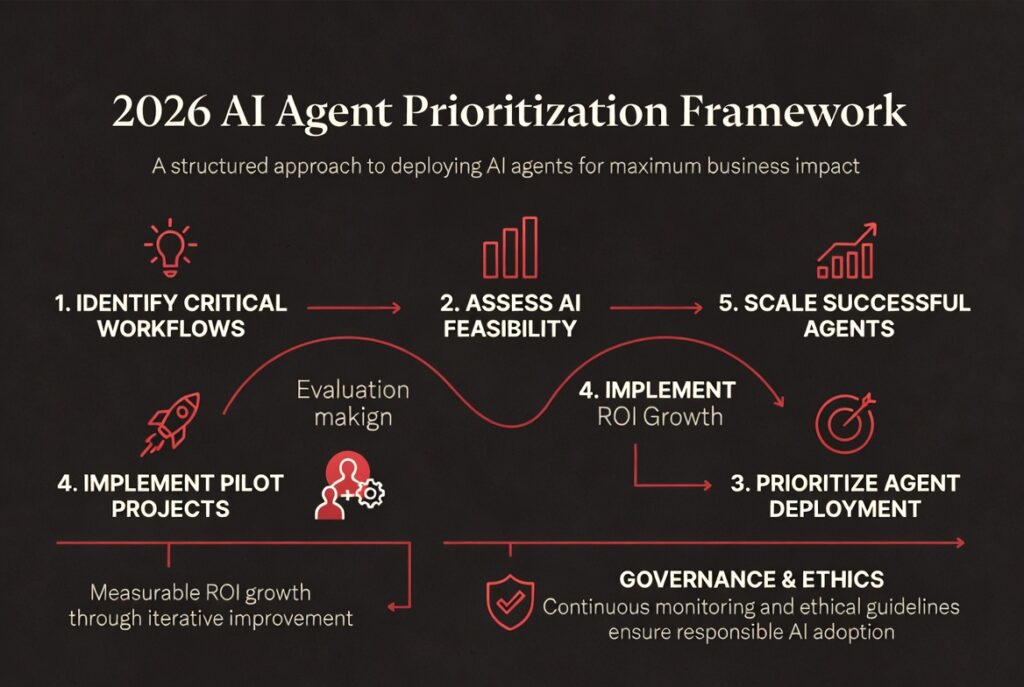
The 5-Step Deployment Prioritization Framework
Knowing which functions to prioritize is necessary but not sufficient. The enterprises generating the highest returns in 2026 follow a structured deployment model — not a tool-first, function-second approach. Here is the framework distilled from PwC, McKinsey, and Google Cloud’s documented enterprise deployment patterns.
- Map workflows before selecting agents Document every step of the candidate workflow: where data enters, where decisions are made, where humans intervene, and where errors are consequential. Agents that cannot be described as a clear decision tree at the process level will not work reliably at the automation level.
- Score each candidate use case against four dimensions ROI speed, data maturity, task repeatability, and error tolerance. Use the scoring model above and force a ranking before any vendor conversation. The most common failure pattern is selecting use cases based on what vendors demonstrate rather than what your data and workflows can support.
- Define the human-in-the-loop boundary explicitly For every agent deployment, specify in writing: which decisions the agent owns outright, which it proposes for human approval, and which always require human initiation. This is not a philosophical exercise — it is an operational document. Per Microsoft’s Work Trend Index research, the most effective organizations document agent workflows, human handoffs, and quality standards at the team, function, and organization level.[17]
- Build for measurement from day one Set concrete outcome metrics before deployment — not after. Google Cloud data shows that 74% of executives who achieve ROI within year one begin with pre-defined metrics tied directly to business outcomes (P&L impact, market differentiation, or workforce efficiency), not vanity metrics like “number of tickets handled.”[4]
- Deploy as an all-new workflow, not a layer on top of the old one This is PwC’s clearest observation from the 2026 enterprise AI landscape: agents rolled out on top of existing, unredesigned workflows consistently underperform against projections. The 80% of value comes from redesigning the work itself — not from automating the same steps that humans were following before.[2]
The Governance Layer You Cannot Skip
The single most common cause of AI agent projects failing to scale is not a technology problem. It is a governance problem. 60% of AI projects fail due to poor data quality, and MIT research shows a 95% failure rate for enterprise generative AI projects that cannot demonstrate measurable financial returns within six months.[18]
In 2026, governance for agentic AI has three mandatory components that were optional in earlier AI deployments:
- Agent-level audit trails. Every action an agent takes must be logged with a timestamp, the context that triggered the action, the data the agent accessed, and the output it produced. Forrester predicts half of enterprise ERP vendors will launch autonomous governance modules combining explainable AI and automated audit trails by the end of 2026.
- Cross-agent monitoring. In multi-agent systems — where specialized agents hand off work to each other — a monitoring agent from a different model provider should check the work of production agents. This is the “checks and balances” model that PwC explicitly recommends for higher-risk agentic scenarios.
- Human escalation paths that are genuinely used. Agents that cannot escalate reliably produce a specific failure mode: they complete the task incorrectly and mark it done, removing it from human visibility. Every production agent needs a tested escalation path, not a theoretical one.
PwC’s 2025 Responsible AI survey found that while 60% of executives confirm that Responsible AI boosts ROI and efficiency, nearly half of respondents said turning RAI principles into operational processes has been a challenge. Agentic workflows are spreading faster than governance models can address their unique needs. In many cases, agents can do roughly half of the tasks that people now do — but that requires a new kind of governance to manage both risks and outputs.[2]
What “Good” Looks Like in 2026
After two years of enterprise AI agent deployments at scale, we have enough evidence to describe what successful programs actually look like — not in theory, but in operational practice.
According to Google Cloud’s ROI of AI 2025 Report: 39% of executives report their organizations have already deployed more than 10 agents across their enterprise, and among those reporting productivity gains, 39% have seen productivity at least double.[4] These are not outlier results from the most sophisticated AI-native firms. They are the median outcomes for organizations that deployed with the structured approach described above.
The organizations generating the top-line returns — the ones where agentic AI is appearing on the P&L rather than just in an IT report — share a defining operational pattern. Per PwC: visionary players show 1.7x revenue growth, 3.6x three-year total shareholder return, 2.7x return on invested capital, and 1.6x EBIT margin versus laggards.[11] The gap is not marginal. It is structural.
The distinguishing characteristics of the leaders:
- A centralized AI studio or command center that manages reusable agent components, deployment protocols, and shared evaluation frameworks — not a collection of team-level experiments.
- Top-down use-case selection by senior leadership, focused on a small number of workflows where payoffs are large and data is ready — not bottom-up “whoever has the biggest enthusiasm budget.”
- Agents tested before deployment with working demos reviewed by future end users — not deployed from a slide deck into a live environment.
- Upskilling programs that convert employees into effective supervisors of agents, not passive recipients of technology change.
Your Three-Question Prioritization Shortcut
If you are looking for a practical starting point and do not yet have the organizational infrastructure for a full deployment matrix exercise, these three questions will put you in the right place faster than any vendor conversation will.
Question 1: Where does your highest-volume, most-repetitive work currently live? The answer is almost always customer service, sales operations, or IT. Start there. Volume is the single best predictor of early agentic ROI because it maximizes the hours recovered per dollar of deployment cost.
Question 2: Where is your data cleanest and most accessible? AI agents are only as good as the data they act on. The function with the best-maintained, best-integrated data wins the deployment race, regardless of where the theoretical ROI is highest.
Question 3: Where can you afford to have agents make errors while you refine them? This is the question most organizations skip — and the one that determines whether your first deployment becomes a showcase or a cautionary tale. Functions with low error cost (content drafts, lead scores, ticket routing) should lead. Functions with high error cost (legal filings, financial postings, clinical decisions) should follow once the model and governance are proven.
Sources & References
- Gartner (August 2025). Gartner Predicts 40% of Enterprise Apps Will Feature Task-Specific AI Agents by 2026. gartner.com
- PwC (2026). 2026 AI Business Predictions. pwc.com
- Warmly (2026). 35+ Powerful AI Agents Statistics: Adoption & Insights. warmly.ai
- Google Cloud (September 2025). The ROI of AI: Agents Are Delivering for Business Now. cloud.google.com
- We Are Tenet (2026). 200+ AI Agents Statistics: Usage, ROI & Industry Trends. wearetenet.com
- McKinsey & Company (2025–2026). Revenue and ROI data cited in: masterofcode.com — 150+ AI Agent Statistics
- Master of Code (March 2026). 150+ AI Agent Statistics. masterofcode.com
- Salesmate (2026). AI Agent Trends 2026: 7 Shifts to Watch. salesmate.io
- Fintech News CH (April 2026). 5 Defining AI Agent Trends for 2026 — citing Google Cloud 2025 ROI of AI Study. fintechnews.ch
- TechAhead (May 2026). Top Use Cases of Agentic AI in 2026 Across Industries. techaheadcorp.com
- Master of Code (April 2026). AI ROI: Why Only 5% of Enterprises See Real Returns in 2026. masterofcode.com
- We Are Tenet / KPMG / IDC (2026). HR statistics compiled in: wearetenet.com
- Vellum (November 2025). AI Agent Use Cases to Unlock AI ROI in 2025 (Guide). vellum.ai
- Warmly (2026). Marketing productivity data: warmly.ai
- TechAhead (May 2026). Walmart & Amazon supply chain cases. techaheadcorp.com
- We Are Tenet (2026). Amazon AI engine statistics. wearetenet.com
- Microsoft Work Trend Index (May 2026). Agents, Human Agency, and the Opportunity for Organizations. microsoft.com/worklab
- SentiSight / MIT / Forbes (January 2026). AI ROI failure rates: sentisight.ai
Continue Your 2026 AI Agent Journey on Trendix
- AI Agent Framework Selection Scorecard (2025–2026)
The definitive decision guide for choosing the right agentic platforms and orchestration tools. - Human-in-the-Loop AI: Production Implementation Guide
How to design effective human-AI collaboration boundaries — essential reading after this prioritization guide. - AI Agent Governance: A CISO’s 2026 Checklist
Deep dive into audit trails, monitoring, and risk management for production agents.
0 responses to “AI Agent Use Cases by Business Function:The 2026 Prioritization Guide”