

The Best AI Research Tools in 2026: The Definitive Expert Guide
From literature discovery to synthesis and citation verification — every tool benchmarked, compared, and mapped to your exact research stage.
01 — Context Why AI Research Tools Have Become Essential in 2026
Over 5 million academic papers are published every year. No human researcher can read them all. AI tools don’t just speed things up — they fundamentally change what’s possible.
The shift happened fast. In 2024, 45% of researchers reported using AI tools for publication tasks. By 2025, that number jumped to 62%. In 2026, a Wiley survey of 2,400 researchers worldwide found that 84% now use AI tools, with nearly 75% reporting measurable improvements in efficiency, output quantity, and quality.
This isn’t about replacing researchers. It’s about compressing the mechanical phases — discovery, screening, data extraction, citation formatting — that used to eat weeks of a PhD student’s life, leaving more time for what actually matters: interpretation, analysis, and original thought.
“AI compresses the mechanical phases of research — discovery, screening, extraction, formatting — into hours instead of weeks. The researcher’s job is to do what AI cannot: evaluate quality, identify subtle bias, and synthesize findings in context.”
Atlas AI Research Team — from the 2026 Hallucination-Verified Benchmark Report
02 — The Landscape How to Think About the Research Tool Ecosystem
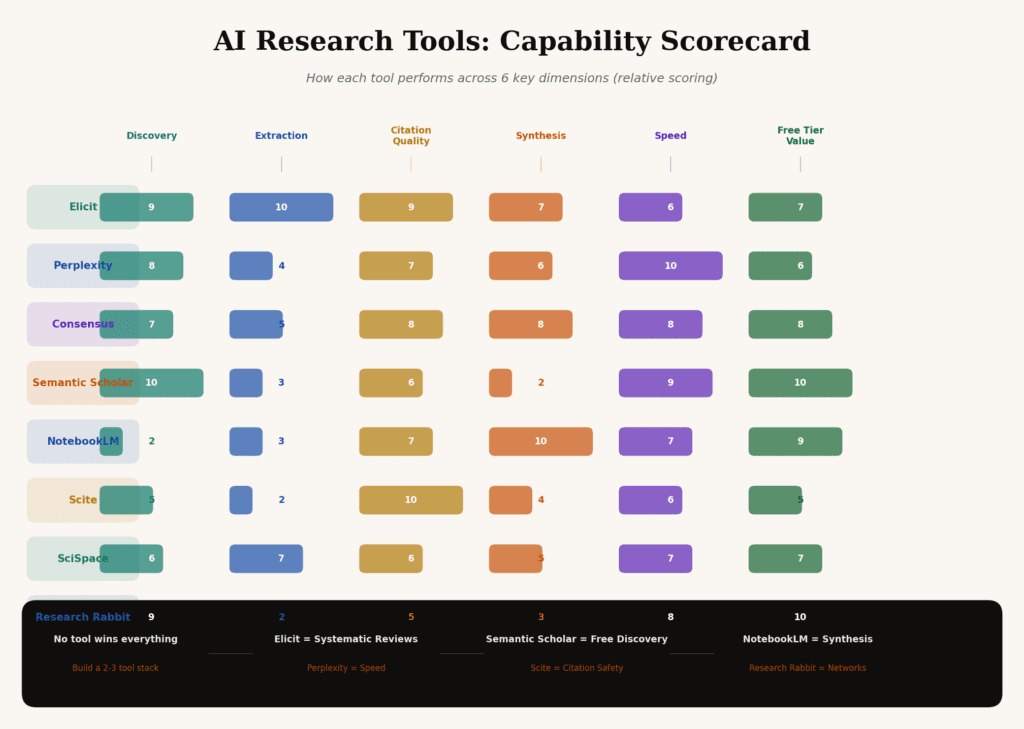
One mistake researchers make is picking a single tool and trying to force it across the entire research process. In 2026, the smart approach is to match the right tool to the right phase. No single platform excels at everything.
🔍 Discovery
- Best: Elicit, Semantic Scholar
- Also: Perplexity (broad), Consensus
- Free: Semantic Scholar, Research Rabbit
📖 Reading & Comprehension
- Best: SciSpace Copilot
- Also: Claude Projects, Atlas
- Free: SciSpace (free tier)
🔗 Citation Mapping
- Best: Research Rabbit, Connected Papers
- Also: Semantic Scholar, Scite
- Free: Research Rabbit, Connected Papers
✅ Verification
- Best: Scite Smart Citations
- Also: Semantic Scholar
- Free: Scite (limited tier)
🧬 Synthesis
- Best: NotebookLM, Atlas, Claude
- Also: Elicit Reports
- Free: NotebookLM
✍️ Writing & Editing
- Best: Paperpal, Jenni AI
- Also: Claude, ChatGPT
- Free: Grammarly (basic)
The 2-Tool Minimum Rule
According to Atlas’s 2026 benchmark study, the strongest research stacks always combine at least one discovery tool (Elicit or Semantic Scholar) with one synthesis tool (Atlas or NotebookLM). Single-tool workflows reliably compromise on one or the other.
03 — Tool Deep Dive Elicit — The Gold Standard for Systematic Reviews
Elicit is the most rigorously validated AI tool in the academic research space. Built by Ought (now Elicit), it was designed from the ground up for the demands of systematic reviews rather than general-purpose AI chat. What sets it apart is the combination of scale, accuracy, and citation transparency that other tools simply don’t match.
In 2026, Elicit’s database spans 138 million pieces of scholarly literature drawn from Semantic Scholar, PubMed, and OpenAlex. But the number is less important than what Elicit does with those papers: it can analyze up to 20,000 data points in a single query, extracting structured fields like sample size, methodology, study design, key findings, and limitations — and presenting them in interactive comparison tables.
Independent validation is remarkable. Across 994 Cochrane systematic reviews, Elicit hit 95% search recall, 97% abstract screening accuracy, 99% full-text screening accuracy, and 96% extraction accuracy. Those aren’t marketing numbers — they’re published benchmarks against the gold standard of systematic review methodology. Researchers report up to 80% time savings on the screening phase alone.
Recent 2025–2026 additions include: the Elicit API for custom research workflows, integration with ClinicalTrials.gov, strict PRISMA screening criteria, 80-paper comprehensive reports, and Research Agents for competitive landscape and topic exploration. The March 2026 API launch opened Elicit’s engine to developers building research pipelines at scale.
Strengths
- Industry-leading extraction accuracy (96–99%)
- Full PRISMA 2020 compliance
- Sentence-level citations — every claim is traceable
- Structured data tables across hundreds of papers
- Research Agents for multi-step workflows
- API for custom integrations
Limitations
- Steeper learning curve than chat-based tools
- Free tier limited to 8 Pro searches/month
- Strongest for biomedical/social science, narrower humanities coverage
- Not designed for real-time web information
04 — Tool Deep Dive Perplexity AI — The Fastest Path from Question to Cited Answer
If Elicit is the rigorous systematic reviewer, Perplexity AI is the brilliant research assistant who can find you a well-sourced answer in 30 seconds. Its core strength — real-time search with inline citations — makes it uniquely valuable for fast-moving topics where information from even 6 months ago may be outdated.
The Academic Focus mode (available on Pro) routes queries through Semantic Scholar’s database of 200+ million academic papers, filtering out blogs, news sites, and Wikipedia. The result is peer-reviewed synthesis with inline citations, delivered in roughly 30 seconds versus the 2–4 hours a comparable manual literature survey would take.
The Deep Research feature, upgraded significantly in early 2026, acts as an autonomous research agent: it plans a search strategy, runs multiple queries, synthesizes across sources, and produces a structured report — all without manual prompting. Perplexity Pro costs $20/month and remains one of the best value research subscriptions for professionals.
Key caveat: studies in 2025 documented a 5–10% hallucination rate even on Pro. Perplexity citations must always be verified against Google Scholar before use in formal academic work. Use Perplexity for orientation and speed; verify before citing.
Strengths
- Real-time information from the live web
- 30-second synthesis vs hours manually
- Academic Focus for peer-reviewed-only results
- Excellent for fast-moving topics
- Perplexity Spaces for project-based research
- 93.9% factual accuracy on SimpleQA benchmark
Limitations
- 5–10% hallucination rate — citation verification required
- Academic Focus sometimes includes non-peer-reviewed sources
- Not designed for deep systematic review methodology
- Deep Research limited to 5 reports/month on free tier
05 — Tool Deep Dive Consensus — Evidence-Based Answers, Instantly
Consensus occupies a unique position in the AI research tool landscape. Rather than finding papers for you to read, it answers specific research questions by synthesizing what peer-reviewed literature collectively says — and its Consensus Meter visualizes the weight of evidence for or against a claim at a glance.
Ask “Does creatine improve cognitive function?” and you get not just a list of papers, but a visual breakdown of how many studies support, oppose, or are neutral on the question — drawn from Semantic Scholar’s database of 200 million peer-reviewed papers. This makes Consensus the fastest tool for answering binary empirical questions, particularly in health sciences, psychology, and social sciences.
The 2025–2026 Deep Research capabilities push Consensus beyond quick answers into multi-paper synthesis reports. Premium access unlocks advanced filters, researcher-quality search, and the ability to drill into methodology and study quality. CompareGen’s 2026 academic tool benchmark rated Consensus best-in-class for evidence synthesis in structured empirical domains.
Strengths
- Consensus Meter gives instant evidence overview
- Exclusively peer-reviewed sources
- Ideal for yes/no empirical questions
- Strong in health, psychology, social science
- 25 free AI searches per month
Limitations
- Poor fit for open-ended or theoretical questions
- Weaker coverage in humanities and arts
- Not designed for full-text data extraction
- Yes/no framing doesn’t suit nuanced topics
06 — Tool Deep Dive Semantic Scholar — The Definitive Free Academic Search Engine
Built by the Allen Institute for AI, Semantic Scholar is the most powerful free academic search tool available in 2026. Its index of 200+ million papers spans all major scientific disciplines, and it’s the underlying database that powers search inside Perplexity Academic Focus, Consensus, and Elicit — meaning you’re often searching Semantic Scholar even when you don’t realize it.
The AI-powered TLDR (Too Long; Didn’t Read) feature generates one-sentence summaries of papers directly in search results, allowing researchers to rapidly triage relevance without clicking into each paper. The Semantic Reader provides an enhanced reading interface with inline definitions, context-aware citations, and paper structure navigation.
For developers and researchers building custom pipelines, the Semantic Scholar API provides programmatic access to the full database with citation data, author information, and paper metadata — completely free. Research Feeds also let you set up automated alerts for new papers in your area, making it an essential ongoing discovery tool.
Strengths
- Completely free — no paywalls, ever
- 200M+ papers across all disciplines
- AI TLDRs for fast relevance triage
- Robust free API for developers
- Powers most other tools (trustworthy foundation)
- Research Feeds for automated discovery
Limitations
- No synthesis — links only, no AI-generated summaries across papers
- Discovery tool, not a workflow platform
- Less intuitive than purpose-built research assistants
- Doesn’t analyze citations for support/contradiction
07 — Tool Deep Dive Google NotebookLM — Grounded Synthesis from Your Own Sources
Google NotebookLM has evolved from an experimental Google Labs project into a full-featured research synthesis platform. The core concept is powerful: upload up to 50 documents (PDFs, web pages, Google Docs, YouTube transcripts) and NotebookLM creates a private knowledge base that the AI can reason over — answering questions, finding contradictions, and generating synthesis documents that are provably grounded in your sources.
The Audio Overviews feature — which generates a natural-sounding podcast-style discussion of your uploaded materials — remains NotebookLM’s most distinctive differentiator. Nothing else in the market does this as well. For researchers who retain more from audio, this feature alone justifies the tool.
Critical limitation: NotebookLM is a synthesis tool, not a discovery tool. It cannot search for papers, access academic databases, or find sources you haven’t already collected. Use Elicit or Semantic Scholar to find papers first, then bring them into NotebookLM for grounded analysis. The free tier covers 100 notebooks with 50 queries per day; NotebookLM Plus (via Google AI Pro at $19.99/month) removes these limits.
Strengths
- Completely source-grounded — no hallucination from training data
- Audio Overviews are genuinely unique
- Free tier is generous and highly functional
- Simple, approachable interface
- Google ecosystem integration
Limitations
- Cannot search for papers — requires pre-collected sources
- 50-source limit on free tier
- No citation network visualization
- Not suitable for 500+ paper corpora (needs RAG architecture)
08 — Tool Deep Dive Scite — The Citation Intelligence Layer Every Researcher Needs
Scite solves a problem that no other tool addresses as well: understanding not just how many times a paper has been cited, but how. Its Smart Citations system has analyzed over 1.2 billion citation statements across 200M+ sources, classifying each one as supporting, contrasting, or mentioning the original paper’s findings.
This matters enormously for research integrity. A paper that has been cited 200 times sounds impressive — until you discover that 40 of those citations explicitly contradict its central finding. Scite’s interface surfaces this immediately, allowing researchers to make a rapid judgment on whether a foundational paper they’re planning to cite is well-supported or contested in the subsequent literature.
According to IatroX’s 2026 clinical research review, Scite is particularly vital in medical research, where citing a paper that has been quietly contradicted by subsequent RCTs can have serious consequences. The pre-submission audit use case — running every paper you’re planning to cite through Scite before submitting — has become standard practice in rigorous academic workflows.
Strengths
- Unique supporting/contrasting citation classification
- 1.2B+ citation statements analyzed
- Identifies retracted or contradicted papers
- Essential for pre-submission citation auditing
- Integrates with Zotero and reference managers
Limitations
- Narrow use case — not a general research tool
- Free tier is quite limited
- Not ideal for discovery or synthesis
- Value concentrated in post-discovery verification phase
09 — More Essential Tools SciSpace, Research Rabbit, Paperpal, and the Rest
SciSpace — The Paper Comprehension Specialist
SciSpace (formerly Typeset) takes a different approach: rather than helping you find papers, it helps you understand them. The AI Copilot sits alongside any paper and answers questions about the content — explaining dense methodology sections, clarifying statistical notation, and translating jargon into accessible language. For interdisciplinary researchers reading outside their primary field, this is invaluable. Free tier includes 100 notebooks with 50 queries per day.
Research Rabbit — Free Citation Network Explorer
Research Rabbit generates visual citation network graphs from a seed paper, revealing the intellectual genealogy of your research area. Completely free, drawing from OpenAlex’s 250M+ scholarly works. Seed it with 3–5 key papers and use it to discover older foundational work and adjacent-field contributions that keyword search consistently misses.
Connected Papers — Visualize Literature Relationships
Connected Papers generates visual graphs showing how papers relate to each other based on co-citation and bibliographic coupling. Papers appear as nodes; larger nodes have more citations; papers closer together are more similar. The Prior Works view shows what influenced a given paper; Derivative Works shows what it influenced. Free tier includes 5 graphs/month.
Paperpal — Best for Academic Manuscript Writing
Paperpal is the writing assistant purpose-built for academic publishing. Trusted by 4 million users globally, it handles grammar, citation support, translation across 50+ languages, plagiarism checking, AI content detection, and journal submission checks. Backed by 23 years of science, technical, and medical expertise from Cactus Communications, it’s trained on scholarly articles rather than general web content — meaning it understands discipline-specific language in ways general AI tools don’t.
Jenni AI — Best for Dissertation and Thesis Writing
Jenni AI focuses specifically on long-form academic writing: dissertations, theses, and research papers. Its @references command auto-cites as you write, and the AI suggests how to continue your argument while staying within your uploaded sources. The free tier offers 10 completions per day.
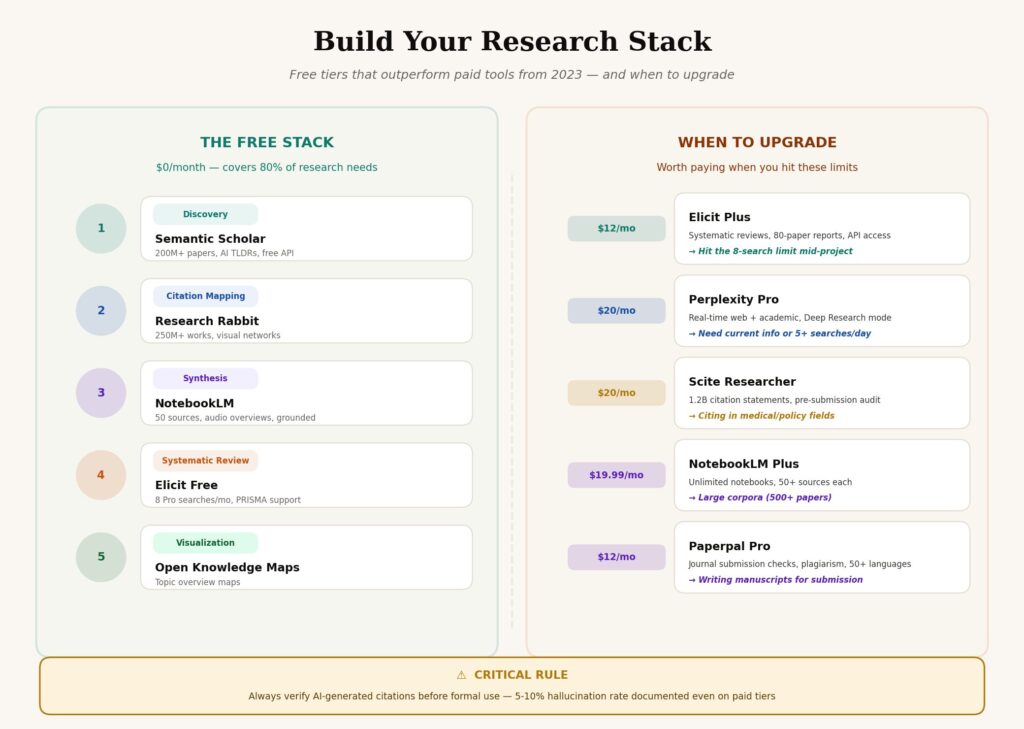
The Ultimate Free Research Stack (2026)
According to Saasnik’s comprehensive 2026 analysis, the following combination covers the full research lifecycle at zero cost — and outperforms many paid tools from 2023:
10 — Full Comparison Every Major AI Research Tool: Side-by-Side
The table below summarizes the key features, pricing, and ideal use cases across 10 major AI research tools. Use this as a quick reference when building your research stack.
| Tool | Primary Phase | Papers Indexed | Free Tier | Paid From | Cites Sources | Real-Time Web | API | Best For |
|---|---|---|---|---|---|---|---|---|
| Elicit | Discovery + Extraction | 138M+ | ✓ 8 Pro/mo | $12/mo | ✓ Sentence-level | ✗ | ✓ | Systematic reviews |
| Perplexity Pro | Fast Synthesis | 200M+ (Academic) | ✓ Limited | $20/mo | ✓ Inline | ✓ Real-time | ✗ | Fast orientation |
| Consensus | Evidence Synthesis | 200M+ | ✓ 25/mo | $11.99/mo | ✓ Paper-level | ✗ | ✗ | Binary evidence Q&A |
| Semantic Scholar | Discovery | 200M+ | ✓ 100% Free | Free | ~ TLDRs | ✗ | ✓ Free | Paper discovery |
| NotebookLM | Synthesis (own docs) | Uploaded only | ✓ 50 queries/day | $19.99/mo | ✓ Source-grounded | ✗ | ✗ | Document synthesis |
| Scite | Verification | 200M+ | ✓ Limited | $20/mo | ✓ Supporting/Contrasting | ✗ | ~ | Citation audit |
| SciSpace | Reading/Comprehension | Search + Upload | ✓ 100 notebooks | $12/mo | ✓ | ~ | ✗ | Dense paper reading |
| Research Rabbit | Citation Networks | 250M+ (OpenAlex) | ✓ 100% Free | Free | ~ Network-based | ✗ | ✗ | Discover related papers |
| Connected Papers | Visualization | Semantic Scholar | ✓ 5 graphs/mo | $6/mo | ~ Co-citation | ✗ | ✗ | Literature mapping |
| Paperpal | Academic Writing | N/A (writing tool) | ✓ Basic | $12/mo | ✓ Citation support | ✗ | ✗ | Manuscript writing |
Pricing as of May 2026. Always verify current pricing at each tool’s website. Some tools offer academic/student discounts.
11 — Proven Workflow The 5-Step AI Research Workflow for 2026
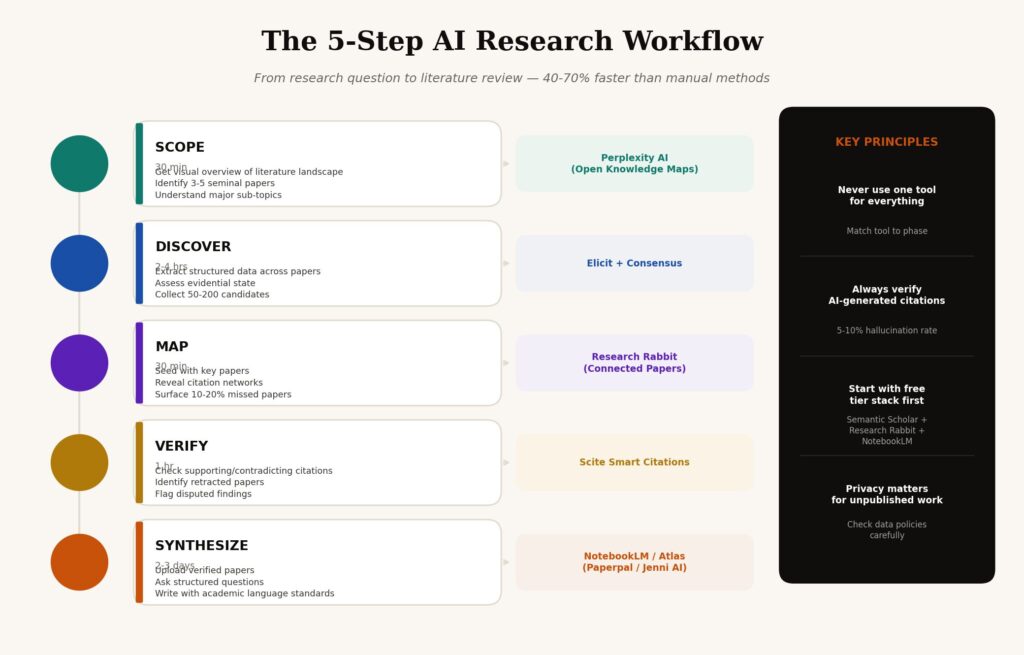
This workflow has been validated by research teams across academia and industry. It covers the full lifecycle from initial scoping through final synthesis, using the best tool at each stage. Total estimated time saving versus manual methods: 40–70% depending on scope.
From Research Question to Literature Review
-
1
Scope — 30 Minutes
Use Perplexity AI (with Academic Focus mode) or Open Knowledge Maps to get a visual overview of the literature landscape. Ask your research question in natural language. Your goal: identify 3–5 seminal papers and understand the major sub-topics within your area. Don’t cite anything yet — just orient yourself.
-
2
Discover — 2–4 Hours
Input your refined research question into Elicit. Let it extract structured data across relevant papers. Simultaneously run your core hypothesis through Consensus to assess the evidential state. Export your paper collection to Zotero or your reference manager. Aim for 50–200 candidate papers at this stage.
-
3
Map — 30 Minutes
Seed Research Rabbit with your 3–5 most important discovered papers. Let the citation network reveal papers your keyword search missed — especially older foundational work and adjacent-field contributions. Cross-check with Connected Papers for a co-citation visualization. This step routinely surfaces 10–20% additional relevant papers.
-
4
Verify — 1 Hour
Before reading deeply, run your most important citations through Scite. Identify any papers that have been explicitly disputed, contradicted, or retracted since publication. This step is especially critical in fast-moving fields (AI, biomedicine, climate science) where findings from 3–5 years ago may have been significantly revised. Eliminate or flag problematic papers before investing reading time.
-
5
Synthesize — 2–3 Days
Upload your verified, collected papers to NotebookLM (for free grounded synthesis) or Atlas (for mind-map synthesis across large corpora). Ask structured questions: “What are the main methodological approaches?”, “Where do studies contradict each other?”, “What gaps does the literature identify?” Use Claude or SciSpace for deep analysis of specific key papers. Write your literature review using Paperpal or Jenni AI to maintain academic language standards throughout.
The Power Combo for PhD Students (per CompareGen, 2026)
Graduate students and PhD candidates: Elicit for systematic reviews + Claude for individual paper analysis + Research Rabbit for discovery. This is the stack that research methodologists recommend most frequently for thesis-level work in 2026. Total cost: approximately $12–20/month for Elicit Pro plus any Claude subscription.
12 — Expert Tips What Experienced Researchers Know That Beginners Don’t
Tip 1: Match Tool to Phase, Not to Brand Familiarity
The biggest mistake is defaulting to one tool for everything. ChatGPT for literature review, Perplexity for citation verification, and NotebookLM for discovery are all wrong fits. Build a stack deliberately: one discovery tool, one verification tool, one synthesis tool. The tools listed above were each designed for their phase and genuinely outperform general AI at it.
Critical: Always Verify AI-Generated Citations
Even the best AI research tools hallucinate citations. Documented 5–10% hallucination rates on Perplexity Pro mean one in ten citations may be fabricated or misquoted. Before including any AI-surfaced citation in formal work, manually verify the paper exists via Google Scholar, confirm the authors and year match, and check that the paper actually says what the AI claims it says.
Tip 2: Data Privacy Matters for Unpublished Work
For sensitive unpublished research, check each tool’s data policy carefully. Claude and Perplexity Pro don’t use paid-tier inputs for model training. Elicit explicitly states it doesn’t train on user data. For the most sensitive work, CompareGen’s 2026 guide recommends Claude’s paid tier as the most protective option.
Tip 3: Use Elicit for Systematic Reviews, Not ChatGPT
General-purpose AI (ChatGPT, Gemini) can brainstorm and write, but they are weak at systematic literature review because they produce fluent text more readily than they retrieve and organize evidence with the transparency academic work requires. For formal systematic reviews, Elicit’s PRISMA-compliant, citation-traceable workflow is the only AI tool that meets methodological standards.
Tip 4: The Free Stack is Better Than You Think
Before committing to paid subscriptions, exhaust the free stack: Semantic Scholar + Research Rabbit + NotebookLM + Elicit free tier + Perplexity free. This combination covers discovery, citation mapping, synthesis, and basic AI-assisted search — all at zero cost. Most undergraduates and casual researchers don’t need more than this.
The Research Tools vs. Clinical Tools Distinction
In medical and health contexts: AI research tools (Elicit, Consensus, Semantic Scholar) are not clinical decision support tools. A research tool that finds 15 papers suggesting a treatment works is not the same as a clinical tool that tells you the treatment is recommended by NICE or the FDA. Never use research-oriented AI tools for point-of-care medical decisions.
Quick-Reference: Which Tool for Which Question?
| Your Situation | Best Tool | Why |
|---|---|---|
| “What does the literature say about X?” (quick) | Perplexity Pro — Academic Focus | Fastest cited synthesis from peer-reviewed sources |
| “I need to run a systematic review” | Elicit | PRISMA compliance, 96–99% accuracy, data extraction |
| “Does intervention X work for condition Y?” | Consensus | Evidence meter gives immediate empirical state |
| “Find papers related to my seed paper” | Research Rabbit | Citation network discovery, completely free |
| “Is this paper safe to cite?” | Scite | 1.2B citation statements, supporting/contrasting |
| “Help me understand this dense methods section” | SciSpace Copilot | Highlight-to-explain, optimized for paper reading |
| “Synthesize these 30 papers I’ve collected” | NotebookLM (free) / Atlas | Source-grounded synthesis from uploaded docs |
| “Polish my manuscript for journal submission” | Paperpal | 23 years of academic publishing expertise |
The Underrated AI Tools Nobody Hypes — But Practitioners Actually Use
7 AI Tools for Researchers and Writers: Moves That Separate Beginners From Experts