

The Best AI Strategies for Entrepreneurs in 2026: What Actually Works (and Why Most Don’t)
A raw, data-driven breakdown of which AI plays compound into asymmetric advantage — and which ones burn your runway while making you feel busy.
Let me tell you about a mistake I made two years ago, one I suspect a lot of entrepreneurs are still making right now.
I was convinced that having more AI tools meant having a better AI strategy. So I subscribed to eleven of them. I had a tool for writing, one for images, one for scheduling, one for CRM, two for analytics, and a couple I honestly can’t remember anymore. My productivity dashboard looked impressive. My actual output was, measured objectively, about the same as before — maybe a bit worse, because context-switching between eleven tools is its own full-time job. I was performing AI adoption. I wasn’t doing it.
That experience — embarrassing in retrospect — turns out to be statistically common. A summer 2025 MIT report found that 95% of generative AI pilots are failing. Meanwhile, the U.S. Chamber of Commerce tells us that 89% of small businesses now use AI in some form, up from just 36% in 2023. The gap between those two numbers — near-universal adoption, near-total pilot failure — is where everything interesting lives.
This article is my attempt to close that gap. Not with a list of tools (you don’t need another one of those), but with the deeper logic of what actually makes AI compound into competitive advantage for entrepreneurs — and what makes it quietly drain your runway while you feel productive.
The Paradox: Everyone’s Using AI, Almost Nobody Is Using It Well
Here is the data picture as it actually stands in mid-2026, stripped of vendor marketing:
On one side: adoption has been breathtaking. The SBE Council’s March 2026 survey found 82% of small business employers have invested in AI tools, with the average firm using a median of five different tools simultaneously. According to Salesforce research, 91% of small businesses using AI report measurable revenue increases. 93% plan to continue investing, and 62% are actively increasing AI spending.
On the other side: a MIT study found 95% of AI pilots collapsing before reaching production. IBM’s Q4 2025 Think Circle discussions confirmed that only about 29% of executives can reliably measure AI ROI today. Deloitte’s 2026 State of AI report notes that while 66% of organizations report productivity gains, only 20% are already achieving revenue growth through AI — with 74% still calling it an “aspiration.” And Gartner projects that 30% of generative AI projects will be abandoned entirely by end of 2026.
The divergence is real and it’s widening. AI is working extraordinarily well for a specific subset of businesses — those with deliberate strategies, measurement frameworks, and workflow-first thinking. For everyone else, it’s producing what IBM calls “modest efficiency gains” that don’t add up to transformation.
“The picture’s starting to shift. Success is becoming visible. We can now see what it looks like to use AI to build a leading-edge operating or business model.” — PwC 2026 AI Business Predictions
The question isn’t whether AI works. It demonstrably does. The question is: what separates the 5% who are realizing extraordinary value from the 95% who are stuck in pilot purgatory?
The Strategy-Execution Gap: An Original Framework for Why AI Fails
After looking hard at the failure patterns across the research, I want to offer something I haven’t seen named quite this way before — I’m calling it the Strategy-Execution Gap (SEG).
The SEG is the distance between an entrepreneur’s AI ambition and their organizational readiness to execute on it. It has three measurable dimensions:
- Workflow Clarity Gap
The degree to which the entrepreneur can precisely specify which workflow AI will touch, what the input/output looks like, and how success is measured. Most AI pilots fail here because the workflow was never mapped — people deploy ChatGPT “to help with marketing” without ever specifying what that means in time, dollars, or measurable output.
- Data Readiness Gap
A 2025 MIT paper by Kate Kellogg and colleagues made a stunning finding: when deploying AI agents in a healthcare setting, 80% of the work was consumed by data engineering, stakeholder alignment, governance, and workflow integration. Not the AI itself. The data. This is true at every scale. If your data isn’t clean, structured, and accessible, your AI is performing on gravel.
- Governance Gap
77% of small businesses using AI have no written AI policy. This isn’t just a compliance risk — it’s a measurement risk. Without governance, you can’t compare performance before and after AI adoption, can’t detect hallucinations in client-facing outputs, and can’t hold any single workflow accountable to a number. No governance = no measurement = no compounding.
Most AI conversation focuses on the tool layer. The SEG framework says: stop there. The tool is the last decision you make, not the first. Where do you sit in this matrix right now? Be honest. The uncomfortable answer is more valuable than the comfortable one.
The Real ROI Model: Unit Economics You Can Actually Use
Most ROI claims around AI are either too vague to be useful or too optimistic to be believed. Here I want to give you something you can actually plug numbers into — a simplified unit economics model for AI investment decisions.
The formula I use is adapted from standard operational ROI analysis:
AI ROI (annualized) = [(Hours Saved × Hourly Rate) + (Revenue Uplift) - (Full AI Cost)] ÷ Full AI CostWhere: Hours Saved = weekly hours saved × 52 Hourly Rate = your effective hourly value (revenue / total hours) Revenue Uplift = incremental revenue attributable to AI workflow Full AI Cost = subscriptions + integration + training + oversight timeLet me run three real-looking scenarios with this model:
A few things jump out from this exercise that I find underappreciated in most AI content:
The hidden cost multiplier is real and almost always ignored. Every analysis I’ve seen shows entrepreneurs underestimating the “Full AI Cost” by 2–3x. Beyond subscription fees, you’re paying in training time (both yours and your team’s), API overages when usage scales, integration engineering if you want tools to talk to each other, and the cognitive overhead of managing new systems during the transition period. A $300/month tool stack often has an effective cost of $700–$900/month when fully accounted.
Revenue uplift is the wild card that separates good ROI from extraordinary ROI. The difference between a 3x and an 11x return in the models above isn’t hours saved — it’s revenue uplift. Entrepreneurs who figure out how to use AI to grow the top line, not just trim costs, are the ones generating asymmetric returns. This requires the AI to be embedded in customer-facing or revenue-generating workflows, not just internal operations.
According to a 2026 Thryv survey, many small businesses using AI report saving over 20 hours per month and between $500–$2,000 per month in operational costs. McKinsey’s 2026 research puts the average SMB ROI on AI investment at 3.7x. But the SBA’s longitudinal data shows that 83% of growing SMBs have adopted AI, compared to only 55% of declining ones — suggesting the causality runs both ways.
The 5-Layer AI Stack: How to Think About Your AI Architecture
One of the biggest structural errors entrepreneurs make is thinking about AI as a flat list of tools. It’s not. It’s a layered architecture, and each layer has different ROI characteristics, different failure modes, and different compounding potential.
Here’s the framework I use — I call it the 5-Layer AI Stack:
The critical insight here: most entrepreneurs are living in Layer 2, skipping Layer 1, and dreaming about Layer 5. That’s backwards. Layer 1 — the data foundation and governance infrastructure — is what makes every other layer work. Without it, you’re building an expensive house on sand.
The Deloitte data confirms this: their 2026 State of AI report found that while 66% of organizations report productivity gains (that’s Layer 2 territory), only 34% are “truly reimagining the business” — which requires Layers 3 through 5. The AI skills gap is cited as the primary barrier, but I’d argue it’s the governance gap that precedes and enables the skills gap — you can’t train people to use something well if you don’t know what “well” looks like.
Agentic AI: The Asymmetric Leverage Most Entrepreneurs Are Sleeping On
Everything I’ve described so far is table stakes. This section is where the conversation gets genuinely interesting — and where the competitive separation is going to happen in the next 18 months.
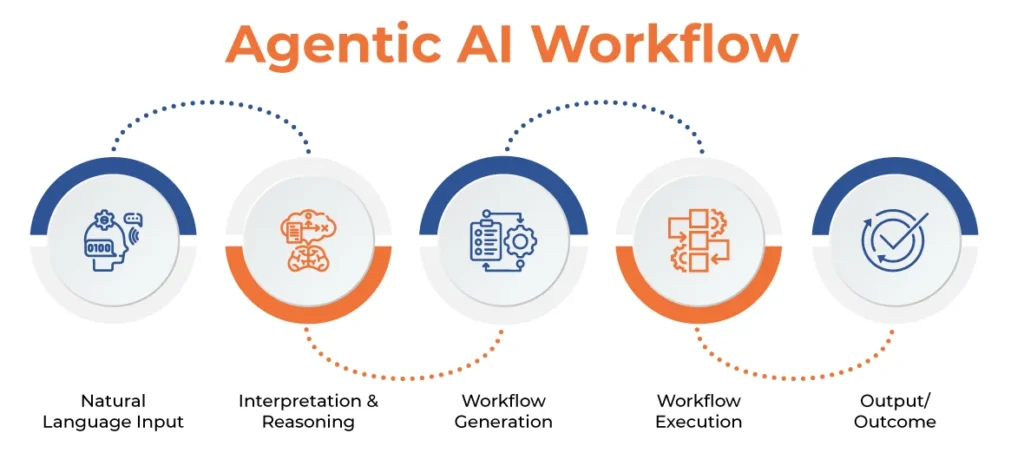
Agentic AI refers to AI systems that can autonomously plan, make decisions, and execute multi-step tasks across multiple systems with minimal human supervision. The distinction from generative AI is profound: a chatbot answers questions; an AI agent completes workflows.
Think about what that means in practice. MIT Sloan describes an agent that could plan an entire vacation — checking flights, reading your emails for schedule conflicts, booking hotels within your stated preferences — without you touching anything beyond the initial instruction. Scale that down to a small business: an agent that monitors your inbox for client inquiries, pulls their project history from your CRM, drafts a personalized response, adds a follow-up task to your project management tool, and notifies you only when the response needs your approval.
That’s not science fiction in 2026. That’s what QuickBooks, Salesforce Agentforce, and Zapier Agents are building right now — and the early data is striking.
According to PwC’s 2025 AI Agent Survey, 66% of organizations adopting AI agents report increased productivity. Knowledge workers using production agents are recovering a median of 6.4 hours per week. McKinsey notes that early agentic AI deployments can contribute to 3–5% annual productivity growth, with scaled implementations driving even greater impact. PwC’s 2026 predictions state that in many cases, agents can do roughly half of the tasks people now do.
But here’s what’s missing from every vendor slide deck about agentic AI: the implementation burden is brutal. MIT’s Kellogg and colleagues studied an AI agent deployed to detect adverse events among cancer patients. The biggest challenge wasn’t model fine-tuning or prompt engineering. It was that 80% of the work was consumed by data engineering, stakeholder alignment, governance, and workflow integration. Not the AI. The plumbing around the AI.
This is the agentic AI tax. And for entrepreneurs, it’s either a barrier or an advantage, depending on how you approach it.
The productivity delta between Layer 2 and Layer 4 is not incremental — it’s categorical. When you move from AI-assisted work to AI-agentic workflows, you’re not saving 20% more time; you’re restructuring which tasks require human time at all.
For a solo entrepreneur, recovering 6.4 hours per week (the PwC median for knowledge workers using production agents) means 332 hours per year. At a conservative $75/hour value, that’s $24,900 in recovered capacity annually — before you account for any revenue uplift from doing higher-value work with those hours.
Agentic AI has a dark side that vendor materials don’t advertise. A Dark Reading poll found that 48% of cybersecurity professionals now consider agentic AI the top attack vector for 2026. Autonomous agents carry elevated permissions, interface with multiple systems, and act without constant oversight — creating what security researchers call “shadow AI” and “non-human identity” risks. Before deploying agents in your business, you need a zero-trust architecture review and explicit data access controls. This isn’t paranoia; it’s table stakes.
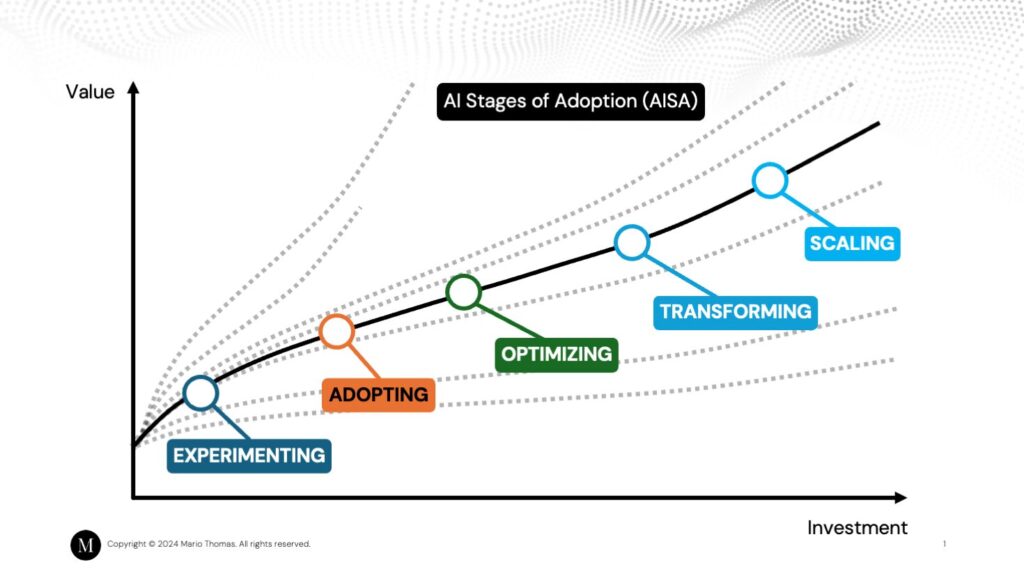
The Bifurcation Curve: Why the Gap Between AI Haves and Have-Nots Is About to Widen Dramatically
There’s a pattern in how transformative technologies distribute their benefits that I think is exactly repeating with AI — and it’s one that should either fill you with urgency or comfort, depending on where you are.
The SBA’s longitudinal analysis is striking: in February 2024, large businesses used AI at 1.8 times the rate of small businesses. By August 2025, that gap had narrowed to 1.2x. Small businesses are adopting AI faster than any previous technology cycle — closing the gap with large enterprises in months, not years.
But within the small business segment, a different bifurcation is emerging. The U.S. Chamber of Commerce data shows small businesses using AI are 2.3x more likely to report revenue growth than those not using AI. Salesforce data shows 91% of AI-using SMBs report revenue increases. And the SBA’s data shows that 83% of growing SMBs have adopted AI, compared to just 55% of declining ones.
This correlation is becoming self-reinforcing. Businesses with AI advantage generate more revenue, which funds more AI investment, which widens the productivity gap, which generates more revenue. The compounding has already started. The question is which side of the curve you’re on.
The dashed portion of that chart is, honestly, a model — not a measurement. I want to be transparent about that. What I’m confident in is the direction and mechanism, not the precise magnitude. The compounding dynamic is real. The 2.3x revenue growth multiple for AI-using SMBs (U.S. Chamber, 2026) is real. How fast it compounds from 2027 onward depends on factors we can’t fully predict — model capability improvements, regulatory interventions, and whether agentic AI delivers on its current promise.
The Uncomfortable Truths Nobody Is Publishing
The productivity gains from AI are real — but they’re making some entrepreneurs more efficiently mediocre. I see this constantly: business owners who are producing more content, more quickly, in a more consistent format, with zero improvement in quality or originality. AI has made the floor of content quality higher and the ceiling lower. If your AI strategy is “produce more of what I was already doing,” you’re racing toward commodity at machine speed.
The “AI will replace your employees” panic is mostly wrong, but the “AI creates more jobs” consolation is mostly wrong too. What’s actually happening is more specific and more uncomfortable: AI is creating a bifurcation within job categories. Junior content writers, junior researchers, and entry-level analysts are seeing their roles contract. Senior strategists, creative directors, and AI orchestrators are seeing their roles expand and their leverage increase. This isn’t job replacement — it’s a compression of the career ladder that makes it harder to enter knowledge-work fields at the junior level.
Most “AI strategy” content is written by people who have never run a business with AI for more than six months. The gap between what AI can do in a demo and what it does in production, across a real team, with real data quality issues and real workflow integration problems, is enormous. The 95% pilot failure rate MIT found isn’t a technology failure — it’s a reality gap between demo conditions and production conditions.
That third point deserves expansion, because I think it’s the most structurally important. IBM’s Q4 2025 Think Circle discussions were blunt about this: “The primary challenge is not a technology problem, but an organizational one. Culture, governance, workflow design and data strategy are the main constraints on realizing ROI.”
This means that the entrepreneur who will win with AI in 2026 is not necessarily the one with the best tech stack. It’s the one who has done the organizational work — mapped their workflows, cleaned their data, trained their team, built their measurement framework, and established their governance policy — before deploying the tools.
Your 90-Day AI Strategy Playbook: What to Actually Do
Everything above is diagnosis. This section is prescription. I want to give you a specific, sequenced playbook that doesn’t require a large budget, a data science team, or any prior AI experience beyond what you already have.
Days 1–30: Foundation Before Tools
- Map your 3 highest-friction workflows
Not “all your workflows.” Three. The ones where you personally spend the most time on repetitive, low-judgment tasks. Write down, in precise detail: what triggers the workflow, what input it takes, what output it produces, how long it takes, and how you’d know if the output was good. This mapping exercise is the difference between productive AI adoption and expensive experimentation.
- Write your AI policy (1 page is enough)
It only needs to cover: what data can go into AI tools, what data cannot (client PII, financial data, trade secrets), what AI outputs require human review before going external, and who is accountable for AI-generated errors. A one-page policy prevents the majority of AI liability exposure that most SMBs are currently running blind into.
- Establish your baseline metrics
You cannot measure ROI if you don’t know your starting point. For each of your three friction workflows: time per completion, cost per completion, error rate, and throughput (how many you can complete per week). Record these now. You’ll need them in 90 days.
Days 31–60: Deploy One Workflow, Measure Everything
- Pick workflow #1 and go narrow and deep
PwC’s 2026 AI predictions make this explicit: don’t cut a few steps from a workflow — rethink the workflow. Ask not “how can AI fit into this workflow?” but “if I were designing this workflow today with AI as a native capability, what would it look like?” Often the answer is that a 12-step process becomes a 3-step process.
- Build your prompt library
A prompt library is a living document of the exact prompts, context instructions, and output specifications that produce consistent, high-quality results for your specific workflows. It is the single most underrated productivity asset for AI-using businesses. One good prompt, documented and refined, is worth dozens of improvised ones.
- Run a 30-day controlled experiment
Use AI for workflow #1 for 30 days. Track the metrics you established in Days 1–30. At the end of 30 days, calculate your actual ROI using the formula in Section 3. If it’s negative, diagnose why before expanding. If it’s positive, document the playbook and move to workflow #2.
Days 61–90: Stack and Orchestrate
- Connect your tools
Once you have one workflow running well, look for the handoffs between that workflow and adjacent ones. These handoffs — where the output of one process becomes the input to another — are where agentic AI creates the most value. A tool like Zapier Agents or n8n can begin orchestrating these handoffs with minimal technical overhead.
- Upskill on AI orchestration, not AI tools
LinkedIn’s 2026 Workforce Report identifies AI upskilling as the #1 competitive differentiator cited by small business owners with above-average growth. But the specific skill that matters most isn’t prompt engineering for a single tool — it’s understanding how to compose AI capabilities across tools into workflows. This is the Layer 3 → Layer 4 transition.
- Run your 90-day ROI assessment
Calculate your overall ROI using the formula from Section 3. Compare to the 3.7x McKinsey average. If you’re above it, you’re doing something right — document what. If you’re below it, the most common culprits are: hidden costs not accounted for, insufficient workflow redesign (fitting AI into old processes rather than rethinking them), or measurement gaps (you don’t actually know if quality improved or declined).
The Closing Constraint Nobody Wants to Hear
Every framework eventually needs a complicating constraint in the closing — something that makes you sit with the question rather than close the tab feeling like you have the answer.
Here’s mine: the thing that will determine whether AI is transformative for your business isn’t in any of the layers I described. It’s the quality of the questions you ask of it.
AI is, at its core, a very sophisticated answering machine. It is extraordinarily good at answering questions. But it cannot ask better questions than the ones you put to it. The entrepreneurs who will generate extraordinary value from AI are the ones who cultivate the ability to ask harder, more specific, more honest questions — about their customers, their processes, their assumptions, their market — and then use AI to help pursue those questions at a speed and scale that wasn’t previously possible.
That’s not a skill you can automate. It’s also the only one that gives you a durable advantage — because while your tools can be copied, your capacity to ask better questions compounds as your understanding deepens.
The 95% who are failing at AI aren’t failing because they have the wrong tools. They’re failing because they haven’t done the harder work of figuring out the right questions.
Start there.
Frequently Asked Questions
What is the average ROI for small businesses using AI?
McKinsey’s 2026 research reports an average 3.7x ROI on AI tool investment for small businesses. But this average masks extreme variance: early-adopter, strategy-first businesses report 5–12x ROI, while late adopters using AI ad hoc often report near-zero or negative returns after accounting for hidden integration and training costs. The quality of your strategy matters more than the quantity of your tools.
Why do most AI pilots fail for small businesses?
A summer 2025 MIT report found 95% of generative AI pilots are failing. IBM’s analysis of the pattern found the primary cause is organizational, not technological: no clear ROI measurement framework, no genuine workflow redesign, inadequate change management, and treating AI as a point tool rather than an operating model shift. The most common failure mode is deploying AI into old workflows rather than rethinking workflows around AI capabilities.
What AI tools deliver the highest ROI for entrepreneurs?
Marketing automation and content generation consistently deliver the strongest and fastest returns — saving 5–15 hours per week per person (HubSpot 2025 State of Marketing). Customer service AI chatbots handle 40–60% of routine inquiries autonomously. The highest ROI comes from agentic AI workflows that connect multiple tools and systems, not isolated single-tool usage. The specific tools matter less than the depth of workflow integration.
How much can AI save a small business per month?
Thryv’s 2026 survey of small businesses using AI reports savings of $500–$2,000 per month in direct costs and 20+ hours of time monthly. However, hidden costs — API overages, training time, integration engineering, and workflow disruption during transition — can double the effective cost of adoption if not planned for. Always calculate your Full AI Cost, not just your subscription cost.
What is agentic AI and why does it matter for entrepreneurs?
Agentic AI refers to AI systems that can autonomously plan, make decisions, and execute multi-step tasks with minimal human supervision. Unlike standard generative AI (which answers questions), agentic AI completes workflows. PwC’s 2025 AI Agent Survey found 66% of organizations adopting agents report increased productivity, with knowledge workers recovering a median of 6.4 hours per week. For entrepreneurs, this means the difference between AI as a tool you use and AI as a workforce multiplier that handles entire processes.
How do I measure whether my AI strategy is working?
Use the unit economics formula: AI ROI = [(Hours Saved × Hourly Rate) + Revenue Uplift - Full AI Cost] ÷ Full AI Cost. Measure before and after on three metrics for each workflow: time per completion, cost per completion, and quality or error rate. Compare your result to the 3.7x McKinsey average. If you’re below it after 90 days, the most common diagnoses are: underestimated hidden costs, insufficient workflow redesign, or absent measurement baseline.