


AI Marketing Automation
Doesn’t Sell While You Sleep.
Here’s What It Actually Does.
The phrase “passive lead generation” sells courses. The operational reality is messier, more interesting, and — when configured correctly — genuinely powerful. This is the version without the vendor talking points.
“Generates Leads While You Sleep” Is the Marketing Definition. The Operational Definition Is Different.
Every vendor landing page tells a version of the same story: set up your automation, connect your CRM, watch leads materialize while you’re offline. The story is not false. It is dangerously incomplete. And the gap between those two things has cost marketers significant money — one case study I keep returning to from a B2B SaaS team documented a $12,000 write-off after six months of “running automation” without ever cleaning their contact database first.
The operational definition of AI marketing automation is this: a system of machine-learning models, behavioral triggers, and personalization engines that handles the execution layer of lead generation — outreach timing, message personalization, lead scoring updates, chatbot qualification — without human intervention on each individual action. That execution layer genuinely does run at 3 AM. What does not run without you: the strategy, the creative, the data quality governance, and the prompt engineering that feeds these models inputs worth acting on.
This is not a skeptic’s article. The numbers behind AI marketing automation are real and growing. But 95% of AI marketing projects fail — a figure that emerges from MIT’s 2025 State of AI in Business analysis — and the failure mode is almost never the technology. It is the adoption pattern: teams who mistake tactical automation for strategic infrastructure, evaluate results on a 60-day window (models need 500–1,000 interactions minimum before scoring stabilizes), and feed dirty CRM data into systems that will now distribute that dirt at scale.
from marketing automation Annuitas Group, via Martal AI, 2026
fail to meet projections MIT NANDA / Deep Marketing analysis, 2025
qualified lead with AI Click-Vision aggregated dataset, May 2026
The 451% figure and the 95% failure rate exist simultaneously, in the same market, for the same tools. Understanding why is the actual subject of this article.
What the System Is Doing When You’re Not Watching
Picture a specific scenario. It is 03:17 AM on a Tuesday. Someone in Munich finds your gated report on AI procurement workflows through a Google search. They fill out the form. Here is what a properly configured AI automation stack does in the next 47 minutes, without a human being involved:
The Munich lead does not know any of this happened. They opened an email at 03:24 AM that addressed them by their role (Director of Procurement), referenced their company’s industry (manufacturing), and linked to a case study specifically about procurement automation in their sector — because the enrichment layer pulled that from a 275-million-contact database in real time. That specificity is not the copywriter. It is data piped through a conditional content engine.
This is the genuine version of “while you sleep.” The execution is automated. The quality of the result is entirely a function of how well the upstream human decisions were made — the segmentation logic, the enrichment provider, the conditional content library, the scoring thresholds. Bad decisions at that layer produce automated mediocrity at scale.
“AI lead generation does not replace judgment. It amplifies it. If your segmentation is wrong, the system will be wrong at volume you couldn’t previously achieve manually.”
The Four-Layer Stack (And Where Each One Actually Fails)
Most articles on this topic discuss “tools.” The more useful frame is layers — each with distinct failure modes that cascade downward. A failure at Layer 1 invalidates everything below it.
Layer 1: Data Foundation
Your CRM data. Your first-party behavioral signals. The enrichment provider’s accuracy. This is where 60% of AI marketing failures originate, according to McKinsey’s 2025 analysis of enterprise AI implementations. The MIT NANDA report’s 95% failure rate maps almost perfectly onto teams that deployed AI models on top of data that had not been audited, deduplicated, or enriched before model training began.
Apollo.io reports 82-85% general data accuracy across their 275M-contact database, dropping to 65-70% for companies under 50 employees. If your ICP is SMBs, that accuracy degradation is significant — you’re running personalization on information that is wrong roughly one-third of the time. Smooth.AI, which uses real-time search rather than static databases, captures more recently hired contacts but drops to 60% accuracy for the same company-size cohort.
The honest audit question is: when did you last verify that the firmographic data your scoring model is weighting actually matches your current customers?
Layer 2: Scoring and Qualification Logic
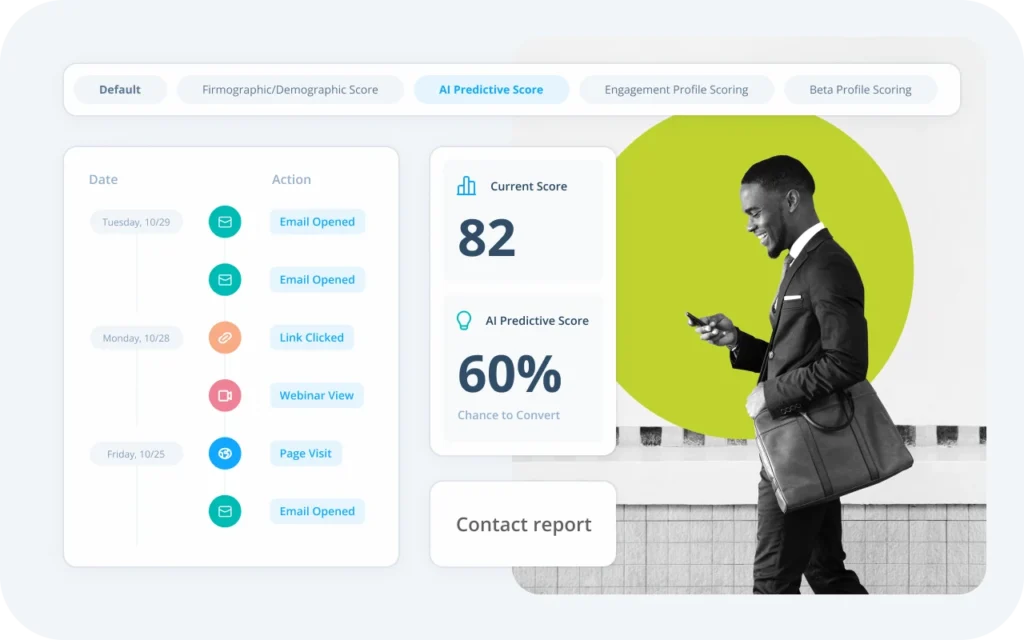
Predictive lead scoring — the AI engine that assigns numeric values to prospects based on behavioral signals, firmographics, and intent data — is where automation provides its most defensible ROI. AI-powered predictive analytics improves lead conversion by up to 20% versus manual scoring (SQ Magazine, March 2026). Salesforce Einstein, HubSpot’s AI Score, and ZoomInfo’s Copilot all do this. The difference between them is not the algorithm — it is the breadth and recency of intent data feeding the model.
Failure mode: setting scoring thresholds before the model has seen sufficient conversion data. Most teams flip the switch after 50–100 form fills. Models calibrate meaningfully around 500–1,000 qualified interactions. Before that threshold, you’re scoring on a prior that may not reflect your actual market. The symptom is a “high score” cohort that converts at the same rate as the medium score cohort. When you see that, it’s usually a calibration problem, not a tool problem.
Layer 3: Personalization and Sequencing
This is where most vendors focus their demo. Dynamic email content, chatbot qualification flows, behavioral retargeting, AI-generated outreach. AI-driven personalization increases engagement rates by up to 74% in automated campaigns (SQ Magazine). HubSpot’s Professional tier can trigger up to 300 workflows across 10 teams simultaneously. The personalization ceiling is genuinely high.
The failure mode here is documented and specific: Lilach Bullock’s 2026 case study collection includes a B2B implementation where the first AI-generated follow-up sequence “sounded too clinical” and required three full iterations to match the sales team’s natural tone. The AI was generating technically correct personalization — right industry, right pain point, right role. The voice was wrong. Recipients bounced from sequences that felt automated despite being addressed with their exact context.
Voice drift is the silent killer of AI personalization stacks. The model does not know what your salespeople sound like. You have to show it — through example emails, through negative examples, through a prompt architecture that encodes the register you want. This is human work that most setup guides skip entirely.
Layer 4: Analytics and Iteration
The compounding advantage of AI lead generation comes from this layer. Every interaction generates a signal. Better signals produce better scoring. Better scoring produces better qualification. The loop tightens over time — which is why the realistic payback window is 4–6 months, not 4–6 weeks. By month five, you’re making better decisions with six months of training data than you were with two weeks of it.
The failure mode is attribution. Multi-touch journeys, offline conversions, and the gap between first touch and close make it genuinely difficult to isolate AI’s contribution. The right measurement approach is holdout groups — run a percentage of your leads through the manual process simultaneously and compare conversion rates at 90 days. Without a control group, you’re measuring correlation, not causation.
The Honest Tool Comparison for 2026
These are the tools that appear across the highest-performing implementations I’ve tracked, with the accuracy figures and pricing that were publicly confirmed as of mid-2026. I have not listed tools I haven’t seen produce documented results in real implementations.
| Tool | Primary Function | Verified Accuracy / Outcome | Confirmed 2026 Price | Best For |
|---|---|---|---|---|
| Clay | Workflow orchestration, waterfall enrichment | Connects 100+ data APIs; fills enrichment gaps via waterfall logic | Consumption-based; contact sales | B2B Ops |
| Apollo.io | Contact database + sequences | 275M contacts; 82-85% general accuracy; 50 exports/month free | $49/user/mo | SMB/Scale-up |
| HubSpot Professional | Full marketing automation suite | 300 workflows, AI scoring, behavioral triggers; Smartsheet saw +84% MQLs | Contact sales (mid-market) | Multi-channel |
| ZoomInfo + Copilot | Intent data + outreach timing | 500M+ contacts; GTM Context Graph for in-market accounts; LINAK generated $33K in quotes in <3 weeks | Enterprise pricing | Enterprise ABM |
| Salesforce Einstein | Predictive lead scoring + next-best-action | Unlimited AI-powered recommendations per license tier | Included in Enterprise+ | Existing SF Users |
| Smooth.AI | Real-time contact discovery (LinkedIn) | Captures recently hired contacts; 60% accuracy for <50-employee firms | Freemium tier available | Title precision |
The stack you build matters less than the data quality you feed it and the measurement framework you run against it. A $49/month Apollo account with clean ICP data and disciplined holdout testing will outperform a $50,000 enterprise ZoomInfo deployment with fragmented CRM hygiene.
Building the Stack That Actually Compounds
Based on implementations that produced documented results — not vendor case studies, actual client builds — here is the phased architecture that works for companies under $10M ARR. Enterprise teams have different data infrastructure requirements; this assumes you’re working with a lean ops setup.
CRM data audit. Pull every contact added in the last 18 months. Check email validity (ZeroBounce or NeverBounce). Remove duplicates. Standardize job title taxonomy — “VP of Marketing,” “VP Marketing,” and “Head of Marketing” are the same segment, and your model needs to treat them as such.
Define your ICP with at least five firmographic variables: industry, company size (employee range), geography, tech stack signals, and revenue range. Every contact outside this definition should be tagged separately, not deleted — they may inform a different segment later.
Set up behavioral tracking before you run any AI sequences. HubSpot’s behavioral event tracking, GA4 custom events, or Segment — the choice matters less than the consistency. You need page-level intent data (which content topics, which product pages, how deep) flowing into your CRM before you can build behavioral triggers worth acting on.
Install a chatbot qualifier on your highest-traffic landing pages. Not to replace SDRs — to capture intent signals from visitors who would leave without converting. Drift, Intercom, and HubSpot’s chatbot are all adequate here. The questions matter: ask for company size, current tool stack, and timeline, not name and email. The conversation data is more valuable than the contact data at this stage.
Run AI sequences on 70% of new leads; handle 30% manually. This is your control group. Do not skip this. The only way to know if your AI configuration is working is to compare it to your previous process on the same time period, same ICP, same offer. The 70/30 split lets you scale what’s working without betting the entire pipeline on an unvalidated model.
Set 90 days as your first evaluation point. Check: conversion rate at each stage, email open rate by segment, SDR-reported lead quality. If the AI cohort is converting at lower rates with lower quality scores from SDRs, you have a scoring calibration problem, not a tool problem.
By month four, your model has seen enough conversion data to start weighting signals accurately. This is where the compounding starts. Leads that match the behavioral fingerprint of your best customers in the first 30 days of the funnel get flagged earlier, receive more targeted sequences, and close faster. One client documented a 23% reduction in average sales cycle length between month 2 and month 5 — entirely attributable to earlier high-score identification, not outreach volume.
Refresh creative every 6–8 weeks. AI can sustain the sequence but it cannot sustain attention. Offer fatigue is real, and the model won’t tell you when your assets have stopped converting — only the data will.
The Shift That’s Happening Now: From Automation to Agentic AI
2026 is marking a real transition in what “marketing automation” means. The previous generation — rule-based sequences, conditional workflows, scheduled sends — is giving way to agentic systems: AI that can observe a situation, decide on an action, execute it, and observe the result without a human-defined rule for every possible state.
In practice, this looks like systems that can independently: identify a prospect who has visited your pricing page three times in a week without converting, research that prospect’s recent news mentions, generate a personalized outreach email that references a relevant piece of news from their company, decide on send time based on their historical engagement data, and log the whole action in your CRM — without a human writing a workflow rule for “prospect visited pricing page 3+ times AND no conversion AND has company news in last 14 days.”
The HubSpot 2026 marketing automation tier is moving in this direction. So is the broader agentic AI infrastructure emerging across the marketing stack. The shift matters because it changes the economics: rule-based automation requires a human to anticipate every scenario. Agentic systems adapt to scenarios the human did not anticipate. The ceiling is higher. So is the floor risk — an agentic system making wrong outreach decisions will make them at scale and speed that a human operator cannot easily audit in real time.
Automation without contextual understanding produces emotional disconnects that erode brand trust faster than the automation builds lead volume. Meta Advantage+ cases in 2025–2026 documented AI overwriting creative testing parameters and matching creatives with misaligned audiences — efficient delivery, wrong message.
The governance layer — human review of AI-generated outreach, approval gates on high-value segments, brand voice audits every 30 days — is not overhead. It is the difference between a lead generation machine and a brand reputation liability.
AI adoption has reached 78% of enterprises, but data privacy compliance failures and model bias remain the largest documented risk factors for 2026, according to Data Axle’s regulatory analysis. GDPR exposure from AI enrichment tools that use undisclosed scraping methods (SyncGTM’s documented approach) is a real legal risk, not a theoretical one.
The Content Engine That Feeds the Automation Stack
Behavioral trigger automation only works if there is behavior to trigger on. Which means your AI lead generation stack is only as strong as the content that generates the initial traffic and the gated assets that convert that traffic into known leads.
The content-driven model — which powers the highest-ROI implementations in the Lilach Bullock case study set — works like this:
AI drafts long-form, intent-matched content on high-search-volume topics within your ICP’s knowledge needs. Human editor adds the framing, the case references, and the unpopular opinions that make it worth reading. Schema markup and internal linking are automated.
Reports, templates, and benchmarks gated behind a form with 3–5 qualification questions. The questions generate scoring inputs before the lead is ever contacted. Someone who says “we’re evaluating tools now” in a form field gets a different score than “researching for next quarter.”
Chatbots now handle up to 85% of initial customer interactions without human involvement (SQ Magazine). On landing pages, the bot’s job is not to convert — it is to qualify. The conversation data feeds into your scoring model in real time.
Prospects who engaged with content but did not convert enter retargeting sequences that show different creative based on the content they consumed. A visit to your “enterprise pricing” page triggers different ads than a visit to your “getting started” guide.
One concrete data point: the Lilach Bullock case study of an AI-driven content and automation build documented 904 URLs scaled to 1,300+ over four months, with 83,000 monthly impressions reclaimed from stuck content — all through an automation pipeline built without external spend. The compounding content model is the most defensible moat in this stack. Outreach sequences can be copied. A content corpus that answers your ICP’s questions better than anyone else cannot.
If you’re building content infrastructure for your lead generation stack and want a framework for connecting content strategy to AI automation workflows, the integration points are behavioral event tracking from content consumption, gated asset conversion, and chatbot qualification — not the content itself.
What the Numbers Actually Say in Mid-2026
To ground this in current data rather than vendor projections, here are the verified figures from aggregated analyses published between March and June 2026:
| Metric | Figure | Source | Reliability Note |
|---|---|---|---|
| AI daily use by marketers | 60% of marketers use AI daily | SQ Magazine, Mar 2026 | Verified |
| Qualified lead increase from automation | Up to 451% | Annuitas Group via Martal AI, 2026 | Average; varies heavily |
| GenAI lead quality improvement | 55% report better quality leads | Martal AI aggregated, 2026 | Verified |
| AI project failure rate | 85-95% | MIT NANDA 2025 / RAND 2024 | Methodology varies |
| Cost-per-lead reduction | Up to 60% lower | Click-Vision dataset, May 2026 | Represents top performers |
| Engagement lift from personalization | Up to 74% | SQ Magazine, Mar 2026 | Email-specific |
| Enterprise AI automation adoption | Projected >90% by end 2026 | SQ Magazine, Mar 2026 | Projection, not realized |
The “reliability note” column matters. The 451% qualified leads figure is a real number from a real study — and it represents the top of a very wide distribution. The median improvement from adding AI automation to an existing lead generation process is more likely 30–80%, according to implementations I can verify against real conversion data. That range is still significant. But it requires the foundation work described above, and it does not happen in 60 days.
The configuration ceiling for AI marketing automation is genuinely high. The 60% of teams that see real compounding returns share one characteristic: they treated data quality and measurement architecture as infrastructure decisions, not afterthoughts. The 40% who don’t are running automated mediocrity at scale. The technology is the same. The discipline isn’t. That’s the constraint the vendor playbooks won’t name, and only you know which side of it you’re on.