

On April 16, 2013, the day after the Boston Marathon bombing, the food site Epicurious sent out a couple of tweets that read like self-promotion. The backlash was fast. The brand answered with more than a dozen individual apology tweets and then a public one calling its own posts insensitive, according to MarTech’s contemporaneous report.
Here is the part people usually leave out. The reporter who wrote it up said plainly that it wasn’t clear whether those tweets were pre-scheduled. So Epicurious is not proof that automation fails. What makes the story useful is what happened the day before: Buffer and SocialFlow were already telling their users how to pause queued posts, and Hootsuite said its support team was fielding the same questions.
That is the real subject of this article. Getting a machine to post for you is the easy part now. It’s cheap, and the data says it can even help. The hard part is deciding what watches the machine.
I went through the largest published datasets on AI-assisted posting, the current rulebooks of the major platforms, and the vendor “case studies” that dominate search results for this topic. Below is what held up, what didn’t, and how I would build a workflow with that in mind.
The short version
- AI-assisted posts beat non-AI posts in Buffer’s 1.2M-post analysis (median engagement 5.87% vs 4.82%), but Buffer’s own explanation is that people simply posted more and more consistently. The lift on LinkedIn and YouTube was marginal.
- On LinkedIn, the picture is mixed and getting worse for generic content. Originality.ai found about 54% of long posts likely AI in 2024, 53.7% in 2025, and 81.2% in a July 2026 sample. Human posts won clearly in marketing, innovation, and healthcare.
- Every platform has hard limits you will hit. Instagram caps API publishing at 100 posts per rolling 24 hours. X now charges per post, and a post containing a link costs 13 times a plain one.
- Silent failure is the most common way a workflow dies. Expired tokens and half-failed multi-platform publishes don’t send you an alarm.
- Nobody has published a clean study of fully unattended pipelines. The evidence is about AI assistance. Treat anything claiming otherwise with suspicion.
What 1.2 million posts say about AI-assisted content
Buffer is a scheduling company with an AI writing assistant, so it sits on an unusual dataset: what happens to posts after the assistant helps write them. In October 2024, it published an analysis of 1.2 million posts across Facebook, LinkedIn, Pinterest, Threads, TikTok, X, and YouTube (Instagram was excluded). To keep the comparison fair, it only counted people who had posted both AI-assisted and non-AI-assisted content, which left about 15,000 posters. (Buffer)
The headline: a median engagement rate of 4.82% for non-AI posts and 5.87% for AI-assisted ones. Here is the platform breakdown, using Buffer’s published figures.
Three things stand out, and none of them is “AI is magic.”
The gains are lumpy. Threads nearly doubled (5.56% to 11.11%). TikTok, Facebook, and X moved visibly. LinkedIn went from 6.22% to 6.85% and YouTube from 3.7% to 3.9%, which Buffer itself calls marginal.
Buffer doesn’t claim the writing was better. Its stated hypothesis is volume plus consistency: people using the assistant posted more often, and more attempts mean more chances to land one. Buffer also names its own caveats, including that its most engaged users are probably the likeliest to use the assistant at all (it calls this healthy user bias).
“AI-assisted” is a wide bucket. Buffer defines it as content the assistant generated or enhanced. The study doesn’t tell you how much a human changed afterward, or whether anyone reviewed anything.
My reading, and it is a reading rather than a finding: the best-supported benefit of AI in a posting workflow is that you stop skipping days. That is a legitimate win. It is also a smaller and more boring claim than the vendor pages make.
The counter-evidence: a feed already full of AI
Now the other side. Originality.ai, which sells an AI-text detector, has tracked LinkedIn long-form posts (100+ words) over time. Its first study covered 8,795 posts from January 2018 to October 2024 and estimated that 54% were likely AI-generated, with likely-AI posts averaging 45% less engagement. A follow-up of 3,368 posts from 99 influential profiles in 2025 put the share at 53.7%. A third analysis of 5,000 posts from July 2026 reported 81.2%, alongside news that LinkedIn planned a “Seems like AI slop” feedback option.
I’d be careful with these numbers. Three reasons:
- The samples differ (all posts, 99 hand-picked influential profiles, nine topics), so the line from 54% to 81% is suggestive, not a controlled trend.
- A detector vendor is measuring its own market. That doesn’t make the work wrong, but detectors misclassify, and the studies label posts “likely AI” at a confidence threshold.
- Engagement is likes plus comments, which says nothing about whether anyone bought anything.
Still, the industry split in the 2025 study is the most useful thing in any of these reports. Here it is as a ratio of average engagement, AI-likely over human-written (a bar above the line means AI posts did better).
Ratios computed from Originality.ai’s published averages (likes + comments per post): Leadership 2,635 vs 1,504; Finance 127 vs 118; Tech 302 vs 282; Wellness 252 vs 325; Healthcare 116 vs 208; Marketing 207 vs 771; Innovation 143 vs 708.
Notice the pattern. AI posts did fine, or better, in motivational and generic business content, where one competent post is interchangeable with another. They lost badly where the experience is the product: marketing, innovation, healthcare. For a brand, that tells you something awkward. If your social content is the thing that sells your expertise, the generic-post machine is working against you.
There is also a peer-reviewed counterweight. A multi-study paper in Public Relations Review (vol. 51, issue 5, December 2025) reports that GPT-4-written posts outperformed human-written ones on engagement, and that trained PR professionals, even with instruction and a cash incentive, couldn’t match the AI. That’s real evidence that AI can write a strong individual post. It doesn’t contradict the LinkedIn data. A well-crafted post and a feed where over half the long posts sound alike are different problems.
How I reconcile these. Three variables decide the outcome: whether a human shaped the post, whether the niche rewards lived experience, and how saturated the feed already is. Nobody has published a study that isolates the first one, which is the variable you control.
The rulebooks: what you can actually automate
Every guide says “connect your AI to Instagram, X and LinkedIn.” Here is what each platform’s own documentation (or the closest thing available) says, as of November 3, 2026. Rules change; check the linked page before you build.
| Platform | What automation is supported | Hard limits and costs | Watch out for |
|---|---|---|---|
| Publishing your own posts through the Graph API on professional (business/creator) accounts | 100 API-published posts per rolling 24 hours; a carousel counts as one | Long-lived tokens last about 60 days; unpublished media containers expire after 24 hours; feed images outside 4:5 to 1.91:1 fail (Postproxy) | |
| X | Posting through the API, pay-per-use since Feb 6, 2026 | $0.015 per plain post, $0.20 per post with a URL (the link surcharge dates from April 2026 per a third-party tracker) | A secondary reading of X’s Automation Rules says AI reply bots need prior written approval; verify on X’s own policy pages |
| Posting through LinkedIn’s official API or approved scheduling partners | LinkedIn’s help center says it doesn’t permit third-party software that automates activity on the site | Sources disagree on how API terms treat automated posting; one analysis quotes a developer-terms clause against it. Read the terms yourself and prefer an approved partner | |
| Page posting through Meta’s tools | Meta’s July 2025 crackdown on unoriginal content covered about 500,000 accounts in H1 2025; duplicate content gets reduced distribution | Remixing with real commentary is treated differently from re-posting copies |
Two honest notes. First, I couldn’t confirm LinkedIn’s position on API-based automated posting from a single authoritative page, which is why that row says what it says. Second, the X “AI reply bot” point comes from a vendor’s field guide summarizing X’s policies, so treat it as a lead to verify, not as settled.
The practical rule that falls out of all four: publish your own content to your own accounts through official APIs or approved partners, and keep automation away from engagement actions (auto-replies, auto-likes, auto-follows). That’s where platforms draw their enforcement lines.
A workflow that survives contact with reality
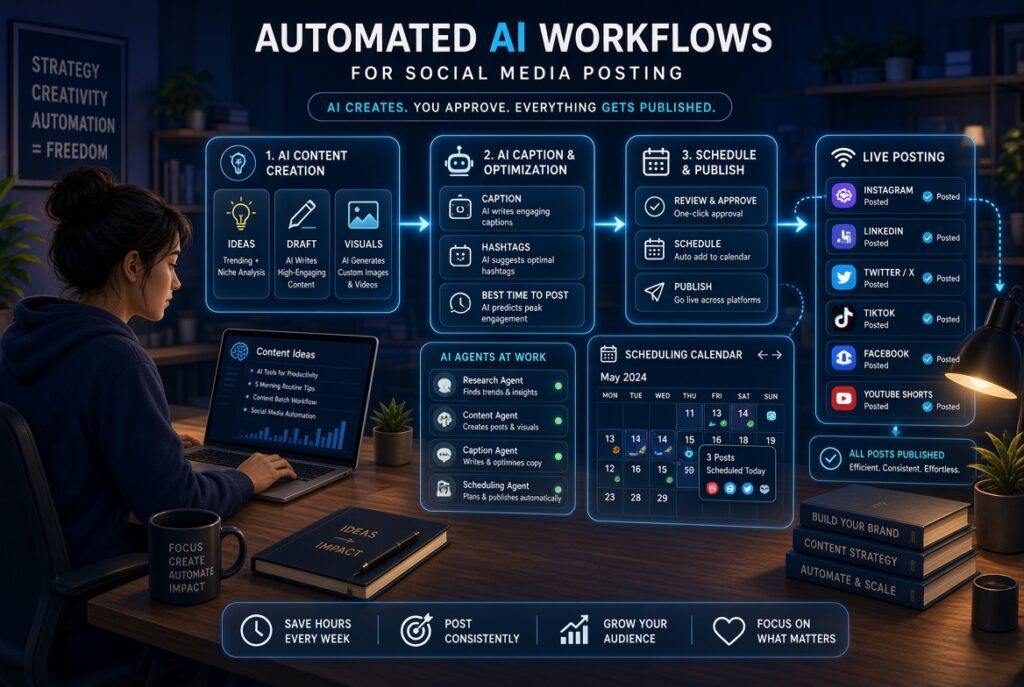
Most template workflows have the same skeleton: trigger, AI draft, publish. That skeleton has no brakes. This is the version I’d build, and the failure each stage exists to prevent:
text
[1 Source] -> [2 Draft] -> [3 Human gate] -> [4 Publish] -> [5 Verify] -> [6 Learn] ^ | [Kill switch: pauses 3 and 4 for every channel]| Stage | Its job | The failure it prevents |
|---|---|---|
| 1. Source | Pull from things you actually made: a new blog post, a product update, a row in a content calendar | Posts about nothing; invented facts when the AI has no input to work from |
| 2. Draft | One draft per platform, written against a short voice guide with 2–3 of your best past posts as examples | Identical text pasted everywhere; the generic voice that the LinkedIn data penalizes |
| 3. Human gate | You approve, edit or reject in one place (a sheet, Slack, a review queue). Cheap, but never skipped | The AI stating something false about your product; tone-deaf timing |
| 4. Publish | Official API or approved scheduler, with each platform’s limits built into the logic | Hitting Instagram’s 100-post window; paying X’s link surcharge by accident |
| 5. Verify | Check each platform’s response and alert you on any failure; log post IDs | The silent partial failure: Instagram succeeds, X doesn’t, and nobody notices |
| 6. Learn | Weekly pull of engagement per post, compared against your own baseline | Running a pipeline for months on a hunch |
Stage 5 is the one people skip. According to Postproxy’s write-up, an Instagram token that expires after 60 days stops the workflow without any visible error, and multi-platform workflows can succeed on one platform and fail on another with nothing to tell you. That’s a vendor’s description, but it matches how these systems behave. A workflow you can’t see failing will fail for weeks.
The kill switch is not optional. Epicurious is the famous case, but the principle is simple: scheduled content doesn’t know what happened this morning. Buffer’s own 2013 guidance shows the minimum viable version, which was a way to turn off queued posts across days. A better version is a single switch (a sheet cell, a Slack command) that your workflow checks before every publish. When it’s on, nothing goes out. Build it before you build anything clever.
What it really costs
The scheduling tools vary too much to quote reliably, so check their pricing pages. The one platform cost that can surprise you is X, where the arithmetic is simple. With 30 days in a month:
| Posting pattern on X | Posts/month | API cost/month |
|---|---|---|
| 3 plain posts a day | 90 | $1.35 |
| 10 plain posts a day | 300 | $4.50 |
| 3 posts a day, each with a link | 90 | $18.00 |
| 10 posts a day, each with a link | 300 | $60.00 |
Calculated from the per-post rates on X’s pricing page. Read costs, tool subscriptions, and your own time are not included.
Plain posting is cheap. A link-heavy feed costs 13 times more, which turns an “RSS to X” auto-poster, the most common template, into the expensive way to do it. Whether links are worth that depends on what a click is worth to you.
What to automate, and what not to
This table is my judgment, built on the evidence above, not a quote from any study.
| Task | Verdict | Why |
|---|---|---|
| Scheduling and queue timing | Automate | Consistency is the best-documented benefit |
| First drafts from your own source material | Automate, with the human gate | Saves hours; the review catches errors |
| Resizing and repurposing a post per platform | Automate | Low risk; but rewrite, don’t paste (Meta penalizes copies) |
| Weekly performance reports | Automate | Pure data work |
| Replies, comments, DMs | Don’t automate | Highest enforcement risk, and where authenticity is the point |
| Posting during breaking news or a crisis | Hard pause | Queued posts can’t read the room |
| Thought-leadership and first-person stories | Human-written | This is where human posts won in the 2025 data |
| Claims about results, prices or customers | Human-verified | An AI will happily make a number up |
A 30-day rollout with checkpoints
Week 1: build the brakes. Set up the source, the human gate, the kill switch, and the failure alerts, with one platform only. Success is that you can trigger a fake failure and see the alert.
Week 2: draft and publish with review. Run 5 to 7 posts through the full pipeline. Count how many drafts you edited. If it’s almost all of them, your voice guide is the problem, not the tool.
Week 3: add a second platform. Rewrite for the platform instead of copying. Check your Instagram call count against the 100-post window (you will be nowhere near it, but build the check now).
Week 4: run Buffer’s comparison on yourself. For each channel, compare the median engagement of your AI-assisted posts with your manually written ones from the same period. Buffer’s method (median per account, both kinds of posts from the same people) is the right design. With a small sample, treat the result as a hint rather than a verdict.
What the evidence doesn’t show
- No independent study of fully unattended AI posting. Buffer measured AI-assisted posts, Originality.ai measures text it suspects is AI, and the PR study tests message quality. None isolates “no human in the loop.”
- No audited named-brand success stories. The vendor case studies I found (GrowwStacks and similar) advertise figures like 90% faster content creation and 10+ hours saved weekly, with no named client or method I could verify. I haven’t used them. If you have a client case with real numbers, that’s the strongest thing you could add to this article.
- Buffer’s data is from 2024, and from Buffer. It’s the best large first-party dataset available, but it’s old, and the company sells the product.
- Platform rules move. X changed its pricing twice in 2026 alone. Recheck before you commit.
FAQ
Is it allowed to automate social media posts with AI? Posting your own content to your own accounts through official APIs or approved schedulers is the supported path on the platforms covered here. What platforms act against is automated engagement (mass replies, likes, follows) and, on Facebook, repeated unoriginal reposts.
Does AI-generated content get less engagement? It depends on what you mean. In Buffer’s 1.2M-post data, AI-assisted posts had higher median engagement, with marginal gains on LinkedIn and YouTube. In Originality.ai’s LinkedIn data, human posts did better in marketing, innovation, and healthcare, and AI posts did better in leadership and inspiration content.
How many posts can I publish to Instagram through the API? Instagram’s documentation sets the limit at 100 API-published posts in a moving 24-hour window per account, with a carousel counting as one.
How much does posting to X through the API cost? On X’s pay-per-use pricing, creating a post costs $0.015 and creating one that contains a URL costs $0.20, per the current pricing page.
Sources
- Buffer, How 1.2 Million Posts Created with Buffer’s AI Assistant Performed vs Human-Only (Oct 2024)
- Originality.ai, Over ½ of Long Posts on LinkedIn Are Likely AI-Generated and 50%+ of LinkedIn Posts Were Likely AI in 2025
- AdNews, More than four in five LinkedIn posts now likely AI-generated (3 Aug 2026)
- Public Relations Review 51(5), Generative AI outperforms humans in social media engagement (Dec 2025)
- Meta, Instagram Platform content publishing documentation
- X, API pay-per-usage pricing
- LinkedIn Help, Prohibited software and extensions
- MarTech, Epicurious Becomes Latest Brand To Suffer Social Backlash (Apr 2013)
- MediaNama, Meta cracks down on unoriginal Facebook content (Jul 2025)
- Secondary sources, used with the caveats stated above: Postproxy, Vorp Labs, Upload-Post, ContentIn
Figures and rules checked on November 6, 2026.