

How to Write a Literature Review
Using AI: Step-by-Step Guide
From sourcing and screening to synthesis and final draft — a complete, honest workflow for researchers who want AI’s speed without sacrificing scholarly integrity. Updated for 2025–2026.
There’s a version of this that goes wrong fast. You paste your research question into ChatGPT, ask it to write a literature review, and 45 seconds later you have 1,200 words of fluent, confident, completely fabricated nonsense — papers that don’t exist, findings that were never published, authors who never wrote the thing being quoted. It happens. Regularly.
The good version of AI-assisted literature reviewing is something else entirely. It’s faster, more thorough, and — done properly — more rigorous than what most humans manage manually. The key is knowing where AI actually helps, where it fails badly, and how to build a workflow that keeps you in control of the intellectual work.
This guide covers the whole process: setting up your research question, finding papers with the right tools, screening and organizing, synthesizing across dozens of sources, drafting with AI assistance, and verifying the result so you’re not handing in (or publishing) someone else’s hallucinated mistakes. It’s practical, it’s opinionated, and it draws on how researchers are actually using these tools in 2025.
What Actually Goes Into a Literature Review
Before we get into the tools, it’s worth being clear about what a literature review is trying to do — because that shapes how you use AI effectively. A literature review isn’t a list of summaries. It’s an argument about what the field knows, doesn’t know, and why your research question fills a meaningful gap.
Most people write something closer to an annotated bibliography dressed up with connecting sentences. That’s not the same thing. A genuine review organizes knowledge thematically or methodologically, identifies contradictions between findings, points to understudied questions, and situates your own work within an existing conversation.
AI is genuinely good at several of the mechanical components: surfacing relevant papers, extracting key findings from PDFs, spotting thematic patterns across many documents. It is not good at the interpretive layer — explaining why conflicting findings matter, assessing methodological quality, or connecting your synthesis to your specific research contribution. That part is still yours.
The AI Tool Landscape in 2025: What Does What
The market for AI research tools has genuinely matured. There are now dedicated platforms for each stage of the literature review process — discovery, screening, extraction, synthesis, and writing. Using the wrong tool at the wrong stage is one of the most common mistakes researchers make.
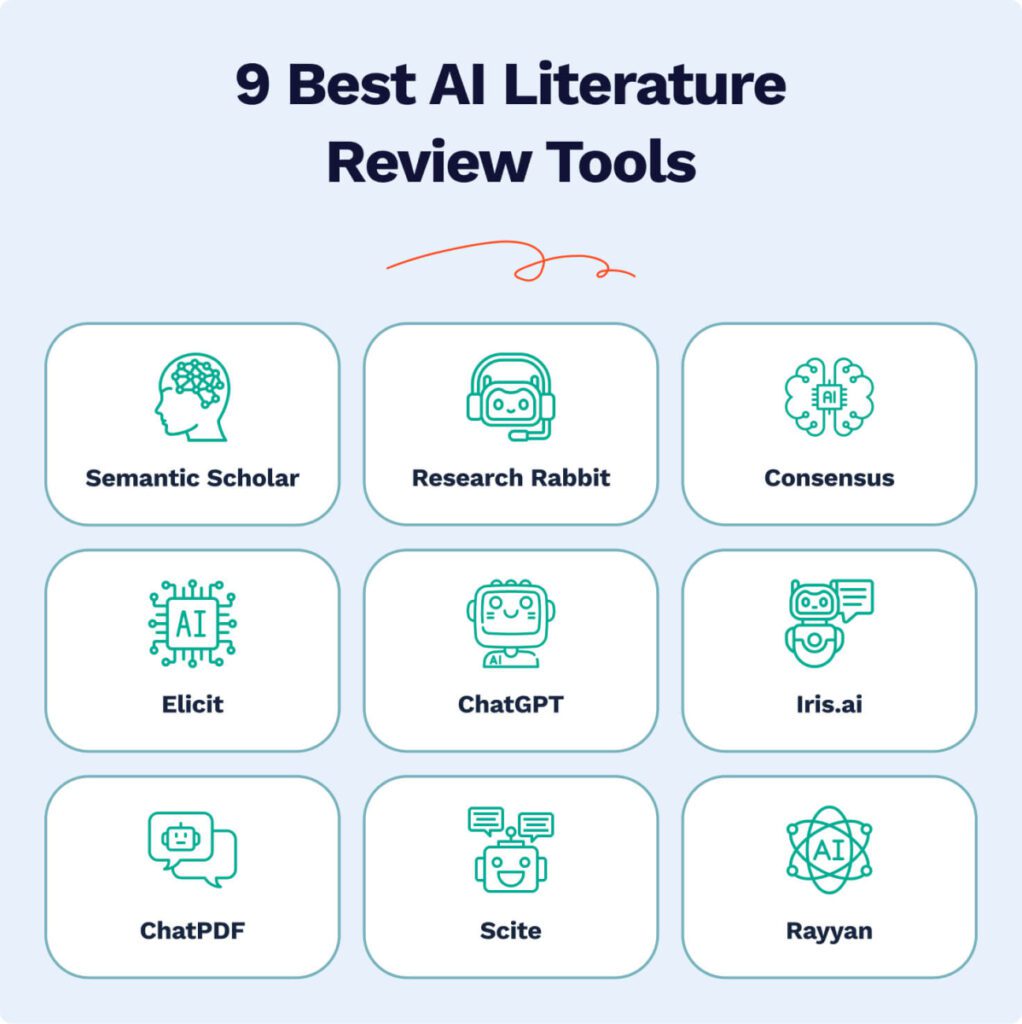
| Tool | Best For | Papers Indexed | Pricing | Hallucination Risk |
|---|---|---|---|---|
| Elicit | Semantic search, data extraction, systematic reviews | 125M+ | Freemium · $12/mo | Low (grounded in actual papers) |
| Semantic Scholar | Free discovery, citation networks | 200M+ | Free | Very low (search only) |
| ResearchRabbit | Visual citation mapping, serendipitous discovery | — | Free | Very low (search only) |
| Consensus | Evidence-backed answers to research questions | 200M+ | Freemium · $11.99/mo | Low (cite-grounded) |
| NotebookLM | Deep analysis of uploaded PDFs, synthesis | Your uploads | Free (Google) | Very low (grounded in uploads) |
| Scite.ai | Citation context (supporting/contrasting/mentioning) | 1.2B+ citation statements | $20/mo | Very low (search only) |
| Claude (Projects) | Long-context synthesis, critical analysis, drafting | Your uploads | Freemium · Pro from $20/mo | Medium (verify outputs) |
| Litmaps | Visual citation timelines, field evolution | — | Freemium | Very low (search only) |
| Rayyan | PRISMA screening, duplicate removal | — | Freemium | Very low |
| SciSpace | PDF reading, methods explanation, Q&A | 270M+ | Freemium | Low–Medium |
“The strongest 2026 research stack is typically two tools: one for discovery and one for synthesis. Single-tool workflows usually compromise on one or the other.” — AtlasWorkspace, 2026 AI Tools for Academic Research Analysis
The Step-by-Step Workflow
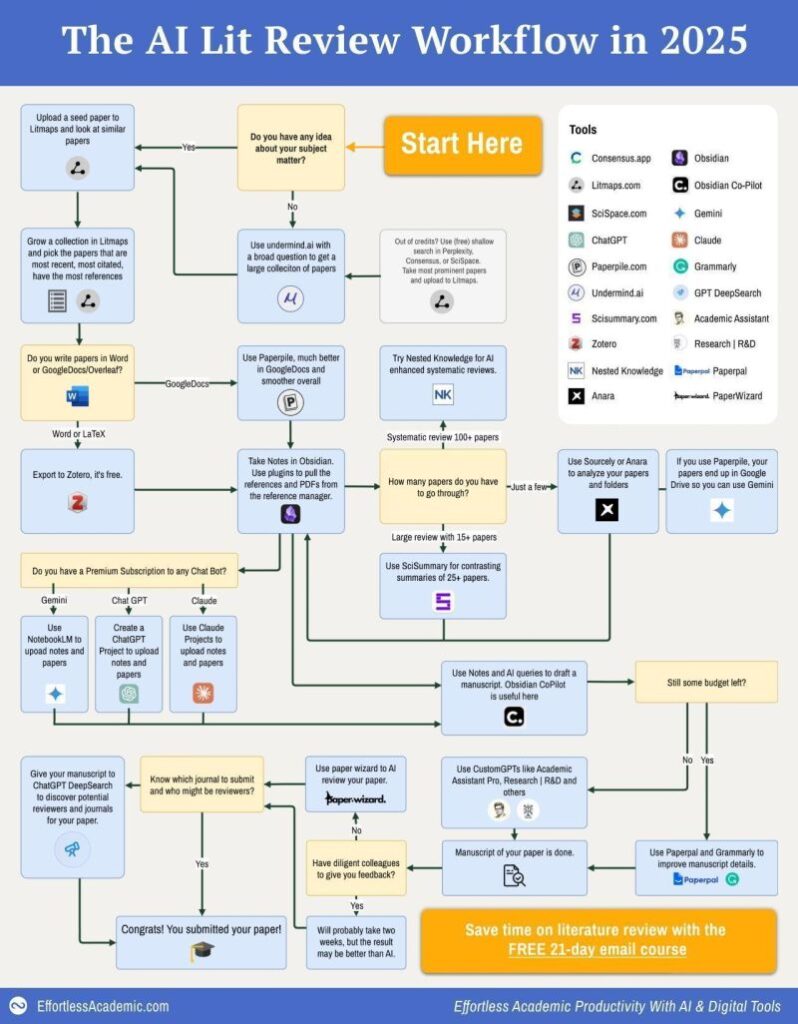
Here’s how an effective AI-assisted literature review actually unfolds. The sequence matters. Most people get into trouble by using generative AI too early — before they’ve established what papers actually exist in the field.
Define Your Research Question (With AI Assistance)
Everything downstream depends on how well you’ve framed your question. A vague question — “how does social media affect mental health?” — produces unfocused searches, irrelevant papers, and a review that never commits to an argument. A specific question produces the opposite.
A useful framework here is PICO (Population, Intervention/Exposure, Comparison, Outcome) for clinical or intervention research, or SPIDER (Sample, Phenomenon of Interest, Design, Evaluation, Research type) for qualitative work. You don’t have to stick rigidly to these, but they force you to be explicit about each dimension of the question.
ChatGPT or Claude genuinely helps at this stage — not to write the question for you, but to challenge vague formulations and suggest narrower angles you hadn’t considered.
I’m writing a literature review on the relationship between social media use and adolescent anxiety. My current question is [paste your draft question]. Please:
- Identify where the question is ambiguous or too broad
- Suggest 3 more specific variations that would produce a focused, reviewable scope
- Flag any terms I should define more precisely before searching
Spend real time here. A better question usually means less total work, not more, because you’re not wading through hundreds of irrelevant papers.
Map the Field Before You Search
Before doing keyword searches, it helps to get a structural sense of the field — which papers are foundational, which researchers are most influential, where the major disagreements sit. This is where visual discovery tools pay off.
ResearchRabbit is the starting point for most researchers. You enter one or two papers you already know are relevant, and it maps related work through citation networks. Think of it like Spotify’s recommendation engine, but for research — start with one paper and let it show you the landscape around it.
Litmaps adds a chronological dimension. You can see how thinking on a topic has evolved over time, identify pivotal studies through citation chains, and spot where the literature clusters or thins out. Its timeline view is particularly useful for topics with a clear historical trajectory.
Connected Papers produces visual similarity maps, which can surface adjacent fields or unexpected connections you wouldn’t find with keyword searches alone.
Systematic Search: Using Elicit and Semantic Scholar
Traditional keyword searching through Google Scholar or PubMed still matters — your institution will likely require documented search terms for a formal systematic review. But AI-powered semantic search changes what’s findable.
Where keyword search requires you to guess the exact terminology authors used, semantic search understands the meaning of your query and surfaces papers that discuss the same concepts using different language. This significantly reduces the chance of missing important work due to terminology differences across disciplines or over time.
Elicit is the most capable tool here for structured reviews. Enter a research question in plain English and it returns ranked papers with automatic extraction of key information — sample sizes, methodologies, outcomes, limitations. Its table view alone can save hours of manual extraction work.
Semantic Scholar is the free alternative with a larger index (200M+ papers). Its API access makes it useful for researchers doing large-scale literature surveys.
Consensus is worth using when you want a quick read on whether the literature leans toward agreement or disagreement on a specific empirical question. It’s not a replacement for full search, but it’s good for orienting yourself before diving deeper.
In Elicit, rather than entering keywords, enter your research question directly:
- “What is the relationship between Instagram use and body image dissatisfaction in female university students?”
- Then filter by study type (RCTs, systematic reviews, observational) and date range
- Use the “extract data” feature to pull sample sizes, methods, and findings into a comparison table automatically
- Export to CSV for use in your reference manager
For formal systematic reviews, document every search strategy in detail. The databases searched, date ranges, search strings, inclusion/exclusion criteria — this is what makes a systematic review reproducible.
Screen and Organize Your Papers
Once you have a pool of candidates — often 200–500 papers for a serious review — you need to screen them systematically. This is where most people without good tools waste enormous time reading abstracts one by one.
Rayyan is specifically designed for PRISMA-compliant screening workflows. You import your candidate papers, set up inclusion/exclusion criteria, and the AI provides initial screening recommendations you can accept, reject, or override. Multiple reviewers can work simultaneously, and it tracks your decisions for the PRISMA flow diagram you’ll need to report your methodology.
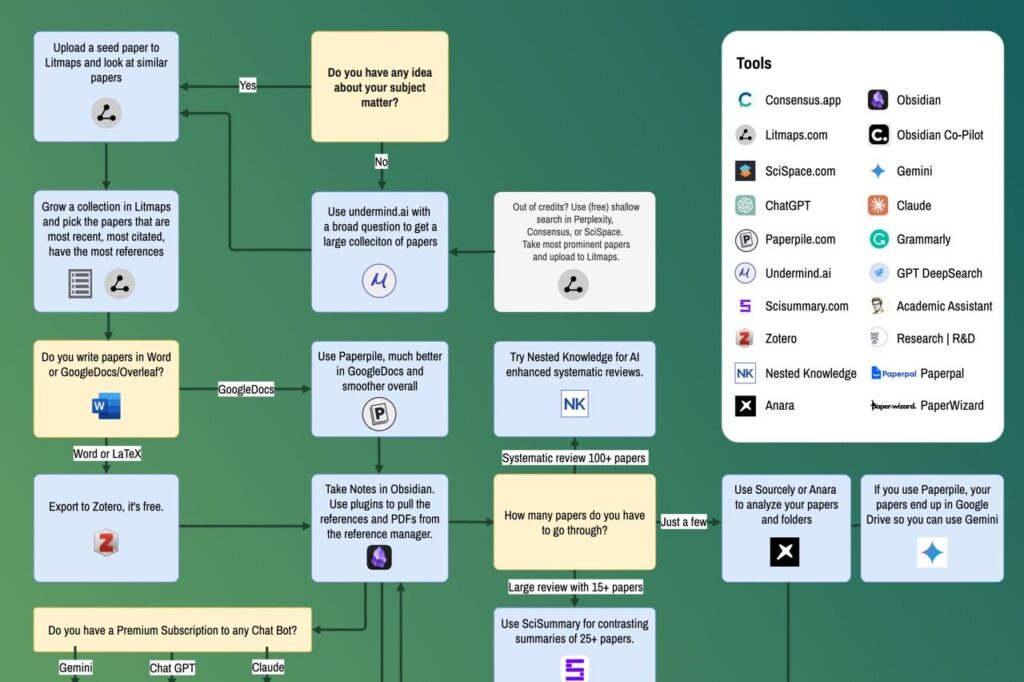
Your reference manager matters here too. Zotero (free) and Paperpile (if you work in Google Docs) are the strongest options. Both integrate with AI tools, and Paperpile puts all your PDFs directly into Google Drive where Gemini can read them. Zotero has plugins like ResearchRabbit direct import and PDF analysis through various add-ons.
The goal of screening is to get from 500 papers to perhaps 40–80 that genuinely fit your scope. Be methodical about this — and document your exclusion reasons. Not for aesthetics, but because reviewers will ask, and because your own thinking will sharpen as you articulate why something doesn’t fit.
Extract and Synthesize with AI
This is where the real intellectual work begins — and where AI’s contribution is most valuable if deployed carefully. You have 40–80 papers. You need to understand what each says and then understand how they speak to each other.
NotebookLM is outstanding at this stage. Upload your PDFs (up to 50 at a time) and it creates a grounded knowledge base where every response is traceable to source passages. The hallucination risk is very low because the model is only synthesizing from what you’ve given it. You can ask it to compare methodologies, identify contradictions between studies, summarize findings on a specific subtopic, or generate a list of gaps across the literature.
Claude in Projects (accessed via Claude.ai) offers a similar capability with long-context reasoning. Upload your key papers and ask it to analyze them critically — not just summarize, but evaluate quality, compare methodological choices, and draft thematic syntheses.
- “Across these papers, what are the three most consistent findings? Where do studies disagree and why might that be?”
- “Identify the main methodological approaches used across these studies. What are the trade-offs of each approach?”
- “What questions do these papers collectively leave unanswered? What would a researcher need to do to fill those gaps?”
- “Draft a 400-word synthesis of findings on [specific subtopic], drawing only from the uploaded documents. Cite specific papers.”
The matrix method is still useful here alongside AI tools. Build a spreadsheet with papers as rows and key dimensions as columns (year, methodology, sample, key finding, limitations). AI can help populate this table; you verify the entries for the most important papers. Gaps in the matrix reveal gaps in the literature — that’s your contribution.
Build Your Narrative Framework
Before writing a single word of prose, decide how you’re organizing the review. The three main structural options are thematic, chronological, and methodological — and the right choice depends on your topic.
| Structure | When to Use | What AI Can Help With |
|---|---|---|
| Thematic | Most common; topic has multiple distinct conceptual areas | Identifying themes across papers; suggesting subsection structure |
| Chronological | Topic has clear historical evolution; ideas built sequentially | Mapping how key concepts shifted across time periods |
| Methodological | Comparing results across different research designs | Categorizing papers by method; identifying methodological trends |
Resist the temptation to use AI to generate an outline before you’ve read your papers. The outline should emerge from your understanding of the literature, not be imposed on it. Use AI to stress-test an outline you’ve drafted — ask it what arguments the structure doesn’t account for, or whether the sequencing makes logical sense.
Write the Draft: AI as Co-Author, Not Ghost-Writer
This is the stage most people think of when they think “using AI for a literature review,” and it’s the stage that needs the most discipline. The question isn’t whether AI can write a literature review — it obviously can produce plausible prose quickly. The question is whether that prose actually represents what the literature says, and whether it contains your intellectual contribution.
The approach that works: write in passes. Draft the key arguments yourself first — even a rough, rough version. Then use AI to expand specific passages, improve clarity, identify where transitions are weak, or suggest how to integrate a specific paper you’re struggling to place. Never use AI to write a section from scratch where you haven’t already worked out what argument the section needs to make.
- “Here is my draft paragraph on [topic]. It needs to integrate the finding from [paper] that [X]. Help me incorporate it without disrupting the flow or changing my central argument.”
- “This transition between the [X] section and [Y] section feels abrupt. Suggest 2–3 ways to link them more effectively.”
- “I’ve drafted this synthesis sentence: [paste]. Is it an accurate representation of what these three studies actually found? Flag anything that seems overstated.”
- “My argument in this paragraph is [X]. Is the evidence I’ve cited actually sufficient to support that claim, or am I overstating it?”
One thing worth being explicit about: paraphrasing with AI can easily slide into misrepresentation. If you ask AI to “put this finding in different words,” it might subtly change the meaning — particularly around nuances of effect size, causality claims, or study limitations. Always check the original paper when AI paraphrases for you.
Verify Every Citation — No Exceptions
This step is non-negotiable, and it’s also where AI literature reviews most commonly come undone in practice. The research is clear: hallucinated citations are a genuine epidemic in AI-assisted academic work.
A striking example: in January 2026, analysis of papers accepted to NeurIPS 2025 — among the most competitive AI conferences in the world — found at least 100 confirmed hallucinated citations across 53 papers. These papers went through rigorous peer review by 3–5 experts each. The hallucinations survived anyway.
Scite.ai is the most powerful verification tool available. It classifies citation context — whether subsequent papers support, contrast, or merely mention a given claim — so you can check not just whether a paper exists, but whether the finding you’re citing is well-supported or contested in the literature since publication.
For basic verification, Google Scholar and PubMed are sufficient. Search for the title, author, journal, and year. Check that the DOI resolves. Read the relevant section of the abstract or paper yourself. This takes 2–3 minutes per citation and is the only reliable way to catch AI errors.
Revise, Polish, and Finalize
A first draft is always just a first draft. Once you have something complete, revisit it with the specific goal of strengthening the argument rather than improving the prose. These are different things. You can have beautifully written sentences in service of a weak or muddled argument.
Ask yourself: does each section make a clear claim, support it with evidence, and explain why it matters for your overall argument? Are contradictions between studies acknowledged and interpreted, or just noted and left hanging? Is the gap you’ve identified at the end genuinely something the existing literature hasn’t addressed, or is it a gap you’ve created by defining your scope too narrowly?
AI is useful here for editing, but not for strengthening the argument. Grammar and clarity help is fine. Asking AI to make your argument “more compelling” tends to produce empty rhetoric. The argument gets stronger by reading more carefully and thinking harder, not by polishing prose.
- “Identify any sentences in this passage where I’ve made a stronger causal claim than the evidence actually supports.”
- “Are there any logical jumps in this section — places where I’ve moved from one idea to the next without explaining the connection?”
- “Read this section for academic register. Flag any phrases that are too informal, too hedged, or that read as vague.”
- “I’ve claimed that [X] is a gap in the literature. Based on what I’ve described in this review, is that gap claim convincing or does it need more support?”
Using AI Ethically: What the Guidelines Actually Say
Institutional policies on AI use in research are moving quickly in 2025. Most universities have now issued formal guidance, and many journals have explicit disclosure requirements. The trend across both is toward transparency rather than prohibition — AI use isn’t automatically prohibited, but it must be disclosed accurately.
The most important principle is that you remain intellectually responsible for every claim in your review. AI assistance doesn’t transfer any burden of accuracy to the tool. If you submit a literature review containing fabricated citations because AI generated them and you didn’t verify them, that’s academic misconduct on your part, not a technology failure.
A few practical guidelines that most institutions and journals converge on:
- Disclose AI use in your methods section — which tools, for which tasks
- Never use AI-generated text as a substitute for reading the actual papers
- Verify every citation independently; “the AI cited it” is not a defense
- Do not submit AI-generated text as your own without substantial revision and expert judgment
- Check your specific institution’s and target journal’s policies — they vary significantly
“AI cannot learn the topics for you. The best gauge of whether you’re using AI properly is whether you’re in a state of intellectual flow — if you’re just waiting for AI to give you text, you’ve outsourced the wrong thing.” — The Effortless Academic, AI for Literature Review (2025)
A Real Workflow Case: Medical Research in the Field
Here’s what effective AI-assisted literature review looks like in practice. A medical researcher working on cancer navigation research in Africa described their workflow: before using AI tools, a comprehensive literature review would routinely cause significant delays — enough to stall a project. With a structured AI workflow, they completed the same work in four to five days.
Their approach was methodical: they started by listing every sub-topic within the review scope before opening any AI tool, used traditional academic databases to identify initial candidates, then brought those papers into Anara for systematic reading and synthesis. They explicitly used AI to suggest alternative phrasings when paraphrasing — not to write for them, but to avoid inadvertent close copying while keeping accurate representation of findings.
The thing that made this work, and that distinguishes it from the approach that produces hallucinated garbage, was sequence: human judgment first, AI assistance second. The researcher defined the scope, set the criteria, and evaluated relevance. AI handled the reading at scale and the synthesis of patterns. The intellectual architecture was human.
Recommended Tool Stacks by Use Case
For Undergraduate or Masters Students
Keep it simple and free. Start with Semantic Scholar or Google Scholar for discovery. Use ResearchRabbit (free) to expand from seed papers. Import into Zotero. Use NotebookLM (free, Google account required) to analyze your downloaded PDFs. Draft in Word or Google Docs. Verify citations manually.
For PhD Researchers and Systematic Reviews
You need Elicit for structured extraction and systematic search documentation. Rayyan for PRISMA-compliant screening. Scite for citation context verification. Claude Projects or NotebookLM for synthesis. This stack costs roughly $32–50/month for full access to paid tiers.
For Grant Proposals and Rapid Reviews
Time pressure is the constraint. Consensus for quick evidence summaries. Elicit for fast semantic search. Litmaps for field positioning. ChatGPT or Claude for rapid synthesis drafts — but verify everything before the final version goes in.
The Five Mistakes That Ruin AI-Assisted Literature Reviews
- Skipping the scope definition. Feeding a vague question into AI gets a vague review. The question definition stage is not where AI should lead — it’s where you need to do the intellectual work first.
- Using a general LLM as your primary search tool. ChatGPT and Claude do not search academic databases. They generate plausible-sounding citations from training data — which means they will confidently fabricate papers that don’t exist. Use purpose-built search tools for discovery.
- Not reading the actual papers. AI can summarize; it cannot tell you whether a summary is accurate. If you haven’t read at least the abstract and key findings sections of every paper you cite, you’re flying blind. The papers most likely to be misrepresented by AI are also the most important ones — the ones making strong, specific claims.
- Treating the first AI draft as a draft to polish. An AI first draft has structural problems, not just prose problems. If the argument structure is wrong, polishing the prose makes it worse, not better. Get the argument right on paper before worrying about how it reads.
- Ignoring institutional policy. AI disclosure requirements vary significantly by institution and journal. Using AI in ways your institution prohibits is academic misconduct, regardless of how well it worked. Check the policy before you start, not after you’ve written 5,000 words.
A Quick Prompt Library
These are prompts worth bookmarking for each stage. All assume you’re working with actual papers you’ve identified through proper search — not asking AI to generate sources from scratch.
QUESTION REFINEMENT:
“I’m writing a [type of review] on [topic]. My draft research question is [question]. Identify ambiguities, suggest 3 narrower alternatives, and flag terms I need to operationalize.”
SYNTHESIS:
“Based on the papers I’ve uploaded, summarize findings on [subtopic]. Identify where studies agree, where they conflict, and what the most plausible explanation is for any contradictions. Cite specific papers.”
GAP IDENTIFICATION:
“Based on what these papers collectively cover, what populations, contexts, or questions have not been studied? Which gaps are most significant for future research?”
CRITICAL REVIEW:
“Evaluate the methodological quality of these studies. What are the common limitations? Are there systematic biases in the research designs used?”
WRITING CHECK:
“Read this draft paragraph. Am I accurately representing the studies I’ve cited? Are there any claims that go beyond what the evidence actually shows?”
Honest Final Thoughts
The honest case for AI-assisted literature review isn’t that it makes the work easier. It’s that it makes thoroughness achievable. A careful researcher without AI tools can miss significant papers simply because they can’t read fast enough or can’t afford all the databases. A researcher using the right AI tools can genuinely cover a field more completely — and with better-documented methodology — than was possible five years ago.
But the honest case comes with an honest caveat: the intellectual work doesn’t get easier. If anything, it gets harder to distinguish the researchers who understand their fields from those who merely have well-organized AI outputs. The tools lower the floor for what’s achievable at low effort; they don’t raise the ceiling. That part is still entirely up to you.
Use these tools as the researchers who use them best seem to use them: as amplifiers of your own knowledge, not as substitutes for acquiring it in the first place. That’s the version that produces literature reviews worth reading.
More From Our Research & AI Tools Library
AI Research Agents: The Definitive Guide for 2025–2026
How to Write a Systematic Review: PRISMA Guide for 2026
AI Research Paper Writing: Complete Guide From Outline to Submission
NotebookLM for Researchers: A Deep Dive Into the Most Underused AI Tool
How to Set Up a Zettelkasten in Obsidian
How to Use ChatGPT for Academic Writing — Without Compromising Integrity
AI Hallucinations in Academic Writing: What They Are and How to Catch Them
How to Set Up Stable Diffusion 3.5 Locally — Step-by-Step
7 AI Tools for Researchers and Writers: Moves That Separate Beginners From Experts
ATLAS.ti 25 Review: Testing the AI Lab Features in Practice
PhD Tools That Actually Work in 2026