

Last updated 6 November 2026. Prices and plan details change often, so trust the vendor’s page over this one.
Three independent audits have tested these tools, and they do not agree on a winner.
In one, Perplexity made the fewest mistakes. In another, it repeated false claims almost half the time, while Gemini, which looked worst everywhere else, did best. Copilot refused so many questions in a third test that “accuracy” barely applied.
That disagreement is the most useful thing to know before you pick a tool. Most comparison pages hide it behind a single percentage. This one explains it.
Key takeaways
- Best when you need to check the source: Perplexity. It had the lowest error rate in the Tow Center citation test (37% wrong) and the fewest significant issues in the EBU/BBC news study (30%).
- Best for everyday, local and shopping questions: Google (AI Mode or Gemini), because it sits on Google’s index. Its documented weakness is sourcing, not facts.
- Best if you work in Word, Excel and Outlook: Copilot. It is cautious to a fault, which cuts both ways.
- No tool has earned blind trust. Open the cited source before you rely on any answer.
Contents
- Four ways AI search fails
- The evidence: three audits
- Why the rankings flip
- What about ChatGPT?
- What the evidence can’t tell you
- Pick by situation
- What they cost (November 2026)
- Run your own 15-minute test
- The 60-second verification habit
- FAQ
- Sources and method
Four ways AI search fails
“Which one is most accurate?” is the wrong question, because tools make different kinds of mistakes. Four matter:
- The confident wrong answer. It sounds certain and is wrong. This is the most dangerous failure.
- The broken source. The answer may be fine, but the link is fabricated, dead, or points to a syndicated copy instead of the original.
- The echo. The tool repeats a false claim that is circulating online instead of challenging it.
- The refusal. The tool says it can’t help. It is annoying but honest.
Here is how the published evidence maps onto them:
| Tool | Where the evidence points | Main failure type |
|---|---|---|
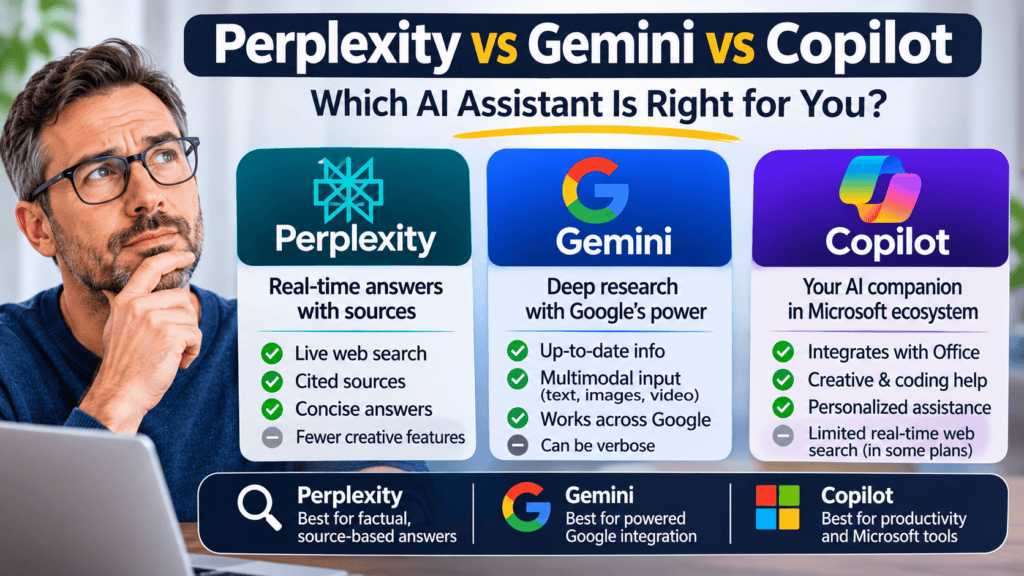
| Perplexity | Fewest wrong answers and sourcing problems in two audits, but the highest false-claim rate of the main assistants in a third | 1 and 3 |
| Gemini | Worst sourcing of the four assistants in the EBU/BBC study, and more than half of its links fabricated or broken in the Tow test. Best at resisting false claims in the NewsGuard audit | 2 |
| Copilot | Declined more questions than it answered in the Tow test. Middle of the pack elsewhere | 4 |
The evidence: three audits
1. Columbia’s Tow Center: can the tool find the source? (published March 2025)
Researchers gave eight AI search tools short excerpts from real news articles. Each tool had to name the headline, the publisher, the date, and the link. They used 20 publishers with 10 articles each and chose excerpts that a normal Google search would trace to the original within its top three results. That made 1,600 queries (CJR methodology).
What they found:
- The tools were wrong on more than 60% of queries overall. Perplexity was wrong 37% of the time; Grok 3, 94%.
- Confidence was a problem. ChatGPT gave 134 wrong answers out of 200 and hedged on only 15 of them (Nieman Lab).
- Premium tiers were not safer. Perplexity Pro and Grok 3 answered more prompts correctly than their free versions, but also had higher error rates.
- Gemini and Grok 3 were the only tools that returned more fabricated links than correct ones.
- Copilot declined more questions than it answered. In theory, it could access all the content tested, yet it had the highest rate of declined answers.
One more detail affects trust. Perplexity’s free version correctly identified all ten excerpts from National Geographic’s paywalled articles, even though the publisher had blocked Perplexity’s crawlers. The study’s authors flagged this as a concern about respecting publishers’ wishes.
2. EBU/BBC: can the tool report the news faithfully? (published October 2025)
Journalists at 22 public-service media organizations in 18 countries assessed ChatGPT, Copilot, Gemini and Perplexity in 14 languages. They reviewed about 3,000 responses. Overall, 45% had at least one significant issue (EBU report).
| Assistant | Answers with a significant issue | Answers with a significant sourcing issue |
|---|---|---|
| Perplexity | 30% | 15% |
| ChatGPT | 36% | 24% |
| Copilot | 37% | 15% |
| Gemini | 76% | 72% |
Sourcing explains most of Gemini’s gap. This study built on an earlier BBC study from February 2025. Coverage of the new results described the improvement as real but modest, with error levels still high.
3. NewsGuard: will the tool repeat a false claim? (August 2025)
NewsGuard, a commercial fact-checking company, tests whether chatbots repeat provably false claims circulating online. In its August 2025 audit of 10 leading chatbots, the average false-claim rate was 35%, nearly double the 18% a year earlier.
| Assistant | Repeated a false claim |
|---|---|
| Gemini | 16.7% |
| Copilot | 36.7% |
| ChatGPT | 40% |
| Perplexity | 46.7% |
Two caveats apply. The test used a small set of claims (10 per audit), so each percentage rests on roughly 30 responses. And it measures a different skill from the first two studies. NewsGuard attributed much of the rise in failures to chatbots answering nearly everything instead of declining. NewsGuard published a May 2026 audit in June, but its results sit behind a sign-up form, so this article uses the August 2025 figures it could verify.
Why the rankings flip
Put the three audits side by side:
| Tow Center (find the source) | EBU/BBC (summarize news) | NewsGuard (resist false claims) | |
|---|---|---|---|
| Perplexity | Best (37% wrong) | Best (30%) | Second-worst of ten (46.7%) |
| Gemini | Over half of links fabricated or broken | Worst (76%) | Second-best of ten (16.7%) |
| Copilot | Declined more than it answered | 37% | 36.7% |
| ChatGPT | 67% wrong | 36% | 40% |
The pattern makes sense once you look at what each test rewards:
- Perplexity is built around retrieval. It finds sources and shows them. That helps when the question is “where did this come from?” It can also mean pulling a bad source in and repeating it.
- Gemini is good at not endorsing falsehoods but bad at showing its work. Its answers can be sound while the citations are missing, broken, or wrong. That matters if you need to verify them.
- Copilot’s caution buys safety on some tests, not all. Refusals avoid errors, but it still had significant issues in 37% of EBU/BBC answers.
So “which is most accurate?” has no single answer. It depends on whether your risk is a bad source, a bad summary, or a believed rumor.
What about ChatGPT?
ChatGPT search is the biggest competitor, so it deserves a mention even though this article compares three tools. In the Tow test, it gave 134 wrong answers out of 200. In the EBU/BBC study, it landed in the middle (36%). In NewsGuard’s audit, it repeated false claims 40% of the time. It is neither the best nor the worst, which is why it doesn’t change the picture above.
What the evidence can’t tell you
An honest comparison has to say this clearly:
- The data is aging. The Tow study was published in March 2025, the EBU/BBC study in October 2025, and the NewsGuard figures here are from August 2025. All three products have been updated since, and I found no newer independent head-to-head of these tools.
- They measure news. None test shopping, coding, health or travel.
- They tested assistants, not necessarily Google’s AI Mode. AI Mode lives inside Google Search and may behave differently from the Gemini app.
- Each query ran once. The same prompt can give a different answer tomorrow.
- Beware neat accuracy numbers elsewhere. Many comparison pages publish figures like “92% accuracy” with no visible method or named test. A number without a method is marketing, not evidence.
Pick by situation
| Your situation | Start with | Why | Watch out for |
|---|---|---|---|
| You need to cite or verify a claim | Perplexity | Best record on wrong answers and sourcing | Can repeat a bad source; click through |
| Quick everyday, local or shopping question | Google AI Mode or Gemini | Built into Search, widest index | Weak sourcing record: check links |
| You work in Microsoft 365 | Copilot | Native to Word, Excel, Outlook and Teams | Advanced consumer features are owner-only on shared plans |
| You follow fast-moving news | Any of them, then the article | None is reliable enough alone | Summaries of complex stories were the hardest task in the EBU/BBC study |
| A wrong answer costs more than no answer | Copilot, with checking | It declines before guessing | Expect more “I can’t help with that” |
What they cost (November 2026)
Prices are in US dollars and vary by country. Check the vendor’s page before paying.
| Tool | Free tier | Paid options |
|---|---|---|
| Perplexity | Yes, with capped Pro searches | Pro $20/month or $200/year; Max $200/month or $2,000/year; Education Pro $10/month (pricing) |
| Google / Gemini | AI features in Search and the Gemini app are free | AI Plus $4.99; AI Pro $19.99; AI Ultra $99.99 (5x Pro limits) or $199.99 (20x) (Google AI plans) |
| Microsoft Copilot | Yes | Microsoft 365 Personal $9.99, Family $12.99, Premium $19.99 as listed at the Premium launch (Microsoft 365) |
Five things trip people up:
- Google AI Ultra changed at I/O 2026. A new $99.99 tier appeared, and the old top tier dropped from $249.99 to $199.99 (Engadget).
- Google AI Plus lost its Pro models. According to emails sent to subscribers, from 13 November 2026, manual selection of Pro models in the Gemini app and AI Mode is limited to AI Pro and above (Online Tech Tips; Digital Trends). Dates are set per account, so check your own inbox.
- Copilot Pro no longer exists. Microsoft replaced it with Microsoft 365 Premium at the same $19.99 (Thurrott). Many lists still quote the old plan.
- Shared plans. On Microsoft 365 Family and Premium, the advanced Copilot features are for the subscription owner, not everyone in the household.
- Usage caps move. Perplexity and Google adjust daily limits and model access often. Don’t buy based on a number in an old review.
Paying more does not buy certainty. In the Tow test, premium tiers made more confident errors, not fewer.
Run your own 15-minute test
Published studies can’t tell you how these tools handle your questions. Copy this table into a doc and fill it in:
| # | Question type | Perplexity | Gemini / AI Mode | Copilot |
|---|---|---|---|---|
| 1 | A fact you know cold | |||
| 2 | Something that changed in the last 3 months | |||
| 3 | A news story you followed closely (ask for a summary) | |||
| 4 | A product comparison where you know the answer | |||
| 5 | A local question (hours, directions) | |||
| 6 | A question in your area of expertise | |||
| 7 | A rumor you suspect is false |
For each cell, record three things:
- Correct, partly wrong, or wrong?
- Did the link open, and did the page actually say what the answer claimed?
- Did the tool decline? Count refusals separately from errors.
Row 7 is the one most people skip. It tests the “echo” failure the first two audits don’t measure. If a tool is confidently wrong on a topic you know well, treat it with suspicion on topics you don’t.
The 60-second verification habit
This matters more than which tool you pick.
- Treat every answer as a lead, not a result.
- Open at least one cited source. Use your browser’s find function to locate the specific claim on the page.
- Check who published it. The Tow Center found tools often cite syndicated or copied versions instead of the original.
- Check the date. Outdated information is a documented failure.
- For health, money, legal, or news decisions, confirm with a primary source.
FAQ
Is Perplexity better than Gemini for research?
On sourcing and news accuracy, the independent evidence says yes: Perplexity beat Gemini in the Tow Center test and the EBU/BBC study. But in NewsGuard’s August 2025 audit, Gemini was far less likely than Perplexity to repeat a false claim. These tests used 2025 versions and news questions, so they don’t prove either is better on every topic.
Is Copilot better than Gemini?
In the EBU/BBC study, Copilot had significant issues in 37% of answers versus 76% for Gemini. In the Tow test, Copilot often declined to answer. In NewsGuard’s audit, Gemini did better. Copilot’s main advantage is its Microsoft 365 integration.
Is Google AI Mode the same as Gemini?
No. AI Mode is a search experience inside Google Search, while Gemini is also a standalone assistant. Results for one don’t automatically apply to the other.
Are paid plans more accurate?
Not necessarily. In the Tow Center test, premium versions answered more prompts correctly but also had higher error rates.
Which AI search tool is best for free?
All three have free tiers. Run the 15-minute test above on your own questions before paying for anything.
Can I trust AI search for news?
Not on its own. The EBU/BBC researchers concluded that assistants are not yet a reliable way to get news. Use them to find articles, then read the articles.
Sources and method
This article contains no original benchmark. It compares three independent audits and shows where they agree and disagree. The test above is how you can generate your own evidence.
- Tow Center for Digital Journalism: methodology and findings at CJR, with the March 2025 publication date and ChatGPT figures confirmed via Nieman Lab.
- EBU/BBC News Integrity in AI Assistants: the EBU report page, published 22 October 2025.
- NewsGuard AI False Claims Monitor: the monitor page and its August 2025 anniversary audit.
- Pricing: Microsoft’s launch coverage, Perplexity’s pricing as reported by multiple trackers, and Google I/O 2026 coverage for Google. Google’s Plus and Pro figures come from news reporting and price trackers, not only Google’s own page.
If a price or product detail has changed, trust the vendor’s page over this one.