

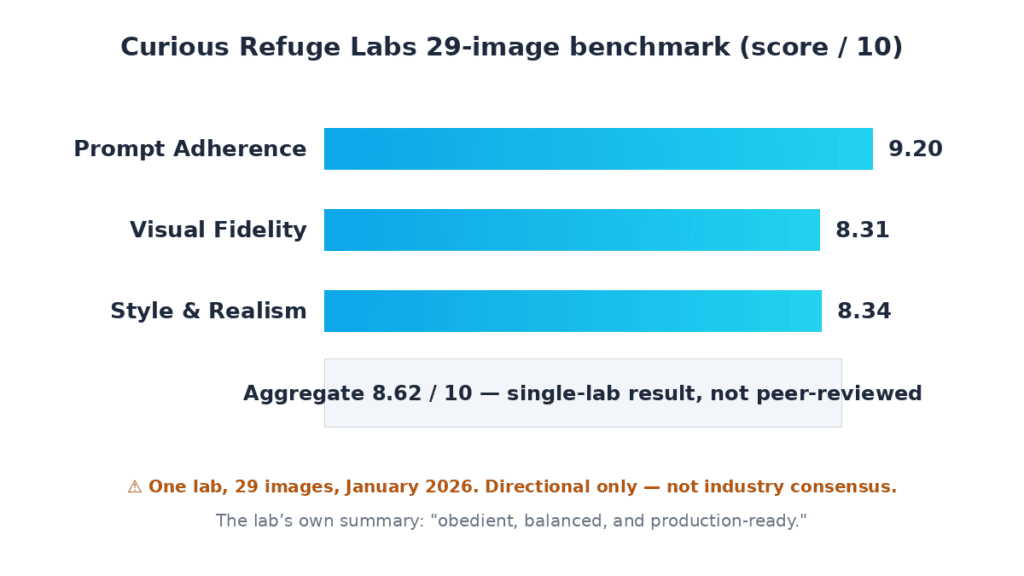
Direct answer. Midjourney V7 — in alpha on April 3, 2025, the platform default from June 17, 2025 to June 9, 2026 — turned personalization into a default-on layer, added voice prompting, half-cost Draft Mode, and Omni Reference for character consistency. V8.1 briefly held the default slot after it (June 10 – July 23, 2026), and V8.2 has been the default since July 24, 2026 — it still is, as of this writing. The best verifiable benchmark of the V7 era (Curious Refuge Labs, January 2026: 29 images, three scored categories, independently corroborated) put V7 at 8.62/10 aggregate with 9.2/10 prompt adherence. It still failed at precise in-image text, physical plausibility, and multi-scene character identity — weaknesses V8.2 improves on but doesn’t fully solve. Pricing is unchanged at $10/$30/$60/$120 per month; a standard Fast image runs roughly 3 cents on either version — the exact figure depends on which GPU-cost basis you’re on (V7’s or V8.2’s), covered in the pricing section below.
TL;DR
- V7’s biggest change was workflow, not raw output: personalization became a default-on taste layer applied to every prompt. That trained profile carries forward through V8.1 and V8.2 — the rating work you did in 2025 wasn’t wasted.
- Draft Mode survived and got bigger, not smaller. It’s supported on V7, V8.1, and V8.2 — Midjourney’s general feature chart just hasn’t caught up to say so. On V8, one prompt now returns 24 images at 512×512 for a fraction of a cent.
- The V7 quality gain was distributional: the floor rose more than the ceiling, which is why V7’s launch felt flat to power users comparing best-case grids even as everyone else stopped throwing away half their output.
- Omni Reference got rerouted, not removed — attach one on a V8.1/V8.2 prompt and the job quietly renders on V7. Midjourney’s intended path for V8.X is the new Edit Model instead (details below).
- Standard ($30/month) is the right plan for most creators. Pro ($60) exists mainly to unlock Stealth Mode, and Midjourney’s revenue-based terms make that choice mandatory for larger businesses anyway.
The launch everyone misread
On April 3, 2025, Midjourney shipped a model that applied your preferences to every prompt — whether you asked it to or not.
Personalization wasn’t new. Midjourney had offered optional personalization profiles on V6 since mid-2024, applied only when you explicitly enabled them. V7 flipped the default: the profile became a standing layer between prompt and render, on for every job unless toggled off.
New users had to unlock their V7 profile first — rating roughly 200 image pairs, about five minutes of clicking — and VentureBeat’s launch-day reporting confirmed the unlock was required to run the model at all, with older V6 styles selectable but moodboards temporarily missing.
What launch-week coverage also captured — and retrospective coverage usually deletes — is that the reception was mixed, unusually so for Midjourney. Magnific AI founder Javi Lopez said V7 “doesn’t really feel like v7. It feels more like v6.2.” Ethan Mollick’s complaint was blunter: v6 had already set the bar high. The grievances were specific: the personalization gate, no standard-speed mode at launch, and upscaling, inpainting, and retexturing all falling back to the old model.
Two facts got lost in that noise, though. First, the profile could be switched off at any time; the gate opened once and stayed open. Second, the mandatory unlock itself was short-lived — within weeks, amid pushback, Midjourney made personalization fully optional. What survived was the default: from V7 onward, the platform assumes you want your taste applied, and most users never change that.
That’s the real legacy. Not a wall, but a quiet architectural decision that made taste an input on par with the prompt text — and the trained profiles turned out to be durable infrastructure, carrying forward through V8.1 into V8.2 in 2026. Founder David Holz described V7 as the company’s “most intelligent, aesthetically pleasing, and coherent model to date” — vendor language, but the “coherent” part held up in testing.
Under the hood it was a ground-up rebuild: new architecture, new datasets, reworked natural-language processing. It held the default slot for just under a year — until June 9, 2026, when V8.1 took over.
The version timeline, verified against Midjourney’s own documentation
This is the part most coverage gets wrong, because two version switches happened in quick succession in mid-2026 and a lot of write-ups locked in whichever state was current when they were published. Per Midjourney’s official version documentation, current as of September 2026:
| Version | Alpha / release | Default period | Status now |
|---|---|---|---|
| V6.1 | Jul 30, 2024 | Until Jun 16, 2025 | Retired |
| V7 | Apr 3, 2025 | Jun 17, 2025 – Jun 9, 2026 | Selectable via --v 7 |
| V8.0 | Mar 17, 2026 | Never the platform default (alpha only) | Retired Jul 24, 2026 |
| V8.1 | Apr 14, 2026 | Jun 10 – Jul 23, 2026 | Selectable, feature-frozen |
| V8.2 | Jul 24, 2026 | Jul 24, 2026 – present | Current default |
V8.1’s stint in the default slot lasted about six weeks — long enough to generate a wave of “V8.1 is the new default” coverage, short enough that most of it never got updated when V8.2 replaced it. If you’re reading a guide that treats V8.1 as current, check its publish date; anything filed before late July 2026 is describing a state that no longer exists.
Seventeen months of independent testing, synthesized in one table
This isn’t one lab’s longitudinal test — it’s a synthesis of the independent benchmarks published across V7’s lifespan, cross-checked against each other and against Midjourney’s own documentation rather than taken at face value. These benchmarks predate the V8.1/V8.2 switch and describe V7 specifically; treat them as a baseline for “how good was the model that spent a year as default,” not as a live score for what ships today.
| Test | Method | Headline result | Persistent weak spots |
|---|---|---|---|
| Curious Refuge Labs (Jan 2026) — independent lab, independently corroborated | 29-image benchmark, three scored categories | Prompt Adherence 9.2/10, Visual Fidelity 8.31, Style & Realism 8.34 — aggregate 8.62/10. The lab’s own summary: “obedient, balanced, and production-ready.” A separate May 2026 head-to-head from Rangy cites the identical 8.62/10 figure for V7 alongside Flux 2’s 8.78 and Nano Banana Pro’s 9.50, confirming the number circulates independently of the original source. | Precise text, physics, repeating patterns |
| Pixmind (Jul 2026) — practical review | Creator use-cases, V7 vs. V8.1 | V7 still won for Draft Mode and Omni Reference at the time; V8.1 already led on realism, text, and native 2K | Text; strict multi-image consistency |
⚠ Single-source data, quarantined on purpose. A third set of results — V7 beating V6 on photorealism in 23 of 30 head-to-head prompts (77%), and Omni Reference losing a five-scene identity test to Google’s Nano Banana Pro at strength 400 — comes from AI Video Bootcamp, a company that sells courses on these tools. Its underlying methodology page could not be verified at publication time, so these numbers stay out of the main table. Read them as directional: the direction matches what every other source reports (better photorealism, identity drift from scene 3), but the precision is unearned.
Caveats, stated once and seriously: the community tests above have modest sample sizes and are not peer-reviewed benchmarks. Treat every number as directional, not definitive — and see the self-test protocol below, which settles the question for your own workflow in about 15 minutes and roughly $2 of GPU time.
V7 bought reliability, not capability
The non-obvious read of those numbers: the gap between V7’s best and median output narrowed more than the best output improved. That’s what “feels like v6.2” actually meant — power users comparing peak outputs saw an increment, while everyone else stopped throwing away half their grids.
And notice the shape of the verified scores. Prompt adherence (9.2) outruns fidelity (8.31, 8.34): the model does what you ask more often than the physics of the result survives inspection. It obeys, then occasionally hands you a reflection pointing the wrong way.
The Omni Reference failure mode was the one that cost people real work, because it was gradual rather than a clean miss — worse for exactly the people who needed consistency most. An avatar creator doesn’t need a character to look right in one image; they need identity to hold across thirty. Drift that starts at scene three and compounds is precisely the failure shape that kills an AI-hosted channel, and it’s why the five-scene head-to-head above still gave the consistency crown to Nano Banana Pro over V7’s Omni Reference. That comparison is now mostly historical for reasons covered later in this piece — see “Where V7 sits now” — but the underlying lesson (test identity drift on your own reference images before committing a series to any tool) hasn’t dated at all.
The 15-minute test that settles it for your workflow
Every benchmark above is someone else’s prompt set on someone else’s taste profile, run on a model that may no longer be what you’d actually use. The only benchmark that predicts your results is yours, and Midjourney’s own metering makes it cheap to run on whichever version — V7 or V8.2 — you’re evaluating. Total cost: about $2 of Fast GPU time at Standard-tier rates.
- Pick five prompts that mirror your real deliverables — not showcase prompts. One portrait, one product shot, one environment, one multi-element scene, one with text in-frame.
- Run each twice: once with personalization ON, once OFF. Same prompts, same settings. This single step answers the question most reviews skip — whether your trained profile helps or homogenizes your work.
- If you need characters, run a drift test on whichever consistency tool the version offers — Omni Reference at strength 400 on V7, or the Edit Model’s reference input on V8.2 — across five scenes of escalating distance from the reference. Score identity at scene 1 and scene 5, blind, a day later.
- Score what you actually keep. For each prompt, count how many of the four candidates you’d ship without retouching. Divide jobs run by keepers — that ratio, not any benchmark aggregate, is your cost per finished image.
- Compare against the table above. If your keep-rate beats the published benchmarks’ implied failure profile, the floor-rise story applies to you; if your identity test collapses at scene 3, plan your stack around a dedicated consistency tool like Nano Banana Pro for faces, on whichever base model you’re using.
Publish your numbers as a comment or a follow-up post — a crowd-sourced version of this protocol across twenty creators would be worth more than every lab test on this page combined.
What still costs you renders
- In-image text. Improved with each version, still not production-typography reliable even on V8.2. Assume every headline, logo, and label needs a design tool afterward.
- Physics. Reflections, object interactions, and consistent causality (water, glass, stacked objects) remain coin flips at the pixel level.
- Repeating patterns. Tiled textures and regular grids still break symmetry.
- Identity drift. Whatever tool you use for character consistency — Omni Reference (which renders on V7 even if invoked from a V8.1/V8.2 prompt) or the newer Edit Model — re-anchors appearance, not identity, and drift compounds with distance from the reference scene.
- Relax priority decay. Heavy Relax users get pushed down the queue over time; the “unlimited” tier quietly throttles its heaviest users.
- Thin personalization profiles. Profiles built on fewer than ~50 image ratings produce erratic output; the model is extrapolating your taste from almost nothing. Past ~100 ratings it stabilizes.
- No API. There is no official public API, and Midjourney’s terms prohibit automated access. Wrappers exist; they operate outside the sanctioned terms. If a workflow needs programmatic generation, this disqualifies the platform regardless of image quality.
The pricing math reviews skip

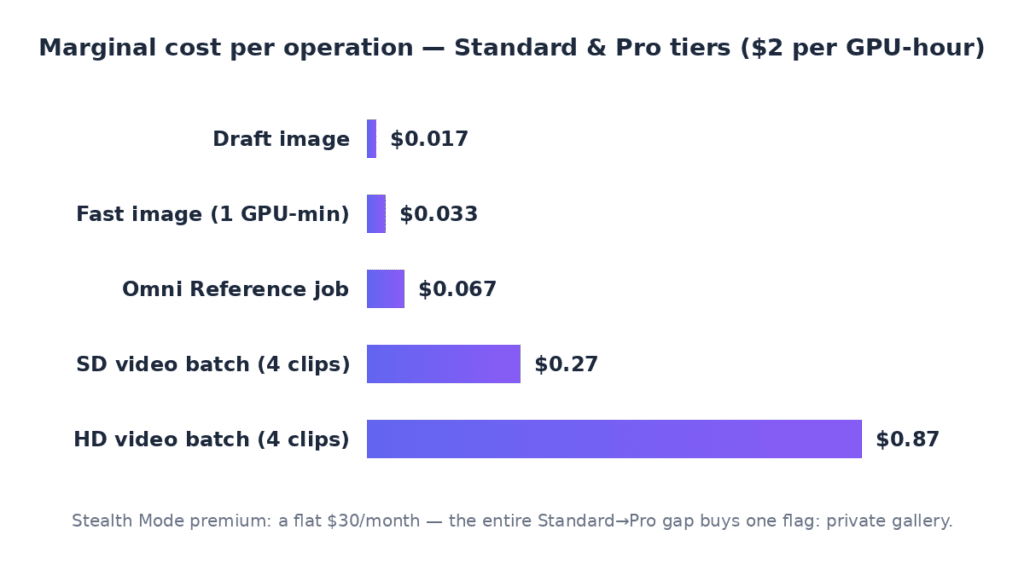
Marginal cost per image at $2/GPU-hour, the rate implied by Standard and Pro pricing. V8.2’s GPU-native pipeline uses fewer minutes per job than V7’s, which is the entire reason the two versions don’t cost the same per image.
Midjourney sells GPU minutes, not images, and every plan is a different packaging of the same clock — and the packaging changed with V8. V7’s standard job cost about 1 GPU-minute; V8.1/V8.2’s GPU-native pipeline dropped that to about 0.8 GPU-minutes for SD and 1.3 for HD, per Midjourney’s own V8.1 documentation. That means the same 15 Fast-hours on Standard stretches further today than it did a year ago — roughly 900 V7-era jobs versus roughly 1,125 jobs at V8.2’s SD rate. The job-count column below uses the current V8.2 basis; if you’re deliberately running --v 7, expect 15–20% fewer jobs per Fast-hour block.
Figures below are corroborated across independent breakdowns from eesel AI and Fello AI, current through August 2026. Verify live at midjourney.com before you publish or purchase — pricing moves, and GPU-cost-per-job can shift again with the next version.
| Plan | Monthly | Annual (per month) | Fast GPU time | ~SD jobs (V8.2 basis) | Relax | Stealth |
|---|---|---|---|---|---|---|
| Basic | $10 | $8 ($96/yr) | 3.3 h | ~245 | None | No |
| Standard | $30 | $24 ($288/yr) | 15 h | ~1,125 | Unlimited images | No |
| Pro | $60 | $48 ($576/yr) | 30 h | ~2,250 | Unlimited images + SD video | Yes |
| Mega | $120 | $96 ($1,152/yr) | 60 h | ~4,500 | Unlimited images + SD video | Yes |
The marginal math, rounded to one significant figure since the underlying GPU-hour rate is itself an approximation: at roughly $2/GPU-hour on the middle tiers, a Fast SD image costs about 3 cents on V8.2 and about 3 cents on legacy V7 too — V7’s slightly higher per-minute cost and V8.2’s slightly lower one land close enough that the difference doesn’t clear a full cent at this rate. An HD image runs closer to 4 cents; V7’s old Draft mode ran about 2 cents. V8.1/V8.2’s own Draft Mode is cheaper still per image — one draft prompt returns 24 images at 512×512 for 0.4 GPU-minutes, a fraction of a cent each, though at lower resolution than either version’s Fast output. The Stealth premium is a flat $30/month — the entire Standard→Pro price gap buys one boolean flag: public vs. private gallery.
The traps, all in the fine print: Fast hours expire every billing cycle with no rollover. Refunds apply only under 20 total GPU-minutes consumed — too little to evaluate anything. There is no free tier, and none has existed since March 2023. And any organization above $1,000,000 in gross annual revenue is contractually required onto Pro or Mega for commercial use — a rule that makes the plan decision for an entire class of businesses before a single prompt is typed.
Which plan, which tool
| Your situation | The right call |
|---|---|
| Evaluating whether AI images fit your work | Skip Basic. Use Nano Banana Pro via standard Gemini (free) or Adobe Firefly’s free tier to learn prompting; subscribe when the ceiling, not the floor, is the problem. |
| Regular creator, no privacy requirements | Standard, $30/month, on V8.2 by default. Relax for volume; amortized across unlimited Relax images, marginal cost trends toward zero if your waiting time is billable anyway. |
| Client work, agency, or >$1M revenue | Pro, $60/month. Stealth Mode is not a luxury here; client imagery sitting in a public gallery is a liability, and the revenue rule makes it mandatory regardless. |
| Character-consistent avatar or brand series | Test both the V8.2 Edit Model and legacy V7 Omni Reference (--v 7) on your own reference images before committing; neither has a settled, independently verified consistency record as strong as a dedicated tool like Nano Banana Pro. |
| Automated or API-driven pipelines | Not Midjourney. No public API and prohibited automation close this door regardless of output quality. |
Settings that pay rent
Six production habits, briefly: build your personalization profile past ~100 ratings before judging output — this carries forward regardless of which version you’re on. Use Draft Mode to explore cheaply before committing Fast hours — it works the same way in spirit on V7 and V8.1/V8.2, though the V8 version trades resolution (512×512, web-only) for a much bigger 24-image batch per prompt, and audit the speed toggle before long sessions, since Turbo doubles burn silently. If you need locked character identity, budget time to test both --v 7 Omni Reference and V8.2’s Edit Model rather than assuming either behaves like the other — and remember that attaching an Omni Reference on a V8.X prompt quietly reroutes that job to V7. Use Raw mode for photorealism and product work on any version. Set aspect ratio before generating, not after. And treat video as a finishing step, not a volume play — HD video batches punish casual experimentation on GPU time.
Where V7 sits now that V8.2 runs the show
V7’s run as the default ended on June 9, 2026, when Midjourney switched the automatic slot to V8.1. V8.1 itself lasted only six weeks before V8.2 took over on July 24, 2026 — and V8.2 is what you get by default today.
What this means in practice:
- New work belongs on V8.2. It carries the personalization and aesthetic lineage forward from V7 and V8.1, renders faster, and improves text handling and small-detail preservation — though still not reliably enough for long text passages.
- Prompts don’t transfer one-to-one across the line. V8.1 and V8.2 reward longer, more specific prompting where V7 rewarded brevity. Re-test your go-to prompts after switching versions; treat saved
--srefcodes as suspects until re-validated, even though style references remain supported across all three versions per Midjourney’s own compatibility chart. - Omni Reference got rerouted, not removed. You can still attach one to a V8.1 or V8.2 prompt, but per Midjourney’s own Omni Reference documentation and confirmed independently by several trackers, that job then renders on V7 — you don’t get a V8-quality image with a reference attached, you get a V7 image. Midjourney’s stated direction is for V8.X users to use the new Edit Model instead: released alongside V8.2 and opened to broader testing on August 27, 2026, it accepts up to four reference images and folds in inpainting, outpainting, and instruction-based editing, explicitly replacing Omni Reference, Character Reference, and the old Retexture tool as Midjourney’s primary consistency and editing workflow going forward. It’s new enough that it hasn’t accumulated the same independent scrutiny Omni Reference has. If persistent characters are core to your work, run the identity-drift test from the protocol above on the Edit Model specifically — and keep
--v 7in rotation if you want the older, better-documented tool for a specific project rather than triggering it accidentally. - The personalization layer outlived V7. Personalization, moodboards, and style references are explicitly supported across V6, V7, and the V8.1/V8.2 generation per Midjourney’s compatibility chart. The rating work done in 2025 still pays off — the default-on taste layer V7 introduced is now permanent infrastructure.
- Draft Mode survived, and actually got more useful. Midjourney’s dedicated Draft Mode documentation confirms compatibility with V7, V8.1, and V8.2 — the general feature-comparison chart on the Version page hasn’t been updated to reflect this and still shows it unsupported for the V8 line, which is a stale-chart problem rather than a real gap. On V8.1/V8.2, one Draft prompt returns a 24-image batch at 512×512 for 0.4 GPU-minutes, web-only (not in Discord); V7’s Draft mode returns a smaller batch at higher resolution for roughly half the cost of a standard job. They’re different tools now, not the same feature ported forward unchanged, and it’s worth testing both if your workflow depends on cheap iteration.
Quick answers
Is Midjourney V7 still worth using in 2026?
For two specific jobs: reproducing a V7-era look on legacy projects (via --v 7), and character work where you specifically want Omni Reference’s fully documented behavior rather than the newer Edit Model — though note that attaching an Omni Reference from a V8.1/V8.2 prompt already runs on V7 automatically. For new general work, V8.2 is the default and the better tool.
What does a Midjourney image actually cost?
On Standard or Pro, a Fast image runs about 3 cents on either V7 or V8.2 — the two versions’ different GPU-minute costs happen to round to the same figure at this rate. An HD image on V8.2 runs closer to 4 cents. With unlimited Relax on Standard and above, volume work’s marginal cost trends toward zero — you pay in queue time, not dollars. Your real cost is per kept image; measure it with the protocol above.
Is V8.1 or V8.2 the current default?
V8.2. It became the default on July 24, 2026, replacing V8.1, which had held the slot for only six weeks after taking it from V7 on June 10, 2026. A fair amount of coverage published in June and early July 2026 still describes V8.1 as current — check the publish date on anything that does.
Does Midjourney have an API?
No. There is no official public API as of September 2026, and the terms of service prohibit automated access. Third-party wrappers exist but operate outside the sanctioned terms.
Sources
Launch & primary-adjacent
- VentureBeat — “Midjourney v7 launches with voice prompting and faster draft mode” (Apr 4, 2025 — launch reporting, personalization gate, launch modes, mixed reception)
- Wikipedia — Midjourney (version history, aggregating official release notes)
Version history (primary source)
- Midjourney official documentation — “Version” — the authoritative record of default-model periods; confirms V8.2 as current default since July 24, 2026, V8.1’s default window as June 10–July 23, 2026, and V7’s as June 17, 2025–June 9, 2026. Verified directly at time of writing.
- Midjourney Updates — “V8.1 is now the default model on Midjourney!” (Jun 11, 2026) and Midjourney Updates — “V8.1 Alpha” (Apr 14, 2026)
Benchmarks & testing
- Curious Refuge Labs — Midjourney V7 benchmark (Jan 2026 — 29-image test, 8.62/10)
- Rangy — Flux 2 vs. Midjourney head-to-head (May 2026 — independently cites the same 8.62/10 figure, corroborating the Curious Refuge result)
- AI Video Bootcamp — V7 test data (Q1–Mar 2026 — commercial training provider; cited without link because the underlying methodology page could not be verified at publication time; treated as directional throughout)
- Pixmind — “Midjourney V7 review and guide” and “Midjourney V8.2: What Changed and How to Use It” (pixmind.io, Jul 2026)
Omni Reference, Edit Model & Draft Mode (primary source)
- Midjourney official documentation — Omni Reference, Draft & Conversational Modes — confirm Omni Reference routes V8.1/V8.2 jobs to V7, and Draft Mode’s compatibility with V7/V8.1/V8.2 despite the general feature chart lagging behind
- Midjourney Updates — “Edit Model for V8” — announcement post describing the four-reference-image workflow
- AlphaSignal, SketchTo, Superpower Daily — independent coverage of the Edit Model’s August 27, 2026 broader-testing rollout
Pricing & GPU economics
- eesel AI — Midjourney pricing and GPU-hour breakdown (verified June 2026)
- Fello AI — Midjourney pricing breakdown (verified June 2026)
- Midjourney official plan comparison page (midjourney.com) — verify live before publishing, as pricing and per-job GPU costs can move independently of the plan structure