
AI Governance Checklist
The AI Governance Checklist Companies Are Using to Stay Safe
Fully enforced deadlines are weeks away. Most companies still haven’t completed a basic AI inventory. Here’s the practical, no-hype checklist that enterprise and mid-market teams are actually using — with real regulatory stakes, real incident data, and an honest look at what’s hard.
TL;DR – What You Need to Know in 2 Minutes
The core problem: On August 2, 2026, the EU AI Act’s high-risk system obligations become fully enforceable. Simultaneously, over 30 US states passed AI bills in 2025 alone. If you haven’t structured your AI governance program yet, you’re not behind schedule — you’re approaching a hard deadline with real financial consequences.
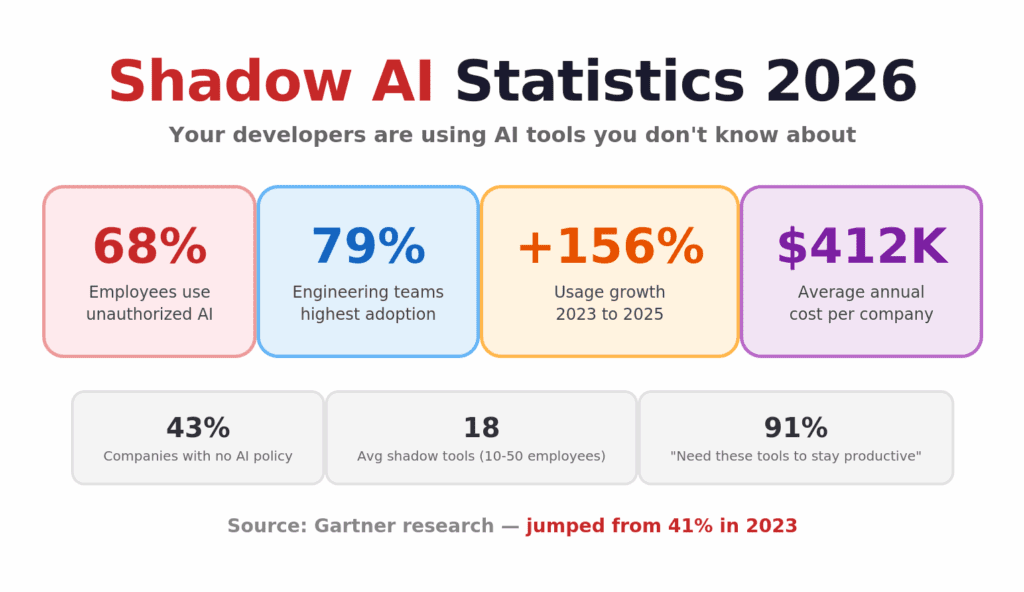
- 98% of organizations have employees using unsanctioned AI tools. Most companies don’t know what AI is running inside their own walls.
- Fines under the EU AI Act reach €35M or 7% of global turnover — exceeding GDPR’s most severe penalties for certain violations.
- Only 20% of companies have a mature AI governance model (Deloitte, 2026). The other 80% are exposed.
- AI governance doesn’t have to start from scratch. NIST AI RMF + ISO 42001 + a documented AI inventory covers the foundation for most organizations.
- The 10-section checklist below covers inventory, risk classification, policy, bias auditing, data governance, vendor contracts, human oversight, incident response, board reporting, and agentic AI — the areas regulators and plaintiff attorneys are already focusing on.
- Warning: Documentation assembled quickly in the weeks before an inspection is recognizable to auditors. Building governance retroactively is both harder and less defensible than building it incrementally.
Realistic next step: Start with an AI system inventory. You genuinely cannot govern what you haven’t catalogued. Everything else builds from there.
Why 2026 Is the Year This Gets Serious
For the past four years, AI governance has occupied that uncomfortable middle zone where everyone agrees it matters and very few people do anything structured about it. Most large organizations set up an AI ethics working group sometime in 2022 or 2023, published a set of principles, and then watched adoption accelerate well past what those principles could actually govern. The working group issued guidance; the business units kept deploying.
That era is ending. Not because companies have suddenly become more conscientious — but because the legal and financial consequences of ungoverned AI have crystallized into specific, enforceable deadlines.
The companies moving fast on governance right now aren’t doing it because of abstract ethics concerns. They’re doing it because their enterprise customers started including AI governance sections in vendor due diligence questionnaires. Their cyber insurers added AI-specific risk questions to renewal applications. Their legal teams flagged the EU AI Act deadlines. And their HR systems, credit tools, or customer-facing AI might qualify as “high-risk” systems under regulations they haven’t fully read yet.
The Regulatory Landscape: What’s Actually Binding
Let’s be direct about what’s mandatory versus what’s voluntary, because most explainers blur this distinction in ways that leave compliance teams confused about priorities.
EU AI Act
Status: Mandatory for EU market exposure
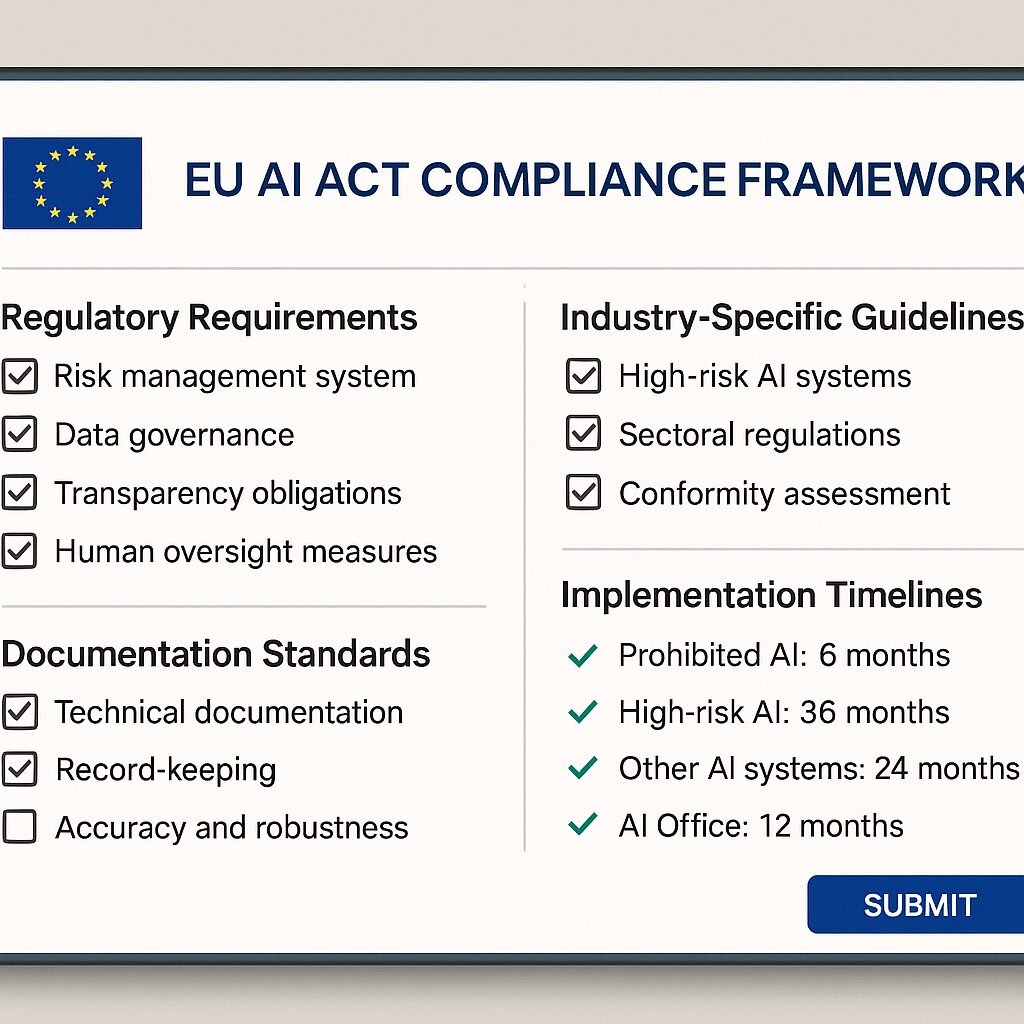
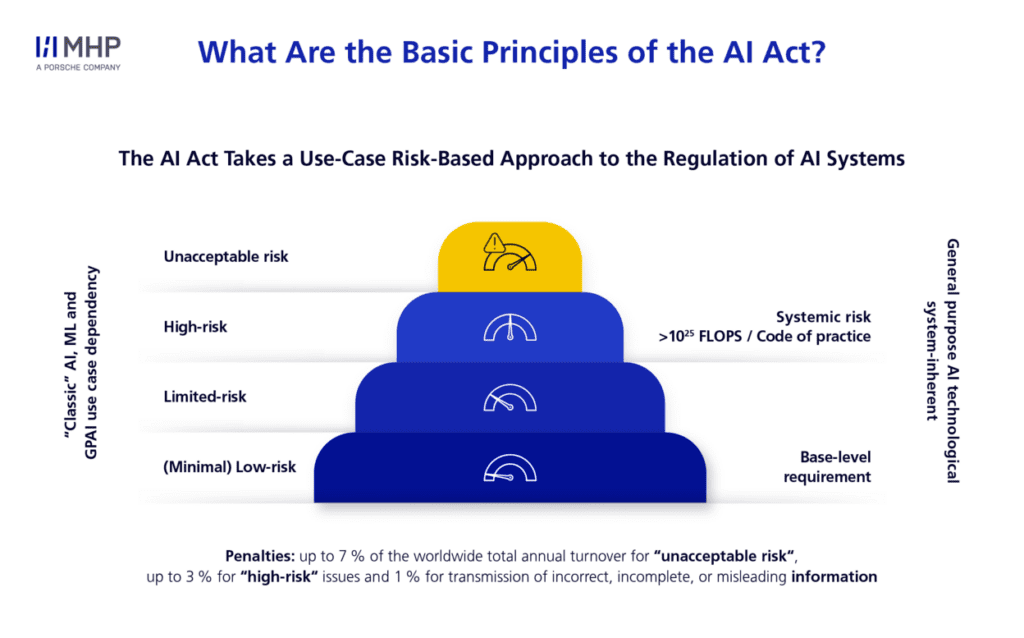
Full enforcement for high-risk AI systems begins August 2, 2026. Applies to any organization deploying or providing AI systems affecting people in the EU — regardless of where the company is headquartered. Four risk tiers: unacceptable (banned), high-risk (strict obligations), limited risk (transparency rules), minimal risk (largely unregulated).
- Fines up to €35M or 7% turnover (prohibited practices)
- Up to €15M or 3% turnover (high-risk system failures)
- Requires technical documentation, risk management, human oversight
- General-purpose AI model rules active since August 2025
NIST AI RMF 1.0
Status: Voluntary (US), de facto standard
Published January 2023. Four functions — Govern, Map, Measure, Manage — that have become the vocabulary for AI risk management in the US. Federal agencies, the FTC, CFPB, FDA, and DOD all reference it. Enterprise customers use it to evaluate vendor AI governance maturity. No formal certification, but its influence exceeds its voluntary status.
- Sector-specific profiles now available (critical infrastructure)
- Aligns with EU AI Act and ISO 42001
- Best used as the operational layer underneath regulatory compliance
ISO/IEC 42001:2023
Status: Voluntary, certifiable
First international standard for AI Management Systems. Increasingly serves as the unifying compliance layer for multinational organizations because it maps to both EU AI Act obligations and NIST RMF functions. Third-party certification available through accredited bodies (auditors must meet ISO/IEC 42006:2025).
- Structured around a Plan-Do-Check-Act cycle
- Answers customer due diligence questions with specificity
- Makes EU AI Act and US state alignment significantly easier
Critical deadline for US companies: The EU AI Act’s extraterritorial reach mirrors GDPR’s. If your AI systems produce outputs used in the EU — even if your company has no EU offices — you have obligations. The August 2, 2026 deadline is approximately 10 weeks away as of this writing. Companies whose AI touches EU employment decisions, credit scoring, or critical infrastructure are legally required to have documented risk management systems, human oversight mechanisms, and technical documentation in place by that date.
Additionally, the Texas Responsible AI Governance Act (TRAIGA) took effect January 1, 2026, and Colorado’s AI Act takes effect June 30, 2026. This is no longer a single-jurisdiction compliance problem.
The Shadow AI Problem Nobody Wants to Talk About
Before any company can govern its AI, it has to know what AI it’s running. That turns out to be surprisingly difficult. The phenomenon is commonly called “shadow AI” — AI tools used within organizations without IT approval or security governance — and the scale of it is genuinely alarming.
“Worker access to AI rose by 50% in 2025 alone, yet only one in five companies has a mature governance model to oversee how that AI is actually being used.” Deloitte State of AI in the Enterprise, 2026
The Verizon DBIR 2026 found that in their 2025 dataset, 15% of employees were classified as regular AI users on corporate devices. In the 2026 dataset, that figure reached 45% — a tripling in a single twelve-month window. Shadow AI is now the third most common non-malicious insider action in their data loss prevention dataset.
What’s actually happening in practice: employees discover that an AI tool makes their work faster, they use a personal account to access it, and they paste customer data, internal memos, or proprietary code into it. Nobody approved it. Nobody knows. The data has left the building.
The answer isn’t blanket bans — research consistently shows employees route around them. The answer is: discover what’s actually being used, understand why, provide sanctioned alternatives that meet the genuine productivity need, and then enforce clear boundaries around what data may not leave approved systems. That last point is the one that actually reduces risk. You’re not trying to stop AI use; you’re trying to stop uncontrolled data flows.
Three Frameworks, One Practical Program
The three frameworks above — EU AI Act, NIST AI RMF, ISO 42001 — are frequently presented as competing options. They’re not. They address different things and, when mapped together, they’re more complementary than redundant.
The simplest mental model: ISO 42001 is the management system (the “how you run the program”), NIST RMF is the technical and operational guidance (the “how you assess and manage risk”), and the EU AI Act is the specific legal obligation (the “what you legally must do if you serve the EU market”). A company that builds its governance program around ISO 42001, uses NIST RMF as its risk assessment methodology, and maps both to EU AI Act requirements will find it significantly easier to answer any regulatory question that comes at them — including from US state regulators who increasingly use NIST as their reference framework.
Practical recommendation for most US organizations with international operations: Start with NIST AI RMF to build operational fluency in AI risk vocabulary. Structure your management system around ISO 42001 (even without pursuing formal certification initially). Then map your EU AI Act obligations against both to identify gaps. This sequence gives you the most flexible starting point and lets you build toward certification incrementally rather than treating it as a one-time event.
Singapore’s January 2026 framework is currently the only governance document addressing agentic AI (autonomous multi-step systems) directly. If you’re deploying AI agents — and you almost certainly are or will be — consult it.
The 10-Part AI Governance Checklist
What follows is the practical checklist that enterprise compliance teams are actually using in 2026. It’s structured around 10 core areas. Completing all 10 puts most organizations in a defensible position with regulators, insurers, and enterprise customers. I’ve noted the specific regulatory mapping for each area.
01 AI System Inventory
Regulatory mapping: EU AI Act Article 60 (transparency), NIST RMF MAP function, ISO 42001 §6.1
You cannot govern what you haven’t catalogued. An AI inventory is the non-negotiable foundation for every other governance activity. It needs to include purpose, data sources, risk exposure, integration points, deployment environments, human-in-the-loop expectations, the business owner, and which regulatory tier the system falls into.
- Conduct an organization-wide discovery scan for all deployed AI systems, including embedded AI in third-party SaaS tools
- Identify all shadow AI usage via network traffic analysis, employee surveys, and department audits
- Document each system: purpose, data inputs/outputs, affected populations, business owner, vendor/provider
- Classify each system by risk tier (EU AI Act tiers or equivalent internal taxonomy)
- Assign a unique identifier and version-controlled record to each system
- Establish a process for registering new AI systems before deployment (not after)
- Review and update the inventory at minimum quarterly; automate discovery scanning where possible
02 Risk Classification
Regulatory mapping: EU AI Act Articles 6–9, NIST RMF MAP/MEASURE functions
Risk classification under the EU AI Act determines everything downstream: documentation requirements, testing scope, oversight obligations, and potential fine exposure. Getting this classification wrong — in either direction — is a costly mistake. Misclassifying a high-risk system as limited-risk is a compliance failure. Over-classifying minimal-risk tools as high-risk wastes resources and slows legitimate innovation.
- Apply EU AI Act’s four-tier taxonomy to every inventoried system: unacceptable, high-risk (Annex III), limited risk, minimal risk
- For high-risk AI systems: implement full risk management documentation before deployment
- Identify whether any systems fall under “prohibited AI practices” (social scoring, manipulative design, biometric identification without authorization)
- Assess general-purpose AI (GPAI) models for systemic risk designation
- Document the classification rationale for each system — this is audit-critical
- Assign risk tiers using NIST RMF MAP function to supplement EU classification with operational risk context
- Re-classify systems when their purpose, data inputs, or deployment context materially changes
High-risk AI categories under EU AI Act Annex III include: biometric identification, critical infrastructure management, educational assessment, employment and worker management, access to essential private services (including credit scoring and insurance), law enforcement, migration and border control, and administration of justice. If your AI touches any of these areas and serves EU market participants, you’re in the high-risk tier.
03 Policy & Acceptable Use
Regulatory mapping: NIST RMF GOVERN function, ISO 42001 §5.2, §6.2
A policy that lives in a SharePoint folder nobody reads is not a governance control. Effective acceptable-use policy for AI needs to be specific, layered by role, and actively trained — not just published. The Cloud Security Alliance recommends classifying AI tools into three tiers: fully approved, limited use (approved with data handling rules), and prohibited.
- Define and publish a clear AI Acceptable Use Policy covering which tools are approved, limited, and prohibited
- Specify data classification rules: what categories of data may not be input into AI systems (PII, trade secrets, client-confidential, regulated data)
- Establish role-specific guidelines for high-risk use cases (HR, legal, finance, clinical)
- Require annual training on AI acceptable use for all employees — not just technical staff
- Define a clear process for employees to request approval of new AI tools before using them
- Document consequences for policy violations and enforce them consistently
- Review and update policy at minimum annually, or when significant new AI capabilities become available
04 Bias & Fairness Auditing
Regulatory mapping: EU AI Act Articles 9–10, NYC Local Law 144, Colorado AI Act, EEOC guidance
AI bias incidents aren’t hypothetical. In May 2025, a federal court certified Mobley v. Workday, Inc. as a collective action under the Age Discrimination in Employment Act, covering all applicants over 40 denied recommendations since September 2020. The case is now in discovery, and courts are compelling Workday to provide data on employer lists and technical details of their AI screening processes. This is the blueprint other plaintiffs and regulators will follow.
Workday Hiring Algorithm Class Action (2023–ongoing)
Plaintiff Derek Mobley alleged that Workday’s AI-powered screening tools disproportionately disadvantaged applicants over 40, Black applicants, and applicants with disabilities. The court found that Workday’s AI “constitutes a unified policy applicable to all members of the collective, even though they applied to different positions with different employers.” Critically, the AI was ruled an “active participant in the hiring process,” not merely a neutral tool — a legal framing with enormous implications for any company using third-party AI in hiring.
- Conduct pre-deployment bias testing across all affected demographic groups for high-risk AI systems
- For employment AI tools: commission independent annual bias audits (required under NYC Local Law 144)
- Establish ongoing monitoring for demographic disparity in AI outputs post-deployment
- Maintain documentation of test datasets, evaluation metrics, and disparate impact analysis
- Implement a clear escalation path when bias is detected in production
- Ensure bias audit methodology and results are available to regulators on request
- For EU high-risk systems: maintain technical documentation per Article 11 requirements
05 Data Governance for AI
Regulatory mapping: EU AI Act Article 10, GDPR, NIST RMF MAP function, ISO 42001 §8.4
Data governance for AI is distinct from general data governance in one critical way: AI systems don’t just process data — they learn from it, and biases in training data propagate through to outputs in ways that are difficult to detect and expensive to remediate. The pattern across documented AI bias cases is consistent: bias enters at the data layer, gets amplified through the training pipeline, and goes undetected because evaluation benchmarks don’t reflect the populations the model actually serves.
- Document training data provenance, lineage, and data quality assessments for all AI models
- Apply data minimization principles to AI training: use only data necessary for the stated purpose
- Assess training datasets for representational gaps, historical bias, and proxy discrimination risks
- Implement data access controls specific to AI workflows (separate from general data lake access)
- Establish data retention and deletion processes for AI training and inference data
- Map AI data flows to GDPR/privacy obligations: identify whether AI decisions constitute automated processing requiring DPIA
- Require vendors to provide training data provenance on request (contractual clause)
06 Vendor & Procurement Controls
Regulatory mapping: EU AI Act Chapter III (provider obligations), NIST RMF GOVERN function
Procurement teams at enterprise customers now routinely include AI governance sections in vendor due diligence questionnaires. If your company is a vendor, failing to answer these with specificity costs deals. If your company is a buyer, failing to include them creates downstream liability — as the Workday case demonstrates clearly. AI governance has become a supply chain risk issue.
- Add AI-specific clauses to all vendor contracts: model card disclosure, training data provenance, bias audit access
- Require vendors to disclose AI Act risk classification and compliance status for systems you deploy
- Specify incident notification SLAs in contracts (mandatory reporting timelines for AI-related failures)
- Require vendors to notify you when AI models are updated in ways that could affect outputs
- Include audit rights for third-party AI systems that fall into your high-risk inventory
- Conduct AI governance due diligence for AI vendors using the same rigor as security due diligence
- Maintain a vendor AI inventory as a subset of your overall AI inventory
07 Human Oversight Mechanisms
Regulatory mapping: EU AI Act Article 14 (mandatory for high-risk systems), NIST RMF MANAGE function
Human oversight isn’t just a checkbox — it’s one of the most commonly cited failures in AI incident post-mortems. The EU AI Act makes meaningful human oversight mandatory for high-risk AI systems. “Meaningful” is the operative word: rubber-stamp approval processes where a human technically signs off but lacks the information, time, or authority to override the AI recommendation don’t satisfy the requirement and won’t satisfy a regulator.
- Define specific human-in-the-loop requirements for each high-risk AI system
- Ensure human reviewers have adequate information to understand and challenge AI outputs
- Provide explicit override mechanisms and document override decisions
- Train human reviewers on AI limitations and known failure modes — not just how to use the interface
- Establish escalation thresholds: when is human review mandatory vs. optional?
- Monitor override rates: an override rate of 0% is often a signal that oversight is nominal, not real
- Document the design rationale for oversight mechanisms in technical documentation
08 AI Incident Response
Regulatory mapping: EU AI Act Article 73 (serious incident reporting), NIST RMF MANAGE function
Under the EU AI Act, providers of high-risk AI systems must report serious incidents or malfunctioning to market surveillance authorities. A “serious incident” includes any incident that causes or could cause the death of a person, serious damage to a person’s health or safety, or serious adverse impacts on fundamental rights. You need an incident response plan that’s specific to AI failures — not just a generic IT incident plan with “AI” added to the scope.
- Define what constitutes an AI incident in your context (include near-misses, not just failures with realized harm)
- Establish an AI incident log and review it on a regular cadence
- Create a specific escalation path for AI incidents that may require regulatory notification
- Define the roles responsible for AI incident investigation and remediation
- Run tabletop exercises for high-risk AI failure scenarios at minimum annually
- Document post-incident root cause analysis and remediation steps
- Maintain version-controlled audit logs for all high-risk AI system decisions
09 Board & Executive Reporting
Regulatory mapping: NIST RMF GOVERN function, ISO 42001 §5.1, EU AI Act governance requirements
AI governance is not a purely operational function. The EU AI Act explicitly requires governance structures with executive visibility, and regulators expect boards to be aware of material AI risks in the same way they’re expected to be aware of financial and cybersecurity risks. Companies that treat AI governance as a technical team responsibility without executive accountability tend to have governance programs that lack both resources and credibility.
- Establish a named executive (CAIO, Chief AI Officer, or equivalent) accountable for AI governance
- Report AI governance status to the board on the same cadence as financial reporting — quarterly, with a written narrative
- Quarterly reporting should cover: AI inventory changes, current risk posture, active incidents, regulatory developments, and resource needs
- Link AI governance program to corporate risk register
- Ensure board members understand their personal liability exposure for material AI governance failures
- Document governance decisions and the rationale behind them at the senior level
- Publish an annual AI governance transparency report for enterprise customers (increasingly expected)
10 Agentic AI Governance
Regulatory mapping: Singapore AI Governance Framework (January 2026), EU AI Act GPAI provisions
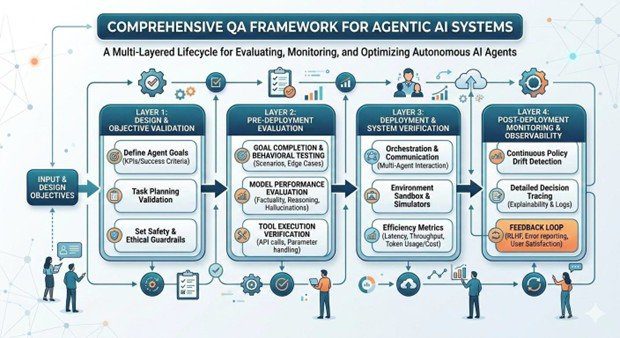
None of the three major frameworks above — EU AI Act, NIST RMF, ISO 42001 — were designed for agentic AI. Singapore’s January 2026 framework is currently the only governance document that addresses autonomous agents directly. This matters because agentic AI (multi-step autonomous systems that can take actions, call APIs, and make cascading decisions without human approval at each step) is already deployed in production at many organizations. Gartner predicts 40% of enterprise applications will feature task-specific AI agents by end of 2026 — up from under 5% in 2025.
The Governance Gap for Autonomous Agents
Traditional AI governance assumes a human reviewing an AI output before action is taken. Agentic AI breaks this assumption. A coding agent that autonomously writes, commits, and deploys code; a procurement agent that autonomously orders supplies when inventory drops below a threshold; a customer service agent that autonomously issues refunds or updates account details — all of these involve consequential actions without per-action human approval. Attribution for errors becomes genuinely complicated. Who is responsible when an agent takes an action that traverses three systems and triggers a consequence nobody anticipated?
- Define and document the authorized scope of action for each deployed AI agent
- Implement hard technical limits on agent authority (read-only vs. read-write access, maximum transaction value, etc.)
- Log every agent action with full context — inputs, reasoning (where accessible), outputs, and downstream effects
- Treat agent scope creep as an incident requiring investigation
- Define human approval requirements for irreversible or high-value agent actions
- Test failure modes: what happens when an agent encounters an ambiguous situation or conflicting instructions?
- Review Singapore’s January 2026 Agentic AI Governance Framework for current best practice guidance
Governance Maturity Matrix
The checklist above describes what “done” looks like. The matrix below describes three realistic stages most organizations will move through. Be honest about where you are — there’s no governance value in claiming Level 3 maturity when you’re operating at Level 1.
Five Mistakes Companies Keep Making
These aren’t theoretical. They come from documented incidents, regulatory findings, and litigation outcomes.
1. Treating governance as documentation rather than process
The most common governance theater: producing a polished AI ethics policy, a risk framework document, and a governance committee charter — then continuing to deploy AI exactly as before. Regulators can tell when documentation was assembled in the weeks before an inspection. Auditors look for version history, meeting minutes, evidence of decisions actually being made and followed. A governance program that doesn’t change behavior isn’t a governance program; it’s a liability.
2. Assuming vendor compliance transfers to you
Multiple organizations have discovered — the hard way — that deploying a vendor’s AI system doesn’t transfer legal liability to the vendor. The Workday case established that a company using third-party AI in hiring decisions is the “active participant” responsible for discriminatory outcomes. EU AI Act deployer obligations are separate from provider obligations. Know yours.
3. Classifying high-risk systems as limited-risk to reduce compliance burden
This happens more than regulators will admit publicly. A company realizes its AI-assisted hiring tool might fall under the EU AI Act’s high-risk employment category, decides the documentation requirements are onerous, and reclassifies it as “limited risk” with thin justification. This is exactly what investigators will look for when an incident triggers scrutiny. The classification should follow the facts, not the compliance budget.
4. Measuring oversight by headcount rather than effectiveness
A human reviewer who processes 400 AI decisions per day in a queue with 15 seconds per item is not providing meaningful oversight, regardless of what the policy document says. Regulators increasingly understand what nominal oversight looks like. Track override rates. If they’re at 0% over months, that’s a red flag — either the AI is genuinely perfect (it isn’t), or the human review is not functioning as designed.
5. Ignoring US state law because it seems fragmented
Over 30 US states introduced or passed AI bills in 2025. Colorado’s AI Act takes effect June 30, 2026. Texas TRAIGA is already in effect (January 1, 2026). NYC Local Law 144 for employment AI has been enforceable since 2023. The fragmentation is real, but the combined effect is that most US companies with operations in multiple states are already subject to AI-specific legal obligations — they just haven’t mapped them yet.
Frequently Asked Questions
How long does it take to build a functional AI governance program from scratch?
Realistically, 3–6 months to get from nothing to a defensible Level 2 governance posture (structured but not yet fully managed). The AI inventory alone typically takes 4–8 weeks for a mid-market company. Don’t let perfect be the enemy of good: a documented, honest Level 1 program is better than no program, and it gives you a baseline to improve from. If you’re facing the August 2026 EU AI Act deadline, prioritize inventory and risk classification for your highest-risk systems first.
Does every company with EU customers need to comply with the EU AI Act?
If your AI systems produce outputs used by people in the EU — regardless of where your company is headquartered — you likely have obligations. The Act mirrors GDPR’s extraterritorial reach. However, the specific obligations depend on your risk tier: minimal-risk systems face almost no requirements, while high-risk systems face extensive documentation, oversight, and audit requirements. The first step is classifying your systems accurately against the Act’s four tiers.
What’s the difference between NIST AI RMF and ISO 42001? Which one should I use?
Use both, in combination. NIST AI RMF is US-focused, voluntary, and provides practical operational guidance for AI risk management across four functions (Govern, Map, Measure, Manage). ISO 42001 is an international standard that specifies requirements for an AI Management System and is certifiable through accredited third parties. For most organizations: use NIST RMF as your risk methodology and ISO 42001 as your management system structure. They’re complementary and both map to EU AI Act obligations.
How do I handle shadow AI — employees using unauthorized AI tools?
Blanket bans don’t work and research consistently shows employees route around them. The effective approach is: (1) discover what’s actually being used, (2) understand why employees adopted those tools, (3) provide sanctioned alternatives that meet the genuine productivity need, (4) enforce clear data handling rules about what may not enter any AI system regardless of authorization status. The 89% drop in unauthorized use when approved alternatives are provided (Healthcare Brew, 2026) is the single most actionable data point in this space.
What constitutes “meaningful” human oversight under the EU AI Act?
The Act requires that human overseers have the ability to understand and interpret AI outputs, the authority and tools to override them, and the practical capacity to exercise real judgment rather than rubber-stamp approvals. A queue of 400 decisions at 15 seconds each does not constitute meaningful oversight. Design oversight mechanisms that are operationally realistic and document the design rationale. Override rates near zero over extended periods should trigger a review of whether oversight is functioning as designed.
Does my company need a Chief AI Officer?
You need a named executive with clear accountability for AI governance — whether you call them CAIO, Chief Risk Officer for AI, or something else is less important than having the function exist with real authority and resources. The EU AI Act governance requirements expect this. More practically, AI governance programs without executive sponsorship consistently fail to get the resources and cross-functional cooperation they need. The governance structure should be defined in writing with explicit authority, reporting lines, and accountability.
Do the EU AI Act fines really reach 7% of global turnover?
Yes, for violations of prohibited AI practices (manipulative AI, unauthorized biometric identification, social scoring, exploiting vulnerabilities). Violations of high-risk system obligations are capped at €15M or 3% of global turnover. Providing incorrect or misleading information to authorities is capped at €7.5M or 1%. No formal fines have been levied yet — full enforcement begins August 2, 2026 — but the penalty structure is explicit in Article 99 and exceeds GDPR’s most severe sanctions in the top tier.
What are the governance requirements specific to agentic AI or AI agents?
This is the current governance frontier. None of the three major frameworks (EU AI Act, NIST RMF, ISO 42001) was designed for agentic AI. Singapore’s January 2026 framework is the only document that addresses autonomous agents directly. Key requirements: define and technically enforce the scope of actions agents can take autonomously; log all agent actions with full context; treat scope creep as an incident; define maximum blast radius for agent actions; require human approval for irreversible or high-value decisions. This area is evolving fast and your governance approach should be reviewed at least twice a year.
Can I rely on my AI vendor’s compliance documentation rather than building my own?
Partially, but not fully. Vendor documentation may satisfy provider obligations under the EU AI Act, but deployer obligations are yours — they cannot be contracted away. You need your own documentation covering how you deploy, monitor, and oversee the vendor’s AI in your specific context. Additionally, as the Workday litigation demonstrates, legal liability for discriminatory or harmful outcomes can attach to the deploying company regardless of vendor terms of service.
How often should AI systems be re-audited or re-evaluated?
At minimum: annually for all documented high-risk systems, and whenever the system’s purpose, data inputs, or deployment context materially changes. For bias auditing in employment contexts, NYC Local Law 144 requires annual independent audits. The EU AI Act requires ongoing post-market monitoring for high-risk systems. In practice, models drift — their performance across demographic groups and edge cases changes over time as training data and deployment context evolve. Ongoing monitoring (not just point-in-time audits) is the appropriate standard for high-risk systems.
What’s the minimum viable governance program for a small or mid-market company?
Start here: (1) conduct an AI inventory — everything deployed, including third-party SaaS with AI features; (2) classify each system using the EU AI Act risk tiers; (3) publish an acceptable-use policy with clear data handling rules; (4) add AI-specific clauses to new vendor contracts; (5) designate a named owner for AI governance. That’s not comprehensive governance, but it’s a defensible foundation that demonstrates good faith and gives you the information you need to prioritize further investment.
Final Thoughts
The companies that handle AI governance well in 2026 won’t be the ones with the most elaborate frameworks or the thickest policy documents. They’ll be the ones that actually know what AI they’re running, have honest answers about what risks those systems carry, and have built oversight mechanisms that function in practice — not just on paper.
The regulatory pressure is real and the deadlines are imminent. But governance built entirely in response to external pressure tends to be brittle — designed to satisfy the minimum requirements of a specific regulation rather than to actually manage AI risk in a way that’s useful to the organization. The best programs I’ve seen are built around genuine understanding of what the AI actually does and what can go wrong. That understanding informs the governance — not the other way around.
Start with the inventory. Build from there. And revisit the checklist every quarter, because the AI landscape is moving fast enough that what was adequate six months ago may not be adequate today.
Questions about applying this checklist to your specific situation? The frameworks referenced throughout this article — NIST AI RMF, ISO 42001, and the EU AI Act itself — are all publicly available and worth reading directly, not just through summaries. The EU AI Act explorer at artificialintelligenceact.eu is a particularly useful resource for understanding specific article requirements.
More From Trendix.tech
Further reading on AI strategy, governance, and enterprise technology.
How leading organizations are structuring AI risk programs, with practical implementation guides and framework comparisons.
Article-by-article breakdown of obligations, risk tier classification, and enforcement timeline — updated for August 2026 deadlines.
How to find unauthorized AI usage across your organization and build a governance program that reduces risk without blocking legitimate productivity.
The methodologies, tools, and legal requirements shaping AI bias auditing in 2026 — from NYC Local Law 144 to EU AI Act Article 10.
Step-by-step implementation of ISO/IEC 42001:2023 for organizations building certifiable AI management systems.
The emerging governance framework for autonomous AI agents — scope controls, action logging, and the Singapore 2026 framework explained.
0 responses to “The AI Governance Checklist Companies Are Using to Stay Safe”