


AI-Generated Code Is Riskier Than You Think — Here’s Why
The vulnerability stats are bad. But the real danger is something the benchmarks don’t measure: speed removes the friction that kept insecure code out of production.
- AI coding tools produce vulnerable code nearly half the time — and improving model capability hasn’t changed this rate.
- The bigger threat isn’t bad code in isolation. It’s bad code deployed at speed, bypassing every review gate that existed before.
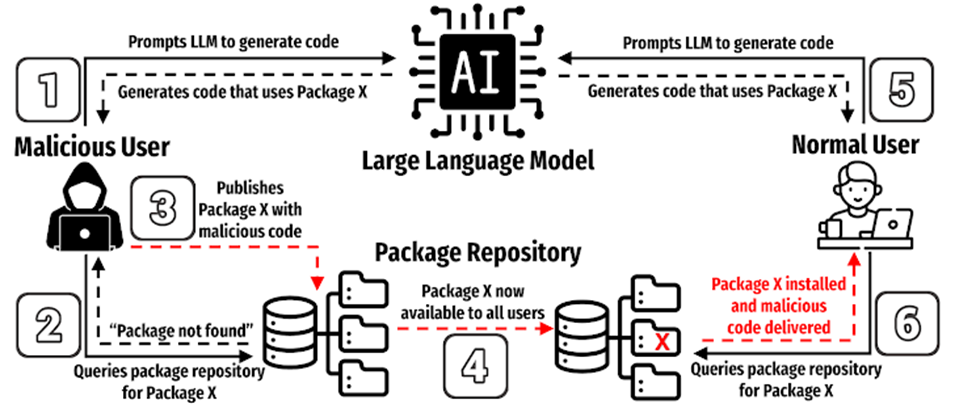
- A new attack class — “slopsquatting” — lets attackers exploit AI hallucinations to poison your supply chain without writing a single line of malware.
- There’s a viable security posture. But it requires treating AI output as untrusted input, not a trusted shortcut.
Should You Even Use AI-Generated Code in Production?
This isn’t a binary question, and anyone who tells you “never” or “always” isn’t being honest with you. The answer is contextual. Here’s the actual decision framework:
- Every PR goes through automated SAST scanning
- You have a dependency audit pipeline that checks AI-suggested packages
- The code is in low-sensitivity, non-auth, non-data paths
- A security-literate engineer reviews the output
- You’re using it for prototyping, not moving straight to prod
- You ship from AI prompt to production without review
- Your team treats “it runs” as “it’s safe”
- The code handles auth, payments, PII, or permissions
- You’re in a regulated industry without formal code audit requirements
- No one on the team can read and audit what was generated
The Problem No One Is Framing Correctly
The conversation about AI code security has been dominated by a single data point: 45% failure rate on security benchmarks. That number is real, sourced, and alarming. But fixating on it misses the more dangerous dynamic at play.
Every senior engineer who spent years shipping software will tell you: bugs have always existed in human-written code. The difference was never zero vulnerabilities — it was the friction between writing bad code and that code reaching production. Code review caught things. Static analysis caught things. Slow iteration cycles gave teams time to think.
AI tools have dissolved that friction. What OX Security found when analyzing over 300 software repositories — including 50 using tools like GitHub Copilot, Cursor, and Claude — was that AI-generated code is not necessarily more vulnerable per line than human-written code. The problem is speed. Bottlenecks including code review, debugging, and team-based oversight have been largely removed.
This article breaks down what the data actually shows, which threat classes are genuinely new, and what a functional security posture looks like for teams that aren’t willing to stop using AI tools.
The Four Risk Classes That Actually Matter
1. Classic OWASP Vulnerabilities, at Scale
Veracode’s 2025 GenAI Code Security Report is the most rigorous study on this to date. They tested over 100 LLMs across 80 real-world coding tasks — tasks specifically designed around the MITRE Common Weakness Enumeration system. The result: 45% of all code samples introduced OWASP Top 10 vulnerabilities. Cross-Site Scripting (CWE-80) had an 86% failure rate. Java emerged as the highest-risk language for AI code generation.
Source: Veracode 2025 GenAI Code Security Report — data last verified May 2026
What’s damning isn’t the percentage alone — it’s the trajectory. Despite frontier models improving dramatically on syntax, grammar, and general reasoning, their security performance has remained flat. Better models write cleaner-looking code that fails security checks at roughly the same rate as older ones.
2. The Volume Multiplier Problem
Apiiro’s research across Fortune 50 enterprises found something the benchmarks undercount: AI tools don’t just introduce vulnerabilities — they scale them. Their data showed a 322% increase in privilege escalation paths in codebases using AI tools, a 153% increase in design flaws, and a 40% jump in secrets exposure (API keys, tokens, and credentials embedded in generated code).
Design flaws are particularly hard to catch because they’re not syntax errors. They’re architectural decisions that look correct in isolation but create attack surfaces when combined with other system components. Static analysis tools aren’t built to catch these.
3. Secret Leakage and Over-Permissive Configurations
Repositories using GitHub Copilot show a 40% higher rate of secret leakage compared to those without AI assistance, according to GitGuardian. This isn’t because the models are intentionally writing secrets into code — it’s that AI tools trained on open-source repositories learned patterns from code that included hardcoded credentials. They reproduce those patterns confidently, and developers who aren’t auditing for secrets accept them.
A separate but related issue: AI tools consistently generate IAM policies, permission configurations, and access controls that are over-permissive. They optimize for “code that works” rather than “code that works with minimum necessary access.” In cloud environments, this regularly produces configurations that would fail any security review — if the review ever happened.
4. Slopsquatting — The Genuinely New Threat
This is the attack class that deserves the most attention, because it’s architecturally new and conventional defenses weren’t designed to catch it.
A 2025 study published at USENIX Security analyzed 576,000 code samples across 16 LLMs. Nearly 20% of recommended packages did not exist in any public registry. Commercial tools like GPT-4 hallucinated at roughly 5%; open-source models ran significantly higher. Critically, 43% of hallucinated package names repeated consistently across multiple prompts — they’re not random. They’re predictable.
Security researcher Seth Larson coined the term “slopsquatting” in April 2025: attackers register malicious packages under AI-hallucinated names on PyPI and npm, then wait. No phishing. No credential theft. No zero-day. Just waiting for the statistical inevitability of a developer accepting an AI suggestion without checking whether the package exists.
According to Endor Labs’ 2025 State of Dependency Management report, only one in five dependencies proposed by AI coding tools meet safety standards — meaning 80% introduce risk through known vulnerabilities, hallucinated packages, or unclear provenance.
The AI Code Risk Assessment Framework
| Code Context | Risk Level | Primary Threat | Minimum Gate |
|---|---|---|---|
| Auth / session management | Critical | Broken auth logic, token mishandling | Manual security review, no exceptions |
| Data access / database queries | Critical | SQL injection, over-broad queries | SAST + human review + parameterized query enforcement |
| Third-party integrations / APIs | High | Secrets exposure, over-permissive scopes | Secret scanning on every commit |
| Dependency declarations | High | Slopsquatting, outdated packages with CVEs | SCA tool + manual registry verification |
| Input validation / form handling | Medium | XSS, injection (86% fail rate in benchmarks) | Automated SAST, DAST in staging |
| IAM / cloud permissions | Medium | Over-permissive roles, privilege escalation | Policy-as-code linter + CSPM tool |
| UI components / presentational | Lower | XSS if rendering user content | Automated scan, CSP headers |
| Utility functions / calculations | Lower | Logic errors, edge case mishandling | Unit test coverage |
How the Attack Surface Actually Works in Practice
Abstract risk classifications are useful. What’s more useful is understanding how these threats chain together in a real development workflow. Here’s what a typical vibe-coding pipeline looks like — and where the actual exposure points are:
fastapi-jwt-middleware or auth-helper-utils appear alongside real ones. Without a registry check, they all look equivalent.
A large-scale scan of 5,600 publicly deployed applications built with AI coding platforms found 2,000 highly critical vulnerabilities, 400 exposed secrets including API keys and access tokens, and 175 instances of PII — including medical records and payment data. These weren’t test environments. They were production deployments.
The Security Posture That Actually Works
This is the mental model shift that most engineering teams haven’t made yet. AI-generated code isn’t a peer’s pull request. It’s output from a probabilistic system that has no security intent. Treating it with the same skepticism you’d apply to user-submitted form data changes how you build the tooling around it.
The 80% Solution Stack
For Dependency Risk Specifically
Before installing any package suggested by an AI tool, verify it manually against the relevant registry (PyPI, npm, crates.io). This takes under 30 seconds. It is the single highest-leverage action against slopsquatting. Socket.dev’s analysis of package registries found 454,648 malicious packages published in 2025 alone — the volume of the attack surface makes manual trust meaningful.
What This Posture Doesn’t Solve
Being precise about limitations matters more than overselling a framework.
Design-level flaws remain hard to catch automatically. SAST tools catch implementation bugs. They don’t catch architectural decisions that create systemic attack surfaces — the kind Apiiro found proliferating in enterprise codebases. Those require human understanding of the system, not just the code.
MCP and agentic AI tooling is a frontier. The attack surface of AI coding agents that can read, write, and execute code autonomously is still being mapped. CVE-2025-54136 (MCPoison) demonstrated that persistent code execution through poisoned agent configurations is possible. Conventional security tooling wasn’t designed for an attacker who manipulates the AI rather than the application.
AI security performance hasn’t improved with capability. Veracode’s data shows security failure rates have remained flat as model capability has increased. Better syntax doesn’t mean better judgment about secure defaults. There’s no evidence this changes in the near term without explicit security-oriented training.
Speed pressure will consistently beat security process in teams without executive mandate. The 35% of enterprise development teams already using vibe coding adopted it faster than security governance frameworks could respond. This isn’t a technical problem — it’s an organizational one.
Questions That Change How You Think About This
Is this just a problem with cheaper or older AI models?
Does using an enterprise version of an AI tool (like GitHub Copilot Enterprise) fix this?
What’s the actual slopsquatting exposure for a typical development team?
If we already use SAST scanning, are we adequately protected?
Should non-developers using AI to “vibe code” apps worry about this?
Final Thoughts
AI coding tools are genuinely useful. The productivity gains are real, measurable, and not going away. But the security conversation around them has been framed in the wrong direction — as a bug to be fixed in the next model update, rather than a structural property of how these systems work and how they’ve been adopted.
The bug-fix framing is comfortable because it implies patience will solve the problem. The structural framing is uncomfortable because it implies you need to change how your team builds software right now, while under pressure to ship faster than ever.
What’s genuinely new about slopsquatting is instructive: it doesn’t exploit a vulnerability in your code or your infrastructure. It exploits the workflow. It exploits the trust developers have placed in AI suggestions and the speed at which those suggestions get implemented. The attack surface is a process, not a codebase.
The teams most at risk from AI-generated code aren’t the ones using it badly. They’re the ones using it confidently — because confidence, in this context, is what removes the friction that security depends on.
Primary Sources
- Veracode — 2025 GenAI Code Security Report
- Cloud Security Alliance — Understanding Security Risks in AI-Generated Code (Endor Labs, 2025)
- BleepingComputer — AI-Hallucinated Code Dependencies Become New Supply Chain Risk
Secondary Sources
- Help Net Security — OX Security Army of Juniors Report (Oct 2025)
- Retool — The Risks of Vibe Coding: Security Vulnerabilities and Enterprise Pitfalls
- Snyk — Slopsquatting: New AI Hallucination Threats & Mitigation Strategies
RAG Security: Attack Surfaces in Retrieval Pipelines
AI Hallucinations in Academic Writing: What They Are and How to Catch Them
AI ROI Is Not What You Think —Here’s What the Data Shows
AI Safety in the Enterprise: What Every CTO Should Know
Cursor vs Claude Code: Developer Workflow Deep Dive