

Your Competitor’s Chatbot Closed 3 Deals Last Night While You Slept
AI chatbots have crossed from cost-cutting tool to active revenue engine. Here’s the exact breakdown of how that happens — and what you’re losing every month it doesn’t.
(Juniper, 2026)
(Juniper Research)
zero overtime cost
The honest version of this conversation starts with an uncomfortable arithmetic problem. A mid-size DTC skincare brand — 50,000 monthly visitors, two customer service staff, a Shopify store — deployed an AI chatbot in Q4 2025. By month four, it was generating an additional $47,000 per month: $18K from cart recovery, $14K from product upsells, $15K from after-hours conversions that previously hit a dead inbox. The chatbot’s total cost was under $200/month.
That math doesn’t require commentary. It requires explanation, because most business owners are still mentally categorizing chatbots as a “support automation” tool that saves the equivalent of 1.5 customer service salaries. That frame is about three years out of date. The question is no longer whether an AI chatbot saves costs. It’s which of the five revenue mechanisms it activates — and in what order.
The five revenue channels an AI chatbot activates simultaneously. Most businesses only know about channel 1.
The framing problem that costs you money: 91% of small businesses using AI report revenue increases (Salesforce, 2026). But most deploy their chatbot only to handle support tickets. That’s like buying a Ferrari to carry groceries. The revenue mechanisms described below are available to any deployment — most just never get configured.
The Five Revenue Mechanisms: How Each One Works
24/7 Lead Capture
78% of B2B buyers purchase from the vendor that responds first. The average human response time after hours: 14 hours. An AI chatbot’s response time: 5 seconds. The revenue implication is not subtle — it’s the difference between existing in a competitive market and invisible absence after 5pm.
+55% qualified leads vs. static formsCart Recovery at Conversion Rates Email Can’t Touch
Email cart recovery averages 5–8% conversion. AI chatbot cart recovery runs 20–35%. The difference: real-time objection handling vs. a generic “you left something behind” message sent 4 hours later.
20–35% recovery vs. 5–8% emailUpsell & Cross-sell Automation
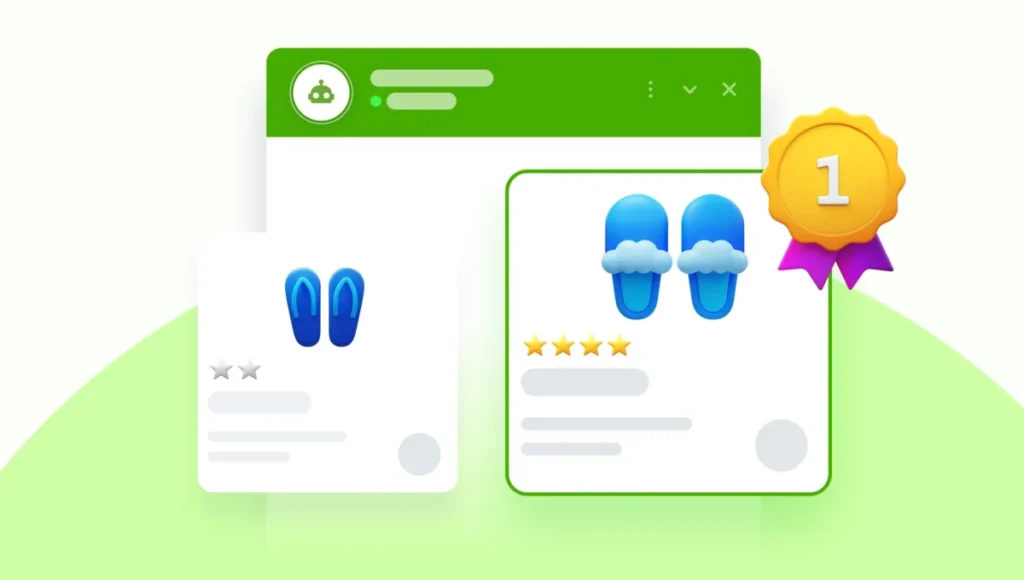
Amazon attributes 35% of total revenue to AI-driven recommendations. At small-business scale, AI chatbots generate 15–25% cross-sell revenue increases by surfacing the right product at the exact moment of highest intent — during active conversation, not a follow-up email.
15–25% cross-sell revenue increaseInstant Lead Qualification
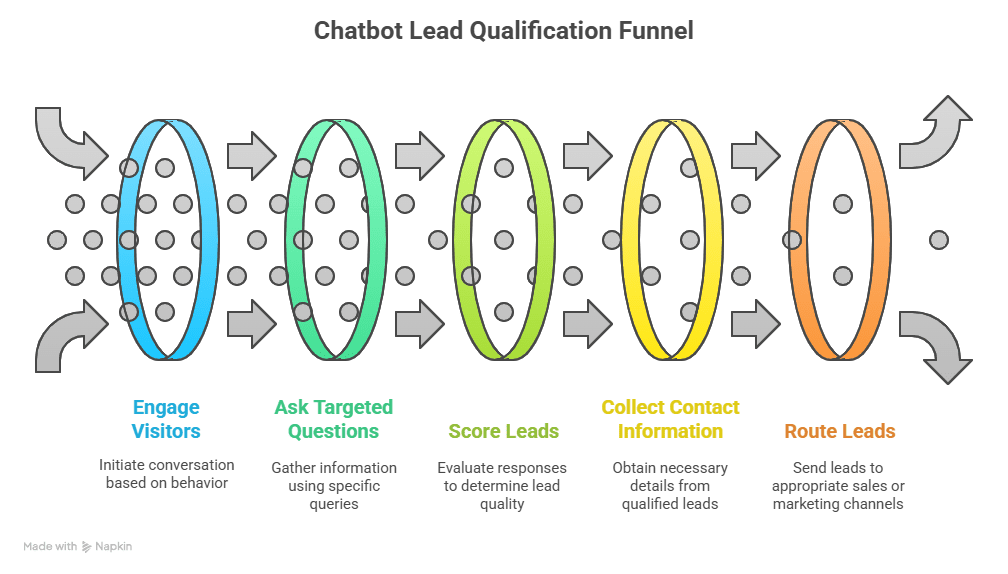
Sales reps spend 50% of working hours on unqualified leads (Salesforce). An AI chatbot running BANT qualification (Budget, Authority, Need, Timeline) filters that before a human ever touches the prospect. B2B chatbot funnels convert at 2.4× the rate of static web forms.
2.4× conversion vs. static formsRetention & Repeat Purchase Loops
Repeat customers represent 8% of visitors but 40%+ of sales. AI chatbots close that loop proactively — refill reminders, repurchase prompts, loyalty triggers. One DTC skincare brand using AI chatbot refill reminders saw a 34% higher repeat purchase rate among chatbot-engaged users.
+34% repeat purchase rate (DTC case)The Math Most Articles Don’t Show You
The industry talks ROI in percentages. That’s useful for comparison but obscures the actual mechanics. Let’s do it with numbers from documented 2026 deployments.
The DTC skincare brand I mentioned at the top — $47K additional monthly revenue by month four — breaks down to three mechanisms firing simultaneously. Cart recovery ($18K) was the biggest single line item. After-hours conversions ($15K) was essentially pure added revenue that didn’t exist before deployment. Upsells ($14K) came from the chatbot surfacing bundle recommendations the human support team never had time to offer consistently.
The chatbot cost under $200/month. The payback period on initial setup was 11 days.
What “Without Hiring Staff” Actually Means in Practice
The operational difference between businesses that deploy AI chat and those that don’t — at 11pm on a Tuesday.
The “no new hires” claim deserves precision. AI chatbots don’t eliminate the need for human staff. What they eliminate is the need to hire entry-level, high-volume, repetitive-task staff — the people your business would otherwise need to handle inquiry volume that scales with traffic. When your ad spend doubles next quarter and inbound inquiries double with it, the chatbot absorbs that volume at the same monthly cost. A human team requires two more salaries.
This is the actual staffing math: AI handles volume scaling; humans handle complexity and relationship. Businesses that understand this distinction find they need better-caliber staff (account managers, closers, strategic partners), not more of them. That’s a fundamentally different cost structure from traditional service models — and a better one.
The numbers that make this real: AI chatbots are capable of completing 70% of conversations autonomously. That 70% — routine inquiries, FAQ, qualification, basic support — is exactly what keeps customer service teams from doing higher-value work. A team of three handling 300 inquiries/week, with AI absorbing 210 of them, isn’t a team of three anymore. It’s a team of three operating at 4× effectiveness.
Revenue Impact by Industry: Where the Numbers Are Actually Coming From
Aggregated statistics hide more than they reveal. The revenue impact of an AI chatbot is sharply different depending on your business model, ticket value, and the nature of your customer interaction. Here’s where the documented ROI is most concentrated as of mid-2026:
| Industry | Primary Revenue Mechanism | Documented Impact | Key Data Point |
|---|---|---|---|
| E-commerce / DTC | Cart recovery + upsells | $47K additional MRR (case) | 20–35% cart recovery vs. 5–8% email |
| Home Services (HVAC, plumbing) | After-hours booking | $170K new revenue (case) | Booking rate 10% → 70%+ (Avoca AI, 2025) |
| B2B SaaS | Lead qualification + demos booked | 2–4× conversion rate | 55% more high-quality leads vs. static forms |
| Real Estate | 24/7 inquiry response + scheduling | Response time: hours → 5 seconds | 89% of buyers prefer messaging over phone |
| Healthcare / Services | Appointment booking + follow-up | 60% admin cost reduction | 68% of organizations integrating AI (2026) |
| Telecom / Subscription | Upsell at churn risk moment | +20% ancillary revenue (Ryanair model) | NLP-driven upsell: +25% sales (IBM Watson data) |
Home services deserve a specific note because the numbers look almost fictional. Top Flight Electric replaced after-hours call handling with AI and went from a 10% to a 70%+ booking rate, unlocking $170K in new annual revenue. Aire Serv went from 58 to 208 after-hours bookings using an AI voice agent, hitting a 90% booking rate. These aren’t optimization-tier improvements. These are structural transformations in revenue capture that were physically impossible before AI voice and chat agents became available at this price point.
Want to know which AI tools are driving this growth?
Trendix tracks the AI platforms generating the highest documented revenue outcomes in 2026 — updated monthly.
The Setup Reality: What Most Guides Skip Over
Revenue lift typically accelerates after month 2–3 as the model learns your specific customers, products, and edge cases.
Most implementations fail in the first 60 days — not because the technology doesn’t work, but because the business treats setup like installing a light switch instead of training a new team member. A few things that are genuinely true and not covered in vendor documentation:
Your knowledge base is the product. The chatbot is only as good as the information you feed it — product specs, return policies, FAQs, pricing edge cases, shipping details. Platforms that use RAG (Retrieval-Augmented Generation) backed by well-structured knowledge bases now achieve 95–98% accuracy with near-zero hallucination rates. That accuracy requires investment in structured documentation upfront. Budget a week for it.
Escalation design matters more than conversation design. The 30% of cases that require human intervention need to transfer seamlessly — with full conversation context, cart contents, and stated objections intact. The chatbots that frustrate customers are the ones that end a conversation with “please contact support,” requiring the customer to repeat everything they’ve already typed. This is a configuration choice, not a technology limitation.
The first month is data collection, not revenue optimization. Expect your first 30 days to surface the questions your knowledge base doesn’t answer, the edge cases your flows don’t handle, and the objections you didn’t anticipate. Build a weekly review into your calendar. The businesses reporting 340% first-year ROI are almost universally the ones that treated month one as an iteration sprint.
Cost Structure in 2026
LLM inference costs have collapsed since 2024. GPT-4 class inference that cost $0.03 per 1,000 tokens in 2024 now costs a fraction of that, making AI chatbots economically accessible to businesses with single-digit staff counts. Realistic 2026 pricing:
| Business Size | Monthly Cost | Setup Cost (one-time) | Typical Payback |
|---|---|---|---|
| 1–5 employees | $100–300/mo | $50–$1,000 (DIY) | 30–45 days |
| 5–20 employees | $300–800/mo | $1,000–4,000 | 45–60 days |
| 20–50 employees | $800–2,500/mo | $3,000–8,000 | 60–90 days |
The Failure Mode That Kills 40% of Deployments
Here’s something I haven’t seen covered honestly in any chatbot vendor’s documentation: the most common reason a business sees no measurable revenue impact from an AI chatbot is not the technology. It’s placement.
A chatbot placed only on the contact page — the digital equivalent of putting your best salesperson in the basement — will generate modest lead capture and nothing else. The same chatbot, deployed on the pricing page (where intent is highest), the cart page (where abandonment happens), the product pages (where recommendations add value), and triggered by 30 seconds of engagement or scroll-depth signals — generates orders of magnitude more revenue.
This is not a nuance. It’s the primary variable separating businesses that report $200/month chatbot cost → $47K monthly revenue from businesses that report “the chatbot didn’t really do much.”
What Actually Happens at 3am
The 24/7 availability story gets told abstractly. Here’s the concrete version: 37% of online shopping happens between 9pm and 9am. For B2B inquiries, 42% of demo requests and contact form submissions arrive outside business hours (Drift, internal data). That’s not a tail of your traffic. That’s nearly half of it arriving when no one is there.
The revenue loss from slow follow-up is not abstract either. Research across B2B sales cycles consistently shows that responding to a lead within 5 minutes makes qualification 100× more likely than responding within 30 minutes. By 14 hours — the average human response time — a meaningful percentage of those leads have already made a decision elsewhere. They didn’t wait. They found a competitor whose chatbot answered in 5 seconds.
For high-ticket industries, this matters enormously. In real estate, where a single missed inquiry can represent $8,000–$18,000 in lost commission, a 5-second AI response at 11pm isn’t a nice-to-have. It’s the entire game. The same logic applies to home services emergency calls, B2B SaaS demos, and any industry where the first responder wins an outsized share of transactions.
A constraint that matters: AI chatbots don’t eliminate the need for human judgment on complex deals. The 30% of conversations they can’t fully resolve still need people. But those people arrive at 9am with full conversation context, a qualified lead, and a customer who already feels heard — which is a completely different starting point than a cold contact form in an overflowing inbox.
Which Platform You Choose Changes the Revenue Outcome
There’s a meaningful performance gap between platforms as of 2026, but it’s not where most articles place it. The difference isn’t primarily AI model quality — most platforms now use GPT-4 class models or equivalent. The differences that actually affect revenue are: native integration depth (Shopify, HubSpot, Salesforce), RAG knowledge base implementation quality, and the flexibility of trigger logic and conversation flows.
| Platform | Best For | Standout Revenue Feature | Notable Limitation |
|---|---|---|---|
| Tidio | E-commerce SMBs | 67% AI resolution rate; Shopify-native upsells | Limited B2B qualification flows |
| Intercom | SaaS / enterprise | Proven ROI track record; deep CRM sync | Higher pricing floor ($~74/mo) |
| Drift (now Salesloft) | B2B lead qualification | Playbook system with behavior-based branching | Steep learning curve; setup-intensive |
| Alhena AI | DTC brands | Tatcha: 3× conversion, +38% AOV documented | Less suited to B2B workflows |
| Oscar Chat | E-commerce cart recovery | Multi-channel cart recovery with Shopify sync | Newer platform; less long-term data |
The selection criteria that actually matter: What percentage of your revenue-generating conversations happen on your website vs. other channels? If significant business comes through WhatsApp, Instagram DM, or SMS, you need a platform with genuine omnichannel support — not just a widget on your site. By 2026, 45% of new chatbot deployments include voice capabilities, and 78% are expected to by end of year. Voice AI is no longer optional for home services, healthcare scheduling, or any business where customers call first.
Questions That Come Up Repeatedly
The Real Question
The market is not waiting for a consensus to form. 91% of small businesses using AI report revenue increases. The gap between businesses that have deployed this infrastructure and businesses that haven’t is widening — not because the technology is getting more expensive or harder to access, but because the compounding nature of AI that learns from conversations means early deployers are building a proprietary advantage that late deployers can’t buy their way into overnight.
The honest version of this: if you deploy a chatbot in the next 90 days and configure it properly across all five revenue mechanisms, you will almost certainly see positive ROI within the first month. If you deploy it only on the contact page and never update the knowledge base, you’ll conclude that chatbots don’t work — and you’ll be right, for your deployment.
The technology works. The configuration is what determines whether you’re the business with $47K additional monthly revenue, or the one that tried a chatbot and “didn’t really see results.”
The uncomfortable implication: If your primary objection to deploying this is cost, the actual barrier is the 20–40 hours of upfront configuration work. The monthly subscription is rarely the friction point. Treat it like a hire that requires onboarding, and staff it accordingly — at least through month two.
Track the AI tools generating the highest revenue in 2026
Trendix monitors documented AI tool outcomes — no affiliate rankings, just performance data.