

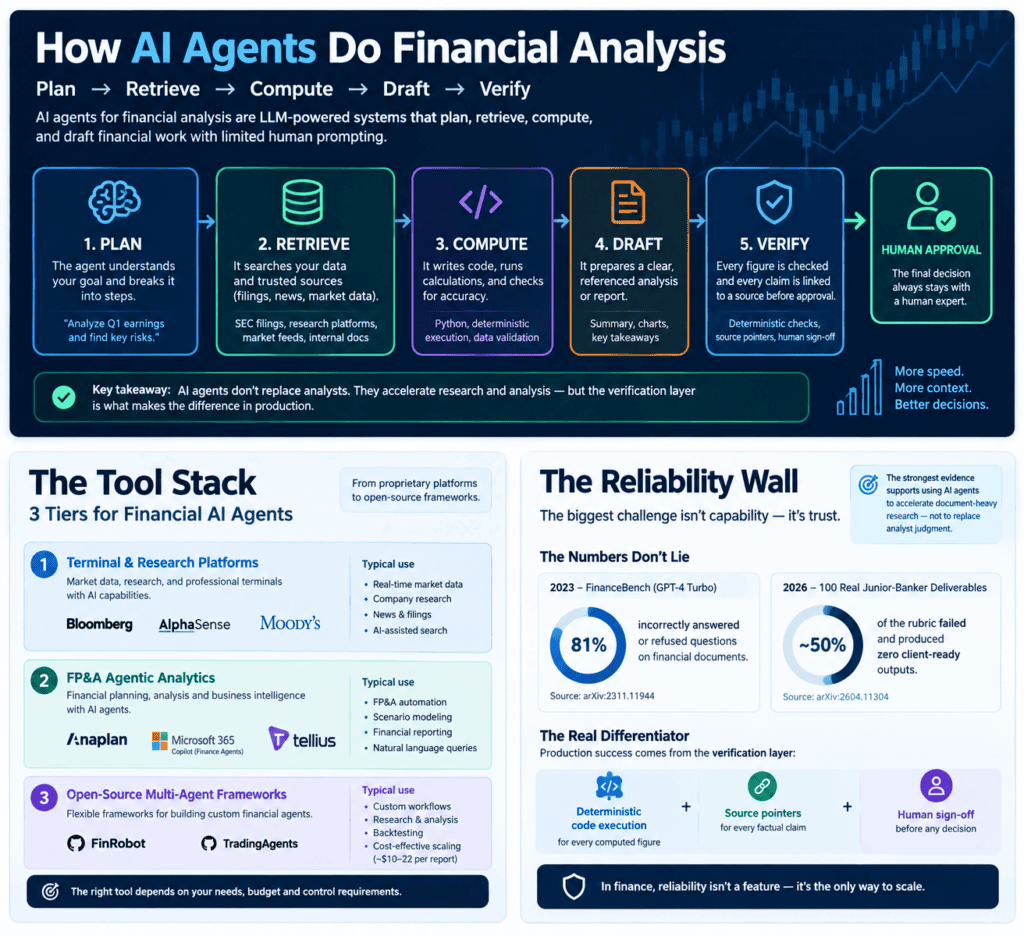
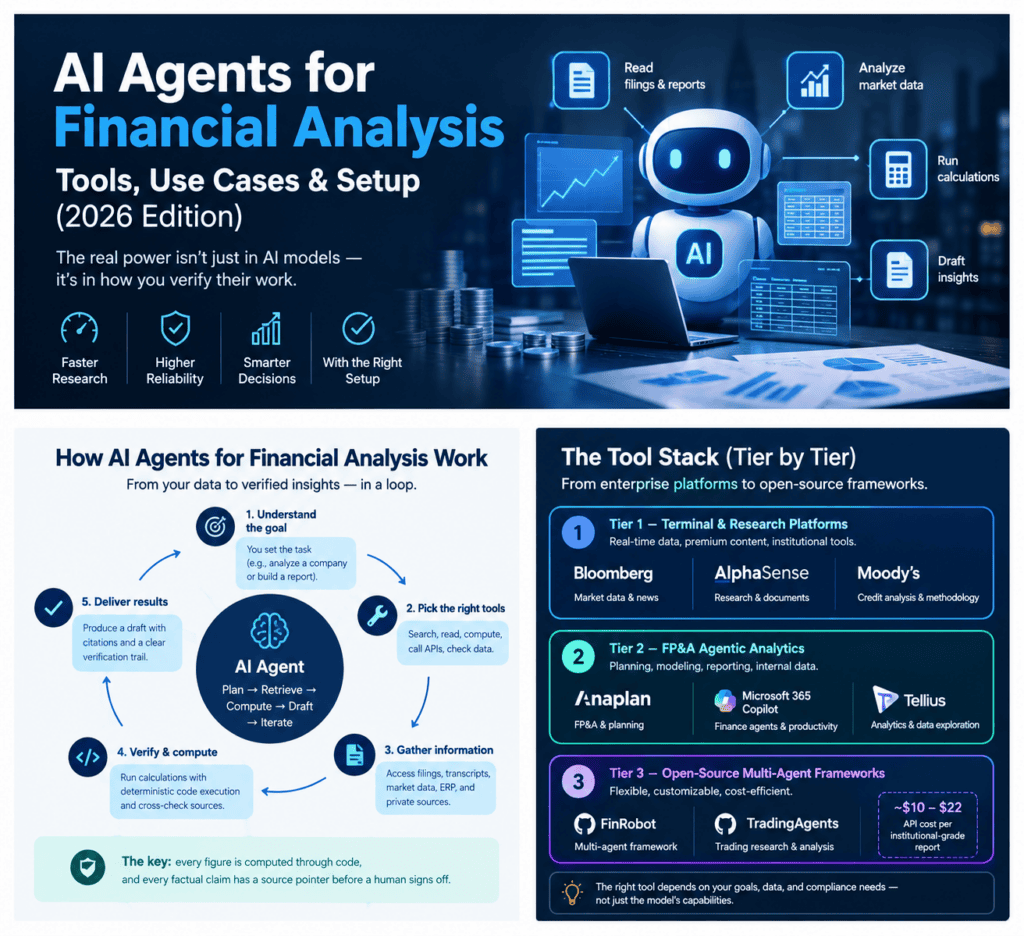
AI agents for financial analysis are LLM-powered systems that plan, retrieve, compute, and draft financial work with limited human prompting. The strongest evidence supports using them to accelerate document-heavy research — not to replace analyst judgment. Production deployments are defined by their verification layer, not their model.
TL;DR
- Reliability, not raw capability, is the bottleneck. A GPT-4-class system incorrectly answered or refused 81% of questions on a 2023 finance benchmark. On the hardest 2026 end-to-end test — 100 real junior-banker deliverables graded by 502 practicing bankers — the best model tested still failed nearly half the rubric and produced zero client-ready outputs.
- Three tool tiers exist today: terminal and research platforms (Bloomberg, AlphaSense, Moody’s), FP&A agentic analytics (Anaplan, Microsoft 365 Copilot finance agents, Tellius), and open-source multi-agent frameworks (FinRobot, TradingAgents) runnable for roughly $10–22 of API cost per institutional-grade report.
- The architectural differentiator is the verification surface: serious deployments route every computed figure through deterministic code execution and every factual claim through a source pointer before a human signs off.
- Autonomous trade execution in live markets has no published production evidence. Every credible framework remains in research or analyst-assist mode.
- Model versions in this space move fast. Where this piece names a specific model and score, it’s date-stamped — check the linked source before you cite it anywhere that matters.
Table of contents
- What an AI agent for financial analysis actually does
- Where the evidence is strong
- The reliability wall
- The tool stack, tier by tier
- Use cases: deploy, pilot, or avoid
- The setup guide
- Myth vs. fact
- Where this could be wrong
- FAQ
In 2023, a benchmark called FinanceBench handed GPT-4 Turbo a retrieval system and a set of questions about corporate filings. The best configuration of the era incorrectly answered or refused 81% of them. Three years on, Bloomberg has put a coordinated network of AI agents directly inside the Terminal, Moody’s has turned its credit methodology into a portable AI skill library, and Anthropic shared a New York stage with JPMorgan CEO Jamie Dimon to launch ten named finance agents. The capability curve is real.
The question a CFO or fund manager should ask hasn’t moved, though. It was never “how smart is the agent?” It’s “what happens at 6 a.m. when it’s confidently wrong and nobody’s watching?”
That question is what actually splits this market. Everything sold as an AI agent for financial analysis falls into one of two camps — systems built to be audited and systems built to be fast — and most coverage blurs the two together on purpose, because “fast” sells better. This piece separates them and gives you a setup sequence organized around the only metric that matters in production: how much of the agent’s output passes through deterministic checks before it can influence a decision.
What an AI agent for financial analysis actually does {#what-it-does}
Strip the marketing away and an agent is a loop. A large language model receives a goal, decides which tools to call, reads the results, and iterates until it produces an output or hits a limit. A chatbot answers from memory. An agent acts on an environment — in finance, that means your filings, transcripts, market feeds, and ERP tables, and the actions are retrieval, computation, and drafting.
Serious implementations add three things on top of the generic loop.
Tool grounding. The agent doesn’t do arithmetic itself; it writes code and a deterministic engine executes it. Calculation is a documented, stubborn weak point for language models — in one financial-document benchmark, seven of eight models failed more than half of all calculation tasks, and the best performer reached only 57% accuracy.
Retrieval over private corpora. Retrieval-augmented generation (RAG) grounds answers in your documents instead of model memory, and it works — but it isn’t free. One controlled evaluation found RAG lifted a mid-tier model’s financial-reasoning accuracy by 10 points while consuming roughly 18 times the tokens and 20 times the latency of an ungrounded answer. That’s one evaluation, not an industry constant — treat the multiplier as a planning heuristic, not a spec.
Role specialization. The most-cited research decomposes analysis into specialist agents. FinRobot, the open-source platform from the AI4Finance Foundation, organizes itself into a Financial AI Agents layer, an algorithms layer, an LLMOps/DataOps layer, and a multi-source foundation-model layer. TradingAgents, from UCLA researchers, simulates a trading firm — fundamental, sentiment, and technical analysts feed bull and bear researchers who debate, a risk-management team reviews exposure, and a fund manager signs off.
The chain you’re actually buying, in every case: input → retrieval and filtering → reasoning (LLM, role prompts) → deterministic tools for math, LLM for judgment → output → human review and logged corrections. If a vendor can’t describe their system this way, you’re looking at a chatbot wearing a finance costume.
Where the evidence is strong {#evidence-strong}
Measured against outcomes rather than slide decks: three clear wins, one tier worth watching, and one category where the evidence runs opposite to the marketing.
Document Q&A and research synthesis — the strongest, best-verified use case. This is where real adoption is happening. Bloomberg’s ASKB moved past simple summarization in 2026: it’s a coordinated network of agents inside the Terminal handling natural-language research, multi-step workflows like pre-earnings prep, and cross-referencing of filings, news, and analytics in one conversational pane, with Third Bridge’s 100,000-plus expert transcripts folded in as of its April roadmap. AlphaSense runs a parallel play with Deep Research and Workflow Agents that automate deliverables like company profiles. Both are vendor-reported on outcomes — nobody’s publishing independently audited accuracy numbers for either product yet.
Methodology encoding — the tier worth watching most closely. Moody’s ships named AI skills — Earnings Call Summary, Peer Analysis, Public Information Book, Rating Pitch, Sector Analysis — where each skill defines the analytical procedure and MCP servers connect it to Moody’s data. As of May 2026 that library is also available as an MCP app inside Claude, covering credit data on more than 600 million public and private companies. The interesting part is architectural: value sits in the encoded methodology rather than the model underneath it, so the same skill runs on whichever AI platform a client already pays for. The catch is access — Moody’s content requires an existing client relationship, so this tier rewards incumbents.
Anthropic’s finance push — the largest single foundation-model bet in this space, as of its May 2026 launch. On May 5, 2026, at an invite-only briefing in New York with Jamie Dimon on stage, Anthropic launched ten ready-to-run agent templates for banking, asset management, insurance, and financial operations — pitchbook building, KYC screening, valuation review, financial-model maintenance, month-end close, earnings reviews — deployable inside Claude Cowork and Claude Code, running on Claude’s then-current Opus model. The same announcement made Claude’s Microsoft 365 add-ins generally available across Excel, PowerPoint, and Word, added the Moody’s MCP app, and expanded data connectors to FactSet, S&P Capital IQ, MSCI, PitchBook, Morningstar, and others. Separately, FIS announced it’s co-building a financial-crimes agent with Anthropic, with BMO and Amalgamated Bank named as early deployment partners.
A freshness note, in the spirit of this article’s own argument: Anthropic has shipped multiple model generations since that May launch. Don’t anchor a procurement decision on a specific named model from a press event — check which model currently powers whatever finance-agent product you’re evaluating, since the underlying model is routinely upgraded without the product name changing.
On raw agentic capability, one useful and genuinely current data point: on Vals AI’s Finance Agent v2 leaderboard, snapshotted September 10, 2026, Gemini 3.8 Flash leads the published board at 61.4%, with the top ten models clustered in roughly a 4-point band. Earlier in 2026, under an older version of the same benchmark, a leading Claude model had been reported at a similar score in the low-to-mid 60s — the exact number moved as the benchmark itself was revised to v2 and new models entered. That instability is the point: which benchmark version a vendor cites, and when it was run, tells you as much as the number does. Treat any single-number claim on this specific benchmark as good for a few weeks, not a year.
Draft valuation and research reports — first drafts, with one lineage caveat. FinRobot’s desktop release runs a lead agent, five pipeline agents (data, analysis, modeling, synthesis, reporting), and three debate agents — bull, bear, judge — across pipelines including DCF, comps, LBO, DDM, and IC-memo generation. Where I’ll flag genuine uncertainty: published secondary coverage describes FinRobot’s evolution as AutoGen → OpenAI Agents SDK → a PydanticAI-based desktop app, but the project’s own GitHub repository traces a different lineage. Treat the exact version history as directional, not settled, and verify against the current repo before citing it. One secondary, non-peer-reviewed benchmark put FinRobot strongest on valuation tasks (75%) and FinGPT strongest on statement analysis (86%); a single unreviewed source is a data point, not a fact.
Trading — where the evidence runs out. TradingAgents reports backtested improvements in cumulative return, Sharpe ratio, and drawdown — but the authors themselves list live deployment as future work. A good backtest from LLM debate is a research finding. It is not, yet, an investment strategy.
The reliability wall {#reliability-wall}
If you take one thing from this article, take this: current systems fail in repeatable, predictable ways, and the newest benchmarks make the gap between “impressive demo” and “usable in production” harder to paper over than it was even a year ago.
Numerical fabrication. On a 2026 hallucination-focused benchmark, GPT-family models produced the highest frequency of fabricated financial values among the systems tested; Claude mostly avoided errors by refusing to answer rather than by being right. That particular benchmark was built by a commercial vendor whose own product tops every metric in the same report, so treat the framing as directionally useful, not neutral. A separate, less commercially entangled 2026 study found four of six leading models fabricated financial data when source documents had gaps — and the fabricated output looked clean, professional, and fully formatted. Indistinguishable from accurate work by appearance alone.
Cross-document drift. Single-document Q&A is largely solved. Comparison across documents is not. The Fin-RATE benchmark evaluated 17 LLMs on SEC filings and found accuracy dropped 14–19% moving from single-document reasoning to cross-entity and longitudinal tracking, driven mostly by comparison hallucinations and entity mismatches. That’s precisely the task analysts value most — “how has leverage evolved against peers” — and precisely where agents are weakest.
The end-to-end wall. BankerToolBench, published in April 2026 and built with 502 practicing investment bankers from firms including Goldman Sachs, JPMorgan, and Evercore, tests agents on 100 real junior-banker workflows — building financial models, preparing pitch decks, writing memos — each scored against an average of 150 expert-authored rubric criteria, with human completion time running up to 21 hours per task. Tested against nine frontier models, the best performer scored 58.1% on average, and the bankers grading the outputs rated zero percent of them as client-ready. That’s not a knock on any one model; every frontier system tested fell short — and it’s the clearest evidence yet that Q&A-style benchmark scores and real deliverable quality measure two different things.
Silent extrapolation. Agents fill gaps. Some disclose the fill; most don’t. The mitigation pattern worth copying is the attribution model Bloomberg and ASKB both use: every AI-generated answer carries explicit sourcing back to a document, dataset, or the analyst who authored the underlying content.
Access control with data-freshness stamps, deterministic recomputation of every number, and human sign-off with a decision log: those three gates are this article’s thesis. A production system you can’t describe in those three gates isn’t ready for financial analysis, whatever its benchmark scores say.
The tool stack, tier by tier {#tool-stack}
Vendors blur these lines on purpose. Here’s the map by what the tools actually are, not how they’re positioned.
| Tier | Examples | What it actually buys | Indicative cost | Main hidden cost |
|---|---|---|---|---|
| Terminal / research | Bloomberg ASKB, AlphaSense, Moody’s skills | Content moat + attribution discipline | Enterprise contract, unpublished | Lock-in to proprietary corpora |
| FP&A agentic analytics | Anaplan agents, M365 Copilot finance agents, Tellius | Variance and workflow automation inside a boundary | ~$30/user/mo (Copilot) to $150K+/yr (Anaplan) | Cross-system root cause stays manual |
| Open-source frameworks | FinRobot, TradingAgents | Auditable multi-agent pipelines, full control | ~$10–22 API cost per full research report | You build governance yourself |
| Foundation-model native | Anthropic finance agents, custom GPTs | Named workflow templates, fastest deployment | API/subscription, metered | Silent extrapolation risk without your own audit trail |
Tier 1 — Terminal and research platforms. Bloomberg’s ASKB and AlphaSense are incumbent research aggregators adding agentic layers on top of proprietary content moats. Moody’s skill library is the methodological bet: domain expertise as portable infrastructure instead of a single product. Reach for this tier when your bottleneck is access to content, and your outputs face clients or regulators. Pricing is unpublished and relationship-gated.
Tier 2 — FP&A and agentic analytics. Anaplan ships a Finance Analyst Agent and Agent Studio, with autonomous anomaly-detection agents on its 2026 roadmap but not yet in production; enterprise implementations reportedly run into six figures annually over multi-month timelines by vendor- and analyst-reported figures — treat that as directional, since neither party publishes audited numbers. Microsoft’s Copilot finance agents ride an existing license at a per-seat monthly price plus an ERP bridge — the cheapest credible entry point, and the most bounded, since they work from spreadsheet context without a finance-native semantic layer underneath. Purpose-built variance-investigation platforms, Tellius’s Kaiya among them, automate root-cause decomposition across connected sources. This tier shares one structural limit, admitted even by its own vendors: agents flag what changed inside their platform reliably; decomposing why across multiple sources with quantified attribution stays manual work.
Tier 3 — Open-source multi-agent frameworks. FinRobot and TradingAgents anchor this tier — auditable, controllable pipelines with data providers spanning FMP, Finnhub, yfinance, and SEC EDGAR with failover. TradingAgents is deployable on API credits alone, no GPU required. What you’re buying is control and auditability; what it costs is engineering time and the discipline to build your own verification gates, because nobody ships them for you.
Tier 4 — Foundation-model native agents. As of May 2026 this is no longer “DIY on a base model” — Anthropic packaged ten named agent templates (Pitch Builder, Earnings Reviewer, Model Builder, KYC Screener, and six others) covering core banking, asset-management, and back-office workflows, running inside Claude Cowork, Claude Code, and Microsoft 365 with shared context across Excel, PowerPoint, and Word. OpenAI’s custom GPTs remain the lighter-weight option for recurring document-review chores. Which specific Claude model powers this stack has changed since launch and will keep changing — check current documentation before you cite a model name in a procurement doc. The trade-off hasn’t changed: flexible and fast to start, and you own effectively all of the verification burden yourself.
Use cases: deploy, pilot, or avoid {#use-cases}
Deploy now — earnings and filing analysis. Summarization, metric extraction, and cross-questioning of transcripts and 10-Ks is where accuracy is highest and verification is cheapest, since every claim maps to a page. Your control is source-level citation on every figure, no exceptions.
Deploy now — first-draft research and valuation pipelines. FinRobot’s pipelines (DCF, comps, LBO, DDM, IC memos) produce reviewable drafts. The rule that makes this safe: the LLM interprets, code computes, and the analyst owns the assumptions list. Break that rule and you inherit the sub-60% calculation record of raw models on finance-document benchmarks.
Deploy with care — credit research and peer comparison. Moody’s-style encoded methodology helps, but Fin-RATE’s finding still applies: cross-entity comparison is exactly where models degrade. Treat peer sets as high-risk outputs that need spot re-derivation, not as a finished product.
Pilot, don’t roll out — autonomous monitoring agents. 24/7 KPI watchers that investigate anomalies unprompted are commercially available now — Tellius Agent Mode, Domo agents among them. The number nobody publishes is the false-positive rate and alert fatigue at scale. Run a bounded pilot and measure alert precision yourself before you trust the watchtower.
Do not deploy — unattended trading. Every multi-agent trading framework in the published literature is backtested research. TradingAgents lists live deployment as future work. There’s no peer-reviewed evidence of autonomous LLM agents executing in live markets at institutional scale. BankerToolBench’s headline number — zero percent client-ready, from the best model tested, in a domain with far lower stakes per error than live trading — is a reasonable proxy for how much unsupervised trust any of these systems have earned so far.
The setup guide: five steps, ordered by risk {#setup-guide}
Step 1 — Classify your decisions by blast radius before you touch a single tool. Tier A outputs leave the building — client reports, regulatory filings, IC materials. Buy Tier 1 platforms with built-in attribution and enforce dual review. Tier B informs internal decisions: Tier 2 or a hybrid. Tier C is exploration: open source and DIY, freely. This classification should drive procurement, not a feature checklist, because the cost of a wrong number scales with where it travels.
Step 2 — Choose the stack per tier, and default to hybrid. The strongest real-world pattern is Tier 1 or 2 for content and distribution, with Tier 3 pipelines for the bespoke analysis platforms don’t do. Pure DIY at Tier A is an audit finding waiting to happen. Pure platform spend at Tier C is money spent on governance you didn’t need.
Step 3 — Build the data layer with freshness as a first-class field. Map your sources — EDGAR is free and machine-readable, transcripts and market data come via API, internal data via warehouse connectors. Stamp every retrieved item with retrieval time and source version. Financial data expires silently, and an agent reasoning over last quarter’s debt schedule against this quarter’s price is exactly how entity-mismatch errors start. Budget for the RAG cost curve too — retrieve deliberately, not greedily.
Step 4 — Enforce deterministic compute and provenance, with no exceptions. Wire a code-execution tool as the default path for any arithmetic, ratio, or aggregation, and forbid the model from emitting a computed number it can’t point to a script for. Then require inline citations on every factual claim — Bloomberg’s and ASKB’s attribution pattern is the reference implementation worth copying wholesale. If an output can’t show its work, it doesn’t ship.
Step 5 — Close the loop with governance. Human sign-off on Tier A and B outputs, a decision log recording who approved what and when, and a standing re-verification calendar. Benchmark figures, model versions, and product capabilities in this space have a shelf life measured in months — the leaderboard chart above will likely look dated within a couple of model release cycles. Run your own corpus evaluation and never trust a public leaderboard on its own; several published analyses flag data-contamination risk across finance benchmarks generally.
What it costs. Anchoring on published per-run benchmark figures for a mid-tier model and a frontier model, and assuming roughly five billable deep-reasoning passes per institutional-grade report (data prep, two to three specialist analyses, one debate-and-synthesis pass), a full multi-agent research report costs somewhere in the neighborhood of $10–22 in API spend — call it $2,500–$5,500 a year at one report per business day, before market-data subscriptions. This is a planning estimate built on a five-pass assumption I chose, not a measured production average. Set it against roughly $300–360 per user per year for Copilot finance agents, six figures for enterprise planning platforms, or five figures per terminal seat, and the arithmetic favors open pipelines for volume analysis and platforms for content access. That’s the actual case for going hybrid — not a preference, a spreadsheet.
Myth vs. fact {#myth-fact}
| Myth | Fact |
|---|---|
| High benchmark scores mean an agent is production-ready. | Simple-Q&A scores in the high 80s and full-deliverable scores like BankerToolBench’s 58.1% (0% client-ready) measure different things. Ask which benchmark a number came from before trusting it. |
| AI agents can already replace junior analysts. | The best-tested model on the hardest 2026 benchmark produced zero client-ready deliverables. Agents replace hours inside a workflow an analyst still owns. |
| More retrieved sources always make an answer safer. | RAG measurably reduces hallucination but costs materially more tokens and latency — and doesn’t eliminate fabrication when source documents have gaps. |
| Autonomous trading agents are already running live. | No credible framework has published live-market production evidence. Every serious system remains backtested research or analyst-assist only. |
| Open-source is always the cheap option. | API cost is genuinely low (~$10–22/report), but you absorb all the engineering time and governance-building that platforms otherwise provide. |
Where this could be wrong {#where-wrong}
Three deployment profiles should stop at the pilot stage. Small teams without data engineering will spend more time fixing connectors than analyzing — FinRobot’s provider-failover logic exists precisely because individual data APIs fail — and a managed Tier 2 tool will return value faster for them. Anyone in a non-English market should verify language coverage explicitly; FinRobot pairs Llama-class models for US markets with ChatGLM for Chinese markets, which is itself a signal that English-tuned agents don’t generalize for free. And teams expecting the agent to know what it doesn’t know will be disappointed — hallucination resistance varies sharply by model family, and the safest systems often work by refusing, so your workflow has to tolerate “data not available” as a valid, even preferred, answer.
Cold-start conditions deserve one honest note too: agents perform worst exactly where you have the least history — new issuers, thin filings, recent IPOs, private companies. There’s no retrieval fix for data that doesn’t exist. Only refusal behavior, or your own judgment, stands between a gap and a fabricated figure.
And a genuine limitation of this article itself: the $10–22 per-report cost estimate rests on a five-pass assumption I chose, not a measured production average. The benchmark numbers cited throughout are snapshots — several are already superseded by newer leaderboard runs by the time you’re reading this, which is exactly the instability this piece argues you should plan around rather than be surprised by.
Bottom line
The market has split into audited systems and fast systems, and the buyers getting real value know which one they’re paying for on any given decision. The evidence supports aggressive adoption for research acceleration — summarization, drafting, screening, structured comparison with recomputation — and supports exactly zero unattended authority over capital or client-facing deliverables without a human in the loop. Build the three gates, classify decisions by blast radius, and make the agent earn autonomy one verified output at a time.
Start this week by pulling your last twenty analyses and sorting each into Tier A, B, or C. Then check whether the tool you used actually matched the tier. That gap is your roadmap.
FAQ {#faq}
Do AI agents replace financial analysts? Not on current evidence — the best-tested model in the hardest 2026 benchmark produced zero client-ready deliverables. They replace hours inside a workflow an analyst still owns and signs off on.
Which is more accurate, Bloomberg’s ASKB or a custom-built agent? Neither is independently audited yet. ASKB has a proprietary content moat and Bloomberg’s attribution discipline; a custom pipeline gives you visibility into every step, at the cost of building the governance yourself.
Can I trust an agent’s calculations without checking them? No. Even top models fail more than half of calculation tasks in some benchmarks. Route every number through deterministic code execution, not the model’s own arithmetic.
Is it safe to let an agent trade autonomously? No credible framework has published live-market production evidence as of this writing; every serious system remains backtested research or analyst-assist only.
How often should I re-verify the tools in this space? Every 3–6 months at minimum. Model versions, benchmark leaderboards, and vendor pricing in agentic finance all shift on a quarterly cycle, not an annual one — this piece includes a specific benchmark, Vals AI’s Finance Agent v2, that reshuffled its leader between two snapshots taken months apart.
Why do benchmark scores for the same task vary so wildly between sources? Because “the same task” usually isn’t. Simple document Q&A, agentic multi-step reasoning, and full end-to-end deliverables are three different measurement regimes with three different difficulty floors — and even a single named benchmark gets revised (v1 to v2) in ways that make cross-time comparisons unreliable without a date stamp.
How this was verified
Every named benchmark and product claim in this piece was checked against a primary source as of September 15, 2026: FinanceBench and BankerToolBench against their arXiv pages, FinRobot and TradingAgents against their GitHub repositories, the Anthropic financial-services launch against contemporaneous coverage of the May 5, 2026 event, and the Vals AI Finance Agent v2 standing against the live leaderboard’s September 10, 2026 snapshot. Two figures remain explicitly self-derived rather than measured and are flagged as such in the text: the $10–22 per-report cost estimate (a five-pass assumption I chose) and the FinRobot version-history lineage (secondary coverage and the project’s own repo don’t fully agree). Where a stat came from a vendor with a commercial stake in the outcome — the hallucination benchmark in the reliability section — that’s disclosed at the point of use, not buried in a footnote. Model names tied to specific benchmark scores are date-stamped throughout, because the underlying leaderboard has already reshuffled once during this piece’s own reporting window.
Tom Morgan tracks agentic AI deployment in capital markets and rebuilds comparisons like this one whenever a benchmark or vendor claim materially shifts — this version corrects an earlier draft’s stale model references and an unverified benchmark claim following a September 2026 review. No tools mentioned here are sponsored. Scope limitation: sourcing skews toward US public markets and English-language vendor disclosures; coverage of EU/APAC deployments and non-English tooling is thinner.