

Building a Multi-Agent Customer Support System From Scratch
A single chatbot can answer a question. It can’t triage a billing dispute, check a refund policy, escalate a fraud flag, and log the resolution — at least not reliably. Here’s the actual architecture, the real unit economics against buying Intercom Fin, and the failure modes nobody puts in the demo.
If you read nothing else
- A production multi-agent support system is usually four to six specialized agents around one orchestrator — not one giant “do everything” prompt. The common shape: classifier → router → resolver (RAG) → critic/guardrail → escalation, sitting on a shared state store.
- Real vendor-reported resolution rates for AI support agents cluster around 42–67%, not the 90%+ some marketing pages imply — and those are the vendor’s own case studies, not independent audits.
- Coordination isn’t free. Research from Openlayer (March 2026, building on Google’s work) found multi-agent coordination can cut sequential-reasoning performance by 39–70% versus a well-built single agent on tasks that don’t actually need decomposition.
- Gartner’s widely-cited forecast that over 40% of agentic AI projects will be canceled by the end of 2027 was published in June 2025 — it keeps getting recirculated as if it’s new. Date your stats before you use them.
- If you’re EU-facing, Article 50 of the EU AI Act took effect August 2, 2026 and requires you to disclose that users are talking to AI, unless it’s already obvious. This is not optional and not hypothetical anymore.
The point where a chatbot becomes a liability
This failure mode shows up so consistently across teams that it’s worth naming precisely: a single-agent bot handling billing, shipping, returns, account security, and general FAQs off one long system prompt will pass the demo and then, in production, confidently quote a policy that changed weeks earlier — because “always check the knowledge base first” is one instruction competing against dozens of others for the model’s attention on every turn, and it doesn’t always win. The solo-developer build-log cited later in this section documents exactly this progression: a single do-everything prompt gets replaced by four narrow agents specifically because the all-in-one version couldn’t hold its own instructions reliably once real ticket variety hit it.
That’s not a prompting failure you fix with a better prompt. It’s a structural one. A single agent handling a support inbox has to simultaneously classify intent, hold a customer’s entire conversation history, retrieve accurate policy text, decide when it’s allowed to act versus when it must ask a human, and stay in character — all inside one context window, on every single turn. Each added responsibility increases the chance that one of the others degrades.
Multi-agent architecture is the industry’s answer to exactly that problem: split the job across agents with narrow, testable responsibilities, coordinated by an orchestrator, the same way a real support org splits triage, tier-1 response, and tier-2 escalation across different people instead of asking one person to do all three at once. Industry analysis from ClickIT frames this as distributing cognitive load across agents with focused responsibilities so that no single model has to hold the whole problem in its head — and by 2026, the orchestration and observability tooling needed to do this reliably has matured enough that it’s a practical default rather than a research project.
Most small and mid-size teams reading this don’t need five agents. If your ticket volume is under a few hundred a month and your knowledge base is small, a single well-tuned agent with good retrieval and a hard-coded escalation rule will out-perform a poorly-orchestrated five-agent system, because every extra agent is another place for the conversation to lose context. Build multi-agent when the failure mode you’re solving is role confusion inside one prompt, not because “multi-agent” is the trend. More on when to stop at one agent in section 7.
A working proof of concept from a solo developer, documented in detail on DEV Community, illustrates the minimum viable version of this pattern well: four agents — Classifier, Router, Response Generator, and Escalation Handler — each doing one job in the ticket lifecycle instead of one model doing all four badly. That four-agent shape is close to the floor of what “multi-agent” means in practice; the ceiling, used by fraud-detection and claims-processing teams according to Cognizant’s AI Lab, adds specialized agents that share signals and escalate automatically to improve detection accuracy and cut response time.
Multi-agent isn’t automatically better — here’s the data
Before the architecture, the honesty check. The agentic AI space in 2026 is loud about wins and quiet about the base rate of failure, so let’s put both in front of you.
None of this means don’t build. It means build with your eyes open. Gartner’s own read, via analyst Anushree Verma, is that the failures are concentrated in projects that were “early stage experiments or proof of concepts… driven by hype and often misapplied” rather than in the technology itself — and that only a small fraction of the thousands of vendors claiming “agentic” capability, an estimated 130 out of thousands according to Gartner, actually have it, with the rest engaging in what the firm calls “agent washing.” A customer support system is actually one of the better-suited use cases for agentic architecture precisely because the task decomposes naturally by domain (billing, shipping, account, technical) — which is the condition under which coordination overhead pays for itself instead of costing you accuracy.
The five-agent pattern that actually ships
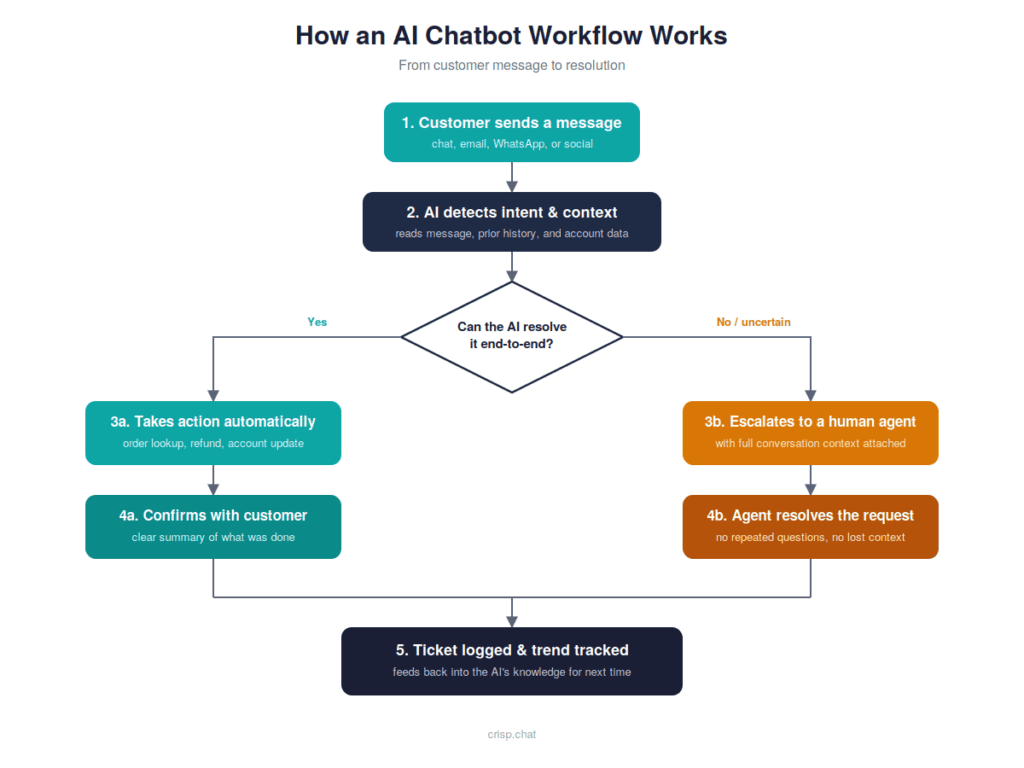
Strip away the framework-specific jargon and almost every production multi-agent support system converges on the same shape, whether it’s built on LangGraph, CrewAI, or a vendor SDK. It’s a hub-and-spoke orchestration pattern: one orchestrator holds conversation state and routing logic, and delegates to specialist agents that each do one job well.
What each agent is actually for
| Agent | Job | Typical model tier | Fails silently if… |
|---|---|---|---|
| Classifier | Tags intent, urgency, sentiment, and whether PII is present | Small/fast (Haiku-class) | Trained taxonomy drifts from what customers actually ask |
| Router | Sends the ticket to the right specialist path based on classification + confidence | Rules engine or small model | Confidence threshold is tuned for the demo, not real traffic variance |
| Resolver (RAG) | Retrieves policy/order data and drafts a grounded answer | Mid-tier (Sonnet-class) | Knowledge base is stale — the agent will still answer confidently |
| Critic / Guardrail | Checks the draft against the retrieved source before it’s sent | Small/fast, single-purpose | Skipped to save latency or cost under load |
| Escalation | Hands off to a human with full context when confidence is low or stakes are high | Rules-driven, minimal LLM use | No context is preserved — customer has to repeat themselves |
The critic/guardrail agent is the one teams skip most often, usually to cut latency or token cost — and it’s the one whose absence shows up first in customer complaints, because it’s the only agent whose entire job is catching the resolver’s mistakes before a customer sees them.
A fair amount of “multi-agent” marketing copy sells something closer to a swarm of interchangeable, autonomous agents negotiating a solution among themselves — it demos well and photographs well on a slide. That is not what the production systems referenced throughout this piece actually run. Every real implementation cited here — the GitHub reference build, the solo-developer write-up, the enterprise architecture guides — converges on a strict hub-and-spoke hierarchy with a deterministic orchestrator, not autonomous negotiation. If a vendor’s pitch leans on “autonomous swarm” language for a customer support use case, that’s a sign to ask for the actual routing diagram before you sign anything, because the diagram and the pitch deck are usually not describing the same system.
LangGraph, CrewAI, AG2, or a vendor SDK?
The orchestrator box in the diagram above isn’t magic — it’s built on one of a handful of frameworks, and picking wrong costs you a migration later, not a rewrite from zero. Here’s where each one actually stands as of mid-2026, synthesized from multiple framework comparisons published this year.
| Framework | Best for | Adoption signal | Watch out for |
|---|---|---|---|
| LangGraph | Production, durable state, checkpointing, long-running human-in-the-loop flows | ~39.2M monthly PyPI downloads; reportedly run by Klarna, LinkedIn, Uber | More boilerplate than role-based frameworks; steeper learning curve |
| CrewAI | Fast prototyping of role-based agent teams; validating the concept before hardening it | ~46.3K GitHub stars; added A2A protocol support in 2026 | Less sophisticated for complex, long-running production systems |
| AG2 (was AutoGen) | Conversational multi-agent patterns, code-execution-heavy workflows | Community-driven successor after Microsoft moved AutoGen to maintenance mode | Don’t start new projects on legacy AutoGen — plan a migration path |
| OpenAI Agents SDK | Simple handoff chains, teams fully committed to OpenAI models | Evolved from the Swarm project; now supports 100+ models via LiteLLM | Weakest choice if you need model flexibility across providers |
| Claude Agent SDK | General-purpose agent runtime with strong built-in error handling | Renamed from Claude Code SDK in late 2025; ships as Python + TypeScript packages | Newer to multi-agent orchestration specifically vs. single-agent runtimes |
The pattern that keeps showing up across teams who’ve actually shipped, rather than just benchmarked: prototype in CrewAI, harden in LangGraph. Validate that your agent decomposition and routing logic actually work with CrewAI’s faster iteration loop, then migrate the production-critical path to LangGraph once you need its checkpointing, error recovery, and observability — a workflow explicitly described by teams at agencies like Techsy who’ve built on all three stacks for client work. If you’re already fully on one vendor’s models with a simple, mostly-linear flow, the matching vendor SDK (OpenAI Agents SDK or Claude Agent SDK) gets you to a working system with the least ceremony.
By 2026, the Model Context Protocol (MCP) for tool integration and the Agent2Agent (A2A) protocol for cross-framework agent communication have become the de facto standardization layer. Before these existed, connecting agents built on different frameworks meant custom serialization and bespoke error handling for every pairing. If you expect to ever swap frameworks or integrate a third-party agent, weight MCP/A2A support in your decision now — it’s cheaper than retrofitting it later.
Build vs. buy: what it actually costs
This is the section every “how to build” guide skips, because the honest answer is: for a lot of teams, the right move is not to build this from scratch at all. Let’s put real numbers on both paths.
Buying: Intercom Fin’s published pricing
Intercom’s Fin AI Agent — now operating under its own corporate entity, Fin, which Salesforce agreed to acquire for roughly $3.6 billion in a deal signed but not yet closed as of mid-2026 — runs on outcome-based pricing, per Fin’s own pricing page and Fin’s help-center pricing documentation: $0.99 per billable outcome — a resolution, a procedure handoff, or a disqualification (qualifications are billed separately at $9.99). Standalone deployments on a non-Intercom helpdesk carry a $49/month base fee that includes 50 resolutions, with each additional outcome billed at $0.99; there’s no seat cost on Fin’s side in that configuration. Intercom’s own published case studies report real-world resolution rates of 42% (Linktree) to 50% (Robin), and the company’s broader trailing-30-day figure is closer to 67% — though that’s Intercom’s own vendor-reported number, not an independent audit, so treat it as a ceiling, not a baseline you should expect on day one.
At scale, per-resolution pricing dominates the bill regardless of exact plan mix. Run the arithmetic yourself off the primary figures above: a team resolving 5,000 conversations a month through Fin at the $0.99 rate is looking at roughly $4,950/month in outcome charges alone, before Intercom seat fees, Copilot, or any proactive-messaging add-ons — and that number scales linearly with resolution volume, which is the thing to model against your own ticket forecast before committing, not the headline per-unit price in isolation.
Building: a back-of-envelope token cost model
This is not a benchmark — it’s an illustrative calculation using published API rates so you can build your own model with your real ticket data. As of August 2026, Claude Sonnet 5 is priced at $2/$10 per million input/output tokens (introductory rate through August 31, 2026), and Haiku 4.5 at $1/$5 per million.
| Assumption | Value |
|---|---|
| Classifier call (Haiku-tier) | ~800 input / 60 output tokens |
| Resolver call (Sonnet-tier, with RAG context) | ~3,500 input / 350 output tokens |
| Critic/guardrail call (Haiku-tier) | ~1,200 input / 40 output tokens |
| Escalation logic | Rules-based, negligible token cost |
Run the math on that stack: classifier ≈ $0.0011, resolver ≈ $0.0105, critic ≈ $0.0014 — roughly $0.013 in raw LLM token cost per ticket. Stopping the model there would be misleading, though, and it’s worth being explicit about why: that figure is generation cost only. It leaves out everything a real RAG resolver actually runs before it drafts an answer.
The costs the token math above leaves out
A resolver agent that only calls the LLM once, on raw ticket text, will hallucinate policy details constantly. A working resolver embeds the query, runs vector search, usually re-ranks the top candidates, and often needs two to three retrieval passes before it has enough grounded context to draft — and every one of those steps carries its own cost and latency, separate from the token math above:
| Component | Typical cost/latency | Why it’s easy to miss |
|---|---|---|
| Embedding (query + corpus refresh) | ~$0.02–$0.18 per million tokens; corpus re-embedding can add ~$4K/month at 1M-document scale if re-embedded on a naive weekly schedule | Feels free at prototype scale; compounds fast once the corpus updates on a real content schedule |
| Vector DB query | Per-query fee or hosted-cluster cost, plus infrastructure to run and scale it | Rarely appears in a token-pricing calculator — it’s an infra line, not an API line |
| Re-ranking pass | ~$0.001/query (e.g. Cohere Rerank), 50–200ms added latency | Cheap per call, but multiplies with every retrieval attempt, not just the first |
| Multi-pass / agentic retrieval | Roughly 10x a single naive RAG pass in published cost comparisons | The resolver’s “one clean answer” often took 2–3 retrieval rounds to get there |
Put plainly: the $0.013 raw-token figure is a floor, not a budget. Once embeddings, vector search, and reranking are in the picture, per-ticket infra cost commonly lands well above the raw-token number — reported multipliers on agentic RAG pipelines specifically run around 10x a naive single-pass query. Budget for that from the start rather than discovering it in your first infrastructure bill.
The latency problem nobody puts in the pitch deck
A sequential five-agent pipeline — classify, route, retrieve, rerank, draft, check — is not fast. Published production RAG benchmarks put naive single-pass retrieval-and-generation at roughly 4–6 seconds end-to-end once vector search, reranking, and citation parsing are all in the critical path; agentic RAG with multiple retrieval rounds is documented running up to 8 seconds for a meaningful share of queries. Stack a critic/guardrail check after that resolver step, as this piece recommends, and you’re adding another model call, not subtracting one.
For synchronous chat, several seconds of silence reads as broken, not thoughtful. This is a real architectural trade-off, not a footnote: the standard mitigations are streaming the resolver’s draft token-by-token so the customer sees progress immediately, running the critic check against the streamed draft in parallel rather than strictly after it (with a fallback to hold the last sentence if the critic flags something), and caching embeddings for your highest-frequency queries so repeat questions skip the slow path entirely. If you skip the critic agent to shave that latency — the trade-off flagged in section 6 — you’re not making it faster for free; you’re trading an unverified answer for roughly one model call’s worth of speed. Know that’s the trade before you make it, not after a customer complaint tells you.
The honest build-vs-buy call
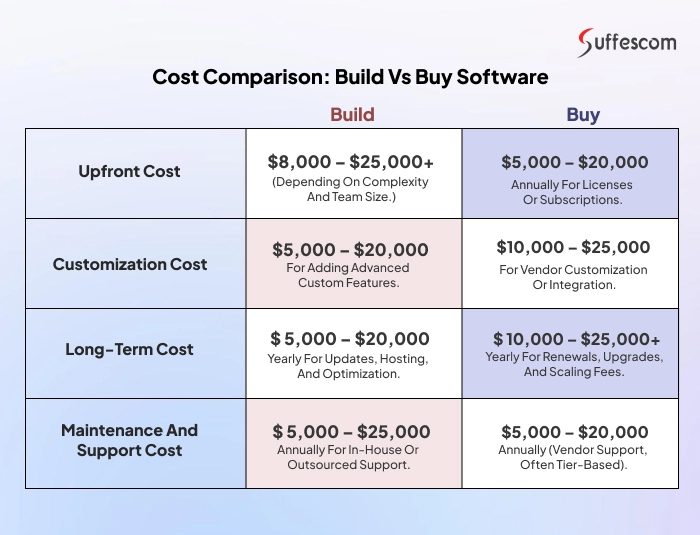
| Buy (Fin / similar) | Build (LangGraph / CrewAI) | |
|---|---|---|
| Time to first resolution | Days | Weeks to months |
| Cost at low volume (<500 tickets/mo) | Predictable, low absolute cost | Fixed engineering cost dominates — often not worth it |
| Cost at high volume (10K+ tickets/mo) | Per-outcome pricing compounds fast | Marginal cost per ticket shrinks toward raw model price |
| Control over routing / escalation logic | Limited to vendor’s configuration surface | Full control |
| Ongoing maintenance burden | Vendor’s problem | Yours — models change, prompts drift, evals need upkeep |
| Best fit | Teams that need it running this quarter, standard support flows | Teams with proprietary workflows, high volume, or in-house AI eng capacity |
The build sequence, phase by phase
Pull three to six months of real tickets and hand-classify a sample. Your agent boundaries should mirror the actual clusters in your data, not a generic template. This is also where you decide whether you have five distinct problem domains or really only two — over-decomposing is as common a mistake as under-decomposing.
Start in CrewAI or a vendor SDK to validate that the decomposition actually resolves tickets correctly on a held-out sample. Don’t invest in production infrastructure until the agent boundaries have proven themselves against real data.
These are the cheapest agents to get right and the ones everything downstream depends on. A router with a badly-tuned confidence threshold will either escalate everything (defeats the purpose) or escalate nothing (erodes trust fast).
Ground every claim the resolver makes in a specific retrieved document, and log which document it cited. This is what makes the next phase possible and what makes root-causing a bad answer someone else’s five-minute job instead of your afternoon.
This is the agent most likely to get cut under deadline pressure and the one whose absence is most likely to cost you a public trust incident. Its only job is checking the resolver’s draft against the retrieved source and refusing to let unsupported claims through.
The full conversation trace and state should transfer with the handoff. A customer who’s already explained their problem to a bot and then has to explain it again to a human is a worse experience than never having talked to the bot at all.
Trace every inter-agent message, log every tool call, and track resolution rate, escalation rate, and — critically — the rate at which the critic agent actually blocks something. If that number is ever zero for more than a week, the critic isn’t checking anything real anymore.
Don’t point a brand-new multi-agent system at billing disputes on day one. Start with password resets or order-status lookups, prove the resolution and escalation rates hold under real traffic, then expand.
Production reality, per infrastructure analysis from TrueFoundry: many multi-agent systems that work well in demos begin to fail once they reach production scale, and the challenges rarely come from model quality alone — they come from infrastructure gaps around state management, credentials, observability, and governance. Phases 6 through 8 above exist specifically to close those gaps before they become incidents.
When multi-agent is the wrong answer
“Multi-agent systems should be used when tasks decompose by domain — not by default.” That’s roughly the position the Redis AI Architecture Team has taken publicly, and it’s the single most useful filter I know for this decision.
Stay on a single agent if any of the following are true: your ticket volume is low enough that engineering time won’t pay for itself in savings; your knowledge base fits comfortably in one retrieval pass; your support categories genuinely overlap rather than cleanly separating (a lot of “billing” tickets are actually “account” tickets in disguise, and splitting them creates routing errors instead of preventing them); or you don’t yet have anyone who can own evals and observability, because an unmonitored multi-agent system degrades in ways that are much harder to diagnose than an unmonitored single-agent one.
The Google/Openlayer finding cited in section 2 — a 39–70% drop in sequential-reasoning performance from unnecessary coordination — is the sharpest version of this warning. Agent decomposition adds a coordination tax. You pay it whether or not the task actually needed splitting. Only take on that tax when the task genuinely divides into independent domains of expertise, the same test a manager should apply before splitting one person’s job into three.
The EU AI Act just made this non-hypothetical
This isn’t a “future consideration” section — it’s current law. Article 50 of the EU AI Act took effect on August 2, 2026, roughly three weeks before this piece was last updated. If any part of your customer base is in the EU, the transparency obligation applies regardless of where your company is headquartered: providers of AI systems that interact directly with individuals — chatbots, voice assistants, agentic support systems — must disclose that the person is engaging with AI, unless that’s already obvious from context. The disclosure has to be clear and given at the latest at the first interaction.
Non-compliance carries fines up to €15 million or 3% of worldwide annual turnover, whichever is higher. A narrower related obligation — machine-readable marking for generative AI content already on the market — has a later deadline of December 2, 2026, but the core “tell the user they’re talking to a machine” requirement is live today, not a future milestone. This is a one-line addition to your escalation agent’s opening message and an easy compliance win; skipping it is not a gray area anymore.
Outside the EU, the regulatory picture is more fragmented — the UK currently relies on existing sector regulators (Ofcom, the ICO, the FCA) rather than an equivalent statute, and most US states are handling AI disclosure through consumer-protection law rather than a dedicated framework. If you operate across regions, the pragmatic move is to build the disclosure into every deployment by default rather than region-gating it — it costs you nothing where it isn’t required, and it’s one less thing to remember to switch on where it is.
Frequently asked questions
Most working systems land between three and six. Four is a documented practical floor (classifier, router, resolver, escalation); adding a critic/guardrail agent is the fifth most teams should add before anything more specialized. More than six or seven agents in a support context is usually over-decomposition unless you’re at genuine enterprise scale with clearly separate domains.
CrewAI for validating the concept — it has the lowest barrier to entry and the fastest iteration loop. LangGraph once you need durable state, checkpointing, and production-grade error recovery. Many teams deliberately use both in sequence rather than picking one permanently.
Not for a new project. Microsoft moved AutoGen to maintenance mode in favor of the broader Microsoft Agent Framework, and its community successor, AG2, has taken over active development. Existing AutoGen code still runs, but don’t start fresh there in 2026.
Treat 40–50% as a realistic early target, based on Intercom’s own published case-study range, not the higher vendor-reported aggregate figures you’ll see in marketing. Resolution rate is also highly dependent on how narrow and well-maintained your knowledge base is — it’s rarely a fixed property of the technology.
On raw model cost per ticket, usually yes, often by an order of magnitude. On total cost of ownership including engineering time, retrieval infrastructure, ongoing prompt/eval maintenance, and incident response, frequently no — especially below a few thousand tickets a month, where the fixed engineering cost doesn’t have enough volume to amortize against.
Cutting the critic/guardrail agent to save latency or cost. It’s invisible in a demo — nothing looks different — and its absence only shows up later, as a wrong answer reaching a customer with no check in between.
If you have EU customers, yes, as of August 2, 2026, under Article 50 of the EU AI Act, unless it’s already obvious to the user. Outside the EU the requirement varies by jurisdiction, but disclosing by default is the lowest-risk approach regardless of where a given customer is located.
No — research cited in section 2 found coordination overhead can reduce sequential-reasoning performance by 39–70% on tasks that don’t actually need decomposition. Multi-agent wins when the task genuinely splits into independent domains; it’s a net loss when it doesn’t.
Track resolution rate, escalation rate, and the rate at which the critic agent actually intervenes — not just uptime. A critic that never blocks anything for weeks at a time is a signal it’s no longer checking anything meaningful, not a signal your resolver has gotten flawless.
Where the numbers in this piece came from
- Gartner — Over 40% of agentic AI projects canceled by 2027 (June 2025)
- AgentsIndex — Multi-agent systems guide, incl. Openlayer coordination-overhead research
- ClickIT — Multi-Agent System Architecture Guide for 2026
- Cognizant AI Lab — Multi-Agent Systems: Architecture, Applications & Real-World Impact
- DEV Community — Building an Intelligent Customer Support System with Multi-Agent Architecture
- GitHub — LangGraph-based multi-agent RAG customer support reference implementation
- TrueFoundry — Multi-Agent Architecture: Patterns, Use Cases & Production Reality
- Fin AI — official pricing page ($0.99/outcome, $49/mo base plan)
- Fin AI Help Center — Fin pricing: Outcomes (primary documentation)
- Abhishek Gautam — RAG in Production 2026: embedding costs, re-ranking, latency
- Datarmatics — How to Build a RAG Pipeline: Complete Guide for 2026
- Anthropic — Claude Platform API pricing documentation
- Techsy — LangGraph vs CrewAI vs OpenAI Agents (Ship Test 2026)
- OpenAgents — CrewAI vs LangGraph vs AutoGen vs OpenAgents framework comparison
- Smart Supply Hub — RAND Corporation AI project failure-rate research
- Forbes — Why 40% of agentic AI projects may be canceled by 2027
- Cooley — EU AI Act: Transparency Obligations Take Effect 2 August 2026
- European Commission — AI Act enforcement and transparency rules from 2 August 2026